2026 Crypto Narratives to Watch: Who Will Be the Next Star?

marsbitPublished on 2025-12-30Last updated on 2025-12-30

Abstract

Crypto Narratives to Watch in 2026: Key Trends and Opportunities The crypto industry continues to evolve through narratives and trends. Identifying these early is crucial for success. Key narratives expected to shape 2026 include: - **GambleFi**: Prediction and information markets like Polymarket and Kalshi are becoming essential tools for real-world decision-making, offering economically-backed insights. - **Launchpads**: Community-led fundraising and ICOs are making a strong comeback, with over $341M raised recently. Platforms like Legion, MetaDao, and Coinlist are leading this shift toward investor-friendly and protocol-economy focused sales. - **Privacy**: With institutional capital demanding confidentiality, privacy is no longer optional. Over $500M has been invested in privacy-focused dApps and chains in 2025. Selective disclosure—proving legitimacy without exposing data—will be critical. - **Crypto Neo-Banks**: Wallets are evolving into full financial interfaces integrating custody, payments, yield, reporting, and compliance. Projects like Revolut and Avici are pioneering this shift. - **DePIN**: After a 2025 slump, decentralized physical infrastructure networks like Helium, Hivemapper, and Render are gaining real traction with measurable usage and revenue, attracting continued VC interest. - **Perp DEXs**: Platforms like Hyperliquid and dYdX are proving that decentralized perpetual exchanges can compete with CEXs in volume and fees. The winners will offer capit...

Author:HEADBOY

Compiled by: Deep Tide TechFlow

The development of the crypto industry has always been accompanied by the evolution of trends and narratives. The ability to identify opportunities before these trends fully form is a key skill of many successful players in the crypto space. In this article, I will outline the major narratives that are likely to capture the attention of the community in 2026.

▪️ GambleFI: Prediction and Opinion Markets

Prediction and opinion markets have evolved from tools primarily for crypto enthusiasts into vital resources for everyday decision-making.

When people want to determine the truth of an event, they often have to sift through numerous articles, blogs, and social media posts, yet still struggle to find reliable insights. Opinion markets change this. They not only provide clear views on specific events but also back these views with economic stakes.

Currently, Polymarket and Kalshi are the two giants in this field, capturing most of the market attention and trading volume. However, I believe their potential is not yet fully realized, and more protocols will explore different dynamics within this narrative.

This area is worth close attention, especially because it naturally aligns with the needs of real-world users.

▪️ Launchpads: The Return of Fundraising and ICOs

As airdrops gradually cease to be the default model for community launches, we are likely to see more community-led fundraising activities, starting even from the seed stage, accompanied by a strong comeback of ICOs.

Since October 27, 2025 (62 days ago), over $341.35 million has been raised through community fundraising and community-led initiatives, with more projects expected to launch in Q1 2026:

  • MegaETH: $50 million

  • Monad: $187.5 million

  • Gensyn: $16.14 million

  • Aztec: $52.31 million

  • Superform: $3 million

  • Vooi: $1.5 million

  • Solomon Labs: $8 million

  • Solstice, Football Fun: $1.5 million

  • Makina: $1.3 million

  • Rainbow: $3 million

  • Immune fi: $5 million

  • Reya Labs: $3 million

  • Humidi fi: $6.1 million

  • Zkpass: $3 million

With the launch of some successful projects, community fundraising is expected to become the default model for community launches, fundamentally changing how projects interact with their communities.

In this process, the biggest winners will be the fundraising platforms that can offer the most investor-friendly terms while prioritizing strong protocol economics.

Currently, Legion, MetaDao, Buildpad, Echo, Coinlist, and Kaito are the platforms that have hosted the most token sales this year.

On November 14, 2025, I analyzed the current state of Launchpads based on their performance:
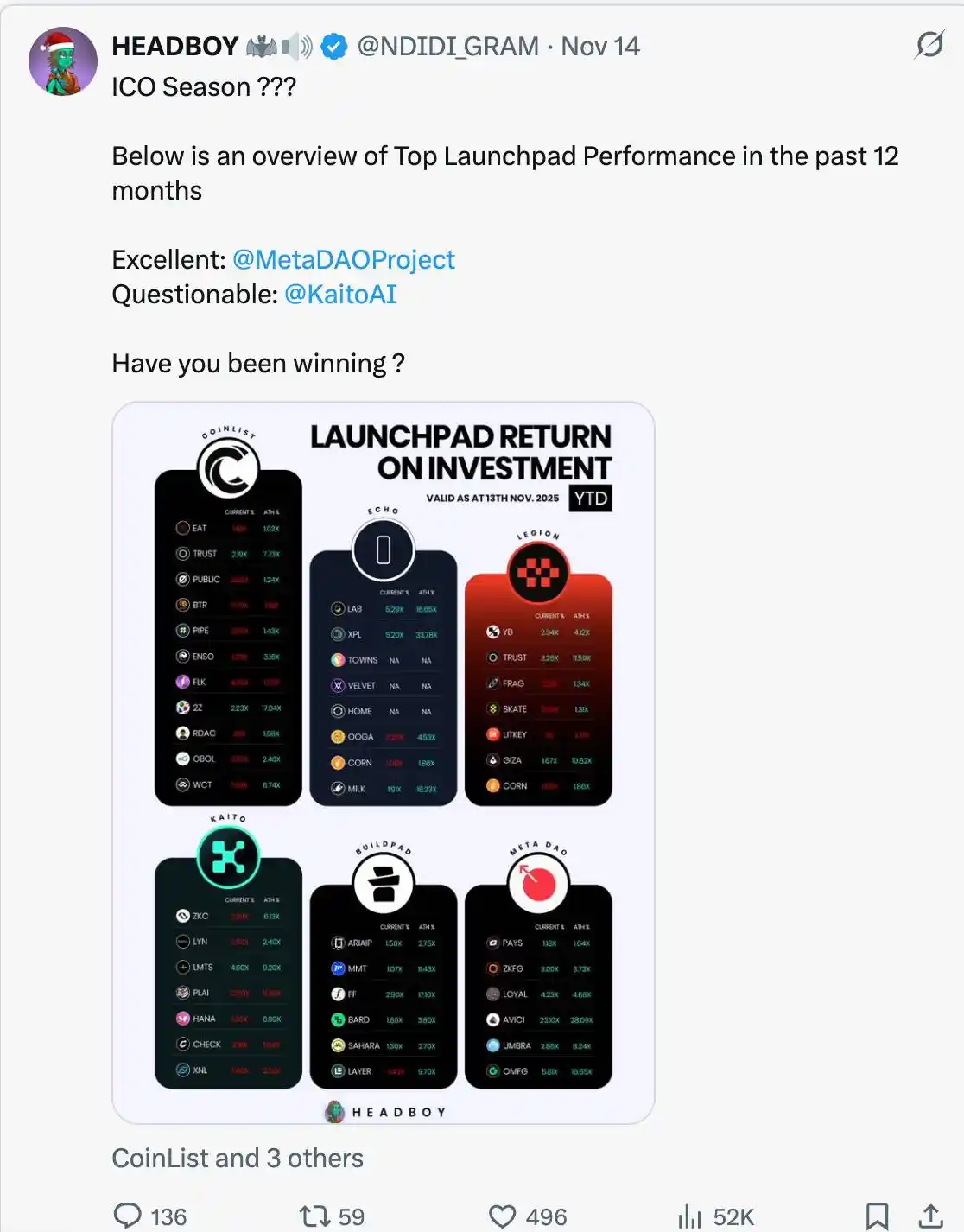
Next year, we are bound to see more new platforms exploring dynamic token issuance models to achieve community fundraising while balancing the interests of investors and protocols. This model will become a new focus in the crypto industry.

▪️ Privacy: The "Stealth" World On-Chain

The lifeblood of the crypto industry is liquidity, and institutions currently control a significant portion of it. To attract institutional capital, privacy is no longer an option but a necessity.

Some data simply cannot be made public, such as trading strategies, account balances, counterparty information, or internal fund flows, especially under the watchful eyes of competitors.

The next phase of on-chain applications will not be about merely hiding activities but achieving selective disclosure: proving legitimacy without exposing all information. This is the only way to attract serious capital on-chain.

Since early 2025, over 44 privacy-focused dApps and blockchain projects have received funding, with a cumulative fundraising amount exceeding $500 million, clearly indicating the rapid growth in demand for privacy-first applications.

Looking ahead to 2026, we are likely to see more such projects emerge, while existing protocols will unlock their full potential as privacy gradually shifts from a niche feature to a core requirement.

▪️ Neo-Banks for Digital Assets: The Full Upgrade of Wallets

The crypto industry has outgrown traditional wallet functionalities.

Tools used solely for storage and transfers are no longer sufficient. As more capital, protocols, and real-world businesses operate on-chain, the gap is evident: there is still a lack of a true bridge connecting wallets with complete financial workflows.

Next year, the industry's focus will shift from single-function wallets to wallet-native neo-banks for digital assets. These products will integrate custody, payments, yield, reporting, and compliance into a single interface.

This is not about replacing traditional banks but upgrading wallets into financial infrastructure.

This year, @Revolut led the pack in overall attention, while newcomer @AviciMoney performed exceptionally well, raising only $3.5 million through community fundraising but still delivering impressive results.

In the future, we are likely to see more such applications emerge, especially those that offer utility not only to crypto-native users (CT Natives) but also to a broader audience.

▪️ DePINs: The Decentralized Future of the Internet of Things

We witnessed the rise of Decentralized Physical Infrastructure (DePINs) in 2024, followed by a sharp decline in 2025. However, I believe next year will be when it fully realizes its potential.

Projects like Helium have proven that distributed connectivity can operate at scale; Hivemapper has shown that crowdsourced maps can compete with traditional giants; Render has pushed decentralized computing into real demand cycles. Emerging networks like Grass are turning idle resources into measurable economic output.

Even more interestingly, venture capital firms (VCs) continue to invest in these infrastructures, and some well-known projects have not only maintained usage but also successfully converted it into revenue streams.
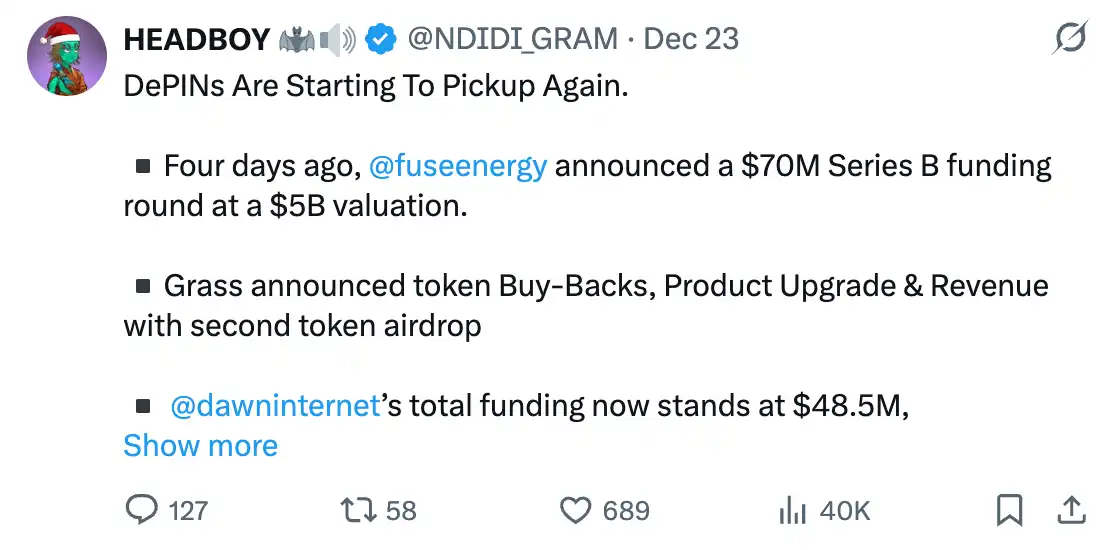
What was once seen as a "narrative of tokenized hardware disguised as malware" is gradually transforming into networks with real users, practical use cases, and revenue. The industry is clearly shifting toward products with genuine utility and profitability, and this is where DePINs (Decentralized Physical Infrastructure) stand out.

▪️ Perpetual DEXs: The Future of the Derivatives Market

This year, Perpetual Decentralized Exchanges (Perpetual DEXs) dominated the crypto trading narrative, and this trend is far from over.

Platforms like Hyperliquid, dYdX, Lighter, and Aster have proven that perpetual contracts can generate significant trading volume and fee revenue, even competing with centralized exchanges.

Looking ahead to next year, the ultimate winners will not just be the DEX platforms with the highest trading volumes but those that offer capital-efficient products, low slippage, and innovative risk management. Such platforms will make derivative trading more accessible to both retail and institutional investors.

▪️ AI: The Crypto Evolution of Artificial Intelligence

In recent years, artificial intelligence (AI) has already dominated the broader internet landscape, and it is only a matter of time before it sparks a similar transformation in the crypto space.

We have already seen individuals use AI tools to "vibe-code" DeFi applications from scratch and successfully launch them, demonstrating how rapidly AI tools are advancing.

However, AI's role in the crypto industry goes far beyond trading bots or signal analysis. The real revolution will occur when AI becomes infrastructure—writing smart contracts, managing risk, optimizing liquidity, and running protocols faster and at a lower cost than humans.

It is foreseeable that AI will emerge as a major narrative in the crypto industry, growing only more important over time. This is an area worth watching closely.

Before 2026 arrives, you should familiarize yourself with the following emerging AI skills:

  • Vibecoding

  • Prompting

  • AI-Augmented Research

  • Automation

Additionally, here are some other narratives worth watching:

x402: On-Chain Simplification

Bots: Tokenized Automated Systems

Stablecoins: Tokenized Fiat

Real-World Assets (RWA)

The future of the crypto industry is bright. I believe 2026 will be a year of adventure for those curious about the future of crypto. Look forward to meeting you on the side of wealth creation!

Related Questions

QWhat are the two major players in the prediction and opinion markets mentioned in the article?

AThe two major players in the prediction and opinion markets are Polymarket and Kalshi.

QAccording to the article, what is the total amount of funds raised through community-led fundraising since October 27, 2025?

AOver $341.35 million has been raised through community-led fundraising since October 27, 2025.

QWhy is privacy considered a necessity, not an option, for attracting institutional capital to crypto?

APrivacy is a necessity because institutions need to protect sensitive data such as trading strategies, account balances, counterparty information, and internal fund movements from competitors, which cannot be made public.

QWhat is the key shift in the wallet narrative for 2026, as described in the article?

AThe key shift is from single-function wallets to native digital asset neo-banks that integrate custody, payments, yield, reporting, and compliance into a single interface.

QWhich four emerging AI skills should one be familiar with before 2026, according to the author?

AThe four emerging AI skills are Vibecoding, Prompting, AI-Augmented Research, and Automation.

Related Reads

TRON Refreshes the Bull Image, Creating a More Approachable Brand Character

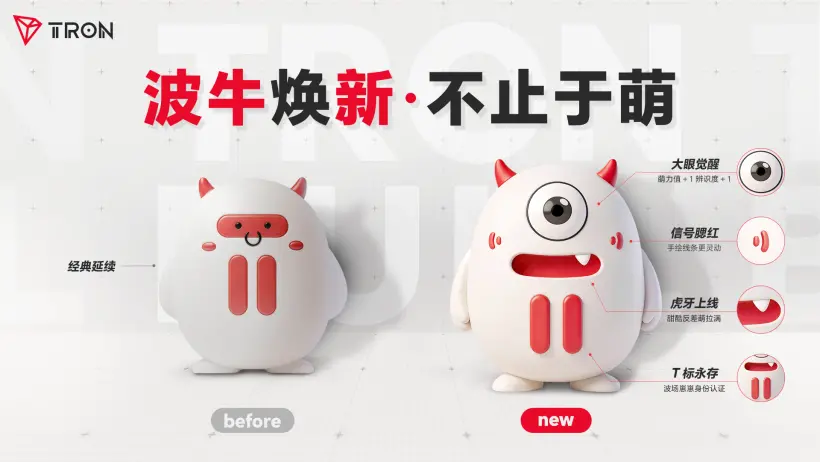
TRON's official mascot "BONiu" (Wave Bull) has received a comprehensive visual upgrade. Retaining its core red-and-white color scheme, horned silhouette, and brand DNA, the refreshed character features larger, brighter eyes, more expressive facial details including a mouth with a small fang, and enhanced emotive capabilities. The redesign aims to strengthen the mascot's亲和力, emotional expressiveness, and adaptability across various scenarios. Key updates include a clearer facial structure for instant recognition, a simplified and more intuitive五官 design, and the integration of subtle brand language. The cheek blushes are now inspired by a "signal" icon, while the smile and chest lines form a stable "T" structure, creating a cohesive超级符号 for the brand. The character has also been equipped with a 12-phoneme lip-sync system to support future动画 and interactive content. Beyond its visual role, BONiu's persona has been enriched. Now titled "TRON's Chief Luck Officer," it carries playful personality tags like "foodie enthusiast" and "full-of-tricks," allowing it to engage with the community in a more approachable and relatable manner. This update provides a lower-barrier, emotionally warm entry point for users amidst the often technical and abstract narratives of Web3. This mascot revamp is part of TRON's ongoing effort to refine its visual asset system, following the earlier logo update. By evolving from a static visual into a dynamic, expressive brand角色, the new BONiu is positioned to become a key asset for connecting with users, building brand记忆, and conveying TRON's personality across社交传播, community互动,线下活动, and merchandise.

链捕手16m ago

TRON Refreshes the Bull Image, Creating a More Approachable Brand Character

链捕手16m ago

With Labour Changing Leaders, Is the Long-Suppressed UK Crypto Market About to Turn Around?

Labour leader change: Hope for UK crypto market? With Keir Starmer's resignation as Prime Minister and Labour leader, a leadership contest has begun. Andy Burnham, the former Mayor of Greater Manchester and now the overwhelming favourite to succeed, has sparked cautious optimism within the UK cryptocurrency industry. Industry figures hope Burnham, seen as more receptive to digital assets than much of the Labour establishment, could shift the party's traditionally harder line. The leadership transition is expected to be swift, with prediction markets like Polymarket assigning a 97% probability to Burnham becoming the next Prime Minister. However, this political shift comes as a comprehensive regulatory framework for crypto, established by law earlier this year, is in its final implementation phase. The Financial Conduct Authority (FCA) is finalizing detailed rules covering trading, custody, stablecoins, and market abuse, with the full regime set to go live in October 2027. While a new Prime Minister can reshuffle ministers and adjust policy priorities, the core regulatory architecture is now law and unlikely to be fundamentally overturned without significant, deliberate government intervention. The main industry hope is that a Burnham government, focusing on economic growth, will ensure the FCA's implementation is pragmatic and growth-oriented. Industry advocates seek proportionate capital requirements, a streamlined licensing process, and clear rules for staking and stablecoins. They argue that embracing the crypto sector could attract investment and listings to London's struggling markets. Despite the optimism, concerns remain that regulatory implementation may still be influenced by more sceptical factions within the Labour party.

Foresight News45m ago

With Labour Changing Leaders, Is the Long-Suppressed UK Crypto Market About to Turn Around?

Foresight News45m ago

A 60-Day Window Depresses Oil Prices, So Why Is the Market Falling Instead?

International oil prices continued to decline on June 23, extending significant losses from the previous session. The market shifted focus from Middle East military risks to actual supply changes following a temporary U.S.-Iran arrangement. The immediate trigger was the resumption of traffic through the Strait of Hormuz, a critical oil shipping chokepoint, with two tankers passing through, signaling eased near-term supply disruption fears. Prices retreated as the "worst-case scenario" was temporarily averted. A reported 60-day window in a U.S.-Iran understanding allows Iran to sell oil during this period, further dampening supply concerns. However, this arrangement is temporary, linked to nuclear talks, and does not guarantee a long-term solution. Market sentiment remains cautious because the deal could still unravel, potentially reinstating sanctions or disrupting shipping. While these developments have lowered immediate risk premiums, prices have not fully returned to pre-conflict levels. Geopolitical news, particularly regarding the stability of the Strait of Hormuz or the progress of negotiations, could quickly reverse the price drop. Additionally, low U.S. strategic petroleum reserves limit the emergency buffer available if supply shocks reemerge. Therefore, the current price decline reflects a reduction in near-term panic, not a complete elimination of Middle East supply risks.

marsbit1h ago

A 60-Day Window Depresses Oil Prices, So Why Is the Market Falling Instead?

marsbit1h ago

SK Hynix Market Cap Exceeds Samsung for First Time in 26 Years, Korean Broker Calls for 50% More Upside

SK Hynix's market capitalization surpassed Samsung Electronics for the first time in 26 years on June 22, reaching 208.1 trillion won. The shift reflects a market trend where companies directly benefiting from AI infrastructure, like SK Hynix, are receiving higher valuation premiums than diversified giants. The surge is driven by AI-driven demand for High Bandwidth Memory (HBM), where SK Hynix holds a dominant 70-80% market share. Its Q1 2026 revenue exceeded 50 trillion won for the first time, with an operating profit margin of 72%. Hanwha Investment & Securities significantly raised its price target for SK Hynix to 430,000 won, the highest among Korean brokerages. The key rationale is that Long-Term Supply Agreements (LTAs) and robust HBM demand have fundamentally reduced the company's historical profit volatility. Several other brokers have also raised targets, arguing the valuation framework for memory semiconductors is being rewritten, moving away from a cyclical model. Despite the bullish outlook, the stock experienced a pullback of over 5% in regular trading on June 23 after briefly surpassing 3 million won pre-market, amid broader tech sector weakness. Some analysts caution that the市值 overtaking Samsung, whose profit scale and growth forecasts remain higher, could signal short-term overheating. However, high-return investors viewed the dip as a buying opportunity.

marsbit1h ago

SK Hynix Market Cap Exceeds Samsung for First Time in 26 Years, Korean Broker Calls for 50% More Upside

marsbit1h ago

Trading

Spot
Futures
活动图片