2026 Crypto Narrative Predictions: Reputation Dominance, ICO Revival, and Neo-Banking, with Stablecoins as the Ultimate Winner

marsbitPublished on 2026-01-08Last updated on 2026-01-08

Abstract

The article predicts three major narratives for the crypto space in 2026: reputation, the revival of ICOs, and the rise of crypto neobanks. In an AI-dominated landscape, reputation will become a critical differentiator between humans and bots, serving as a trust filter to identify credible actors and deter bad behavior, sybil attacks, and impersonators. ICOs are expected to make a comeback amid clearer regulations. Unlike past failures and recent flawed models like low-float, high-FDV VC launches, a new wave of reputation-based ICOs could foster the next generation of major crypto projects. Crypto neobanks will challenge traditional finance by offering self-custody accounts, yield-earning opportunities, and instant cross-border stablecoin payments. While no clear winners have emerged, stablecoins may ultimately benefit the most from this shift.

Author:Wazz

Compiled by: Deep Tide TechFlow

Reputation

Whether driven by InfoFi, the desire for "ElonBucks," or the lofty life goal of becoming a Key Opinion Leader (KOL) in the crypto space, it's undeniable that our Crypto Twitter (CT) feeds, your favorite token airdrop campaigns, and the testnets you're "farming" are already been flooded with bots. As AI technology continues to advance, this situation will only intensify.

In this chaotic, AI-driven dystopian world, only one thing can distinguish real humans from bots. And no, it doesn't require handing over your biometrics to those "trustworthy" French developers.

That thing is "Reputation." It cannot be replicated by bots (any bot) because it requires hundreds or even thousands of hours to build and can only be maintained through meaningful social connections. It's called "Reputation." And no, you can't have Grok dress it up in a bikini to embellish it.
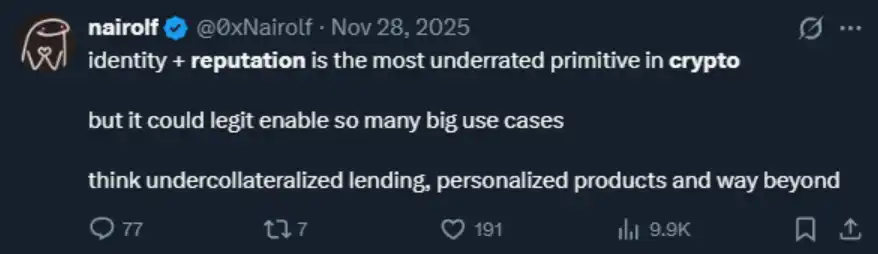
Reputation is an unshakable filter; no matter how much your "binary friends" (referring to bots) flatter in the comments, they ultimately cannot pass this threshold.

It helps you identify bad actors, scammers, and imposters (e.g., @ethos_network); it filters out those who are only there to extract value, sybil attackers, and investors with misaligned incentives (e.g., @legiondotcc); and it allows you to find credible, authentic, and influential voices in the crypto space (e.g., @KaitoAI before the InfoFi craze).

In the age of AI, the importance of reputation will become increasingly prominent. It is not only the key to distinguishing humans from machines but also the cornerstone for ensuring the healthy development of the ecosystem. Therefore, in 2026, reputation will become a dominant topic in the crypto space.

The Revival of ICOs

2017 was a frenzied era for the crypto industry. Driven by a regulatory vacuum, Ethereum's innovative ERC-20 standard, and immense speculative desire, thousands of projects successfully raised funds through what is now widely known as Initial Coin Offerings (ICOs).

This fundraising method was extremely efficient but also became a breeding ground for chaotic scams due to its disorder, eventually being halted by major regulators. However, during that era, major projects like BNB, TRX, and ADA were born and still rank among the top ten cryptocurrencies by market cap today.

The ban on ICOs plunged the crypto industry into a "dark age" and forced the entire sector into an experimental phase regarding token distribution and capital raising.
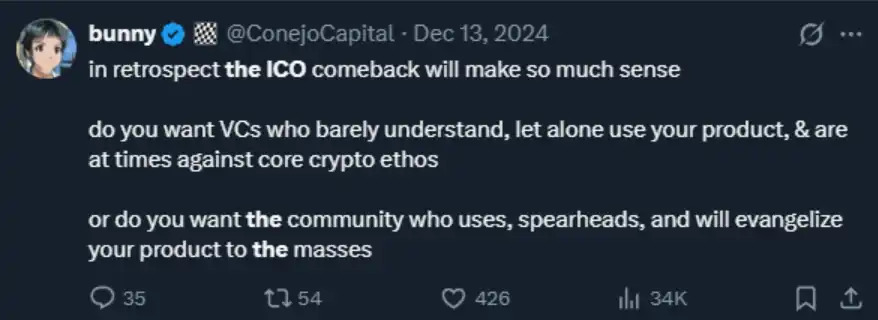
In terms of token distribution, we tried airdrops. Initially, this method achieved good distribution results at low cost and successfully attracted a lot of user attention, but it was eventually overexploited by speculators and industrialized "farmers," draining resources.

In terms of fundraising, we tried the low-circulation, high-FDV (fully diluted valuation) venture capital model. While this method was very beneficial for certain groups (mainly insiders), since most price discovery occurred before the public market, ordinary investors ended up holding the bag, suffering significant losses.

If 2025 is the year of regulatory clarity (which was the main reason ICOs were blocked), then 2026 is likely to become the "Year of the ICO Revival." History may not repeat itself exactly, but it often rhymes—in this new wave of ICOs, we may witness the emergence of some major crypto giants.

This area is becoming one of the most exciting sectors in the crypto industry, with many projects already showing promise, such as the reputation-based ICO project @legiondotcc, as well as @MetaDAOProject and the recently Coinbase-acquired @echodotxyz.

Crypto Neo-Banking

Neobanks have already disrupted traditional banking. Revolut is now one of Europe's most valuable fintech companies, and Nubank is one of the most valuable fintech companies in Latin America. As more digital-native investors emerge, the rise of Crypto Neo-Banking seems natural, especially since it can leverage the same regulatory clarity advantages as ICOs.

Self-custody accounts, yield-bearing accounts, and direct, instant cross-border stablecoin payments are features that distinguish crypto neo-banks from the traditional banking system.

With the proliferation of stablecoins and the provision of larger, more democratized yield opportunities for holders (no more enduring savings accounts with a mere 0.2% annual interest rate), crypto neo-banks will gradually eat into the market share of traditional finance (TradFi).

Although there are no clear winners yet, and I'm not sure if any tokens will benefit, stablecoins might be the ultimate winner. However, in my view, crypto neo-banking will become one of the most important narratives of 2026.


Related Questions

QWhat is predicted to be the dominant narrative in the crypto space by 2026, and why is it considered crucial in the AI era?

AReputation is predicted to be the dominant narrative in the crypto space by 2026. It is considered crucial because it serves as an immutable filter to distinguish real humans from bots, identify bad actors and scammers, and find credible voices in the ecosystem, especially as AI technology advances and bot activity increases.

QWhat event from crypto history is expected to experience a revival in 2026, and what were the two main experimental phases that followed its initial ban?

AThe Initial Coin Offering (ICO) is expected to experience a revival in 2026. The two main experimental phases that followed its initial ban were airdrops (for token distribution) and the low-circulation, high-FDV venture capital model (for fundraising).

QAccording to the article, what are the key features that distinguish crypto neobanks from the traditional banking system?

AThe key features that distinguish crypto neobanks from the traditional banking system are self-custody accounts, yield-bearing accounts, and direct, instant cross-border stablecoin payments.

QWhich asset does the article suggest might be the ultimate winner in the context of the emerging crypto neobanking narrative, and why?

AThe article suggests that stablecoins might be the ultimate winner because their widespread adoption and the ability to provide larger, more democratic yield opportunities for holders will allow crypto neobanks to eat into TradFi's market share.

QName two projects mentioned in the article that are already showing promise in the context of the 'Reputation-based ICO' narrative.

ATwo projects mentioned are @legiondotcc (a reputation-based ICO project) and @MetaDAOProject.

Related Reads

380,000 Apps Exposed, 2,000+ Apps Leaked Secrets: AI Programming Turns 'Intranet' into Public Internet

Israeli cybersecurity firm RedAccess uncovered a severe data exposure trend linked to "vibe coding" or AI-powered software development tools. Their research found approximately 38,000 publicly accessible web applications built with platforms like Lovable, Base44, Netlify, and Replit. Of these, an estimated 2,000 apps exposed sensitive corporate and personal data, including medical records, financial information, internal strategic documents, and customer chat logs. In some cases, access even granted administrative privileges. The core issue stems from default privacy settings that make applications public by default, combined with a lack of built-in security controls (like authentication) in the AI-generated code. This allows employees without security expertise—"citizen developers"—to easily create and deploy applications that bypass standard corporate security reviews. The exposed apps, often indexed by search engines, are trivially discoverable. While some platform providers (Replit, Lovable, Wix/Base44) argue that security configuration is the user's responsibility and question the validity of some findings, security researchers confirm the widespread reality of such exposures. This pattern, also noted in prior studies, highlights a critical security gap as AI democratizes app creation, potentially leading to massive, unintentional data leaks.

marsbit9m ago

380,000 Apps Exposed, 2,000+ Apps Leaked Secrets: AI Programming Turns 'Intranet' into Public Internet

marsbit9m ago

Attracting Global Capital, Asia's New 'Super Cycle' Is Unfolding

Investors are turning to Asia as the next frontier for global equity growth, with a new "super cycle" unfolding across the region. Driven by the AI revolution, Asian markets, particularly South Korea, have seen significant rallies. According to Morgan Stanley analysis, the underlying drivers of Asia's industrial cycle are shifting from traditional sectors like real estate and manufacturing to massive investments in AI infrastructure, energy security and transition, and supply chain resilience. Fixed asset investment in Asia is projected to grow from around $11 trillion in 2025 to $16 trillion by 2030, with a 7% annual growth rate from 2026-2030. The AI wave is a primary catalyst, driving immense capital expenditure for chips, servers, data centers, and power systems. Asia is central to this hardware supply chain. In China, AI investment is focused on building a full-system domestic capability, with the local AI chip market potentially reaching $86 billion by 2030. Beyond AI, China's export story is expanding from EVs and batteries to robotics. The country already captures about half of new global industrial robot demand and over 90% of humanoid robot shipments. This growth phase mirrors the early stages of China's EV export boom. Simultaneously, energy security investments, spurred by AI's massive power needs, are rising, with China benefiting from its leadership in solar, batteries, and EVs. Regional defense spending is also increasing structurally, supporting demand for advanced manufacturing. The main beneficiaries are China, South Korea, and Japan, positioned in core supply chain areas. However, risks remain, including potential overcapacity, profit margin pressures from competition, persistent technological restrictions, geopolitical friction, and workforce displacement due to AI-driven automation. Market volatility is also expected to increase as investor expectations diverge on the realization of these capital investment and export themes.

marsbit10m ago

Attracting Global Capital, Asia's New 'Super Cycle' Is Unfolding

marsbit10m ago

Funding Weekly Report | 14 Public Funding Events, Kalshi Completes $10B New Funding Round at $220B Valuation Led by Coatue Management

Weekly Funding Roundup: 14 Deals and $10.49B+ in Total Funding, Led by Kalshi's $1B Round Last week (5.4-5.10) saw 14 notable funding events in the global blockchain ecosystem, raising over $10.49 billion in total. Key highlights include Kalshi, a prediction market platform, securing a $1 billion round led by Coatue Management, reaching a $22 billion valuation. The platform now boasts ~2 million MAUs and $178B in annualized trading volume. In DeFi, regulated on-chain reinsurer OnRe raised $5 million in Series A funding, and Bitcoin-backed credit protocol Saturn Credit completed a $2 million seed round. For Infrastructure & Tools, OpenTrade raised $17 million to expand its stablecoin yield infrastructure, and RWA platform Balcony secured $12.7 million to deploy its property settlement service in the US. Centralized Finance saw one deal: AI-driven trading platform Stockcoin.ai completed a seed round led by Amber Group. In the prediction market sector alongside Kalshi, AI-powered platform Elastics raised $2 million. Other notable deals include SC Ventures' strategic investment in crypto market maker GSR and Centrifuge securing a "seven-figure" investment from Coinbase to become a core RWA partner for Base. On the investor side, Haun Ventures raised a new $1 billion fund targeting crypto and AI, and Multi Investment raised ~$616 million to focus on blockchain and Web3 investments.

marsbit1h ago

Funding Weekly Report | 14 Public Funding Events, Kalshi Completes $10B New Funding Round at $220B Valuation Led by Coatue Management

marsbit1h ago

Trading

Spot
Futures
活动图片




