2026 Crypto Market Off to a Strong Start: A Cautiously Bullish New Beginning

marsbitPublished on 2026-01-07Last updated on 2026-01-07

Abstract

The cryptocurrency market started 2026 on a strong note, with Bitcoin reaching $94,000 and the total market capitalization nearing $3.3 trillion. Despite geopolitical tensions, institutional interest returned as spot ETFs saw net inflows of approximately $400 million on January 5. Large Bitcoin holders reduced selling pressure, while retail investors continued accumulating. Derivatives markets indicated cautious optimism, with significant Bitcoin call open interest at the $100,000 strike and Ethereum calls at $3,500 for January expiries. Futures open interest also rebounded, though funding rates remained moderate. Meme coins like PEPE and BONK outperformed, alongside privacy-focused tokens and DeFi assets with clear revenue models. Stablecoin flows turned positive again in January, supporting further upside potential. However, ongoing tensions between the U.S. and Venezuela remain a short-term risk for global markets.

· At the beginning of 2026, the cryptocurrency market regained its upward momentum. Despite heightened geopolitical uncertainty, Bitcoin's price rose to $94,000, and the total market capitalization of cryptocurrencies approached $3.3 trillion.

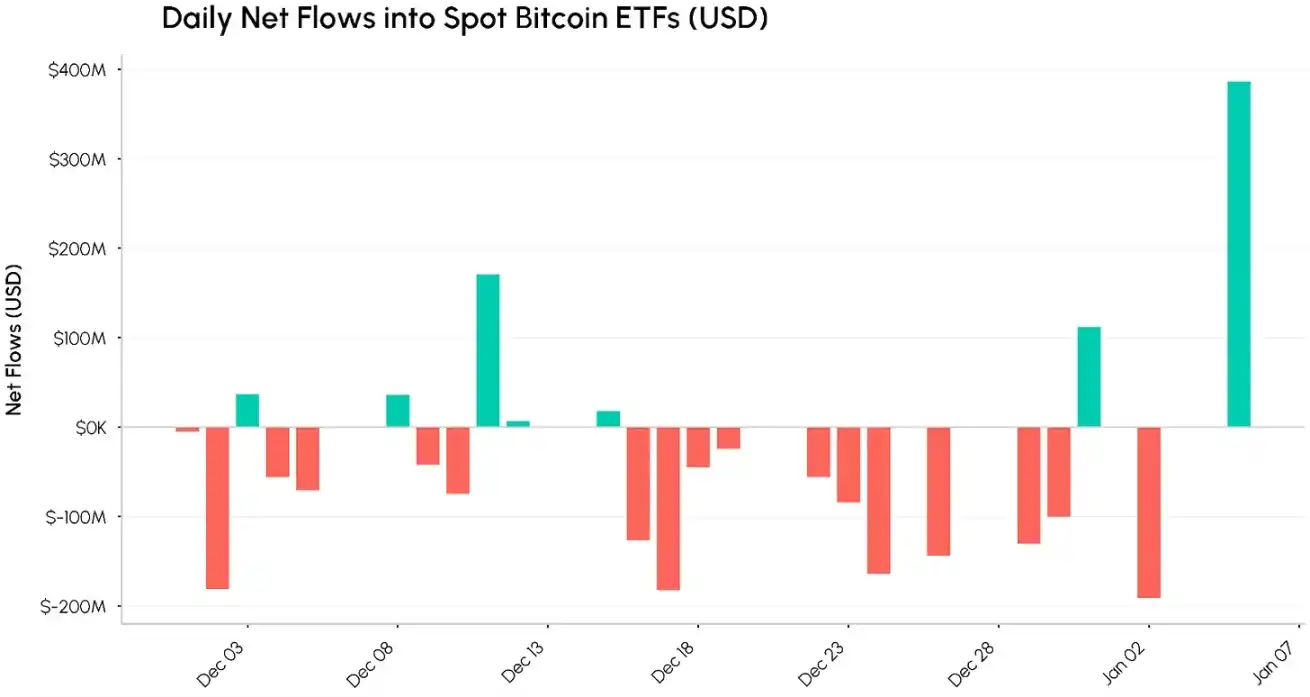
· Spot Bitcoin ETFs reversed the year-end outflow trend on January 5, with a net inflow of approximately $400 million; whale selling activity moderated, while retail investors actively accumulated positions.

· Derivative market positions indicate a cautiously bullish stance. Among the options contracts expiring at the end of January, Bitcoin call open interest is concentrated at the $100,000 strike price, while Ethereum call open interest is concentrated at the $3,500 strike price.

A Green Start to 2026

After several weeks of range-bound trading during the holiday season, the cryptocurrency market started the new year on a strong note. Bitcoin's price surged to $94,000, and the total market capitalization of cryptocurrencies approached $3.3 trillion.

Despite the escalation of geopolitical tensions due to U.S. military action against Venezuela, the cryptocurrency market remained resilient. As year-end prices for precious metals like gold and silver soared, crypto assets gradually recouped their losses. Additionally, the strength of some altcoins signaled a rise in market risk appetite. However, influenced by the evolution of the geopolitical situation, global markets may still experience significant volatility in the short term.
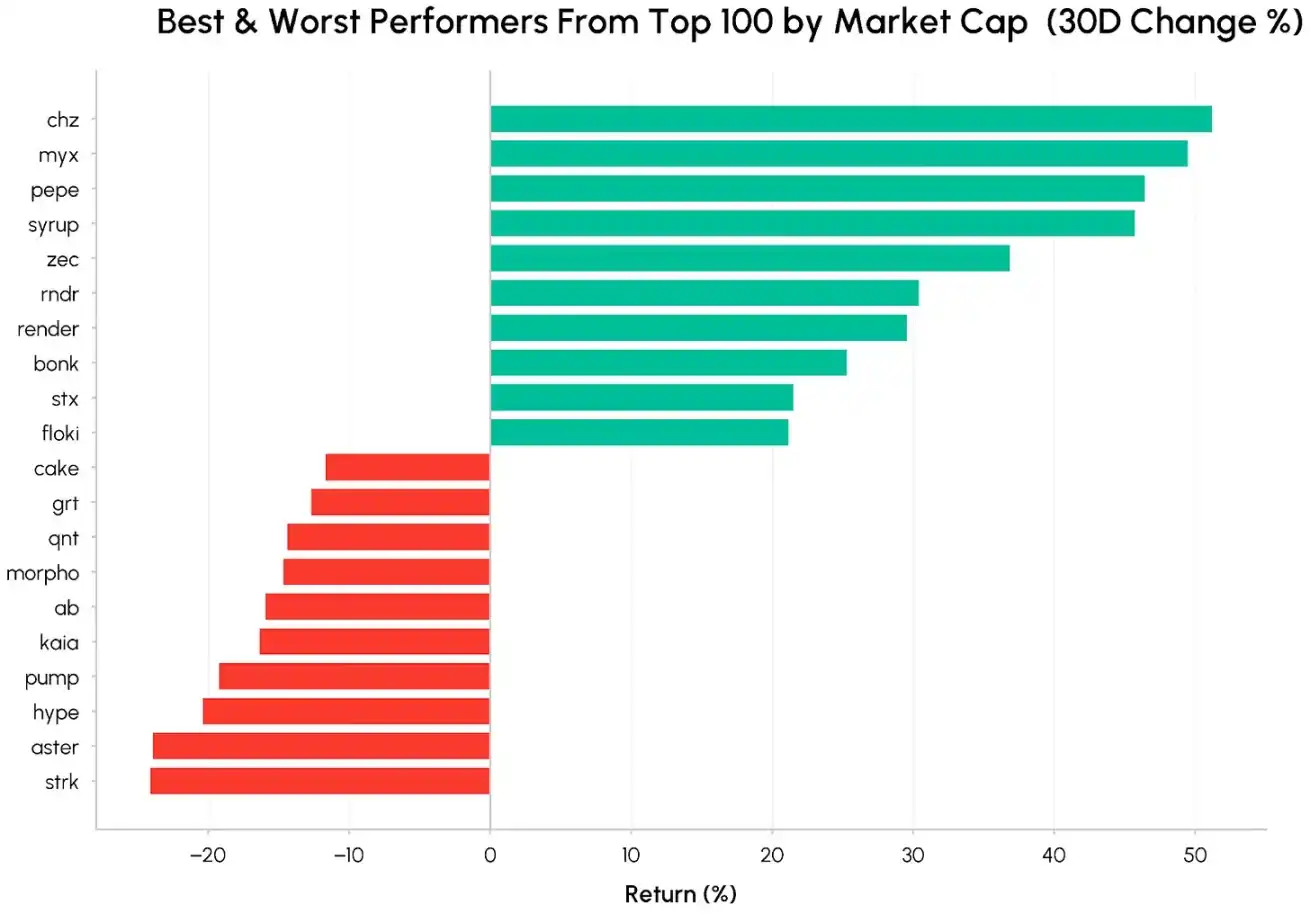
Over the past month, standout performers included Memecoins like PEPE and BONK, privacy-focused Zcash (ZEC), and the institutional credit platform Maple Finance (SYRUP). This trend indicates a resurgence of interest in Memecoins, privacy tokens, and DeFi tokens with clear profit-sharing mechanisms and visible cash flow growth.

In contrast, Hyperliquid (HYPE) and Aster (ASTER) underperformed. The reason lies in the diversion of market attention within the decentralized perpetual contract trading platform sector following the token airdrop by Lighter (LIT), a platform based on zero-knowledge Rollup technology. The decentralized lending protocol Aave (AAVE) also declined during this period due to intense community debate and multiple governance votes regarding token holder rights, profit distribution models, and the role of Aave Labs in the decentralized autonomous organization. This controversy reflects a broader trend across the DeFi industry: leading protocols like Uniswap and Aave are re-evaluating how value flows back to token holders.

Institutional Funds Return, Whale Selling Cools

Spot Bitcoin ETFs reversed the year-end outflow trend, with a single-day net inflow of over $350 million on January 5, marking the return of institutional funds to the crypto market. Around the New Year, spot Bitcoin ETFs had recorded net outflows exceeding $320 million. This reversal suggests a resurgence of institutional investor allocation interest as the first quarter of 2026 begins.

Institutional crypto asset reserves continue to expand: the U.S. Strategic Bitcoin Reserve added 1,287 Bitcoin, bringing its total holdings to 673,783; Bitmine increased its Ethereum reserves to 4.14 million, accounting for approximately 3.4% of Ethereum's total supply.
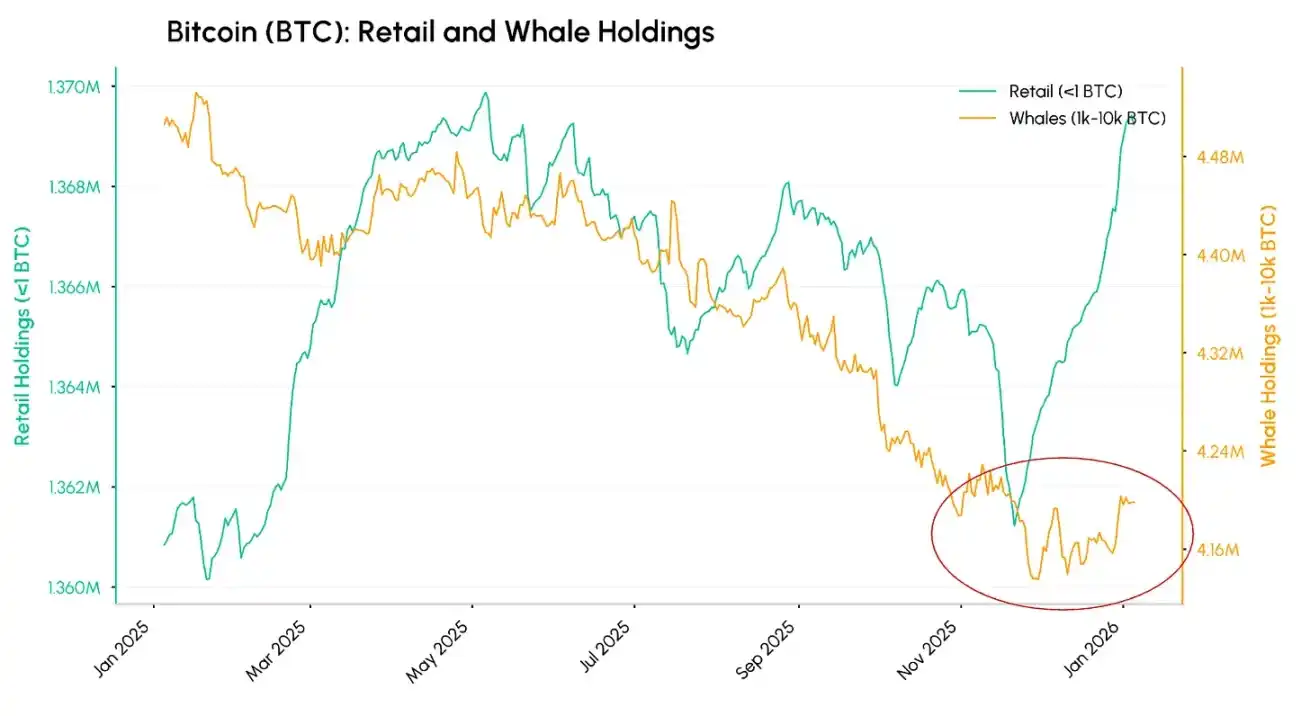
On-chain data shows that since the beginning of January, token selling by whale addresses holding 1,000-10,000 Bitcoin has significantly moderated, indicating reduced selling pressure from this group. Meanwhile, retail investors holding less than 1 Bitcoin have been accelerating their accumulation since mid-November last year. As cryptocurrency prices retreated from highs and consolidated, retail investors bought the dip. The combination of reduced whale selling and sustained retail buying creates a favorable market structure.
Derivatives Market Signals Cautious Optimism

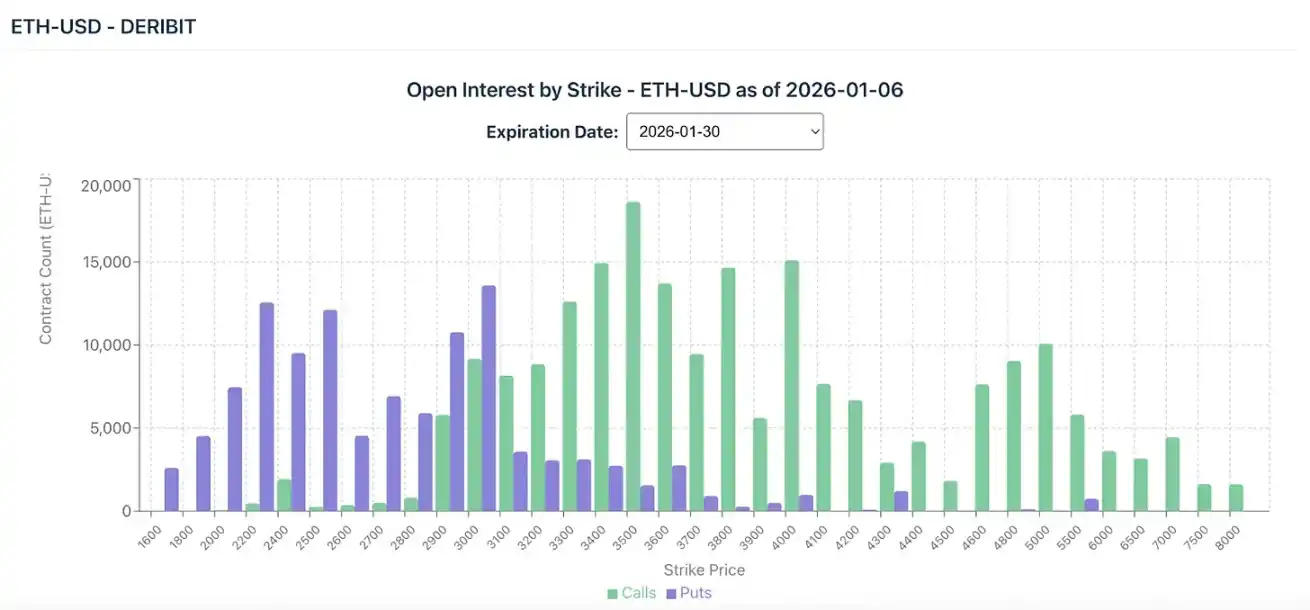
Derivatives market positions indicate a cautiously optimistic view of the Q1 2026 trajectory. The two charts below show the open interest by strike price for Bitcoin and Ethereum options contracts expiring on January 30, 2026, on the Deribit platform, visually reflecting option traders' bets on short-term market direction.
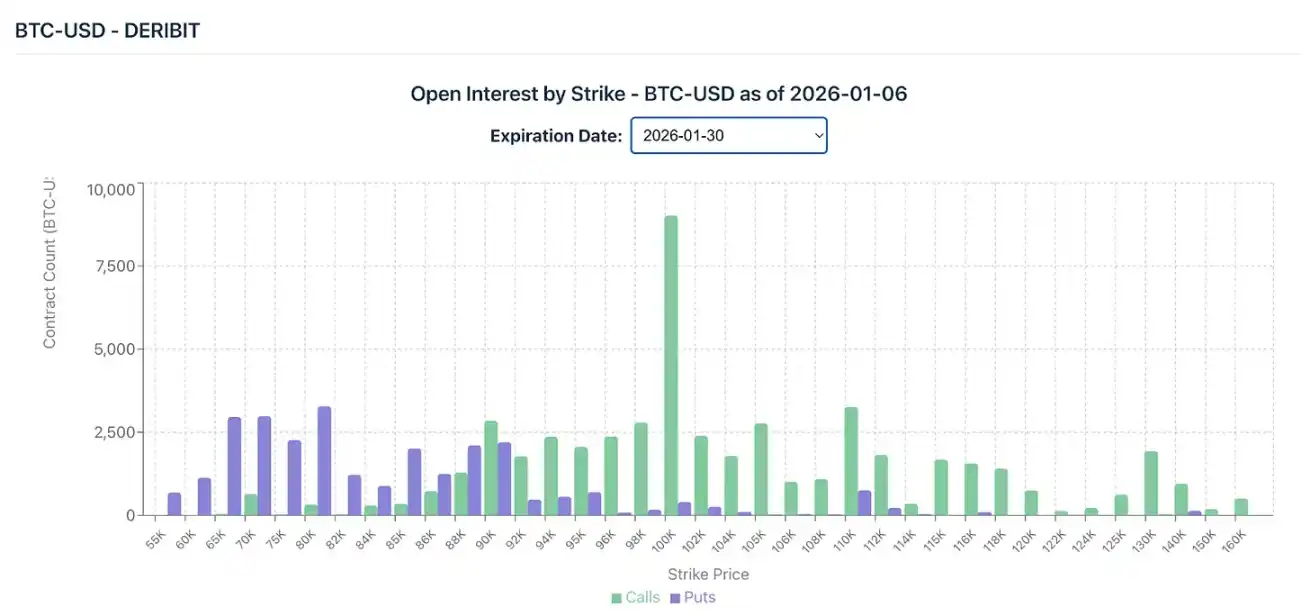
Options market data shows that for contracts expiring on January 30, Bitcoin call open interest is heavily concentrated around the $100,000 strike price, while Ethereum call open interest is concentrated around the $3,500 strike price. This indicates traders are betting on short-term upside potential but are not exhibiting excessive euphoria. Downside protection is also in effect: Bitcoin put open interest is notable in the $70,000 to $90,000 range, though the overall open interest structure remains skewed towards the long side.
The futures market conveys a similar signal. Year-end, Bitcoin and Ethereum futures open interest saw a slight pullback but quickly rebounded in January, with the nominal open interest on major exchanges nearing the highs of last December. In late December, influenced by broad market deleveraging, the funding rates for Bitcoin and Ethereum perpetual contracts briefly turned negative. However, they have since recovered to positive territory, with Ethereum's funding rate significantly stronger than Bitcoin's. Overall, the market is in a cautiously bullish state, not yet showing signs of being overextended.

Stablecoin Flows and On-Chain Activity

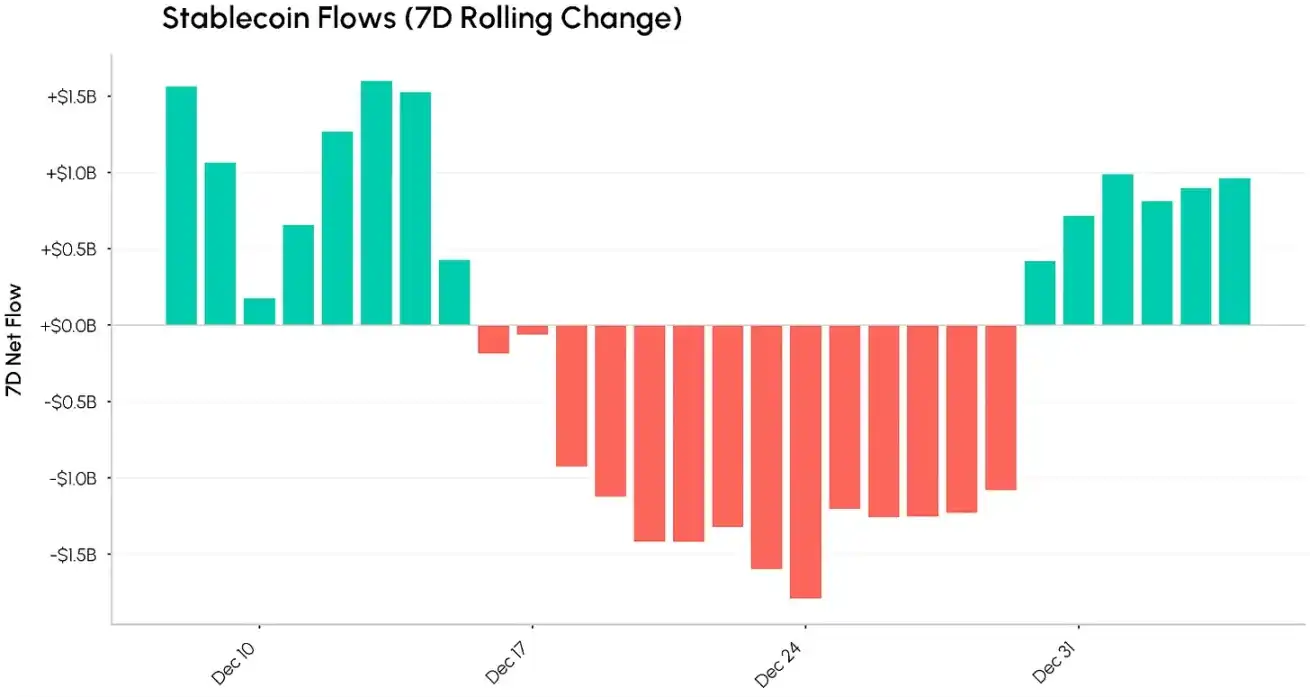
Stablecoin flow is a key indicator for observing capital movements into and out of the crypto market. In early December last year, the stablecoin market recorded sustained net inflows, but towards year-end, flows turned negative, with a single-week net outflow exceeding $1 billion. Entering January 2026, stablecoin flows stabilized and turned net positive again. If this trend continues, it will provide strong support for the sustained rise of the crypto market.
On-chain activity data further corroborates the positive market outlook. Following the implementation of the Ethereum Fusaka upgrade in December, Ethereum mainnet daily transaction volume hit a record high of 2.23 million, and the number of active addresses approached all-time peaks. Concurrently, stablecoin on-chain transfer volume also set a new record in December, indicating that capital flowing into the crypto market is not sitting idle but is actively circulating within the ecosystem.

Conclusion

Market data from the first week of 2026 paints a picture of cautious optimism, with the cryptocurrency market gradually finding its footing. The return of institutional funds, cooling whale selling, optimistic signals from the derivatives market, coupled with high on-chain activity and the return of net inflows into stablecoins, collectively support the market's upward movement. However, it is crucial to remain vigilant, as the geopolitical developments between the U.S. and Venezuela remain a potential risk factor that could trigger global market volatility in the short term.


Related Questions

QWhat was the price of Bitcoin and the total market capitalization of the cryptocurrency market at the beginning of 2026?

AThe price of Bitcoin rose to $94,000, and the total cryptocurrency market capitalization approached $3.3 trillion.

QWhat trend reversal was observed in the spot Bitcoin ETF on January 5th, and what did it signify?

AThe spot Bitcoin ETF reversed its year-end outflow trend with a net inflow of approximately $400 million on January 5th, signaling a renewed interest in crypto asset allocation from institutional investors.

QAccording to the options market, what are the key strike prices where call option open interest is concentrated for Bitcoin and Ethereum expiring at the end of January?

AFor Bitcoin, call option open interest is concentrated around the $100,000 strike price. For Ethereum, it is concentrated around the $3,500 strike price.

QWhat on-chain behavior suggests that selling pressure from large holders (whales) has decreased?

AOn-chain data shows that token selling behavior from whale wallets holding 1,000 to 10,000 Bitcoin has noticeably收敛 (converged/subdued), indicating reduced selling pressure from this group.

QWhat is identified as a potential risk factor that could cause volatility in global markets in the short term?

AThe geopolitical situation between the United States and Venezuela is identified as a potential risk factor that could cause volatility in global markets in the short term.

Related Reads

Agent Race Ends, Super Workbench Takes Over

The era of fragmented AI agents is ending. Over the past month, China's tech giants—Tencent, Alibaba, and ByteDance—have simultaneously shifted strategy: instead of launching new, standalone AI agents, they are consolidating their various agent projects into unified "super workbenches." Tencent integrated its QClaw teams into WorkBuddy, a strategic product hailed as a potential third flagship after QQ and WeChat. Alibaba is merging its QoderWork, Wukong, and MuleRun agents into a new "Qianwen Office" platform under DingTalk's leadership. ByteDance rebranded its TRAE SOLO coding agent to TRAE Work, signaling a broader focus on workflow collaboration. This convergence marks a pivotal industry consensus. The initial exploration phase, where companies rapidly built numerous overlapping agents for different scenarios, proved costly and inefficient. With open-source tools eroding technical barriers, competition has shifted from agent creation to resource consolidation and cost control. Historically, platform wars are won not by creating more products, but by simplifying them—as seen with browsers unifying web access and super-apps consolidating services. Now, the "super workbench" aims to become the unified AI entry point for work. This reflects a deeper market realization: the primary audience for AI is no longer just programmers (a market in the tens of millions) but all knowledge workers (a market of billions). The real opportunity lies in augmenting everyday tasks—managing emails, documents, data, and meetings—across the entire workday. The core battleground is becoming control over the primary AI entry point that employees use daily. Tencent's WorkBuddy leverages WeChat and Tencent Docs; Alibaba's Qianwen Office taps into DingTalk's organizational data; ByteDance's TRAE Work integrates with Feishu's workflows. Whoever owns this "super workbench" gains strategic control over orchestrating enterprise data and APIs. This shift is redefining enterprise software. Traditional SaaS applications, valued for their user interfaces, will recede into the background. Their core functionalities will be exposed as standardized "Skills" or APIs for the super workbench's agents to invoke. Software value will shift from selling user seats to charging based on API calls and outcomes delivered. The evolution of agents is moving through clear stages: first as novel standalone products, then as consolidated primary work entry points, and finally as pervasive, invisible capabilities embedded into the digital fabric. The recent moves by major tech firms signal the transition from the first stage into the second, accelerating toward the third. In the end, the most successful agent technology may become invisible—like electricity or the HTTP protocol—a fundamental, unnamed infrastructure powering work itself.

marsbit8m ago

Agent Race Ends, Super Workbench Takes Over

marsbit8m ago

Michael Saylor: 110 Reasons to Oppose BIP-110

Michael Saylor presents 110 arguments against Bitcoin Improvement Proposal (BIP) 110, a soft fork aimed at restricting certain non-monetary data storage uses (like inscriptions) on the Bitcoin blockchain. He acknowledges the proponents' valid concerns—such as node costs, fee pressure, and preserving Bitcoin's monetary focus—but fundamentally disagrees with the proposed solution. Saylor argues that BIP 110 represents a dangerous precedent of using consensus rules to enforce value judgments on transaction validity, moving away from Bitcoin's core principles of neutrality and permissionless innovation. His key objections are organized into eleven categories: 1) It violates neutrality and hard consensus by banning currently valid transactions. 2) It fails to meet the high burden of proof required for a consensus change, lacking concrete data on the alleged crisis. 3) Its seven bundled technical restrictions are overly broad, targeting generic script functionalities and blocking future upgrade paths. 4) It sacrifices compatibility and future optionality by closing off designed upgrade hooks. 5) Its temporary rules add significant complexity (grandfathering, expiry states) without sufficient justification. 6) The economic and security impacts, particularly on miner revenue and fee markets, are uncertain and unmodeled. 7) Superior, market-based tools (fee markets, relay/mining policies) already exist to manage blockchain load. 8) It stifles innovation by creating a chilling effect for developers. 9) Its modified activation mechanism (55% threshold, forced signaling) is aggressive and risks network splits. 10) The precedent it sets—using consensus to suppress disliked but legal uses—is more dangerous than the problem it aims to solve. 11) A better path exists: improving measurements, refining resource-based policies, and allowing market forces to work. Saylor concludes that Bitcoin's strength lies in its neutral rules, open markets, and hard consensus. Changing these foundational elements to target specific use cases is an unnecessary and risky "iatrogenic" intervention. He advocates for guarding Bitcoin's neutrality rather than acting as its redeemer.

marsbit23m ago

Michael Saylor: 110 Reasons to Oppose BIP-110

marsbit23m ago

Trading

Spot
活动图片

