20% of Americans Are on the Fence: The Next Wave of Crypto Market Lies Here

marsbitPublished on 2026-03-05Last updated on 2026-03-05

Abstract

A study reveals that 20% of U.S. adults are considering cryptocurrency adoption, representing a critical intermediate group between outright rejecters and current holders. The research frames crypto acceptance as a three-stage process: rejection, consideration, and ownership. Key findings show that factors influencing the "consideration" phase (e.g., conservative ideology, support for tech innovation) differ from those driving "actual ownership" (e.g., existing stock ownership, higher risk tolerance). This intermediate group is essential for market growth, regulatory policy, and public opinion, as they represent the tipping point for broader adoption. The study emphasizes that understanding this gradual behavioral process—rather than a binary holder/non-holder view—is crucial for accurately predicting market and political trends.

Written by: Kyle Saunders

Compiled by: Chopper, Foresight News

Most research revolves around a simple question: Who holds it? Who doesn't?

Admittedly, this is a reasonable starting point for research. Holding behavior is observable, quantifiable, and actual. But for a market with a market cap in the trillions, it might not be the most critical question.

If you are concerned with market development, regulatory policy, political discourse, or the future direction of crypto assets, there is a question that might be more practically significant: Who is considering acquiring cryptocurrency?

Because the acceptance and adoption of an asset is never a binary, either-or choice, but a gradual process.

If you only study the final stage of this process, you miss the entire conversion funnel.

Rejection → Consideration → Holding: The Three Stages of Crypto Acceptance

In a new paper I recently co-authored with Erin Fitz, we did not treat crypto acceptance as a black-and-white outcome, but defined it as a gradual process.

From late 2024 to 2025, we conducted three independent representative surveys of US adults. Based on the results, we categorized respondents into three groups:

  • Do not hold and have no intention to hold cryptocurrency
  • Do not hold but are considering holding cryptocurrency
  • Currently hold cryptocurrency

Our first finding was straightforward yet crucial: About one-fifth of Americans do not hold cryptocurrency but are considering it.

This group is by no means an insignificant niche, a statistical error, or a group 'destined to hold.' They are a distinct segment with unique psychological characteristics and behavioral patterns, and this attribute makes them critically important.

Why is the 'Potential Holder' Group So Critical?

If the research perspective is limited to the binary comparison of 'holders' vs. 'non-holders,' it assumes all those not in the market are an undifferentiated whole.

But real-world behavioral choices are never like that.

The classic social psychology Theory of Planned Behavior posits that human behavior evolves through a series of preceding stages: beliefs, attitudes, perceived control, behavioral intention. One first 'considers' before forming a 'behavioral intention'; a 'behavioral intention' precedes taking actual action. And each stage does not necessarily transition to the next.
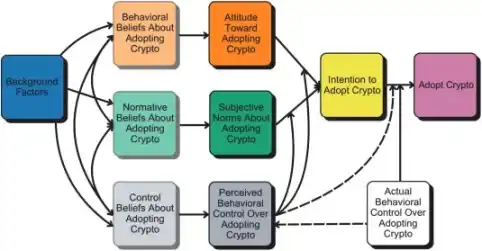
In other words, all holders were once potential holders; but not all potential holders will ultimately become actual holders.

When we view people's engagement with cryptocurrency as an ordered, gradual process rather than a binary characteristic, an interesting conclusion emerges: The factors influencing 'consideration to hold' are not entirely the same as those driving 'actual holding.'

There is a filtering mechanism at work in this conversion funnel.

Which Factors Influence 'Consideration'? Which Drive 'Actual Holding'?

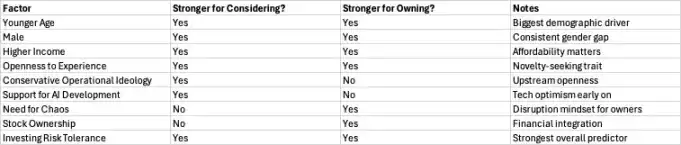
Some common influencing factors aligned with expectations: Younger individuals, men, those more open to new experiences, and those with a higher tolerance for financial risk were more likely to cross both the 'rejection→consideration' and 'consideration→holding' thresholds.

But two sets of significantly different patterns are worth highlighting.

Factors more strongly associated with 'Consideration to Hold':

  • More conservative operational ideology
  • Support for AI technology development

These factors play a role in the early stages of the crypto acceptance process, explaining why people might be open to cryptocurrency, but not necessarily pushing them to take the final step to 'actually hold.'

Factors more strongly associated with 'Actual Holding':

  • Already hold stocks
  • Need for chaos

Risk tolerance was the most influential factor overall: From the lowest to the highest levels, the probability of behavioral choice changed dramatically, with the probability of rejecting crypto decreasing by 32 percentage points and the probability of actually holding crypto increasing by 27 percentage points.

Here is a brief summary of the core differences:
Our survey data also aligns closely with the actual crypto market landscape: Bitcoin dominates overwhelmingly among both 'potential' and 'actual' holders (with Ethereum second), and many are open to multiple cryptocurrencies. The market itself corroborates this finding.
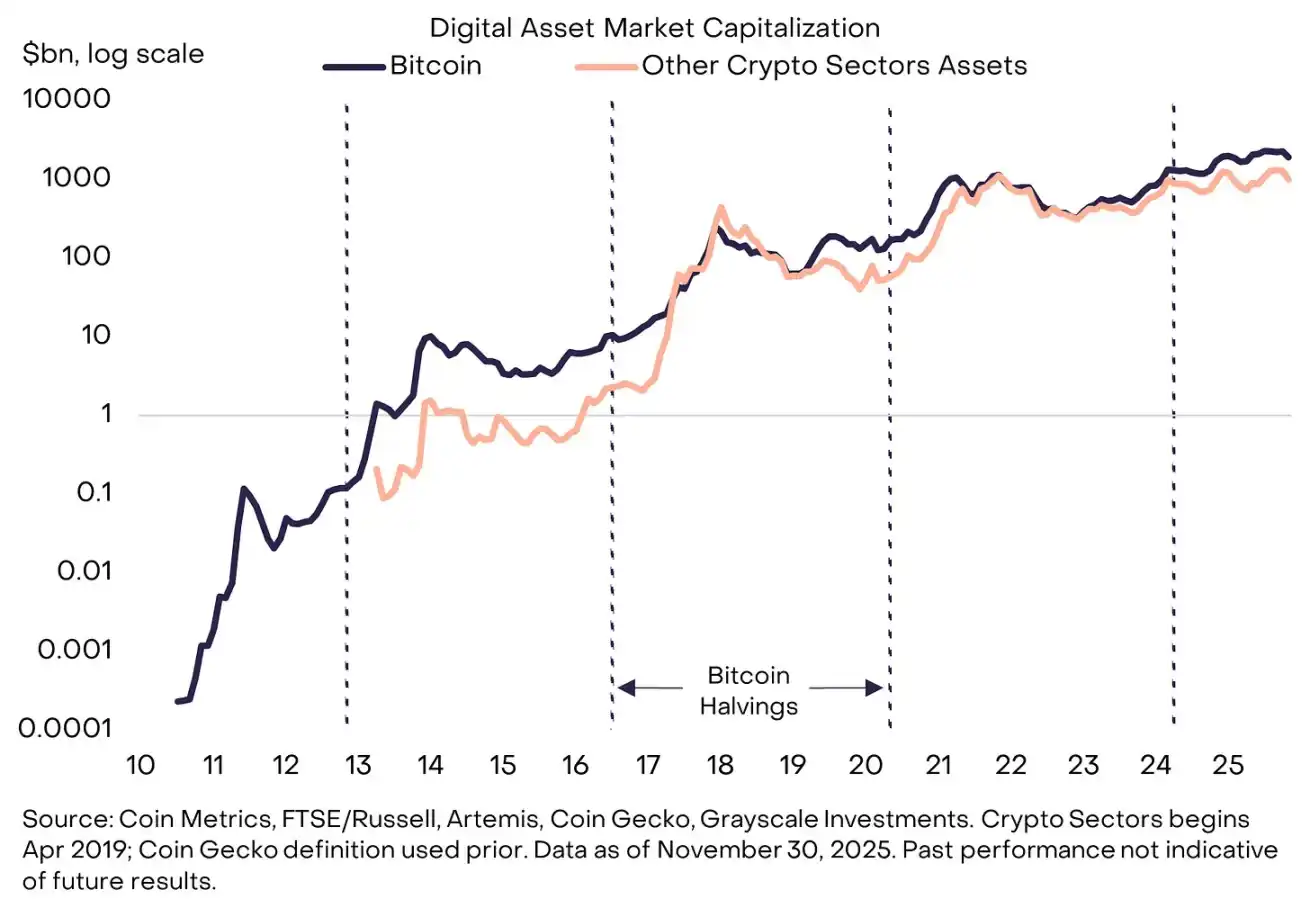
To understand how this landscape fits the broader technology diffusion curve (and why the 'potential holder' stage will determine whether crypto development stalls or scales), one can compare Bitcoin's adoption trajectory with that of the early internet. Survey data shows AI technology acceptance in the US reached about 55% in 2026.
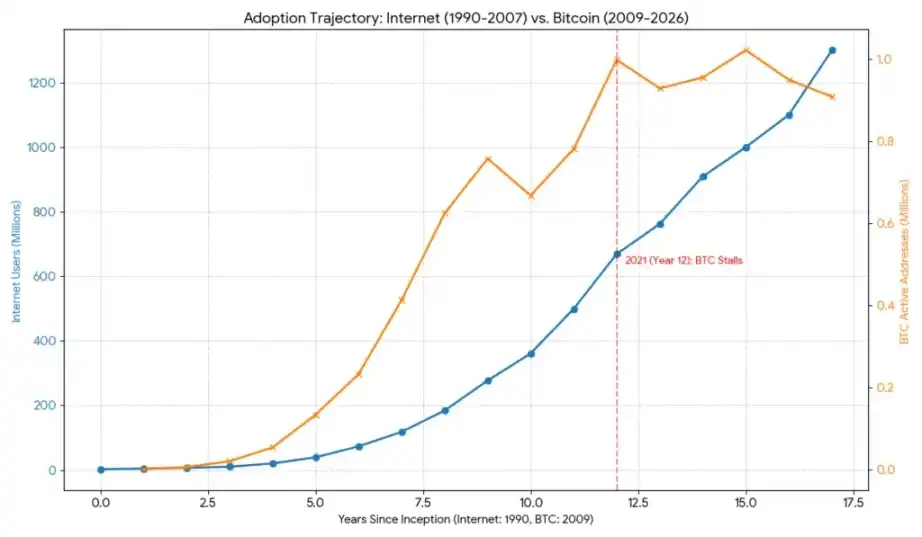
Furthermore, this chart from the paper shows how crypto acceptance fits the Rogers Diffusion of Innovations curve:
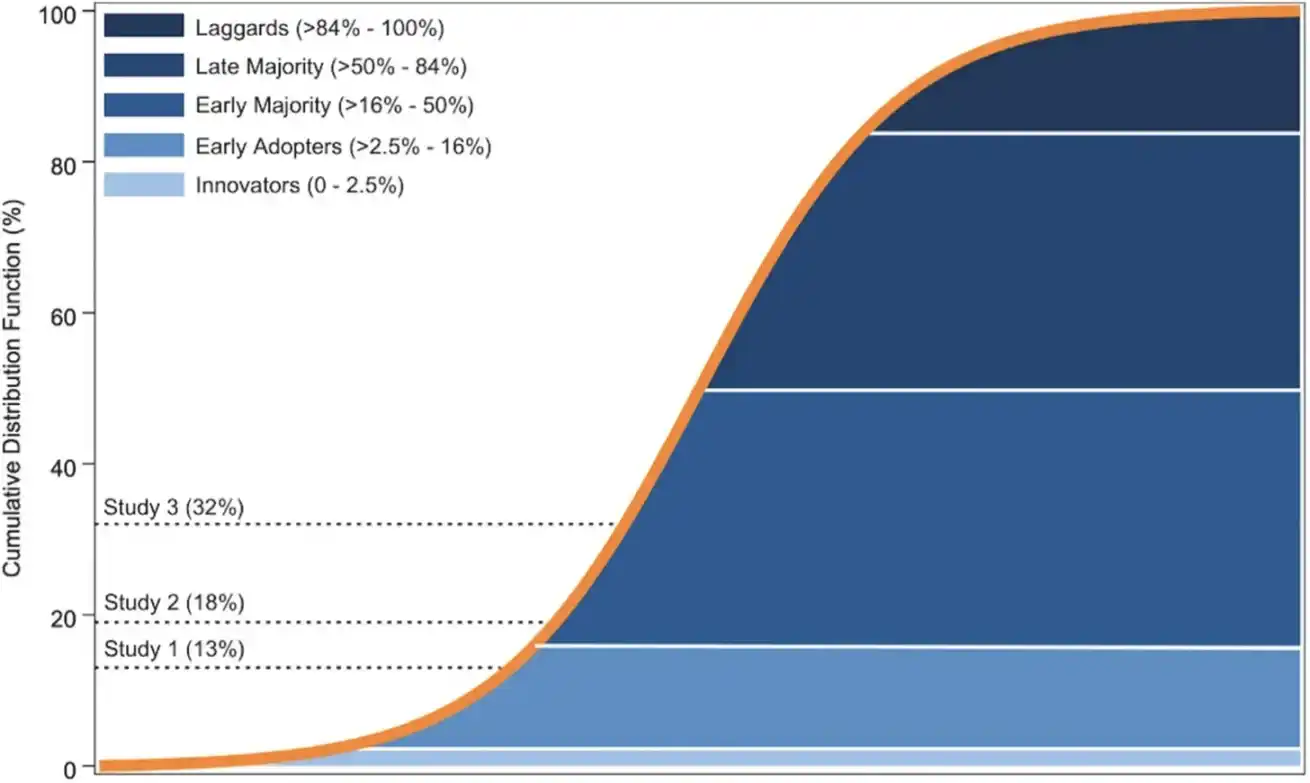
This is an adapted version of Rogers' 2003 Diffusion of Innovations curve. The solid orange line is the S-curve (the cumulative distribution function, with the scale on the left vertical axis). The blue area under the curve represents the probability distribution of the five adopter categories in Rogers' model, divided based on standard deviations from the mean in a normal distribution. In a normal distribution, these areas represent the probability proportion of each category in the whole population: Innovators (2.5%, 0 to mean minus 2 SD), Early Adopters (13.5%, mean minus 2 SD to mean minus 1 SD), Early Majority (34%, mean minus 1 SD to mean), Late Majority (34%, mean to mean plus 1 SD), Laggards (16%, mean plus 1 SD to 100%). The black dashed lines represent the self-reported cryptocurrency holding rates from our three studies (Study 1: 13%, Study 2: 18%, Study 3: 32%).

The Implications of These Findings Extend Beyond Crypto

You could interpret these results narrowly as consumer segmentation, but they have broader significance.

For Market Growth

The expansion potential of the crypto market lies not in converting staunch 'rejecters' into holders, but in figuring out what prevents potential holders from becoming actual holders. This barrier might not be ideological, but rather people's perception of their behavioral control, concerns about market volatility, or issues with asset liquidity.

For Regulatory Policy

If policymakers view only current cryptocurrency holders as the group with political influence, they misjudge the market's current state. The policy direction in the digital asset space will likely be determined by these open-minded yet undecided potential holders. Their preferences, risk profiles, and trust in institutions are critically important, especially as the crypto regulatory framework takes shape in 2026.

For Public Discourse

Online discussions often fall into polarization: either pro-crypto or anti-crypto. But our survey data shows a large, psychologically distinct middle group exists in reality. Historical experience suggests that it is this middle group, not the early adopters, that ultimately determines whether an innovation achieves widespread adoption, stalls, or triggers a backlash.

Acceptance and adoption are inherently gradual processes.

The core insight of this research is not just specific to the crypto space, but also a shift in research methodology and perspective.

When we simplify complex behaviors into binary, either-or choices, we risk conflating the behavioral rules of different stages. The factors that make people open to a new thing are not necessarily the same ones that drive them to take actual action.

This applies not only to cryptocurrency but also to the acceptance of AI technology, political participation, trust in institutions, and many other behavioral choices I've explored in this column.

The overlooked middle stage often holds the most intriguing behavioral patterns.

The acceptance and adoption of cryptocurrency is never simply a personality trait or an ideological signal, but a step-by-step behavioral process.

If you ignore this intermediate 'potential holding' stage, you will misjudge both the true direction of the market and the underlying political and social logic.


Related Questions

QAccording to the research, what percentage of Americans are considered 'potential adopters' of cryptocurrency?

AApproximately one-fifth (20%) of Americans are potential adopters, meaning they do not currently hold cryptocurrency but are considering it.

QWhat is the key difference between the factors that influence 'considering adoption' and those that drive 'actual adoption' of crypto?

AFactors like a more conservative operational ideology and support for AI development are more strongly associated with the 'considering adoption' phase. In contrast, factors like already holding stocks and a 'need for chaos' are more strongly linked to taking the final step into 'actual adoption'.

QWhy is the 'potential adopter' group so crucial for understanding the crypto market's future?

AThis group is crucial because market growth depends on converting them into actual holders, not on convincing those who firmly reject crypto. Their preferences and perceived barriers (like concerns about volatility or liquidity) will determine if the market expands or stagnates.

QHow does the acceptance of cryptocurrency fit into Rogers' Diffusion of Innovations curve?

AThe research data shows that crypto adoption follows the S-curve of the Diffusion of Innovations model. The 'potential adopters' represent the large middle groups (early and late majority) whose adoption is critical for moving the technology from early adopters to mainstream普及.

QBeyond market growth, what other significant implications does the 'potential adopter' group have?

AThe group has major implications for regulatory policy, as their trust in institutions and risk profile will influence the shaping of crypto regulation. It also impacts social discourse, as this large middle group, not the polarized extremes, often determines whether an innovation is widely accepted or faces a backlash.

Related Reads

After 50x Storage Surge, Justin Sun Always Looks to the Next Decade

Sun Yuchen, known for his controversial stunts like a $30 million lunch with Warren Buffett (canceled due to a kidney stone) and eating a $6.2 million duct-taped banana, is often overshadowed by a significant fact: his decade-long track record of spotting major investment trends. In 2016, he famously advised young people to invest in Bitcoin, Nvidia, Tesla, and Tencent instead of buying property. A hypothetical $20,000 investment in Nvidia and Tesla from that list would now be worth over 50 million RMB. His latest major call was on November 6, 2025, predicting a "50x storage opportunity" tied to the AI boom, which materialized with Sandisk's stock surging nearly 50-fold by 2026. Looking ahead, Sun now focuses on the next frontier: Physical AI. He identifies four key areas: 1. **Embodied AI/Robotics**: He sees this reaching its "iPhone moment," with companies like UBTech and Galaxy General leading in commercialization. 2. **Drones**: Viewed as the first commercially viable form of Physical AI, revolutionizing sectors from warfare (e.g., AeroVironment's Switchblade) to logistics. 3. **Spatial Computing**: Beyond VR, it's about AI understanding physical space, a foundational technology for robotics and autonomous systems, exemplified by Apple's Vision Pro. 4. **Space Exploration**: After a 2025 suborbital flight with Blue Origin, Sun advocates for space as the ultimate frontier, discussing blockchain's potential role in space asset management and data transactions. His investment philosophy involves betting on entire, inevitable trends rather than single companies. For robotics, he sees Tesla (the body/manufacturer) and Nvidia (the brain/AI platform) as complementary plays. In defense drones, he highlights companies making tanks obsolete (AeroVironment) and those augmenting fighter jets (Kratos). For space, he participated in Blue Origin's flight and anticipates SpaceX's potential IPO to redefine the sector's valuation. Sun Yuchen's vision frames the next two decades not as a revolution in information flow (like the internet), but in the fundamental operation of the physical world through AI-powered robots, autonomous systems, and spatial intelligence, ultimately extending human and AI activity into space. While many still focus on conventional assets, he continues to look toward the next technological horizon.

marsbit36m ago

After 50x Storage Surge, Justin Sun Always Looks to the Next Decade

marsbit36m ago

The Billionaires Behind the Most Expensive Midterm Election in History

"The Most Expensive Midterm Elections and Their Billionaire Backers" This analysis details the unprecedented scale of spending in the 2026 midterm elections, highlighting the key billionaire donors shaping the political landscape. Jeff Yass, founder of Susquehanna International Group, has contributed over $81 million, ranking third among individual donors behind George Soros ($102.6M) and Elon Musk ($84.8M). Yass is a major donor to Trump's MAGA Inc. and supports school choice and various candidates. Overall, federal committees have raised over $4.7 billion this cycle, with political ad spending projected to reach $10.8 billion. Republican-aligned groups are significantly out-raising their Democratic counterparts. "Dark money" from undisclosed sources continues to grow. The core stakes involve control of Congress and policy direction for Trump's final term. Donors are also motivated by specific issues: Sergey Brin and Chris Larsen are funding opposition to a proposed California wealth tax and supporting crypto-friendly policies. Other top donors include OpenAI's Greg Brockman and his wife Anna ($50M total to MAGA Inc. and an AI-focused PAC), Richard Uihlein ($45.3M to conservative causes), venture capitalists Marc Andreessen and Ben Horowitz (each over $44M to crypto/AI PACs and MAGA Inc.), Miriam Adelson ($42.6M to GOP leadership PACs), Paul Singer ($33.9M), and Diane Hendricks ($25.8M to MAGA Inc.). The article notes that the peak fundraising period is still ahead, with major primaries approaching.

marsbit38m ago

The Billionaires Behind the Most Expensive Midterm Election in History

marsbit38m ago

The Largest IPO in History Is Approaching, Surpassing SpaceX, 28 Years of AI Self-Iteration, Countdown to Intelligence Explosion

"Anthropic Nears Trillion-Dollar IPO, Fueled by Explosive Growth and 2028 'Intelligence Explosion' Warning Anthropic is considering a deal valuing the AI company near $1 trillion, potentially leading to one of the largest IPOs ever and surpassing SpaceX. Its revenue has skyrocketed, with Annual Recurring Revenue (ARR) reaching $45 billion in May 2026—a 500% increase in just five months. This vertical growth curve is attributed to its key products, Claude Code and Cowork, dominating AI coding and enterprise collaboration. Beyond commercial success, co-founder Jack Clark issued a pivotal warning in an interview: there is a greater than 50% chance that by the end of 2028, AI systems will achieve recursive self-improvement—the ability to autonomously build a 'better version' of themselves, initiating an 'intelligence explosion.' This prophecy underpins the company's astronomical valuation, as the market prices in the potential for transformative and disruptive AI. Further signaling its ambition, Anthropic formed a $1.5 billion joint venture with Goldman Sachs and Blackstone, aiming to disrupt traditional consulting firms like McKinsey by deploying Claude AI for complex strategic work. This move tests AI's capacity to replace high-level cognitive labor, a precursor to its predicted autonomous evolution. The narrative presents a dual future: unprecedented economic opportunity alongside significant risks like economic restructuring and security threats. Anthropic's meteoric rise and Clark's 2028 prediction frame the coming years as a countdown to a potential technological singularity."

marsbit50m ago

The Largest IPO in History Is Approaching, Surpassing SpaceX, 28 Years of AI Self-Iteration, Countdown to Intelligence Explosion

marsbit50m ago

Trading

Spot
Futures
活动图片




