Hop Protocol reveals details of Hop DAO and Optimism-style airdrop

CointelegraphPublished on 2022-05-06Last updated on 2022-05-06

Abstract

We see Hop as core Ethereum infrastructure. It's very important for users to be able to move their assets from one rollup to the next.

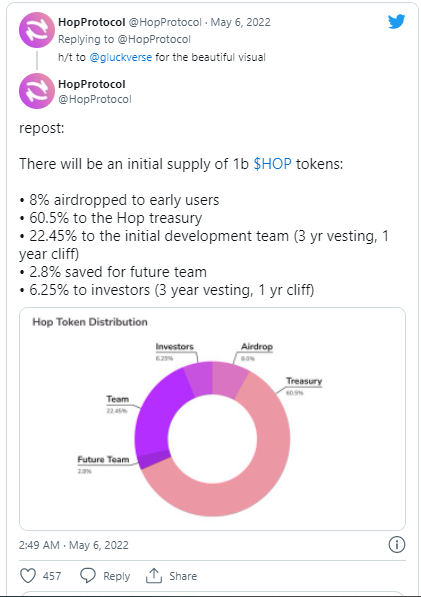
Hop Protocol, a cross-chain bridge designed to facilitate the quick transfer of tokens between different Ethereum Layer-2 scaling solutions, has unveiled a new governance model alongside an airdrop that will see early users receive 8% of the total supply of soon-to-be-released HOP tokens.
Similar to Optimism, which recently unveiled a new governance structure that will see early users airdropped 5% of the total supply of the OP token — Hop Protocol is aiming to create a community-oriented governance model, called Hop DAO, that seeks to aid Layer-2 scalability.
An official date for the airdrop is yet to be announced.
Speaking to Cointelegraph’s Elisha Ayaw on Twitter Spaces, co-founder Chris Winfrey said that Hop Protocol and the Hop DAO airdrop, were designed with unique models for both governance and bridging in mind.
"We see Hop as core Ethereum infrastructure. It's very important for users to be able to move their assets from one rollup to the next. For this reason, we believe Hop should be a community-owned bridge,” said Winfrey.
Speaking on the structure of the airdrop, Winfrey said, “the goals of designing the airdrop were to... make sure that that you know early liquidity providers were rewarded”
“For the users that provided a lot of liquidity, those folks got a lot more HOP, so that piece of the air drop was very plutocratic,” Winfrey continued.
Winfrey noted that the Hop Protocol bridging mechanism is unique, allowing the Hop team to isolate a bridge attack or network threat quickly and minimize harm to users.
“If a catastrophic event were to happen, we can isolate the event to only the place where it's happening and protect users."
"Hop uses an intermediary asset called the H token for every asset we support. Each of these H tokens is claimable on L1 for the underlying asset, and at any time you can send it back to L1 and get the underlying token,” added Winfrey.
According to data compiled by Chainalysis, bridge hacks have cost the cryptocurrency industry more than $1 billion over the past year, underscoring major security vulnerabilities of the new technology. The recent Axie Infinity Ronin bridge hack is perhaps the most infamous attack, with the attackers stealing over $600 million worth of digital assets in just two transactions.
Currently, Hop supports the transfer of ETH, USDC, MATIC, DAI, and USDT from and to the following networks; Mainnet, Polygon, Optimism, Arbitrum, and xDai.
Rollups settle the transactions outside of the main Ethereum network but post the transaction data back to the Ethereum network.

Related Reads

The Verdict in Choi Tae-won's Divorce Case: Revealing the Inheritance Undercurrent Behind SK Hynix's Trillion-Won Empire

SK Group Chairman Chey Tae-won's high-profile divorce case, involving a record 1.38 trillion won settlement, has drawn attention to the succession plans for Korea's second-largest conglomerate, especially its crown jewel, SK hynix. Unlike traditional chaebol scripts centered on the eldest son, Chey's three children from his marriage to former President Roh Tae-woo's daughter, Roh Soh-yeong, are carving distinct, non-traditional paths. Eldest daughter Chey Yun-jung (b. 1989) is seen as the most evident successor. With a scientific and consulting background, she holds executive roles at SK bioscience and SK Inc.'s growth support department, focusing on future strategy and biopharma. Her marriage is to an AI infrastructure entrepreneur, not a traditional business alliance. Second daughter Chey Min-jung (b. 1991) took a unique route, voluntarily serving as a South Korean naval officer, including an anti-piracy deployment. She later worked on policy and strategy for SK hynix in Washington D.C. before co-founding an AI-driven healthcare startup. She married a former U.S. Marine Corps officer, connecting her to U.S. defense and policy circles—networks crucial for a global semiconductor giant. The only son, Chey In-geun (b. 1995), who studied physics like his father, worked briefly at SK E&S before joining McKinsey. Despite fitting the traditional "heir" profile as the eldest son, he remains silent and holds no public position or shares in SK, suggesting the old succession playbook is obsolete. As SK hynix's valuation soars, becoming a geopolitical asset in the AI era, the heirs' legitimacy is no longer automatic. They must prove themselves in fields like AI biotech, global policy, and strategic consulting. Their marriages also reflect new elite networks in tech and defense, not old political alliances. Their inheritance is the complex challenge of navigating a globalized, tech-driven world, not just a corporate throne.

marsbit2 days ago 09:06

The Verdict in Choi Tae-won's Divorce Case: Revealing the Inheritance Undercurrent Behind SK Hynix's Trillion-Won Empire

marsbit2 days ago 09:06

From OpenSea to OpenRouter: Is Alex Atallah Repeating His 'Exit at the Peak' Playbook?

From OpenSea to OpenRouter: Is Alex Atallah Repeating His "Exit at the Peak" Playbook? According to the Wall Street Journal, payments giant Stripe is in talks to acquire the AI model aggregation platform OpenRouter in a potential deal valuing the company near $100 billion. This would mark founder Alex Atallah's second creation of a company reaching a $100 billion valuation, following his co-founding of NFT marketplace OpenSea. OpenRouter, founded just over three years ago, has grown rapidly by acting as a unified gateway for developers to access over 400 AI models. It currently has about 10 million users and processes over 200 trillion tokens monthly. While the platform's annualized revenue is around $50 million, its valuation has skyrocketed from $1.3 billion in March 2026. The potential acquisition by Stripe, a company OpenRouter's founder once likened it to, represents a major expansion into AI infrastructure for the payments leader. This move echoes Atallah's previous timing with OpenSea, where he departed before the NFT market's significant downturn. For OpenRouter, selling now may be strategic. Despite its scale, its business model—charging a 5-5.5% fee on AI inference calls—faces pressure from competition, open-source models, and potential price wars among model providers, limiting its profitability narrative for an IPO. A key asset for potential acquirers like Stripe is OpenRouter's vast repository of real-world AI usage data, which offers unique insights into model performance and developer preferences that are difficult to replicate. Whether this potential deal signifies a new valuation benchmark for AI infrastructure or another market peak signal remains to be seen.

链捕手2 days ago 08:42

From OpenSea to OpenRouter: Is Alex Atallah Repeating His 'Exit at the Peak' Playbook?

链捕手2 days ago 08:42

Trading

Spot
活动图片