Froganas:涅槃重生的百倍Solana NFT新热点

Odaily星球日报Published on 2023-12-26Last updated on 2023-12-26

Abstract

是创作者的坚持,让 Froganas 迎来了涅槃重生。

Solana 生态最近非常火爆。除了出了很多财富效应极强的 meem Token,NFT 市场在过去两天也出现了普涨。这其中,最引人关注的 NFT 项目之一便是 Froganas。

Froganas:涅槃重生的百倍Solana NFT新热点

Froganas

Froganas 在 12 月 22 日以 0.069 SOL 的价格发售,总量 5555 个,在 2 分钟内便快速售罄。根据 Solana 交易市场 Tensor 的数据显示,在今天,Froganas 的地板价曾一度到达过 14.47 SOL,相比于铸造价格的最高涨幅曾达到 14000% 以上。
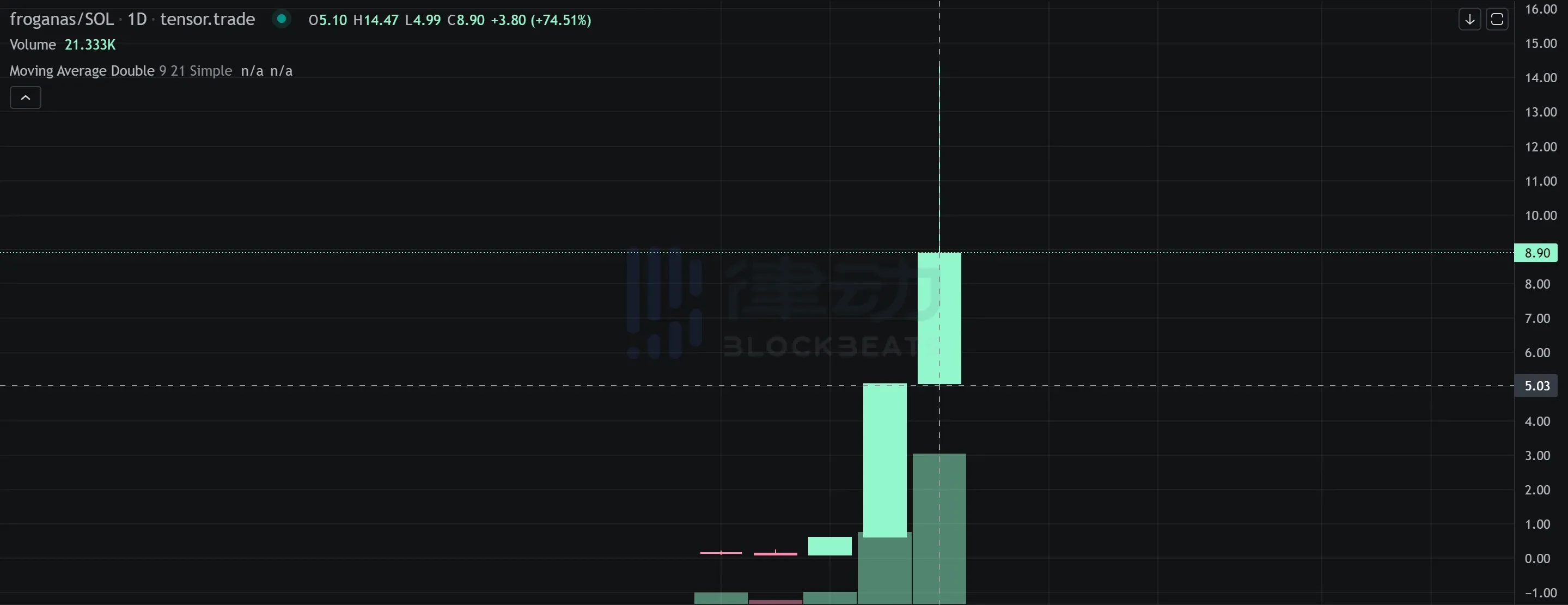
Froganas:涅槃重生的百倍Solana NFT新热点

但在取得如此巨大的成功之前,这个项目已经「夭折」。是创作者的坚持,让 Froganas 迎来了涅槃重生。

「夭折」

这个项目,之前的创始人叫作「Blake」,创作者 @ThinTallTee 对于 Blake 的 Rug 行为始料未及,因为他完全想不到在付出了近两个月的工作后,Blake 只是为了 Rug 将近 9000 美元...

Blake 曾对 @ThinTallTee 解释称进行预售只是为了让项目拥有忠诚的早期支持者,而 Tee 对此并没有想太多,只觉得这可能是为了应对当时还不是很好的市场环境而进行的营销策略。在 200 个 Froganas 预售完成后,Blake 立即关掉了项目的 Discord 服务器然后卷款跑路。

对于付出了相当多心血进行艺术创作的 Tee 来说,这让他非常苦涩。但,他没有消沉,决心将一切拉回正轨。他决定通过空投补偿在预售中被 Rug 的支持者,并且把完整的艺术呈现给所有 Solana NFT 玩家。

涅槃重生

Tee 本人应该也想不到,重生的 Froganas 会引起如此剧烈的 FOMO。不得不说,这个项目的规划在 Solana 上别具一格,就是纯艺术。这在发 Token 横行甚至许多干脆是 DeFi 项目来发 NFT 的 Solana 上,属实清新脱俗。
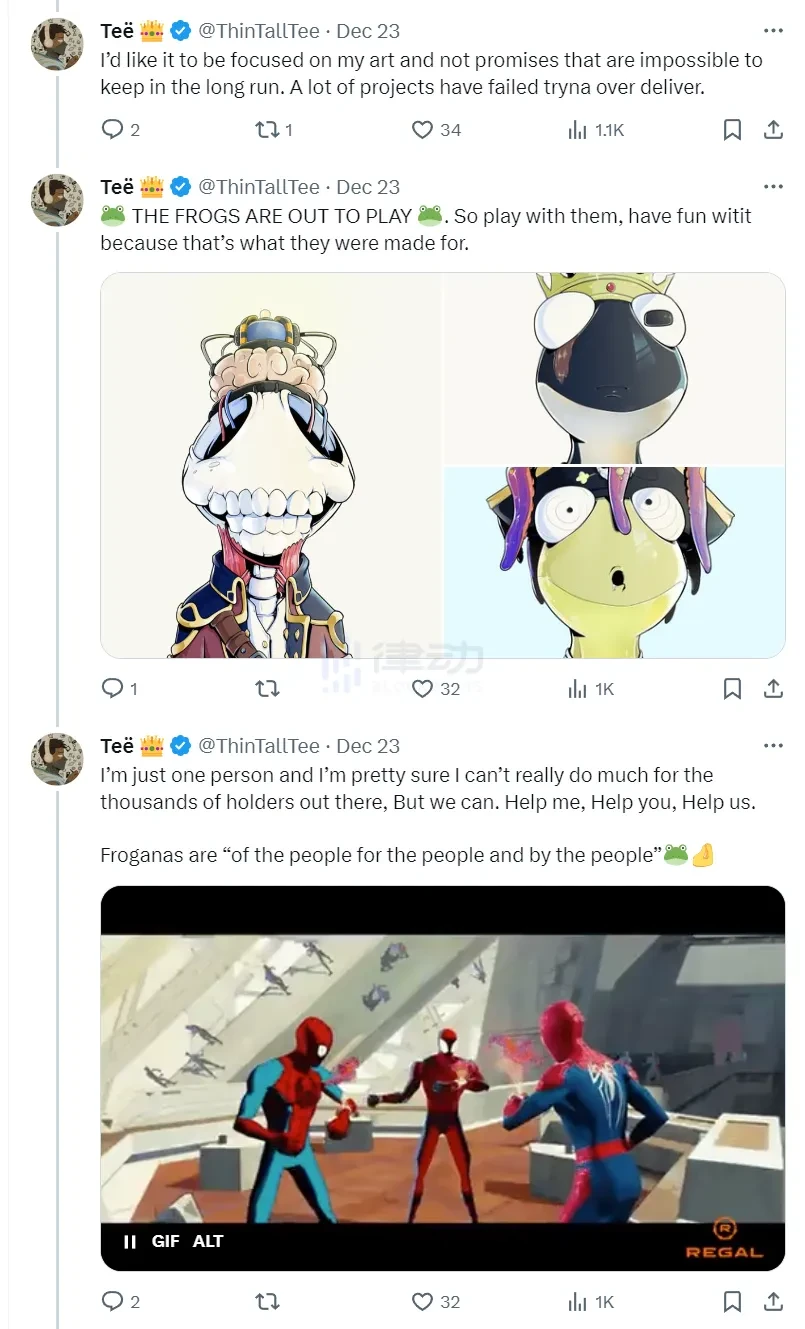
Froganas:涅槃重生的百倍Solana NFT新热点

专注艺术,并且将林肯在葛底斯堡中的「民有、民治、民享」作为 Froganas 的 Slogan

不过,引发 FOMO 的主要原因我想还是有不少 BAYC/MAYC 的持有者在 Twitter 上抱团喊单。麻吉大哥 @machibigbrother 在昨天半夜也发了一条「暧昧」的推文,不确定这是否对 Froganas 的 FOMO 也起到了影响。

Froganas:涅槃重生的百倍Solana NFT新热点

麻吉大哥:「我看上了 Solana 上的一个 PFP 系列,现在要研究怎么买」

Froganas:涅槃重生的百倍Solana NFT新热点

@machibigbrother 发推文后,Froganas 的价格走势

结语

虽然 Froganas 的故事挺感人的,但是 FOMO 的主要原因还是 Solana 生态的火热。这样的上涨其实我们先前已经见过很多,抱团喊起来,同时出现稀有款的高价成交,比如之前我曾在文章中提及的 Gruffters 等。至于,项目之后可持续性如何,又还能够走多远,很多时候我们不应该盲目乐观。

Froganas:涅槃重生的百倍Solana NFT新热点

Froganas #5047 以 250 SOL(28735.5 美元)的价格成交

市场如此火热,大家不用太过焦虑,静下心来研究其它项目,机会还有很多。

Related Reads

Blockchain Has Finally Started to Sail into the Mainstream After 18 Years

Blockchain Finds Its True Path After 18 Years: Becoming the Financial Backbone for AI Agents and Autonomy This analysis explores a pivotal shift in the blockchain and crypto investment landscape, driven by the dominance of AI. Major venture capital firms, including Variant, Paradigm, Haun Ventures, and YZi Labs, are moving beyond pure "crypto" investment theses. They are expanding their focus to AI, robotics, and frontier tech, signaling that blockchain is no longer seen as a standalone sector but as an underlying infrastructure layer. The core argument is that blockchain's killer application may not be user-facing apps, but rather providing the economic rails for the coming wave of AI agents, autonomous robots, and automated systems. Key capabilities like self-custody wallets, programmable stablecoins for micropayments, on-chain identity, and verifiable smart contracts are positioned as essential for a future where machines conduct economic activity. The recent $1.4 billion investment by Tether (via its venture arm) in German robotics company NEURA Robotics exemplifies this, aiming to embed Tether's wallet tools directly into robots for autonomous transactions. While many "AI + Crypto" projects remain superficial, the article concludes that true value lies where crypto is a necessary component—enabling machine-to-machine payments, agent autonomy, verifiable data provenance, and open financial settlement for the AI era. For crypto venture capital, this convergence with AI represents both an adaptation to shifting capital flows and a potential path to unlocking the large-scale, non-speculative utility the industry has long sought.

marsbit1m ago

Blockchain Has Finally Started to Sail into the Mainstream After 18 Years

marsbit1m ago

Blockchain has finally begun sailing toward the main channel after 18 years

After 18 years of development, blockchain technology is beginning to move from a specialized niche into mainstream adoption, according to a recent industry analysis. The shift is reflected in the changing strategies of major crypto venture capital firms, which are expanding their focus beyond pure "digital ownership" towards broader themes like "autonomy." The report highlights that leading VC firms like Variant, Paradigm, Haun Ventures, and YZi Labs are broadening their investment mandates to include not only crypto but also artificial intelligence (AI), robotics, biotech, and other frontier technologies. This reflects a recognition that the isolated "crypto investment" narrative is losing appeal to limited partners (LPs) as capital and attention increasingly flow toward AI and other high-growth tech sectors. A key emerging thesis is that blockchain's most significant future application may not be as a consumer-facing product, but as the underlying economic and settlement infrastructure for the AI era. As AI agents and autonomous systems become more prevalent, they will require programmable, global, and low-cost payment networks (like stablecoins), verifiable digital identities, and secure wallets to manage transactions and assets on behalf of users. The investment by stablecoin issuer Tether into robotics company NEURA, with plans to integrate its wallet technology, is cited as a prime example of this convergence. However, the article cautions that simply labeling projects as "AI + Crypto" is insufficient. True value lies in integrations where blockchain technology is essential—such as enabling machine-to-machine micropayments, verifiable data provenance for AI, or transparent governance for autonomous organizations—rather than being a superficial marketing add-on. In conclusion, while AI currently dominates the tech narrative and capital flows, it may ultimately create the real-world, high-frequency demand that the crypto industry has long sought. For crypto VCs and projects, the path forward is to position blockchain not as a competing sector, but as a critical foundational layer powering autonomy and economic activity in an AI-driven future.

链捕手8m ago

Blockchain has finally begun sailing toward the main channel after 18 years

链捕手8m ago

Y Combinator Co-founder: How to Make a Billion Dollars?

The Y Combinator co-founder argues that becoming a billionaire by founding a successful startup is not only possible but demonstrably achievable without unfair or unethical practices. He disputes a politician's claim to the contrary, using the example of a founder whose company grew at 93% monthly solely through creating a product users loved and recommended. The core mechanism is exponential growth. A conservative 15% monthly growth rate compounds to a 4384x increase over five years, which can easily lead to billion-dollar valuations and founder wealth. The process depends on two key variables: the growth rate and the duration it can be sustained. A high growth rate stems from a great product that users naturally promote, while a long duration requires a large enough market. For aspiring founders, especially young ones, the simplest path is to build something they and their friends genuinely need. Young people's current needs often predict future mass-market trends. He advises against actively "searching" for ideas, as this tends to filter out unconventional but promising ones. Instead, inspiration should come from working on interesting projects with friends, as many iconic companies (e.g., Apple, Facebook) started this way. Ultimately, building a massively valuable startup is not about exploitation but empathy: deeply understanding a user group and building a product that significantly improves their lives. This, powered by exponential growth in a large market, is the legitimate path to immense wealth creation.

Foresight News10m ago

Y Combinator Co-founder: How to Make a Billion Dollars?

Foresight News10m ago

The 800V Voltage Standard Championed by Nvidia: Which Infrastructure Providers Stand to Benefit?

NVIDIA is actively promoting the 800VDC architecture as a key direction for its next-generation AI factories and high-power racks, particularly for the upcoming Rubin and Kyber platforms. The primary driver is the rapidly increasing power density of AI racks, with designs like GB200/GB300 NVL72 reaching 120-140kW and future systems potentially hitting 180-220kW. At such high power levels, traditional low-voltage power delivery becomes inefficient due to massive current, leading to significant copper use, cable bulk, heat, and power loss. The 800VDC standard aims to increase efficiency by transmitting power at higher voltage and lower current to the rack before stepping it down locally for GPUs. NVIDIA claims this can improve efficiency by up to 5%, reduce total cost of ownership (TCO) by up to 30%, and cut copper usage by approximately 45%. This shift redefines infrastructure roles, pushing power engineering to the forefront alongside GPU performance. Key beneficiaries and ecosystem partners highlighted include: 1. **Power Infrastructure Providers:** Companies like Vertiv, Schneider Electric, Delta Electronics (台达电), and Korean firms LS Electric and HD Hyundai Electric are involved in designing next-gen AI factory power distribution, rack power supplies, and backup systems. 2. **Power Semiconductors:** Suppliers of SiC/GaN devices, such as Infineon and STMicroelectronics, are better suited for high-voltage, high-efficiency conversion in this new architecture. 3. **Connectivity & Structure:** The focus shifts to high-reliability components like busbars, high-voltage connectors, and advanced PCBs that meet stricter insulation and safety requirements. 4. **Liquid Cooling & Rack ODM:** As power and heat density rise, liquid cooling becomes critical. Full-rack system integrators (e.g., Dell, Wiwynn, Wistron) must now demonstrate robust pre-delivery testing capabilities, including burn-in testing under full load, requiring significant power and cooling infrastructure in their factories. The transition is not immediate for all data centers but is targeted at high-density AI factories. NVIDIA’s 800VDC ecosystem is in a preparatory phase, with full-scale production expected to align with the 2027 launch of Kyber rack-scale systems. The investment thesis revolves around which companies can demonstrate proven product integration, customer validation, and reliable delivery of complete, high-power AI rack systems, making power, cooling, and testing capabilities new critical variables in the AI infrastructure value chain alongside GPUs.

marsbit30m ago

The 800V Voltage Standard Championed by Nvidia: Which Infrastructure Providers Stand to Benefit?

marsbit30m ago

Did 'Unlimited Minting' Actually Happen? Zcash Founder Responds to Four Major Market Concerns

The Orchard shielding pool in the privacy cryptocurrency Zcash was recently found to have contained a critical counterfeiting vulnerability that existed for four years. This discovery caused significant market panic and a sharp drop in the price of ZEC, though it has since recovered partially. Zcash founder Zooko Wilcox addressed four key questions raised by the vulnerability. First, while it's unknown if the bug was exploited, he believes it likely was not, citing advanced, targeted discovery methods, a rapid response to freeze the pool, and the typical "smash-and-grab" nature of past crypto exploits. Second, he states that if no exploitation occurred, all legitimate user funds in Orchard are recoverable. However, cautious users moving funds should be aware of privacy trade-offs and other risks involved in transferring to transparent or Sapling pools. Third, users currently cannot independently verify that the total ZEC supply hasn't been inflated due to this bug. However, the proposed "Ironwood" network upgrade will restore this ability by permanently sealing the Orchard pool. This will prevent any counterfeit funds from circulating and allow anyone running a node to cryptographically verify that the supply cap has not been breached. Finally, regarding other undiscovered vulnerabilities, Wilcox notes that intensive ongoing audits by multiple teams, including using advanced AI-assisted tools, have so far found no other counterfeiting bugs. This provides increased, though not absolute, confidence. In conclusion, while assessments suggest the bug was likely unused and funds are safe, the core issue was the loss of user-verifiable supply integrity. The Ironwood upgrade is presented as the solution, aiming to restore trust by allowing users to independently verify Zcash's supply security without relying on third-party assurances.

marsbit31m ago

Did 'Unlimited Minting' Actually Happen? Zcash Founder Responds to Four Major Market Concerns

marsbit31m ago

Trading

Spot
Futures
活动图片