Solana 流动性质押格局:Jito 与 Marinade 谁是王者?

foresightnewsPublished on 2023-12-21Last updated on 2023-12-21

Abstract

相较于 Jito,Marinade 的价格被低估了。

相较于 Jito,Marinade 的价格被低估了。


撰文:Michael Nadeau

编译:Luffy,Foresight News


12 月 7 日的 Jito 空投点燃了 Solana DeFi 生态。我们很高兴见证这场浪潮,因为它意味着我们的流动质押理论正在大范围发挥作用。


在本周的报告中,我们将重新审视 Solana 流动性质押理论,涵盖的主题包括:


  • 回顾我们五月分享的观点以及所发生的事情
  • Jito 与 Marinade 的数据对比(加上 Lido)
  • Marinade 2.0 更新
  • 展望未来


重温 Solana 流动性质押理论


5 月 9 日,我们分享了一篇题为「Solana 上的流动质押设置」的报告。


我们的观点很简单:


  • 我们坚信 Solana 将重新成为以太坊的第一大竞争对手。
  • 随着 Solana 的重新崛起,DeFi 将再次活跃起来。
  • 为此,需要激发流动性增长。
  • 我们认为流动性质押可以发挥作用。为什么?用户可以质押 SOL,然后将其存款代币 (mSOL) 投入 DeFi 以获得额外收益(并承担额外的智能合约风险)。 * 我们之前观察到 Lido 通过 stETH 与 Aave 集成后在以太坊上崛起。
  • 我们意识到 Solana 的质押率很高。但只有 2.7% 被锁定在流动性质押解决方案中(以太坊当时的数字是这个 10 倍)。


我们认为差距将会缩小,因此我们开始探索表达我们论点的方法。


进入 Marinade Finance。我们的努力包括成为早期用户、一些数字处理、业务模型分析、阅读治理文档、浏览 Discord 社区、研究以及与一些团队成员交谈。


当时我们正处于加密货币冬天的严寒之中,尚不清楚 Marinade 的精干团队能否生存下来。它的市场估值徘徊在 600 至 1000 万美元之间,这反映出市场的恐惧情绪。


但 Marinade 有很多令人欣喜的地方:


  • 他们是 Solana 上第一个流动性质押协议。
  • 团队诞生于 Solana 黑客松,没有风险投资人参与启动。
  • Marinade 与 Solana 基金会有着密切的联系。
  • Marinade 与所有主要的 Solana DeFi 项目集成(通过 mSOL)。
  • 治理文档组织良好且易于访问。
  • Discord 渠道有序且成熟。
  • Marinade 经常与其社区进行交流。
  • 验证者列表和采用率是透明的。
  • 核心团队希望激励措施与社区保持一致(团队受到 TVL 里程碑的激励)。
  • MNDE 代币在 Coinbase 上市(现在还包括 crypto.com 和 Kucoin)
  • Marinade 对 FTX 的风险敞口为零。


最后,当使用这个产品时,我们灵光一现。这是我们在加密领域见过的最好的用户体验。这里也要赞扬一下 Phantom 钱包。


如前所述,当时 Marinade 的市值还不到 1000 万美元,代币价格约为 0.035 美元。从那时起,Marinade 的市值升至 1.5 亿美元(撰写本文时为 7700 万美元),代币价格触及 0.63 美元(18 倍)。同期唯一表现优于 Marinade 的 Solana 项目是 Bonk,增长了令人瞠目结舌的 43 倍。


是什么推动了这一巨大增长?


流动性又回到了市场。 SOL 从 10 月中旬开始采取了重要举措,然后 Solana DeFi 就活跃起来了。


但真正关键的催化剂是在上周 Jito(Solana 上排名第二的流动性质押解决方案)空投,其完全流通市值超过 20 亿美元。


以下是我们对 2023 年 9 月 5 日的分析的回顾,并使用当前数据进行了更新:
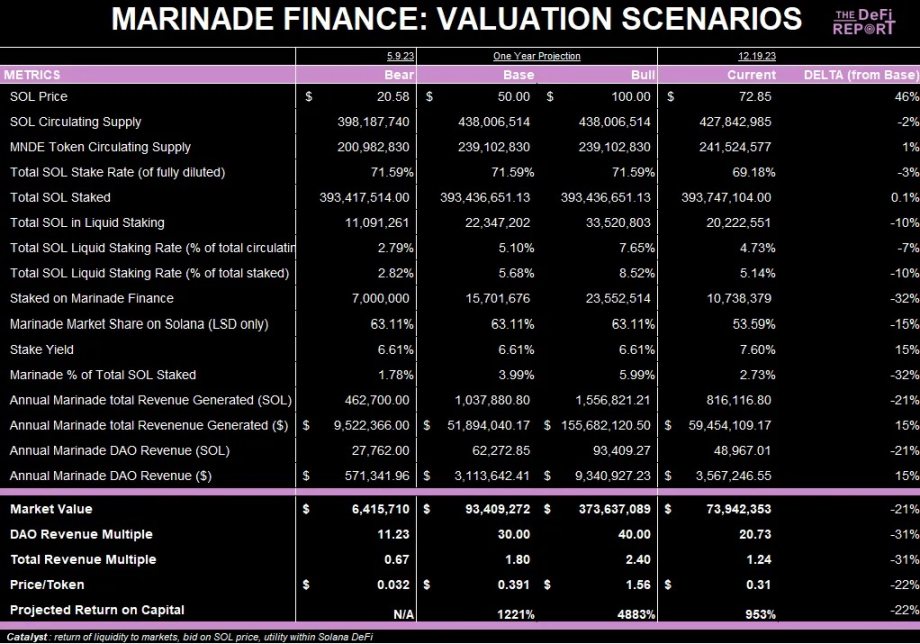
 

数据来源:Solana Compass、Marinade.Finance、Coingecko


截至撰写本文时,Marinade 的交易价格为 0.75 美元(完全流通市值为 3.09 亿美元)。 Jito 的流通估值为 2.78 亿美元(完全流通后为 24 亿美元,是 Marinade 的 7.7 倍)。


这引发我们思考,Marinade 仍然被低估了吗?


Marinade vs Jito


首先,恭喜 Jito 团队以及获得空投的用户。


一些估算表明,超过 10,000 人通过 Jito 空投赚取了 10-20 万美元。虽然有人指出估值存在泡沫,但这是创造财富的一项令人难以置信的壮举,我们认为这一点还没有得到足够的讨论:加密货币对早期用户的奖励比历史上任何行业都多。


更不用说,我们很高兴看到一个强大的竞争对手进入 Solana 的流动质押领域。我们相信这场比赛对两支球队来说都是好事。竞争有利于创新,也有利于 Solana 网络的健康、安全和去中心化。


话虽如此,现在我们的工作是弄清楚为什么市场对 Jito 的定价是 Marinade 的 7.7 倍。


一些重要数据的概览视图:
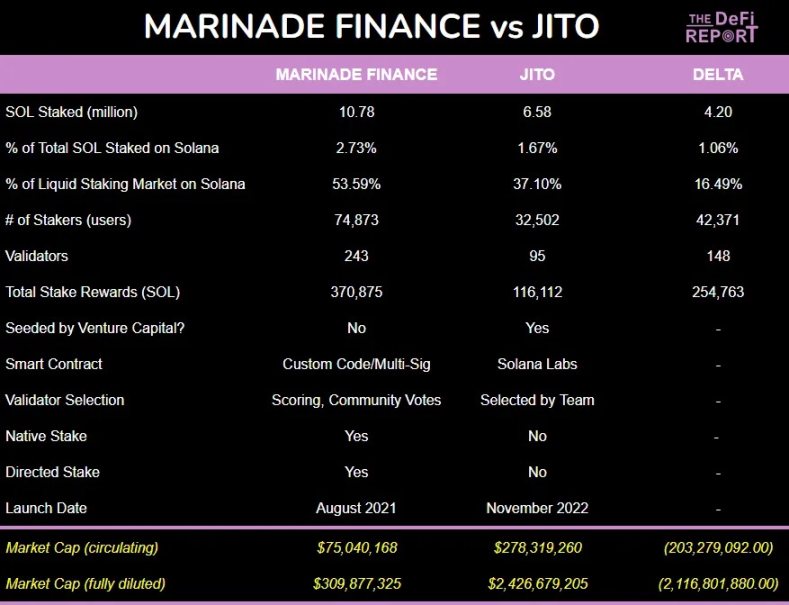

数据来源:Dune (@ilemi)、Jito、Marinade.Finance、defillama


再次强调:Jito 的完全流通后市值是 Marinade 的近 7.7 倍。


我想起了传奇投资者本杰明·格雷厄姆的名言: 


「从短期来看,市场是一台投票机;但从长期来看,市场是一台称重机。」


一些背景:


投票机=短期叙述(长期噪音)。


称重机=基本面(长期信号)。 


市场上的说法是 Jito = Lido + Flashbots。 Jito 有一些「特殊的秘密武器」,因为它会将一些 MEV 返还给其质押池中的委托人。


但 Marinade 也有这个功能。事实上,Marinade 的质押池将其大部分质押委托给 Jito 验证者,后者使用 Marinade 的界面将 MEV 返回给质押者。迄今为止,Marinade 在 MEV 中返还了 200 SOL,而 Jito 为 264 SOL。 (根据团队的说法,Marinade MEV 仪表板即将推出)。


那么,当我们将 Jito 与 Marinade 进行比较时,真正有什么特殊之处呢?我们没有看到。


事实上,我们在 Marinade 中看到了比 Jito 更多的优势。


风险投资


值得重申的是,Marinade Finance 是一个没有 VC 参与启动的项目。当代币通过空投向早期用户分发时(正如 Jito 在 12 月 7 日所做的那样),其初始估值是由市场决定的,没有来自 Marinade 的影响。


Jito 采用了不同的方式融资和启动代币。 Multicoin、Framework、Solana Ventures、Delphi Ventures、Robot Ventures、Alameda (RIP) 等都是项目的投资者。 


我们认为,Jito 的初始上市价格可能受到支持该项目的风投的影响。当然,市场总是可以对代币重新定价,但最初的上市价格在我们认为目前被高估的代币中发挥了作用。


市场清醒了吗?


两个潜在的结果:


Jito 空投重置了 Solana 流动质押协议的估值。在这种情况下,Marinade 的价格仍然偏低。


Jito 空投让市场疯狂了,Jito 的价格需要回归现实。


我们认为这更有可能是两者的结合。


为了进一步进行压力测试,让我们看一下以太坊中的 Lido:
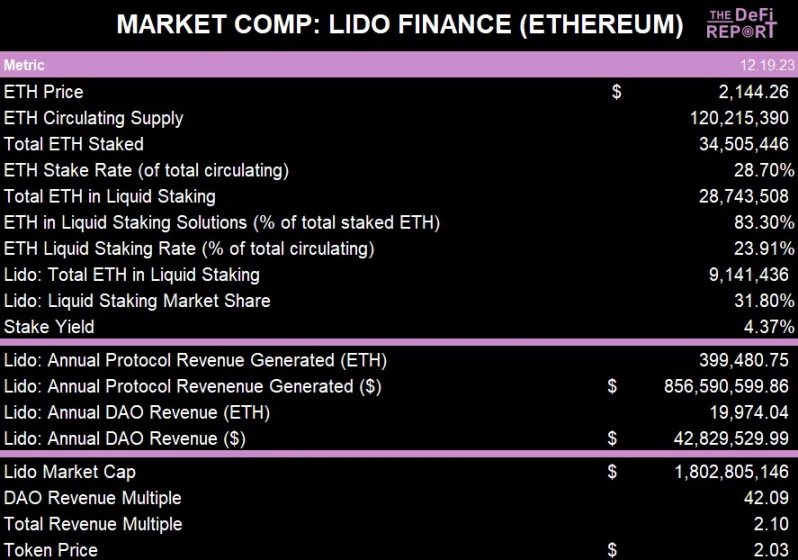
 

数据来源:Etherscan、Lido.finance、Glassnode、Dune (@hildobby)、Coingecko


再一次,数字告诉我们,Marinade 的价格被低估了。例如:Lido 的 DAO 收入目前比 Marinade 高 1.2 倍,总收入高出 0.8 倍。


Marinade 2.0 更新


在过去的几年,Marinade 团队一直在痴迷于质押,并与每一个愿意倾听的质押者交谈。 


自我们五月份首次报道该项目以来,一系列的迭代最终带来了一些重要的创新。 


Marinade 原生质押(Native Stake): 到目前为止,那些希望通过多个网络验证器原生质押 SOL 的人需要 1) 多笔交易,2) 持续的性能监控,以及 3) 接触智能合约风险。 


这使得质押对于许多规避风险的机构投资者来说失去了吸引力。 Native Stake 通过访问 150 多个性能最佳的验证器来消除智能合约风险,从而解决了这个问题。 Marinade 于 7 月推出,目前「Native Stake」超过 380 万个 SOL。 


要点:所有质押 SOL(3.7 亿)中大约 96% 是由个人验证者质押的。因此,通过推出这款新产品,Marinade 成为了 270 亿美元市场机遇的先行者。原生质押者转向 Marinade 的动机是 1) 可以选择委托给经过审查和监控的验证者组,2) 降低中心化风险,3) 监控所有验证者的表现。


请注意,Native Stake 目前尚未商业化,但我们了解团队有计划这样做。Native Stake 的商业模式可能会对我们的前瞻性收入模式产生重大影响。


MNDE 代币效用: Marinade 质押池的 20% 现在由 MNDE 代币通过投票决定。 


要点:MNDE 持有者可以使用他们的 MNDE 代币为验证者投票,从而获得更高的质押奖励。这不仅激励了验证者的正确行为,而且还为 MNDE 代币创造了新的效用。 


DeFi 中锁定的 mSOL

 

数据:Dune (@ilemi)


目前,Solana DeFi 中锁定了超过 200 万个 mSOL(质押 SOL 的「收据代币」),占流通总量的近 30%。我们认为这对于 mSOL 的实用性来说是一个积极的信号,无论是对于 Marinade 用户还是对于整个 Solana DeFi 流动性而言都是如此。


期待


我们问自己的关键问题是什么:


  • 流动质押解决方案中的 Solana 质押率是否会继续接近以太坊数字(目前为 4.7% vs 24%)? 我们认为答案是肯定的。
  • 我们在开源网络和协议中看到的幂律是否适用于 Solana 流动性质押领域? 我们认为答案是肯定的。
  • 市场重新定价 Jito 的价格更有可能下​​跌,还是 Marinade 的价格上涨? 我们认为是后者。
  • Marinade 的表现会超越 Jito 吗? 我们认为答案是肯定的(有波动性)。
  • Marinade 的表现会超越 SOL 吗? 我们认为答案是肯定的(有波动性)。


什么可能会推翻我们的理论?


  • Solana 的势头逐渐消失。 从概率上讲,考虑到我们开始看到的风险投资活动,我们认为这种可能性较小。
  • 技术错误。 这适用于市场上的每个加密协议,但始终需要考虑。
  • 竞争对手进入市场并可能将用户从 Marinade 中夺走。 Marinade TVL 在 Jito 推出代币后不断增长。 Blaze 也是如此,我们正在密切关注的一个新兴解决方案。
  • 执行 / 团队风险。 到目前为止一切都很好,但我们不能忽视这一点。
  • 宏观风险。 我们认为目前看起来一切都好,但预计在某个时候会出现波动。


不要忘记:Solana 目前的通货膨胀率为 5-6%。如果你持有 SOL 而没有质押,该协议就会稀释你的权益。

Related Reads

Three Months, 35 Billion Yuan: Investors Rush to Grab the OpenAI of the Physical World

Investors flock to a physical AI startup as the race for the "OpenAI of the physical world" heats up. Ji Jia Shi Jie (GigaWorld), a company dedicated to developing Artificial General Intelligence (AGI) for the physical world, has raised 3.5 billion RMB (approximately $490 million) in just three months, according to a report from investment media outlet Touzijie. The latest B2 funding round of 1 billion RMB attracted a wide range of top-tier investors, including sovereign wealth funds, industrial capital, and financial institutions. This brings the total funding for the young company, now valued over 10 billion RMB, to 3.5 billion RMB across three recent rounds. The company is led by Huang Guan, a post-90s Tsinghua University PhD with extensive experience in AI, autonomous driving, and entrepreneurship. Its core innovation is a "dual-pyramid" system comprising a five-layer data pyramid (from internet videos to real-world robot data) and a three-layer algorithm pyramid focused on world simulation, action alignment, and reinforcement learning. This system underpins its key models: the "World Action Model" (e.g., GigaBrain series for robot control) and the "World Generation Model" (e.g., GigaWorld series for simulating and understanding the physical world). Its models have reportedly achieved top rankings in global robotics benchmarks. Ji Jia Shi Jie argues that while current digital AGI excels in information processing, the next frontier is physical AGI—systems that can understand and interact with the real world. The company believes the field is approaching its "GPT-3 moment," a key inflection point in capability scaling. To achieve this, the company is pursuing a dual-market strategy. For the consumer (C) market, it launched the "SeeLight" brand and its S1 general-purpose humanoid robot, which has secured initial orders for deployment in real homes. For the business (B) market, it focuses on industrial automation with its Maker series robots, having signed agreements for large-scale deployment in factories, and its DriveDreamer world model for autonomous driving, which is already in use with over 30 automakers and tech companies. The report concludes that by bridging the gap between digital intelligence and physical action, Ji Jia Shi Jie aims to unlock a new wave of productivity, ultimately bringing physical AGI into everyday life.

marsbit6m ago

Three Months, 35 Billion Yuan: Investors Rush to Grab the OpenAI of the Physical World

marsbit6m ago

What's the Connection Between Pinduoduo's Huang Zheng and Blockchain?

This text explores the unexpected connection between Pinduoduo founder Colin Huang and blockchain, as suggested in his article *Turning Capitalism Upside Down*. Huang argues Pinduoduo's core business is about managing "uncertainty." He posits that wealth flows to the rich because they absorb life's uncertainties (e.g., illness, job loss) that devastate the poor, who pay a premium for certainty through insurance or stable prices. Pinduoduo's model attempts a "reverse insurance": by aggregating consumer demand via group-buying and flash sales, it creates a large, predictable order for manufacturers. This certainty allows factories to remove risk premiums, passing savings back as lower prices, thus partially reversing the wealth flow. The key obstacle, Huang notes, is that an individual's buying intent is an unreliable promise. He then asks if blockchain is the natural solution for this "reverse insurance." The text elaborates that blockchain, through smart contracts with binding deposits, could transform casual intent into a costly-to-break, enforceable commitment. This replaces interpersonal trust with coded rules, making promises credible, pricable, and resistant to fraud. Finally, the author draws a parallel to Bitcoin, framing two paths to creating certainty: the "Pinduoduo path" of aggregating decentralized will into scale, and the "Bitcoin path" of locking rules into immutable code. Both sacrifice something—personal freedom or system flexibility—to manufacture trust and predictability.

链捕手1h ago

What's the Connection Between Pinduoduo's Huang Zheng and Blockchain?

链捕手1h ago

The Storage Magnate Who Conquered a Trillion-Dollar Kingdom, Yet Ultimately Could Not Become the Richest

**Summary:** "The Memory Magnate Who Built a Trillion-Dollar Empire, Yet Never Became the Richest" explores the journey of Zhu Yiming, founder of GigaDevice (603986) and co-founder of the soon-to-IPO ChangXin Memory Technologies (CXMT). The article positions GigaDevice, a fabless chip designer now valued at ~¥340 billion, as a prequel to the massive IDM (Integrated Device Manufacturer) venture, CXMT. Starting in 2005 with minimal capital, Zhu strategically "picked up the pieces" by focusing on niche markets like NOR Flash and microcontrollers (MCUs), areas major players were exiting. This allowed GigaDevice to grow into a diversified semiconductor company, maintaining robust profitability even during industry downturns by controlling costs. However, the piece argues that in the highly cyclical and capital-intensive memory chip industry, the fabless model has limits. True resilience and scale require the ability for "counter-cyclical expansion" – investing heavily during downturns – a tactic only possible for IDMs like Samsung or SK Hynix. This insight led Zhu to partner with the Hefei city government in 2016 to establish CXMT, an IDM focused on DRAM. Zhu's symbolic moves, like forfeiting salary and diluting his equity, were crucial in securing the massive state and bank funding needed. CXMT's equipment base is now valued even higher than that of BYD's vast auto manufacturing empire. Despite the potential for CXMT to reach a market cap of ¥1-2 trillion upon its IPO, Zhu's indirect stake in both companies is estimated below 3%, placing his personal wealth far below that of China's top billionaires. The article concludes that his strategic vision built a trillion-yuan memory landscape, but the capital structure necessary to achieve it precluded a personal fortune of similar scale.

marsbit1h ago

The Storage Magnate Who Conquered a Trillion-Dollar Kingdom, Yet Ultimately Could Not Become the Richest

marsbit1h ago

XRP Ledger Daily Fees Drop Below $400 As Network Activity Question Returns

The XRP Ledger is drawing attention as daily network fees have fallen below $400. While low fees align with XRPL's design for affordable transactions and are often seen as a strength, the metric can also serve as an indicator of network demand and paid transaction volume. This data point of around $3,100 in weekly fee burn highlights the stark contrast with higher-fee chains like Ethereum and Bitcoin. The development fuels an ongoing debate. Proponents view low fees as a sign of efficiency and accessibility, while critics may question if the network is generating sufficient high-value activity relative to its market cap and payments-focused narrative. The article cautions against overstating the finding, noting a single low-fee day does not signify network failure. It instead adds context to discussions about XRPL's usage, especially alongside Ripple's broader initiatives in stablecoins (RLUSD), AI payments, and enterprise infrastructure. The report recommends monitoring for a fee rebound, checking transaction counts for a fuller picture, and confirming the trend via native explorers like Bithomp. It frames the story within a larger market shift where on-chain data, protocol updates, and infrastructure developments are becoming crucial alongside price action. The editorial stance is to present the verified data, explain its significance for assessing network activity, and avoid hype, positioning it as part of the daily crypto conversation.

bitcoinist6h ago

XRP Ledger Daily Fees Drop Below $400 As Network Activity Question Returns

bitcoinist6h ago

Trading

Spot
Futures
活动图片