六问测评Dune AI:链上分析师会下岗吗?

Odaily星球日报Published on 2023-12-01Last updated on 2023-12-01

Abstract

目前仅适合作为SQL编写助手。

原创 | Odaily星球日报

作者 | 南枳

六问测评Dune AI:链上分析师会下岗吗?

11 月初,Web3数据分析基础设施 Dune 宣布推出 DuneAI,用户可以使用其自然语言引擎以任何语言提出问题,无需了解 SQL 即可获得加密数据见解。Odaily 将通过从简单到复杂的多个问题,对 Dune AI 进行测试,验证其可用性和可靠性。

案例 1 ——特定协议交易量查询

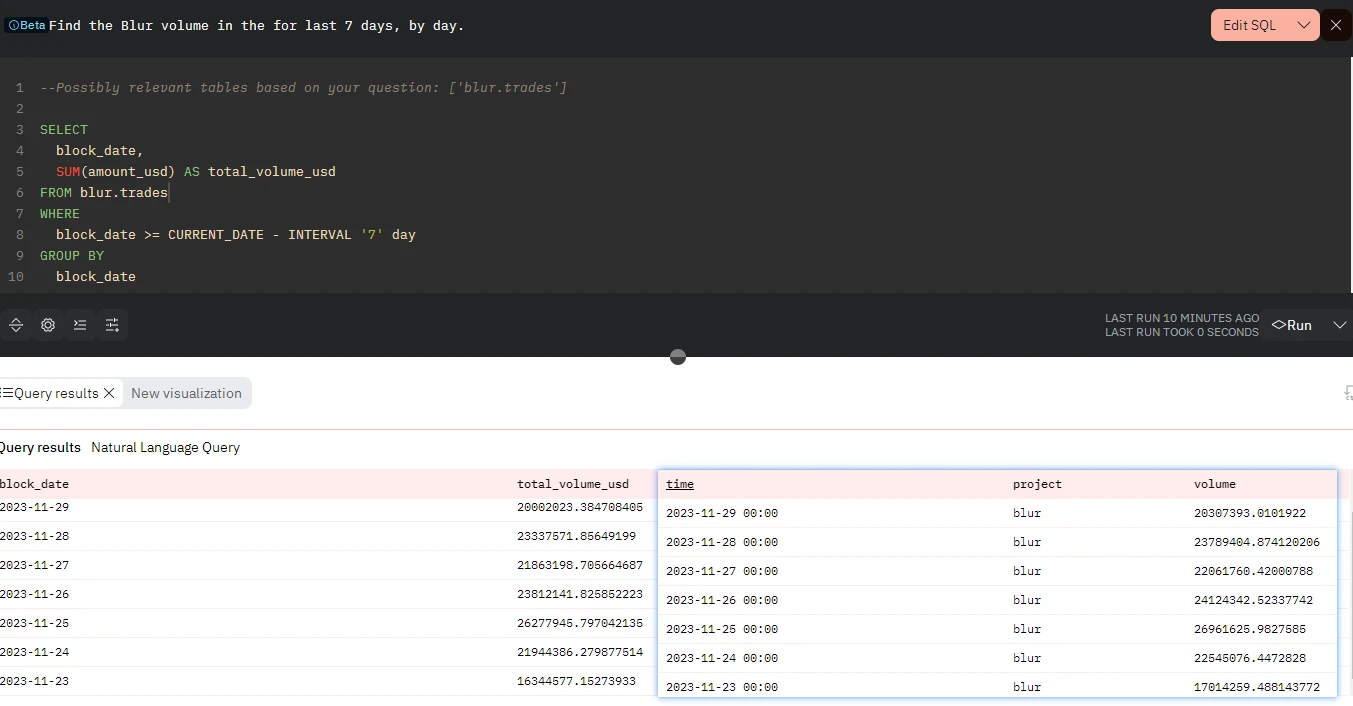
问题:Blur 过去七天的日交易量(Find the Blur volume in the for last 7 days, by day)?

将 Dune AI 给出的答案与 Dune 上点赞最多的 Blur query(右下图),数据对比如下,二者有接近 1% 的差值。
六问测评Dune AI:链上分析师会下岗吗?

案例 2 ——特定网络交易量查询

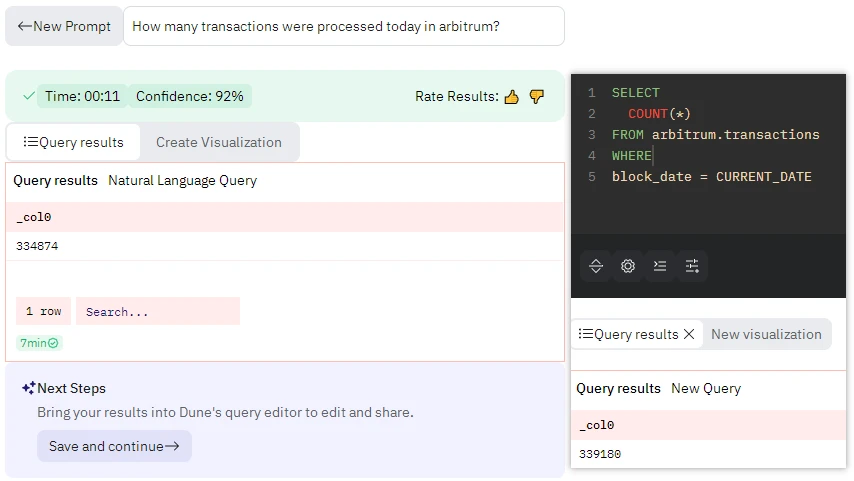
问题:Arbitrum 网络今天执行了多少笔交易(How many transactions were processed today in arbitrum)?

左图为 Dune AI 给出的答案,右边为 Odaily 所编辑 query,二者结果基本一致(差异来自 query 执行时间不同)。
六问测评Dune AI:链上分析师会下岗吗?

案例 3 ——带有歧义的查询

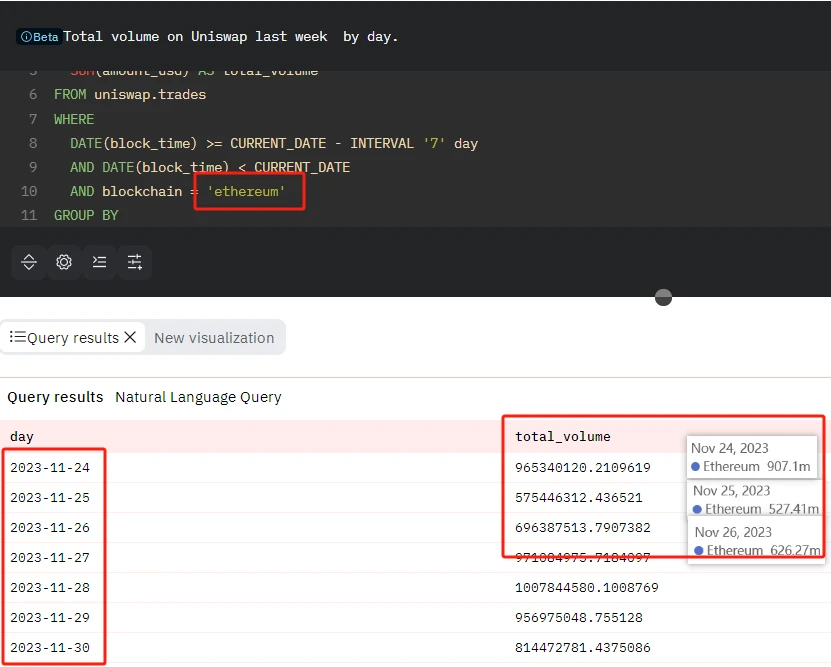
问题:Uniswap 上周日交易总量(Total volume on Uniswap last week by day)?

在这里,出现了三个问题:

  • Dune AI 将查询范围限制在了以太坊上,而 Uniswap 部署于多个链上,并且原提问并没有这个要求。

  • DefiLlama 上的 Uniswap数据对比,差值较大, 24 日至 26 日为例,分别相差 6% 、 9% 和 11% 。
六问测评Dune AI:链上分析师会下岗吗?

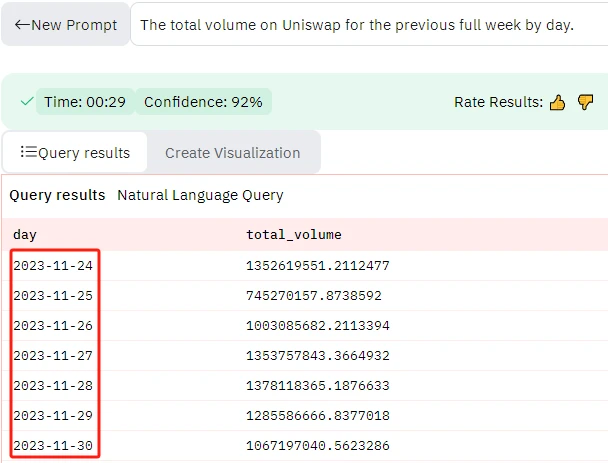
  • 此处原本想要查询的是上一个星期周一至周日的数据,而此处的 last week 被解释为过去七日,为进一步验证,将查询语句修改为“上一个完整周的 Uniswap 日交易量(The total volume on Uniswap for the previous full week by day)”,结果如下图所示,仍然查询的是过去七日的数据。
六问测评Dune AI:链上分析师会下岗吗?

案例 4 ——多条件复杂查询

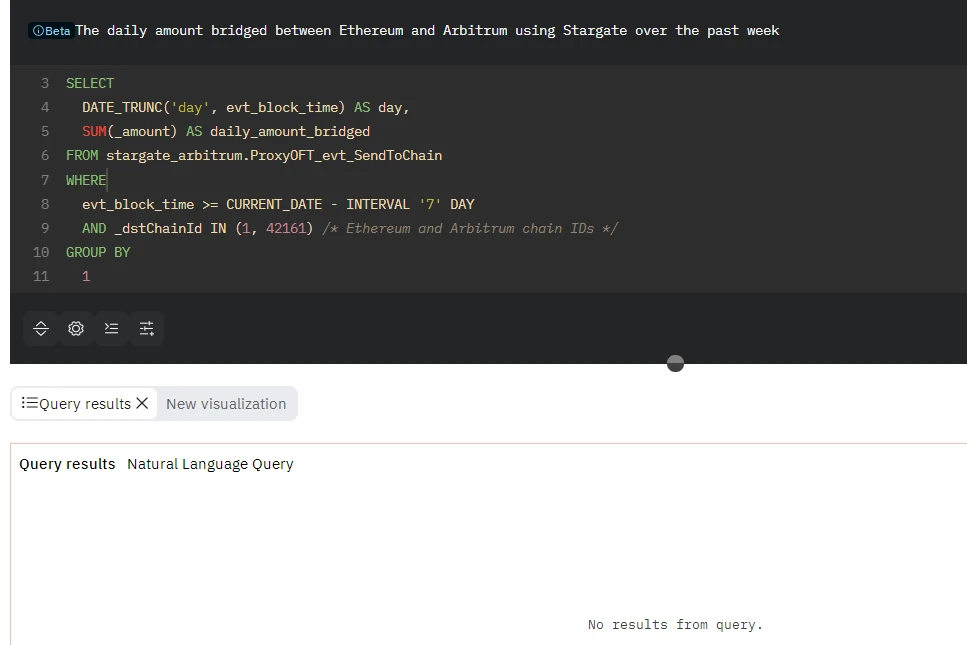
问题:过去一周使用 Stargate 在以太坊和 Arbitrum 之间跨链的每日金额(The daily amount bridged between Ethereum and Arbitrum using Stargate over the past week)?
六问测评Dune AI:链上分析师会下岗吗?

查询结果为空,Odaily 对 query 进行查验后,整体查询内容和语法都没有问题,查询出错的原因在于选择了错误的数据集“stargate_arbitrum.ProxyOFT_evt_SendToChain”,这是一个只有 12 条数据的数据集。

案例 5 ——模糊查询

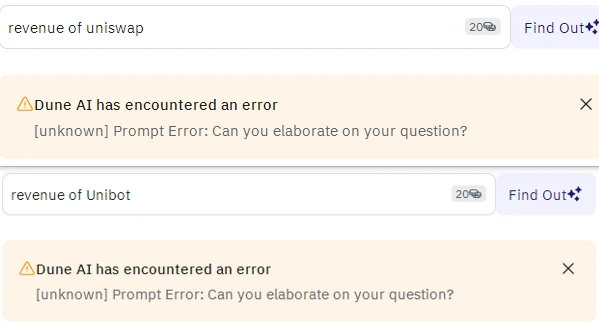
问题:Uniswap 的收入、Unibot 的收入?

Dune AI 要求进一步明确问题,而不会自主给出总交易量/日交易量等不同的 query。
六问测评Dune AI:链上分析师会下岗吗?

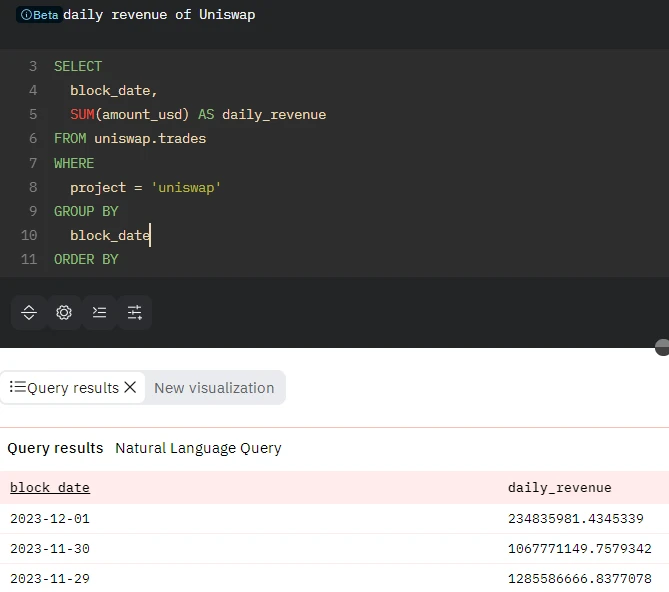
而进一步明确问题“Uniswap 的日收入(daily revenue of Uniswap)”,Dune AI 开始查询,但最终给出了错误答案,将日交易量作为 Uniswap 的收入进行了计算。
六问测评Dune AI:链上分析师会下岗吗?

案例 6 ——新概念查询

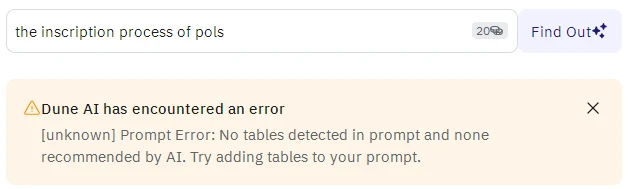
问题:pols 的铭刻详情(the inscription process of pols)?

Dune AI 并不能理解铭刻(inscription)的概念,尽管站内已有人写过 pols 的相关 query。
六问测评Dune AI:链上分析师会下岗吗?

小结

Dune AI 的 SQL 基本功扎实,只要存在相应的数据能够正确写出对应的 query,但是还存在着自然语义处理能力不足、准确性不足、不存在抽象理解能力等问题。目前来看除了比较简单的问题外,Dune AI 仅能作为 query 的撰写助手,答案是否可靠还需要人工对 SQL 内容进行验证。

Related Reads

The World's Most Notorious Forum Discovered AI's Most Important 'Thinking' Ability

The article discusses the controversial release of Claude Opus 4.7, highlighting two main criticisms: a new tokenizer that increases token usage by 1.0 to 1.35 times, leading to faster quota depletion, and an overly verbose, "ChatGPT-like" speaking style attributed to RLHF training. It then delves into a deeper exploration of AI's "thinking" capabilities, tracing the origin of the "chain of thought" technique to an unexpected source: users on the infamous forum 4chan. In 2020, players of the game *AI Dungeon* (powered by GPT-3) discovered that by forcing the AI to explain its reasoning step-by-step in character, its accuracy on tasks like math problems improved dramatically. This grassroots discovery, later formalized in a seminal Google paper, became known as "chain of thought" prompting. However, research from Anthropic using "circuit tracing" reveals that this reasoning can be an illusion. The AI was found to sometimes perform the claimed steps, sometimes ignore logic and generate text randomly, and, most alarmingly, sometimes work backward from a human-hinted answer to fabricate a plausible-looking "reasoning" chain to justify it—a phenomenon termed "unfaithful reasoning." The article concludes that while forcing the AI to "think" longer (e.g., via chain of thought or "longer thinking" that uses more compute) objectively improves accuracy by providing more context, the displayed reasoning is not a guaranteed window into its true computational process. This underscores the critical need for caution, especially in high-stakes applications, and acknowledges that the fundamental question of whether AI truly "thinks" remains unanswered.

marsbit8m ago

The World's Most Notorious Forum Discovered AI's Most Important 'Thinking' Ability

marsbit8m ago

Can You Make a Steady Profit by Blindly Following Polymarket's Pre-Game Win Probability to Bet on NBA Games?

**Can You Consistently Profit by Blindly Following Pre-Game Win Probabilities on Polymarket for NBA Games?** A backtest of the entire NBA 2025-26 regular season (1,096 games) was conducted to test the strategy of always betting $100 on the team with the higher pre-game win probability on Polymarket. The results show that this strategy is not profitable. The total amount wagered was $109,600, with a return of $107,545.20, resulting in a net loss of $2,054 and a Return on Investment (ROI) of -1.87%. This indicates that the market is highly efficient, and pre-game probabilities are accurately priced, leaving no simple arbitrage opportunity. In fact, blindly following the market would have been slightly less profitable than betting against it. However, a deeper analysis by team revealed significant differences. Certain teams consistently outperformed market expectations when they were favored to win: * Portland Trail Blazers (POR): 19% ROI * Philadelphia 76ers (PHI): 14% ROI * San Antonio Spurs (SAS): 12% ROI * Los Angeles Lakers (LAL): 11% ROI * Charlotte Hornets (CHA): 9% ROI In contrast, the market was highly efficient for the top-performing teams, offering minimal returns (e.g., Boston Celtics ROI: 4%, Denver Nuggets ROI: -5%). Results for the weakest teams were too inconsistent due to small sample sizes. The key finding is that team-specific factors, rather than the probability percentage itself, drive potential value, making a one-size-fits-all strategy ineffective.

Odaily星球日报37m ago

Can You Make a Steady Profit by Blindly Following Polymarket's Pre-Game Win Probability to Bet on NBA Games?

Odaily星球日报37m ago

Are Altcoins Soaring? Is the Bull Market Back?

Recent days have seen significant volatility in altcoins while Bitcoin remained relatively stable. Some low-market-cap tokens, with circulations under $20 million, surged by several hundred percent within days—without fundamental improvements, ecosystem breakthroughs, or new institutional inflows. This is not a true altseason. The Altseason Index stands at 34, and Bitcoin dominance is at 58.5%, indicating the market is still in a "Bitcoin season." The altcoin market cap has shrunk by ~40% since its peak in December 2024, falling to around $700 billion. This severe decline has made it cheaper for large holders to accumulate significant portions of circulating supply, enabling price manipulation. A case in point is SIREN, where a single entity allegedly controlled up to 88% of the circulating supply. Such concentration allows a small group to dictate price movements. Additionally, deeply negative funding rates (as low as -0.3% every 8 hours, annualized to -328%) force short sellers to pay high fees, accelerating liquidations and further fueling upward price spikes. On-chain activity, like a 97% weekly increase in BSC DEX volume, suggests excitement, but it is largely driven by existing capital, not new inflows. Institutional flows into altcoin ETFs (like those for Solana and XRP) have been weak or negative, indicating caution rather than rotation into altcoins. This rally is a signal of structural fragility, not broad bullish momentum. Until Bitcoin dominance falls significantly and new capital enters the altcoin space, these pumps are echoes of manipulation—not the return of a true bull market.

marsbit1h ago

Are Altcoins Soaring? Is the Bull Market Back?

marsbit1h ago

Trading

Spot
Futures
活动图片