Plan for $1M bug bounties and double the nodes in wake of $600M Ronin hack

CointelegraphPublished on 2022-04-28Last updated on 2022-04-28

Abstract

The Ronin Network and Sky Mavis have vowed to upgrade their smart contracts, offer lucrative bug bounties and ramp up security following the $600 million hack late last month.

The Ronin Network and Sky Mavis have vowed to upgrade their smart contracts, offer lucrative bug bounties and ramp up security following the $600 million hack late last month.
As Cointelegraph previously reported, the Ethereum sidechain developed for the popular NFT game Axie Infinity was the victim of an exploit for 173,600 Ether (ETH) and 25.5 million USD Coin (USDC) worth more than $612 million at the time.
Earlier this month the Federal Bureau of Investigation (FBI) attributed the attack to North Korea-based and state-sponsored hacking group Lazurus, as it fired off a warning to other crypto and blockchain organizations.
Ronin announced its platform changes via a post-mortem report published yesterday, noting that all user funds are in the process of being restored as it vowed to make sure this “never happens again.”
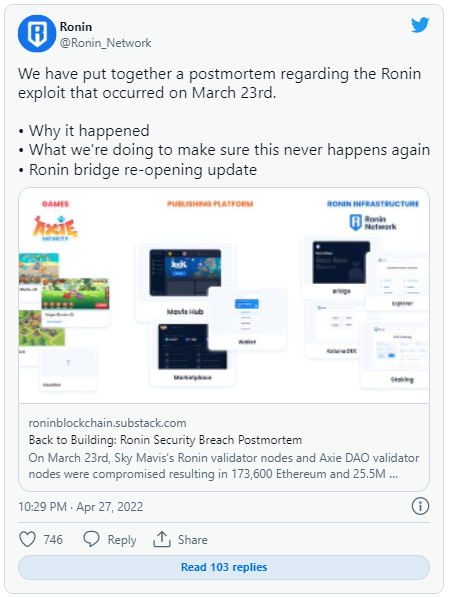
The hack run down
The hack was the result of a spear phishing attack on a former Sky Mavis employee (developers of Axie Infinity). The bad actor was able to leverage the employee’s credentials to access Sky Mavis’s four validator nodes out of a total of nine in the Axie/Ronin ecosystem.
This by itself was not enough to do any damage, but “the attacker found a backdoor through our gas-free RPC node, which they abused to get the signature for the Axie DAO validator.”
“This traces back to November 2021 when Sky Mavis requested help from the Axie DAO to distribute free transactions due to an immense user load. The Axie DAO allowlisted Sky Mavis to sign various transactions on its behalf. This was discontinued in December 2021, but the allow list access was not revoked,” the report reads.
Following the hack, big changes are being implemented at both Sky Mavis and the Ronin Network.
Ronin
The Ronin Network hopes to have its bridge open again by mid to late May, with Binance providing support until then with withdrawal and deposit infrastructure for Axie users.
The team is about 80% through upgrading Ronin bridge smart contracts, they’ll be reworking the backend, migrating all pending withdrawals and launching a validator dashboard that “allows for approving large transactions and adding/removing new validators.”
“The Ronin Network bridge is currently being redesigned and will open once we are confident that it can stand the test of time. We initially expected to be able to deploy the upgrade by the end of April, but this is not a process that we can afford to rush.”
Sky Mavis
Sky Mavis will ramp up its security measures by seeking the help of “top tier security experts,” conducting contract audits and implementing stricter internal procedures such as training courses to “combat external threats.”
Notably, it will also be significantly upping its node count to help decentralize the project. Having already increased from nine to 11, Sky Mavis intends to get that number up to 21 within three months. Longer-term, the project is eyeing more than 100 nodes.
Sky Mavis will also be launching bug bounties of up to $1 million for any white hat hackers who are able to find further vulnerabilities.
“We recognize the importance and value of security researchers’ efforts in helping keep our community safe. Sky Mavis is offering bounties of up to $1 million to encourage responsible disclosure of security vulnerabilities.”


Related Reads

Why Is the World Nervous About Japan Raising Interest Rates?

In June 2026, the Bank of Japan raised its policy rate to 1%, marking its first hike to this level since 1995. While this rate remains low compared to global peers like the US and Europe, the move signals a profound shift for a nation that has been a global source of ultra-cheap funding for decades. Japan's long-standing near-zero or negative interest rates had facilitated massive "yen carry trades," where international investors borrowed low-cost yen to invest in higher-yielding assets worldwide, such as US tech stocks and emerging market bonds. This made Japan a critical, often overlooked, source of global liquidity. Japan's ultra-loose policy stemmed from structural challenges post-1990s asset bubble: aging demographics, chronic low inflation/deflation, and high public debt. Recent shifts, including sustained wage growth (exceeding 5% in recent years) and inflation consistently above the 2% target, have created a "wage-price spiral" possibility, prompting the policy normalization. The global market's concern lies not in the absolute rate but in the potential unwinding of the yen carry trade. As Japanese borrowing costs rise, the economics of these leveraged global investments change, potentially triggering deleveraging and capital outflows from risk assets. Market anxiety focuses on the end of a thirty-year consensus that Japan would perpetually provide cheap funding. Ultimately, the global impact will depend on the interplay with US monetary policy. While Japan is tightening, the significant interest rate differential with the US remains. The key future dynamic is whether simultaneous Japanese hikes and eventual US rate cuts will narrow this gap, forcing a major recalibration of global capital flows and asset pricing built on an era of abundant, cheap yen liquidity.

marsbit3h ago

Why Is the World Nervous About Japan Raising Interest Rates?

marsbit3h ago

Research Report Analysis: MRVL's Optical AI Booming, Why High Valuation Keeps Morgan Stanley's Star Analyst Sidelined?

Report Recap: MRVL Optical AI Boom - Why High Valuation Led Morgan Stanley's Star Analyst to Stay Neutral? Morgan Stanley analyst Joseph Moore maintained an "Equal-weight" (Neutral) rating on Marvell Technology (MRVL) on May 28, raising the price target from $172 to $195, below the trading price. This stance comes despite Marvell reporting a record quarter and significantly raising its full-year outlook (FY27 revenue ~$11.5B, up ~40%). Moore's neutral view is based on valuation. The $195 target implies ~40x CY2027 P/E. He contrasts MRVL with NVDA: both trade near ~$200, but Nvidia's forward EPS is more than double Marvell's. For MRVL's valuation to hold, it needs consistent earnings upgrades, proof of networking market share gains, or certainty on large-scale custom AI chip shipments—none of which are confirmed yet. Growth is driven by two pillars: **1) Optical Interconnect** (the faster runner): Moore raised FY27 growth expectations to >70%, with the optical module product line nearing a $1B annualized run rate. **2) Custom AI Chips** (the climber): Confidence in FY28 is growing, but a major new customer project only ramps in FY28, with no current revenue visibility. Key risks are the underperforming Storage, Enterprise, and legacy Networking segments. Moore acknowledges the real AI opportunity but believes the current price already reflects it. For the stock to work from here, investors need to see the optical business hit its targets, custom chips ramp as planned, and a recovery in the weaker business units.

marsbit4h ago

Research Report Analysis: MRVL's Optical AI Booming, Why High Valuation Keeps Morgan Stanley's Star Analyst Sidelined?

marsbit4h ago

Trading

Spot
Futures
活动图片