Tether Worth $9M Tied to 'Pig Butchering' Scams Is Seized by U.S. DOJ

CoinDeskPolicyPublished on 2023-11-20Last updated on 2023-11-21

Abstract

Tether said Monday it froze $225 million of its USDT stablecoin in light of DOJ investigations.

The U.S. Department of Justice (DOJ) said it seized $9 million worth of the tether (USDT) stablecoin linked to an organization that exploited victims through a "pig butchering" scam.

The seizure comes after agents and analysts from the U.S. Secret Service traced victim deposits that were laundered through several cryptocurrencies, a technique the DOJ described as "chain hopping" in its release Tuesday.

10

Tether froze $225 million worth of its stablecoin on Monday following a collaborative investigation between the DOJ, crypto exchange OKX and Tether itself. Pig butchering is a scam that involves luring victims in with traditional romance scams. The victims are often requested to send cryptocurrencies overseas.

Advertisement
Advertisement

"This seizure should also serve as a reminder to cybercriminals that, although the current landscape of the cryptocurrency ecosystem may seem like an ideal way to launder ill-gotten gains, law enforcement will continue to develop the expertise needed to follow the money and seize it back for victims,” the DOJ said.

Edited by Sheldon Reback.

Related Reads

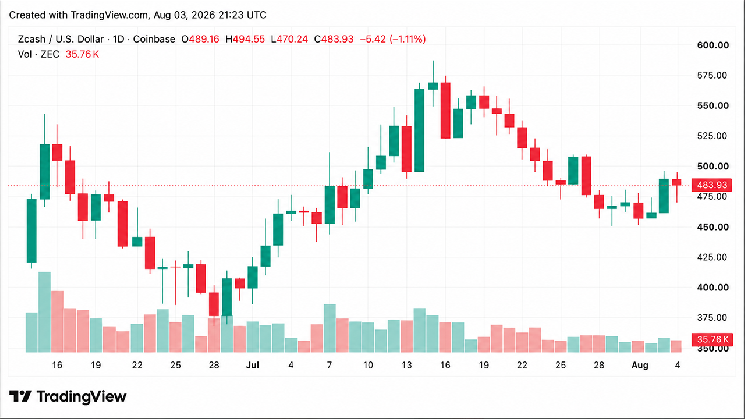
ZEC Price Just Surpassed $490 — Here's What Fueled the Rally

ZEC Surges Past $490, Key Drivers Behind the Rally On August 3, the privacy-focused cryptocurrency Zcash (ZEC) surged nearly 5%, climbing over $20 in a six-hour rally to a session high near $494. This move helped ZEC's market cap reclaim $8 billion, solidifying its position as the most valuable privacy coin and marking an almost 8% gain for the month. While benefiting from a broader market uptrend, ZEC's outperformance was driven by significant fundamental catalysts. The primary driver was the integration by privacy infrastructure project Nym of Zcash's new shielded pool, Ironwood. This enables direct, end-to-end private payments in ZEC for network services, a landmark development for privacy-first decentralized finance. The rally coincides with renewed industry focus on privacy as digital assets mature. Industry observers note privacy is becoming the "next frontier," evolving from Bitcoin's proof-of-concept to Ethereum's programmability and Solana's scalability. Commentary highlighted that true privacy, via zero-knowledge (ZK) technology which is now production-ready, was a foundational goal for early crypto pioneers. Further momentum came from Zcash's progress in decentralized governance, launching a retroactive grant funding (RetroPGF-like) program. This shifts treasury fund distribution from closed committees to direct coin holder voting, pioneering a privacy-native funding mechanism. ZEC's surge helped push the total market capitalization of privacy-focused coins above $30 billion. Other notable gainers included NEAR, ZK, and NOCK. However, losses in coins like ZANO, ZBT, and a significant drop in last week's leader COTI partially offset the sector's overall gains.

cryptonews.ru4m ago

ZEC Price Just Surpassed $490 — Here's What Fueled the Rally

cryptonews.ru4m ago

Jim Cramer Plans to Dump His Bitcoin, Warns Quantum Firm Will Crack Crypto Soon

CNBC's Jim Cramer announced plans to sell his Bitcoin holdings, citing warnings from IBM's CEO Arvind Krishna that commercially viable quantum computers could break Bitcoin's cryptography within three to four years. This statement triggered the popular "Inverse Cramer" reaction in crypto markets, with many traders viewing it as a bullish signal, and Bitcoin's price remained stable around $63,764. The specific quantum threat targets the ECDSA signature scheme, potentially exposing private keys from public ones for Bitcoin addresses that have been reused or are visible during transaction broadcasts. Researchers estimate around 30% of all BTC, or 6-7 million coins held in older "dormant" wallets, could be vulnerable. While a recent Google Quantum AI paper suggested such an attack might require fewer physical qubits than previously thought, current quantum systems are still orders of magnitude away from the reliable logical qubits needed. Expert timelines for a functional cryptographically relevant quantum computer vary widely, from Krishna's 2028-2029 estimate to more conservative predictions in the 2030s or 2040s. Cramer has a history of shifting his Bitcoin stance, and his latest warning was largely interpreted as a market sentiment indicator rather than a technical analysis. The focus now is on whether Bitcoin's development of quantum-resistant upgrades will outpace the advancement of quantum computing hardware.

cryptonews.ru4m ago

Jim Cramer Plans to Dump His Bitcoin, Warns Quantum Firm Will Crack Crypto Soon

cryptonews.ru4m ago

Trading

Spot
活动图片