FTX 暴雷一年了,加密做市商们还好吗?

长文源:foresightnewsPublished on 2023-11-01Last updated on 2023-11-02

Abstract

一些做市商正在减少风险敞口,而另一些正在实现业务多元化。

一些做市商正在减少风险敞口,而另一些正在实现业务多元化。


撰文:Suvashree Ghosh、Olga Kharif

编译:Luffy,Foresight News


Alameda Research 是 Sam Bankman-Fried 失败加密帝国的核心交易公司,在该公司倒闭近一年后,加密资产的做市业务仍在努力复苏中。


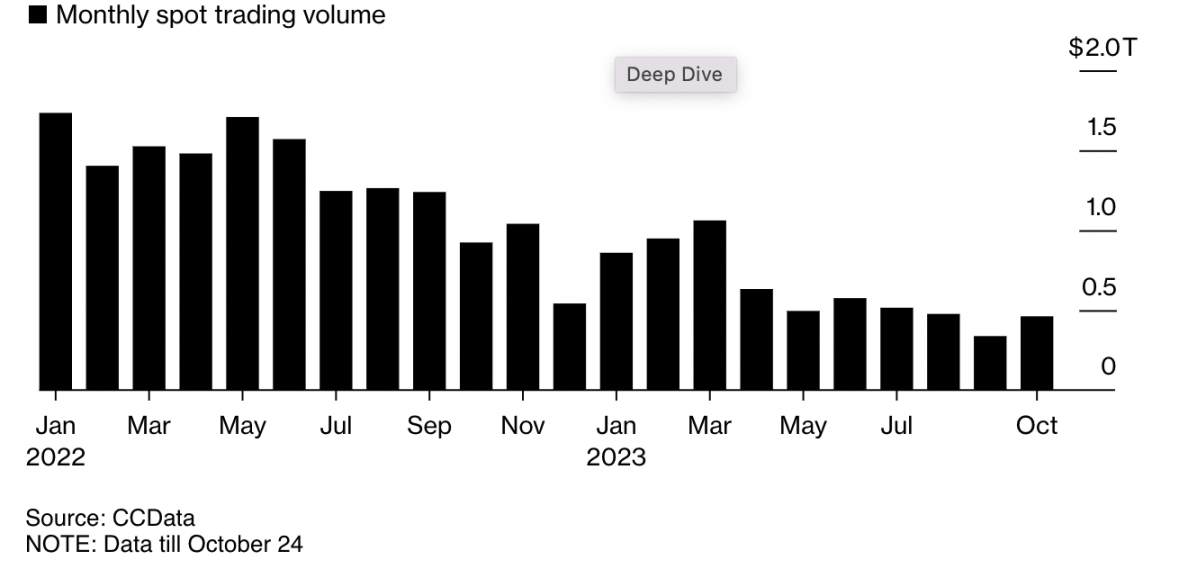
尽管上周比特币上涨近 16%,提振了交易量,但要恢复到加密货币寒冬之前的水平,还有很长的路要走。据 CCData 称,10 月份交易量自 6 月以来首次出现增长,但与 FTX 破产(2022 年 11 月)前相比还是下降了 50%。


这意味着剩下的流动性提供者(他们从代币买卖价格的差价中获利)面临着在缺乏波动性和交易量的市场中创造收入的艰巨任务,而波动性和交易量曾经是加密货币行业的鲜明特征。一些人重新调整了交易活动的重点,而另一些人则在做市之外寻求新的收入来源。


Digital Asset Capital Management 联合创始人 Richard Galvin 表示,「由于交易量下降、多个司法管辖区的监管框架不确定以及对交易所交易对手风险的担忧加剧,今年对做市商来说非常艰难。」 他补充说,如果最近的反弹持续下去,「对于仍然活跃在市场上的做市商和交易者来说将是一个可喜的获利机会」。


自一年前 FTX 崩溃以来,各交易所的交易量减少了一半。


以下是一些仍然活跃在加密货币领域的做市商的最新动态。


Wintermute


Wintermute Trading Ltd.联合创始人 Evgeny Gaevoy 在接受采访时表示,作为最大的加密货币做市商之一,Wintermute 一直保持盈利,并正在实现业务多元化,以应对另一个牛市周期。Wintermute 首席运营官 Marina Gurevich 表示,目前公司每天的交易额在 20 亿至 30 亿美元之间,低于 2021 年市场高峰期间的每天 75 亿美元。


作为在做市以外领域创收的努力的一部分,Wintermute 已成为以太坊网络的主要参与者,帮助打包交易区块。Gaevoy 表示,此举的目的是在向区块添加交易方面获得竞争优势,这有助于其从套利和其他机会中赚更多钱。


Gaevoy 表示,Wintermute 还支持了一个尚未启动的贷款项目,正在考虑启动一个加密货币衍生品交易所,并正在努力推出一个与加密货币相关的指数。Gaevoy 称,其中一些项目的时间表尚未确定,但拒绝提供每个项目更具体的信息。自 2020 年以来,该公司的风险投资部门已支持了 80 多个项目。


Gurevich 在对彭博社询问的书面回复中表示,位于伦敦和新加坡的 Wintermute 计划在未来两到六个月内增加 10% 或 10 名员工。


Cumberland DRW


Cumberland 是总部位于芝加哥的 DRW 的加密货币子公司,成立于 2014 年,专注于场外交易和自有账户交易。该公司表示,其场外衍生品业务持续增长。它通过 ISDA 在 BTC、ETH 和 SOL 上提供双边加密货币期权。


Cumberland 的母公司 DRW 还联合创立了 ErisX(已被 Cboe Global Markets Inc.收购)和 Digital Asset Holdings。Cumberland Labs 是一家区块链项目孵化公司,它支持了 Hashnote 和 Expand.network 等公司。


GSR Markets


总部位于伦敦的 GSR 是加密货币领域最古老的做市商之一,由前高盛交易员于 2013 年创立,现已发展成为加密货币领域领先的做市商之一。它最近获得了新加坡中央银行的批准,可以在新加坡提供数字支付代币服务。


GSR 告诉彭博社,他们历来活跃于各种代币交易,现在更多地关注比特币和以太坊这两种最大的加密货币。


该公司还是一个多产的风险投资者,旗下投资部门是 GSR Investments。根据公司发言人援引 Messari 的数据,GSR Investments 是行业最活跃的投资者之一,持有 EDX Markets、Ethena 和 LayerN 的股份。该发言人表示,在「平静的夏季」之后,该公司的风险投资活动本季度有所回升。


GSR 今年裁员,成为了许多寻求适应更严峻市场环境的加密货币公司之一。该发言人表示,此次裁员是为了「调整和发展我们的业务以适应加密货币行业当前方向」。该发言人补充说,公司正在「积极招聘」交易、工程、法律和金融领域的员工。


Jump Crypto


总部位于芝加哥的 Jump Trading 主要从事传统证券投资业务,于 2015 年底成立了 Jump Crypto,开始投资加密资产。然而,由于美国监管环境的不确定性,该公司一直在着手退出美国的加密货币交易。Jump 是 TerraUSD 项目的主要支持者,也是美国检察官在调查 TerraUSD 过程中接受质询的公司之一。ump Crypto 还面临因 FTX 崩溃而造成的损失,该做市商是 FTX 的客户,并在 Wormhole 遭受 3.2 亿美元的黑客攻击后向该协议用户进行了补偿。根据 Blockworks 的研究,Jump 似乎已经收回了资金。


Jump Crypto 是​​另一家多产的风险投资者,最近的投资包括 Outdid 和 Coinflow Labs。Jump 发言人拒绝就与该公司相关的细节发表评论。


Flow Traders


总部位于阿姆斯特丹的 Flow Traders 是一家横跨各种传统资产类别的老牌做市商,自 2017 年以来一直活跃在加密货币领域。其加密货币业务拥有 60 名员工,主要分布在欧洲,该公司对扩大团队持保守态度。


Flow 在 FTX 上的风险敞口「微不足道」,并且「致力于作为做市商和战略投资者构建数字资产生态系统」。根据该公司半年度收益报告,截至 6 月底,他们持有用于交易的数字资产 8920 万欧元(9410 万美元),高于 12 月底的 5830 万欧元。


Flow Traders 在报告中表示,预计监管不确定性将持续到 2023 年及以后,并补充说,公司正在与监管机构合作,推动「建立一个清晰、公平的监管框架」。


根据 Flow Traders 半年报和网站,他们交易数字资产现货、期货、期权和交易所交易产品,不进行定向押注。该公司于 2022 年 7 月斥资 5000 万欧元(5270 万美元)成立了风险投资部门 Flow Traders Capital,并投资了 Blockdaemon、Elwood、Sei Network 和 Ondo 等公司。


Auros Global


这家在纽约和香港设有办事处的做市商在 FTX 倒闭时被冻结了价值约 2000 万美元的资产,最终导致该公司向英属维尔京群岛法院申请临时清算以重组债务。


Auros 今年 3 月筹集了 1700 万美元,投资方包括 Vivienne Court、Bit Digital、Trovio、Epoch Capital、Primal Capital 以及做市巨头 Optiver 的资深校友财团,这在一定程度上帮助该公司摆脱了危机。


公司发言人表示,自那时起,Auros「优化了对一些加密货币交易所的投资,加强了风险管理」,并要求有业务往来的交易所提高透明度。据公司网站称,该公司与 50 多个交易所合作,目前专注于流动性较高的代币。


Auros 表示,10 月份每天处理的交易额为 130 万美元,低于 2021 年 5 月高峰期间的每天 250 万美元。


Portofino Technologies


总部位于瑞士的 Portofino 由前 Citadel 证券员工于 2021 年 4 月创立,是数字资产市场同行中相对年轻的参与者。Portofino 于 2021 年从 Coatue Management、Valar Ventures 和 Global Founders Capital 等投资者那里筹集了 5000 万美元。


Portofino 发言人在给彭博社的电子邮件回复中表示,该公司通常专注于在最大的加密货币交易所交易的高市值代币。该发言人补充说,公司于 2022 年在 FTX 上交易较为活跃,但在该交易所的资产有限。尽管某些资产类型的做市商利润在全球范围内大幅下降,但 Portofino 预计「未来几个月,加密货币市场交易量将继续增长,因为我们看到一些重要的催化剂将使机构和散户投资者重返加密市场。」

Related Reads

Near Returns to the AI Stage: Transformation into a Public Chain Due to 'Payroll Difficulties,' Agent and Privacy Emerge as New Growth Narratives

NEAR Returns to AI Origins: From Payroll Struggles to Blockchain, Now Focusing on AI Agents and Privacy NEAR Protocol's journey began not with grand blockchain ambitions, but from a practical hurdle: its AI startup founders, including Transformer paper co-author Illia Polosukhin, couldn't efficiently pay international developers in 2017. This led them to pivot and build a high-performance, scalable blockchain. After years navigating various crypto narratives like sharding and cross-chain interoperability, NEAR is now leveraging its AI roots to re-enter the AI arena. A key driver is its "NEAR Intents" layer, which abstracts complex cross-chain transactions. Users simply state their goal (e.g., swap BTC for ETH), and a solver network finds the optimal route. This system has processed over $20B in cross-chain volume, generating significant fee revenue. A major growth area is private transactions via "Confidential Intents/Swaps," which hide trade details until settlement to protect against MEV and front-running. Remarkably, private swaps recently accounted for over 40% of NEAR's transaction volume, highlighting strong demand but also potential regulatory scrutiny. With its AI-founder pedigree, NEAR is positioning itself at the intersection of blockchain, AI agents, and privacy, aiming to become infrastructure for the emerging agent economy while navigating the challenges of its rapid adoption.

marsbit57m ago

Near Returns to the AI Stage: Transformation into a Public Chain Due to 'Payroll Difficulties,' Agent and Privacy Emerge as New Growth Narratives

marsbit57m ago

From Ethereum to AI's 'CROPS': What Exactly is This Set of 'Slow Variables' That Vitalik Repeatedly Emphasizes?

In recent discussions, Vitalik Buterin has frequently emphasized the concept of "CROPS," a framework defining core values for Ethereum's development. CROPS stands for Censorship Resistance, Capture Resistance, Open Source, Privacy, and Security. Initially outlined in the Ethereum Foundation's "EF Mandate," it represents a commitment to user sovereignty, ensuring that the network resists external control, remains open, protects privacy, and prioritizes security. The relevance of CROPS extends beyond Ethereum's foundational principles, becoming crucial in the context of AI integration. As AI agents begin handling wallet operations and automated transactions, the risk increases that users may cede control over their digital assets, privacy, and intentions to centralized AI service providers. A "CROPS AI" would therefore emphasize local execution where possible, privacy-preserving remote model calls (e.g., using zero-knowledge proofs), and transparent, verifiable processes to maintain user agency. Vitalik highlights a significant convergence between "CROPS Ethereum access layer" and "CROPS AI." Both address the same fundamental challenge: how users can access powerful services—be it blockchain data via RPCs or AI models—without exposing sensitive information or relinquishing ultimate control. This intersection points toward a future digital entry point that is more private, secure, and user-controlled. Ultimately, CROPS is not merely an abstract ideal but a practical guidepost. It steers development—from protocol resilience and wallet design to AI agent safety—towards a future where users retain self-sovereignty even as digital systems grow more complex and powerful. In an era of accelerating AI adoption, these "slow variables" of censorship resistance, openness, privacy, and security may define Ethereum's enduring value.

marsbit1h ago

From Ethereum to AI's 'CROPS': What Exactly is This Set of 'Slow Variables' That Vitalik Repeatedly Emphasizes?

marsbit1h ago

Silicon Valley 'Startup Guru' Steve Hoffman: Web3 + AI Could Be a Trap

Silicon Valley investor and "Godfather of Startups" Steve Hoffman warns that combining Web3 with AI is likely a trap, not a promising venture. In an interview, Hoffman argues that while AI is a foundational technology touching all industries, Web3 adds complexity, friction, and regulatory risk without solving mainstream consumer or business needs. He advises founders to focus on deep, specialized applications where startups can out-iterate giants, rather than on generic features easily replicated by large tech companies. Hoffman observes that Silicon Valley will lead foundational AI research, while China excels at rapid, large-scale application and commercialization, particularly in robotics. He stresses that AI-driven autonomous agents capable of collaborative, multi-step tasks are 2-4 years away, which will cause significant job displacement. The solution is not to slow AI but to redesign business models around human-AI collaboration and reform social systems like education and retraining. For startups, Hoffman recommends focusing on vertical, expertise-heavy domains to build defensibility. He sees major opportunities in AI fraud detection and cybersecurity. Key founder mindsets include systemic thinking over feature-focus, relentless customer centricity, building adaptive teams, and deeply understanding AI's capabilities and limits. Hoffman is also leading a non-profit initiative to establish university centers aimed at training future leaders in responsible, human-value-aligned AI innovation.

marsbit2h ago

Silicon Valley 'Startup Guru' Steve Hoffman: Web3 + AI Could Be a Trap

marsbit2h ago

Token Inefficient, Economy Tokenless

The article "Tokens Aren't Economical, Economics Aren't Tokenized" analyzes a pivotal shift in the AI industry from a technology-driven narrative to one dominated by capital efficiency. It highlights two concurrent trends: a severe capital shortage due to the exorbitant and recurring costs of compute (e.g., OpenAI's high burn rate) and a wave of corporate spin-offs where major tech companies are separating their AI units (like Kuaishou's Kling and Baidu's Kunlunxin). The core argument is that AI's "anti-internet" business model, where user growth increases costs rather than profits, has created a disconnect between high valuations and actual cash flow. Spin-offs address this by allowing AI assets to be valued independently. Within a parent company, they are seen as cost centers, but as standalone entities, they are priced based on their growth potential and scarcity in the primary market, leading to massive valuation premiums (e.g., Kling's estimated value tripling post-spin-off). The industry is at an inflection point, moving from "model worship" to "value realization." The competition is evolving from a pure compute (GPU) race to a broader focus on systemic efficiency and full-stack engineering (involving CPUs and orchestration) to achieve viable commercialization. The year 2026 is framed as a critical moment where the industry must definitively answer how to economically translate AI capability into tangible business value, reshaping the sector's future power structure.

marsbit2h ago

Token Inefficient, Economy Tokenless

marsbit2h ago

Trading

Spot
Futures
活动图片