[dragon and tiger list] BTC's main currency holdings were exposed, COMP was among the top gainers

Huobi ResearchPublished on 2022-04-14Last updated on 2022-04-15

Abstract

The latest number of BTC addresses shows that the number of addresses with more than 1000 BTCs is still stable.

1. Market trend: the main currency is stable, and BTC is temporarily supported,

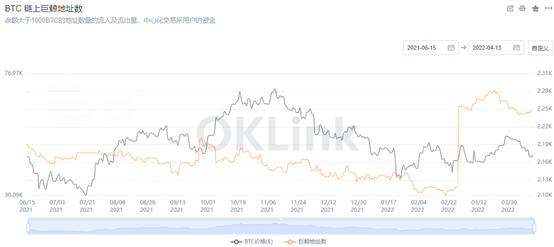
The latest number of BTC addresses shows that the number of addresses with more than 1000 BTCs is still stable. The value on April 13 remained at 2248, indicating that the main force of a large number of currency holders is still stable, indicating that the short-term correction of BTC price may be oversold. After the sharp increase in the number of giant whale addresses on February 28, there is little room for callback, which means that the selling volume of main investors is within a limited range, and low suction opportunities can be paid attention to in the short term.

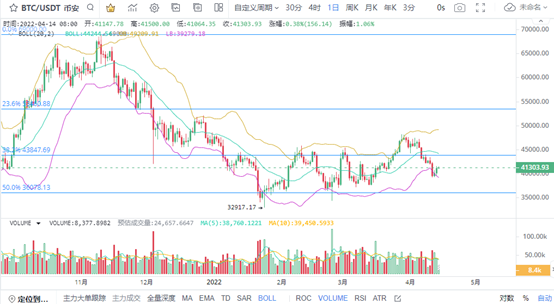
In terms of price, BTC hit the off track of brin line after continuous withdrawal, and the technical rebound has lasted for three trading days. From the closing price point of view, the current short-term low rebounded continuously after January 22. The bottom of BTC has increased to US $39530 on April 11, maintaining a further upward trend.

At present, the disadvantage to the market is that the number of active addresses and trading volume of BTC are flat, and the strong price signal has not been further verified. Therefore, it is still necessary to maintain a medium and low level in the number of coins.
2. Interpretation of investor sentiment:

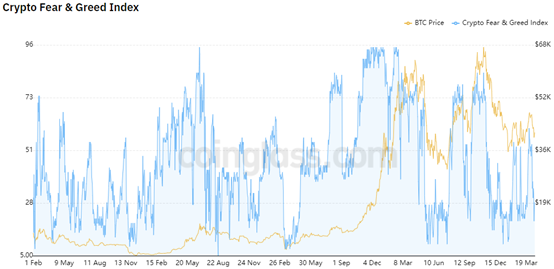
The panic index of BTC trading was sluggish, reaching 25 and 28 on April 13 and April 14. The panic was more serious.

At present, while the trading volume of BTC is running at a low level, the volatility also decreases during the price retreat. In terms of market conditions, BTC trading performance has been at a low level since 2022, and there are few opportunities for upward strong changes.
3. Dragon and tiger list:

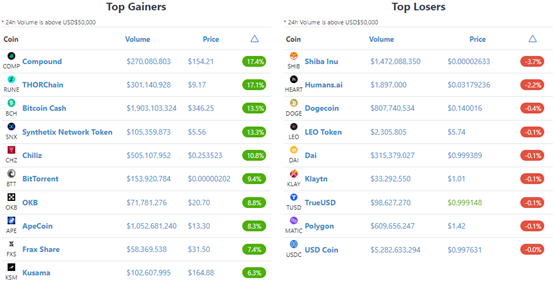
During the short-term rebound of mainstream currencies led by BTC, most sectors showed upward performance. Among the increase list, the top one is the defi concept comp, with a 24-hour increase of 17.4%. For similar currencies, Rune rose 17.1% in 24 hours and SNx rose 13.3% in the short term, also ranking top in the ranking. Other currencies with higher growth were distributed in different sectors, with BCH, CHZ and BTT rising higher.
COMP

Recently, what has a great impact on comp price is the transformation of its economic model.

In 2020, compound innovatively launched the liquidity mining plan. But now, in order to solve the problem that liquidity incentives attract "speculative" liquidity, comp's incentives are expected to continue to change.

For example, comp will completely reduce the incentive to zero on April 15; Further improve the interest rate model in order to balance the interests of both borrowers and lenders. Finally, an alternative incentive plan will be introduced.

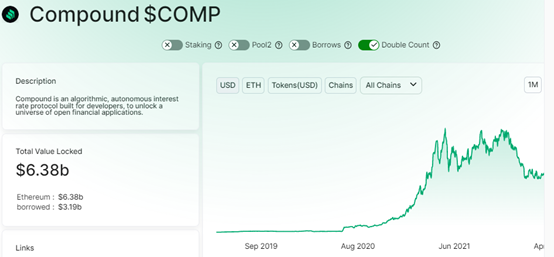
From the change of the number of locked positions of comp, the number of locked positions on April 14 was US $6.38 billion, and the quantitative performance is still relatively low. Therefore, the short-term price rise is driven by sentiment, and trading investors can pay attention to the progress of project incentives.
Rune

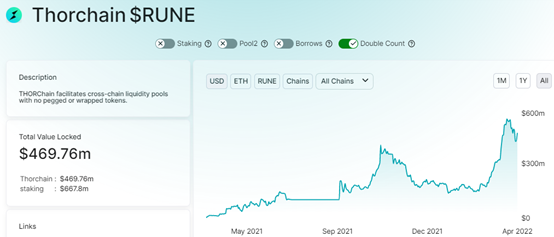
Rune price rebounded in the short term. Due to the amplification of the trading volume in the early stage by more than three times, the short-term price activity remained high. Rune has two ecological concepts of atom and Luna, and the price performance can continue to be concerned in the short term.

One development that inspires the rune community is the integration of Terra (LUNA) into the thorchain protocol. This integration also enables the platform to support all cosmos based projects. Terra integration brings Luna tokens and terrausd (UST) stable coins into the thorchain ecosystem and provides users with more trading and pledge options.

Affected by this, we can continue to pay attention to the ecological development of Rune and its driving effect on prices.
SNX

Synthetix aims to build decentralized and untrusted networks. The synthetix network token (SNx) token supports a variety of comprehensive assets, including legal tender linked to the US dollar, precious metals, indexes and even other cryptocurrencies.

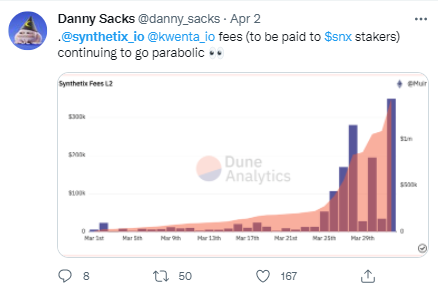
In terms of data, the fees paid by SNx to pledgers continue to rise, which may be a strong evidence to promote the rise of SNx prices.
At the same time, we should also pay attention to the negative side of the news, which can not be ignored.

Grayscale removed synthetix (SNx) and sushiswap (sushi) tokens from its defi fund as part of the rebalancing in the first quarter of this year. SNx and sushi failed to meet the required minimum market value. No other cryptocurrencies were eliminated throughout the rebalancing process.

Decline list

Most of the currencies with the highest decline are concept currencies, with Shib and Doge ranking first and third in decline. In the short term, we need to pay attention to the adjustment expectations of these currencies.


Related Reads

Bitcoin's 'Rally Ends,' Officially Entering the Later Stage of a Bear Market?

Bitcoin prices declined 13% this week, reversing the recent rebound and signaling a likely transition into the later stages of a bear market. Key on-chain metrics deteriorated, with the short-term holder cost basis falling below the Realized Price—a pattern last seen in early 2022, characteristic of bear market maturity. The rally to ~$82k proved to be a bear market bounce, as evidenced by the 90-day realized profit/loss ratio failing to sustain above the bullish threshold of 2. Daily realized losses surged to $1.35B, including significant selling from long-term holders who accumulated near cycle tops, indicating ongoing supply redistribution. Price was rejected almost precisely at the aggregate US spot ETF cost basis of ~$83k, turning that level into resistance and leaving the average ETF investor underwater again. Spot market selling pressure intensified, with the 7-day volume delta turning significantly negative to its weakest level since February. While a major long liquidation event cleared over $400M in leverage, spot demand has not yet stepped in to absorb the resulting supply. Options markets continue pricing in higher future volatility (elevated volatility risk premium) and maintain a skew toward put options, reflecting persistent demand for downside protection, though not yet panic. Overall, market structure remains fragile. Sustained recovery likely requires a reclaim of the ETF cost basis, a shift back to positive spot demand, and a slowdown in realized loss-taking. Until then, the market risks further downside or extended consolidation within the broader bear trend.

Foresight News15m ago

Bitcoin's 'Rally Ends,' Officially Entering the Later Stage of a Bear Market?

Foresight News15m ago

How Risky is the "Death Spiral" of MSTR and STRC?

Summary: This article explores the perceived "death spiral" risk between MicroStrategy (MSTR), its Bitcoin holdings, and its perpetual preferred stock (STRC), drawing comparisons to the LUNA-UST collapse. While both systems feature price anchors, high yields for holders, and potential feedback loops, their core mechanisms differ fundamentally. The MSTR-STRC structure relies on continuous financing to sustain its high dividend payouts, primarily through stock ATM offerings. A negative feedback cycle could occur: falling MSTR stock price makes raising equity capital harder, increasing pressure to sell Bitcoin, which undermines STRC confidence and further depresses MSTR. However, unlike LUNA-UST's automated, direct linkage, the MSTR-STRC loop is weaker and has brakes: STRC dividends can be deferred or rates lowered, and STRC holders have a $100/share liquidation preference in bankruptcy, providing a price floor. The company's sustainability hinges on its ability to continue financing. Its current ~$900 million USD reserves cover only about 6.3 months of its ~$1.71 billion annual interest/dividend burden. The next six months are critical, aligning with both the potential bottom in Bitcoin's four-year cycle and the depletion timeline of its reserves. While a LUNA-style catastrophic collapse is deemed highly unlikely due to structural differences, the key question is whether MicroStrategy can navigate this period through healthy deleveraging to restart its capital engine.

Foresight News33m ago

How Risky is the "Death Spiral" of MSTR and STRC?

Foresight News33m ago

How Much Debt Does Strategy Really Have? Is There a Risk of Implosion?

MicroStrategy's Debt Risk: A Turning Point in the "Never Sell" Strategy As of June 3, 2026, MicroStrategy holds 843,706 bitcoins (valued at ~$53.1B) but faces significant financial obligations. Its capital structure includes $6.75B in convertible notes and $15.48B in perpetual preferred stock (led by the $8.5B STRC series), creating an annual payout burden of ~$1.71B. With software revenue at only ~$500M, interest and dividend obligations far exceed operating income. A critical shift occurred in late May 2026 when the company sold 32 bitcoins for ~$2.5M to cover dividends, breaking CEO Michael Saylor's long-standing "never sell" pledge. This symbolic move triggered a sharp decline in both Bitcoin's price and MSTR stock, reflecting market fears about cash flow sustainability. The core of the strain is the STRC perpetual preferred stock, designed as a "permanent loan" with no maturity date but requiring high monthly dividends (currently 11.5%). Its business model relies on a three-part cycle: issuing new STRC shares, using proceeds to buy more Bitcoin and fund a USD reserve, and using that reserve to pay dividends. This cycle depends on continuous investor demand for STRC and Bitcoin's price appreciation. Analysis shows Bitcoin needs to appreciate at least 2.3% annually to cover the $1.71B in yearly obligations at current holdings. With Bitcoin price down ~22% from March 2026 highs, this pressure has intensified. The company's $900M USD reserve can only cover about 7 months of payments if STRC issuance stalls. Key risks are not immediate bankruptcy or forced Bitcoin liquidation (as BTC is not collateral), but rather: 1) The erosion of MSTR's premium to its Bitcoin holdings (mNAV), which would cripple its ability to raise cheap capital; 2) A vicious cycle where stagnant Bitcoin prices reduce STRC demand, draining the USD reserve and forcing BTC sales, further depressing prices. The period from February 2027 to September 2028 is a crucial test, with over $5.9B in convertible notes facing put options or maturity. In essence, MicroStrategy has evolved from a simple Bitcoin holder into a complex financial entity acting like a "private Bitcoin bank," leveraging its BTC holdings to create layered financial products. Its survival depends on maintaining Bitcoin's price trend, its stock premium, and market appetite for its preferred shares. The recent token sale marks not a betrayal of its Bitcoin thesis, but an admission that the leveraged strategy must eventually be paid for.

marsbit43m ago

How Much Debt Does Strategy Really Have? Is There a Risk of Implosion?

marsbit43m ago

Anthropic Cries Wolf: Is the AGI Threat Real, or Just an IPO Story?

Anthropic has published an article titled "When AI builds itself," discussing the emerging concept of "recursive self-improvement," where AI begins to actively participate in designing, training, testing, and optimizing its own subsequent versions. The company presents internal data showing that by May 2026, over 80% of code merged into its codebase was written by Claude, its AI model. Claude's capabilities have expanded to handling complex, open-ended engineering tasks, achieving a 76% success rate in such areas, and even contributing to research processes, such as optimizing code performance and conducting AI safety experiments. Anthropic outlines an evolution from human-driven development to AI-assisted workflows, culminating in the current stage where AI agents can autonomously write, run, and delegate code. The company cautions that the path toward a "closed loop," where AI continuously improves itself, is becoming visible. It calls for coordinated global mechanisms to potentially slow or pause frontier AI development to allow safety research and societal structures to catch up. However, the timing of this warning coincides with Anthropic's preparations for an IPO, framing the narrative not just as a safety concern but also as a demonstration of Claude's advanced capabilities and its integral role in accelerating Anthropic's own R&D—creating a potential "flywheel" effect for competitive advantage. This contrasts with OpenAI's recent, more policy-oriented discussion of the same risks, highlighting the competitive dynamics in the AI industry as companies position themselves in both the technological and regulatory landscape.

marsbit1h ago

Anthropic Cries Wolf: Is the AGI Threat Real, or Just an IPO Story?

marsbit1h ago

Trading

Spot
Futures
活动图片