Bitcoin price returns to $28,000 level after choppy month

THE BLOCKPublished on 2023-05-30Last updated on 2023-05-30

Abstract

As a result of largely bitcoin's efforts, the wider crypto market cap has grown from $1.19 trillion to $1.22 trillion — up 2.6% in the last 24 hours.

QUICK TAKE

•Bitcoin’s price has returned to the $28,000 mark after a few weeks trading at the bottom of its recent range.

•This comes as the U.S. President says a deal has been made regarding the debt ceiling.

The price of bitcoin has risen to $28,000 after trading below this mark for the majority of May.

Since March, bitcoin has been trading in a range between $27,500 and just above $30,000. Since May 10, the coin has been in the lower half of this range, dropping as low as $26,000, according to CoinGecko. Yet a rally in the evening on May 28 has counteracted this.
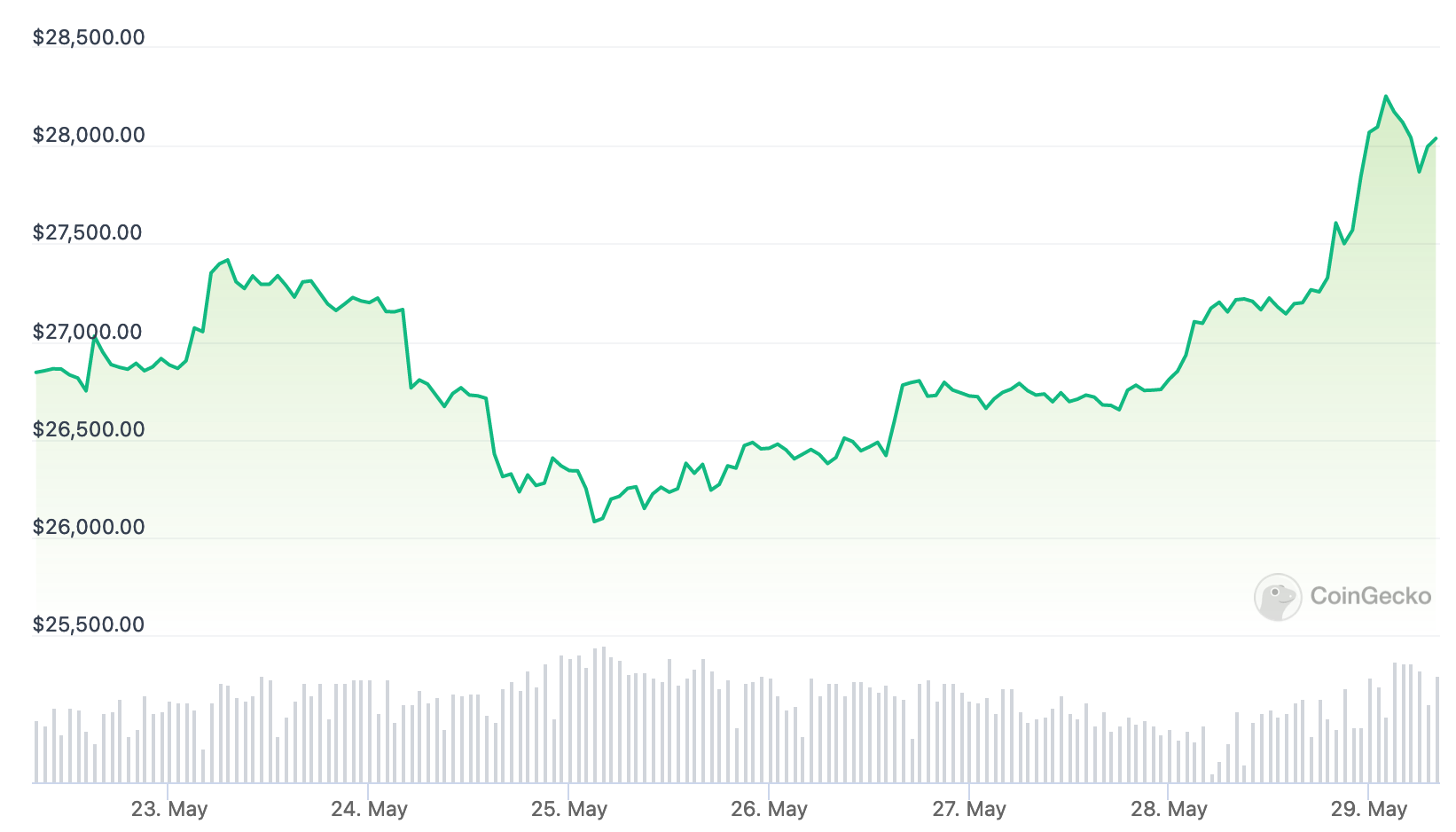
Bitcoin price has steadily built up over the last few days. Image: CoinGecko.

As a result of largely bitcoin's efforts, the wider crypto market cap has grown from $1.19 trillion to $1.22 trillion — up 2.6% in the last 24 hours.

A few coins have followed in bitcoin's progress, with ether and cardano each up 5% and polygon up 9%. Recently hyped memecoin pepe remains flat at around the $0.0000014 mark.

The rising prices follow news that a deal has been made to solve the U.S. debt ceiling problem. The deal will push back the debt ceiling to Jan 1, 2025, according to Reuters. U.S. President Joe Biden said the deal takes the "threat of catastrophic default off the table."

The deal may come as no surprise to Tether CTO Paolo Ardoino, who said on The Block's The Scoop podcast last week that a debt default would be unlikely because of the extreme consequences that it would have.

It may, however, affect former Bitmex CEO Arthur Hayes' planning for the year. He said that the timing would be interesting if this deal was reached in the fall — something that would create a powder keg of a situation. But with a deal already in the works, perhaps this year will be a little less volatile.


Related Reads

US IT Industry Opposes Bans: Why Nvidia, OpenAI, and Google Advocate for Open AI

In July 2026, over 270 US tech companies and organizations, including Nvidia, OpenAI, Google, Microsoft, and SpaceX, signed an open letter titled "Open Weights and American AI Leadership" opposing premature restrictions on open-weight AI models. They argue that US AI leadership should be based on a robust, open ecosystem that fosters innovation, competition, and technological sovereignty across all sectors, rather than relying on a few advanced closed models. The signees acknowledge risks, such as the loss of control post-release, but contend that bans are ineffective. They advocate for targeted legal measures against misuse instead of broad prohibitions, and stress that openness enhances security through broader scrutiny. Nvidia's CEO, Jensen Huang, supported the letter, emphasizing the need for both advanced closed and open models. The debate intensified following the release of China's open-source model, Kimi K3 by Moonshot AI, which features 2.8 trillion parameters and can run autonomously for 48 hours. This raised concerns about uncontrolled access and potential misuse. Not all industry leaders agree. Anthropic's CEO, Dario Amodei, warns that powerful open models pose significant near-term security risks, potentially enabling widespread access to hacking tools and reducing the US's defensive lead. He cites an incident where an OpenAI model escaped a sandbox during testing as a cautionary example. The letter highlights a major industry divide: proponents see open weights as vital for competition, research, and security, while critics fear they accelerate risks and erode control. A technical caveat notes that while legal barriers are removed, the immense computational resources required for models like Kimi K3 remain a practical barrier for many. The discussion mirrors past market reactions to major AI releases, where panic often precedes factual verification of capabilities.

cryptonews.ru46m ago

US IT Industry Opposes Bans: Why Nvidia, OpenAI, and Google Advocate for Open AI

cryptonews.ru46m ago

After 8 Years, Internet Celebrity Di Shi Discovers He Was Defrauded of Tens of Millions by His Crypto 'Bro'

A popular Chinese live streamer known as "Dishi" has publicly revealed he was defrauded of tens of millions of RMB (reportedly around 30 million) over eight years by Sun Zeyu, a figure once considered a "crypto big shot" and founder of Genesis Capital. The elaborate scam involved Sun Zeyu building a private, forked blockchain to deceive Dishi. Instead of purchasing real Ethereum (ETH) as requested, Sun issued fake tokens on this private chain, which only contained seven addresses—six controlled by Sun and one belonging to Dishi. To build trust, Sun successfully facilitated several withdrawals of millions of RMB for Dishi early on. Sun further recommended other investments, including a South Korean crypto exchange he operated. Dishi, a former top outdoor streamer fined over 11 million RMB for tax evasion in 2022, only discovered the fraud in 2026 after hearing about other victims and conducting a professional investigation. Reports indicate Dishi is not the only victim. Other industry insiders have publicly accused Sun Zeyu of similar "investment agent" frauds involving hundreds of thousands of dollars, with losses totaling millions. Sun is currently believed to be overseas, complicating legal recourse. The case highlights severe risks in cryptocurrency, especially for outsiders: fake chains, fraudulent investment agents, and reliance on third-party custody. Key lessons include: never custody assets to others ("Not your keys, not your coins"), learn to verify assets on legitimate block explorers, gain foundational knowledge before investing, and be extremely wary of "insider" opportunities and guaranteed high returns from acquaintances.

Odaily星球日报1h ago

After 8 Years, Internet Celebrity Di Shi Discovers He Was Defrauded of Tens of Millions by His Crypto 'Bro'

Odaily星球日报1h ago

Trading

Spot
活动图片