Why CBDC Is the Key To Achieve Economic Stability

Daily HodlPublished on 2022-04-06Last updated on 2022-04-06

Abstract

As governments around the world move forward with CBDC research and development, it has...

HodlX Guest Post Submit Your Post
As governments around the world move forward with CBDC research and development, it has become clear that such assets will play a notable role in achieving a stable economy.
But what are the benefits of implementing CBDCs for the global payment system, and what are the potential downsides that are causing governments around the world to tread carefully in this matter?
The state of the CBDC race
According to the Atlantic Council’s Central Bank Digital Currency Tracker, 87 nations representing over 90% of the global GDP are actively exploring CBDCs.
Among them, nine countries have already launched their state-issued digital currencies. Meanwhile, 15 central banks are currently piloting their CBDCs, with China being the global leader among major economies that even showcased the trial version of the e-CNY during the 2022 Winter Olympics.
The remaining contenders in the CBDC race are either developing or researching the potential implementation of a central bank digital currency. One of the newest joiners in this field is the United States, where the exploration of a state-issued cryptocurrency has officially kicked off after President Joe Biden signed an executive order on digital assets on March 8, 2022.
CBDCs to power economic stability
As the digital version of a nation’s fiat currency, CBDC is not subject to the excessive volatility of cryptocurrencies yet retain most of their benefits (e.g., instantaneous transactions and low fees) and offers complete control to the state. Most importantly, CBDCs will significantly affect the financial system and its structure.
Currently, if you pay a bill via your debit card or bank account, you spend privately-issued money held at commercial financial institutions. For that reason, you don’t have a direct claim on the state-issued public money (like with cash) but on your bank’s deposits that are only partly backed by liquid reserves held at the central bank.
CBDCs don’t necessarily involve the participation of intermediaries (e.g., private financial institutions) as they can be issued directly to citizens via financial accounts connected to the central bank. However, this implementation is rather inefficient and resource-heavy.
With the hybrid structure most governments are exploring, CBDCs represent a direct claim on the central bank, offering citizens access to safe public money instead of risky commercial bank deposits. At the same time, private financial institutions handle the technical side of the payment network, which fuels innovation.
With central bank guarantees, CBDCs lack the credit and liquidity risks of the existing economic system, which states could utilize to achieve better financial stability. Furthermore, governments can leverage the blockchain’s traceability to execute monetary policies in real-time and tackle financial crime more efficiently.
CBDC implementation remains a challenge to be solved
Despite their advantages, some potential downsides pose a challenge in implemenпting CBDCs into the existing financial system. Among them, privacy is the top concern. Since blockchain transactions are recorded publicly on the ledger, the state could gain increased insight into citizens’ personal finances.
Furthermore, governments have to be smart about the actual implementation. They have to make CBDCs enticing for consumers so they would have a reason to replace their current payment services. But at the same time, they would need to turn to the central bank to lend out money, since commercial banks don’t have access to retail deposits, which could drastically change the credit landscape.
Moreover, as we have seen in the crypto industry, cybercriminals can adapt to changes quickly and efficiently, especially when they see lucrative opportunities. As a result, the government has to put a major focus on securing its CBDC ecosystem as well as monitoring and responding to new types of financial crime.
CBDCs can smooth the integration of crypto with traditional finance
Indeed, governments have to tackle many challenges and tread carefully with the design and implementation of central bank digital currencies. But even with all this in mind, so long as the right decisions are made in this field, central bank digital currencies can become a powerful tool on the global stage.
From eliminating the risks of commercial bank defaults and solving the unbanked problem to making cross-border transactions more efficient by cutting out financial intermediaries and reducing the time and cost of transfers, CBDCs offer many benefits that could be used to improve global financial stability and boost economic growth.
While many see CBDC as a tool to combat the popularity of digital assets like Bitcoin, it is more than that. Combined with advancements in the field of digital asset regulation, CBDCs make it easier to integrate crypto and blockchain concepts with traditional finance, where they will eventually play an important role in shaping the future of the global economy.
With widespread adoption, CBDCs could be used to fuel innovation and international collaboration, significantly boost the competitiveness of businesses and improve the quality of life of the world’s population.

Related Reads

Should You Buy SpaceX Stock at $1.7 Trillion? Here's What the Market Is Worried About

SpaceX is preparing for a massive IPO aiming to raise around $75 billion at a valuation of approximately $1.75 trillion. While its achievements in reusable rockets and the profitable Starlink satellite internet service are clear, the market is concerned about the aggressive valuation. Key issues include: the current $1.75 trillion valuation, which is about 94 times 2025 revenue, seems to price in not just existing businesses but also unproven future ventures like AI infrastructure and orbital data centers. Financially, while Starlink is profitable, the AI division, bolstered by the acquisition of xAI, is incurring massive losses and consuming the majority of capital expenditures. This acquisition also introduced complex related-party financing arrangements and debt onto SpaceX's balance sheet. Furthermore, corporate governance poses a challenge. SpaceX's dual-class share structure ensures founder Elon Musk retains absolute control, limiting ordinary shareholders' influence over high-risk, long-term strategic decisions. The future success of ambitious projects like the Starship rocket—critical for lowering costs and enabling new services—remains a significant variable for the valuation. In summary, the market's apprehension (FUD) centers not on doubting SpaceX's past technological triumphs but on questioning how much premium public investors should pay for a future that combines proven profits with highly speculative and capital-intensive new ventures, all under a governance structure that offers limited shareholder oversight.

marsbit30m ago

Should You Buy SpaceX Stock at $1.7 Trillion? Here's What the Market Is Worried About

marsbit30m ago

Breaking the DeFi Cascading Liquidation Curse: Vitalik Proposes a New Solution

Vitalik Buterin has proposed a new DeFi design to eliminate the automatic liquidation mechanism that causes market instability during sharp downturns. The current system, used by protocols like Aave, triggers forced sales when collateral value falls below a threshold, often exacerbating price drops and creating systemic selling pressure. Buterin's alternative model is based on splitting an asset like ETH into two synthetic option-like tokens, P and N, pegged to a price index. Their combined value always equals one ETH. Instead of sudden liquidation, a position's value gradually drifts from its target peg if the market moves. Users must proactively rebalance their holdings to maintain their desired exposure, transferring the management burden from the protocol to the user or automated tools. A key advantage is the reduced reliance on real-time oracles. Pricing decisions are deferred until contract expiry, allowing for more robust, fault-tolerant oracle designs. This removes a clear liquidation threshold that speculators can target for manipulation or MEV extraction. However, significant challenges remain. Frequent rebalancing could incur high slippage and transaction costs, necessitating new liquidity provider models. The design is better suited for hedging instruments than for stablecoins requiring a rigid 1:1 peg. While not an immediate replacement for existing systems, the proposal challenges the foundational assumption that instantaneous forced liquidation is an unavoidable necessity in DeFi, opening the door for fundamentally different risk management architectures.

marsbit35m ago

Breaking the DeFi Cascading Liquidation Curse: Vitalik Proposes a New Solution

marsbit35m ago

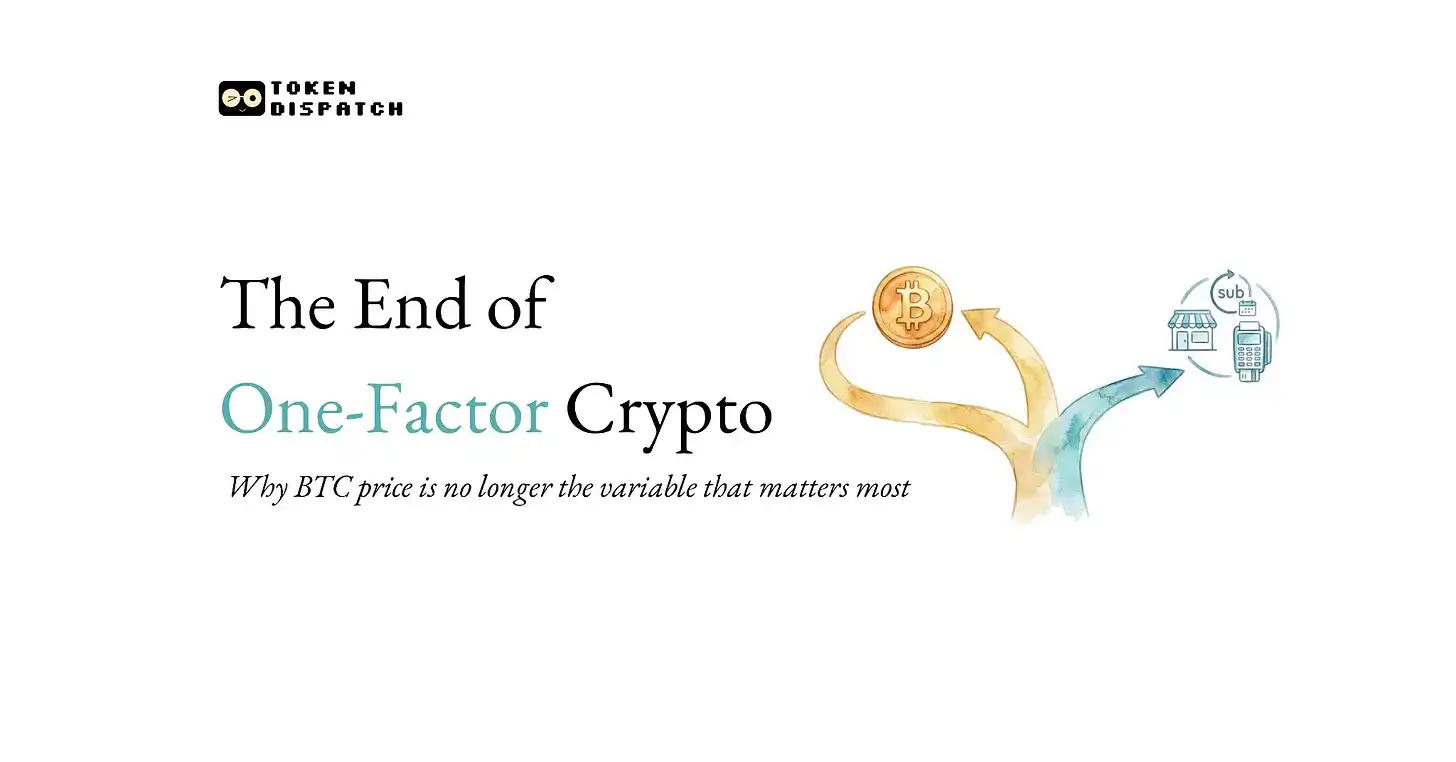
The End of Single-Factor Cryptography

The article "The End of Single-Factor Crypto" posits a fundamental shift in the cryptocurrency ecosystem. It argues the era where crypto asset valuations were predominantly driven by, and correlated with, Bitcoin's price is ending. The space is bifurcating into two distinct economies: endogenous and exogenous. The endogenous economy represents traditional crypto, where token and project values are directly tied to crypto market prices. The emerging exogenous economy comprises projects and businesses that may utilize blockchain technology or tokens but derive their fundamental value from external, non-crypto factors like consumer demand, subscription revenue, or real-world utility. Examples include AI inference platforms like Venice, fintech lenders using blockchain for efficiency, and stablecoin/payment infrastructure companies acquired by giants like Mastercard and Stripe. This shift means investment analysis must change. For exogenous assets, evaluating traditional business fundamentals—such as revenue streams, unit economics, and competitive moats—becomes more critical than tracking Bitcoin charts. While endogenous assets like Bitcoin remain relevant, the growth of the exogenous category is driven by measurable demand independent of crypto price cycles, paving the way for a new, more diversified market phase. Consequently, crypto is evolving from a single-factor, reflexive asset class into a multifaceted ecosystem with varied drivers and investment theses.

marsbit35m ago

The End of Single-Factor Cryptography

marsbit35m ago

Morning Post | Bitmine Plans to Raise $300 Million Through Preferred Stock Issuance; Polymarket Accuses Kalshi of Commercial Espionage

ChainCatcher's Daily Crypto Brief: Key developments from the past 24 hours include significant funding moves, regulatory actions, and market predictions. Bitmine announced a $300 million preferred stock fundraising. Polymarket accused rival prediction platform Kalshi of corporate espionage, citing numerous suspicious coincidences in product launches, a claim Kalshi strongly denied. The U.S. Department of Justice, in a joint "Disruption Week" anti-fraud operation with companies like Coinbase and Meta, froze over $3.8 million in cryptocurrency linked to scams. In infrastructure news, Macau completed its integration with the multi-central bank digital currency bridge, mBridge, aiming to build efficient cross-border payment channels. Cosmos Labs acquired the block explorer Mintscan. Market-wise, Geoffrey Kendrick, Standard Chartered's Head of Digital Assets Research, stated Bitcoin is nearing a bottom around $63,000, maintaining a year-end target of $100,000. He noted stability in U.S. spot Bitcoin ETF holdings. Ahead of SpaceX's anticipated IPO, internal insiders at Rocket Lab (RKLB) sold over $18.41 million in stock. In tokenization, Goldman Sachs partnered with Apex and Archax to launch a tokenized real estate fund. The meme token tracker GMGN reported the top trending tokens: on Ethereum, HEX, SHIB, LINK, PEPE, mUSD; on Solana, TROLL, swarms, WORLDCUP, neet, Buttcoin; and on Base, PEPE, toby, ODDS, ELSA, SKI.

链捕手49m ago

Morning Post | Bitmine Plans to Raise $300 Million Through Preferred Stock Issuance; Polymarket Accuses Kalshi of Commercial Espionage

链捕手49m ago

Trading

Spot
Futures
活动图片