In July 2026, South Korea's capital market underwent a heart-stopping stress test.
Within a few short weeks, the Korea Composite Stock Price Index (KOSPI) plummeted from its all-time high, not only entering a technical bear market but also triggering the year's 7th market-wide trading halt in an extremely short period. Such high-frequency trading halts are rare in global capital markets.
For many young South Koreans, the capital market had long deviated from its essence of long-term investment, morphing into a gambling table that decides one's fate: win and change your life completely; lose and be wiped out entirely.
In the global AI hardware supply chain, South Korea, leveraging the dominant positions of Samsung Electronics and SK Hynix in the HBM (High Bandwidth Memory) field, captures about 35% of the profits. The cumulative operating profits of these two giants over the next three years are projected to exceed 2,200 trillion won.
This enormous profit was directly converted into purchasing power for semiconductor industry employees, especially younger ones, through high bonuses and dividends. Data shows that in May 2026, luxury goods sales in department stores near the headquarters of chip companies in areas like Gyeonggi-do surged over 50% year-on-year, with luxury jewelry and watches skyrocketing.
Since 2026, South Korea's total stock market capitalization surpassed $5 trillion. A large number of citizens saw their paper assets double through widespread stock trading, particularly by buying semiconductor stocks on margin.
The wealth creation effect driven by AI was too obvious. This rise in asset prices directly fueled a recovery in high-end real estate and luxury consumption. The price increase of premium apartments in Seoul far outpaced the national average, and the proportion of all-cash purchases of luxury homes rose significantly.
In the eyes of many young people, facing Seoul's unattainably high housing prices and solidified class barriers, working a regular job seems destined only for respectable poverty. Thus, countless individuals turned to financial markets as their only chance at survival.
Lose either way, might as well go all in, betting on that one-in-ten-thousand chance to turn things around.
01. The Extreme Market of Repeated Halts
This "rarity" is mainly reflected in the high density of trading halts and the extremity of historical comparisons.
Since South Korea established its market-wide trading halt mechanism in 2000, it had been triggered only 13 times in total. Yet, in just the first half of 2026, the Korean stock market had already triggered 7 market-wide halts. This means that the number of halts in a mere six months exceeded half the total number of historical occurrences in over twenty years since the mechanism's inception.
The last time such high-frequency, dense halting phenomena occurred was during the 2008 global financial crisis. Under normal market conditions, a halt might not be triggered for a year or even several years. Yet, in 2026, they happened repeatedly within just a few weeks, representing an extremely rare, extreme market situation in the history of South Korea's capital markets.
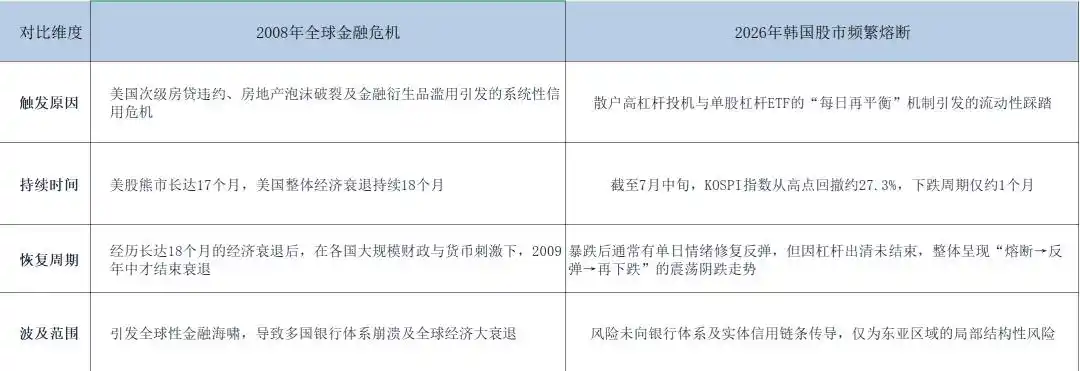
(Comparison with the 2008 Financial Crisis)
It wasn't just the number; the triggering rhythm was also extremely tight. For instance, on July 7th, the Korean stock market first triggered the "sidecar" mechanism targeting programmatic trading in the morning, followed by a full market-wide halt in the afternoon—hitting the brakes twice in a single day. In just a few trading days from July 9th to 13th, the total amount of forced liquidations reached the scale of hundreds of billions of won, with the single-day total even hitting a new high for the year.
02. A Distorted Oligopoly Structure: Two Companies Holding the Entire Market Hostage
The most fatal flaw of the South Korean stock market lies in its highly singular, extremely concentrated weight structure.
As of June 2026, the combined weight of semiconductor giants Samsung Electronics and SK Hynix in the KOSPI index had climbed to an astonishing 60%. They contributed to 70% of the index's doubling gains in the first half of the year.
This distorted pattern of "one company thriving brings market prosperity; one industry collapsing brings the entire market down" essentially turns the Korean stock market into an ETF of just two stocks.
In capital markets with such concentration, the power of any one-sided bearish or bullish sentiment is magnified.
In May this year, the Korea Exchange approved the listing of 2x leveraged ETFs linked to Samsung Electronics and SK Hynix. The introduction of this product had profound policy, market, and fundamental backgrounds.
Previously, to diversify investments and protect the market, South Korea had long prohibited single-stock leveraged ETF trading, stipulating that ETFs must invest in at least 10 stocks and that the maximum holding in a single stock could not exceed 30%.
However, on April 28, 2026, amid the nationwide stock trading frenzy, South Korea formally revised the "Enforcement Decree of the Capital Markets Act," raising the maximum single-stock investment holding limit to 100% and abolishing the rigid requirement that fund holdings must include at least 10 stocks. This policy breakthrough cleared the way for single-stock leveraged ETFs.
The core driver for this policy shift was the local retail investor capital seeking excess returns. Korean society faces pressure from high housing prices, education, and pension costs, leading many young people to hope for asset leaps through high-risk investments.
Under the AI wave, many Koreans chose to "gamble." Due to the long-term domestic lack of such high-risk tools, a large number of Korean investors turned to overseas markets.
In the first few months of 2026, leveraged ETFs for Samsung Electronics and SK Hynix listed in Hong Kong attracted tens of billions of dollars in inflows. To repatriate these high-risk trading activities, mitigate the impact of capital outflow on the Korean won's exchange rate, and enhance the global pricing power of local tech giants, Korean regulators decided to open up domestic trading.
In policy formulation, regulators set strict entry criteria, such as a market cap share exceeding 10% and a trading volume share exceeding 5%. Currently, only Samsung Electronics and SK Hynix meet these conditions.
These two companies are in an AI-driven super-cycle for memory chips, both posting record first-quarter earnings and experiencing massive stock price gains this year. They possess sufficient market attention and liquidity to meet the trading demands of leveraged products.
Against the backdrop of a booming semiconductor sector, retail investor demand for leveraged tools to amplify returns was extremely strong. Prior to the leveraged ETF listings, over 130,000 investors had completed the mandatory education courses required to purchase such products, indicating a huge potential capital pool.
03. The Death Spiral Under Leverage: Margin Calls, Pushing the Snowball Downhill
Entering July, when global AI capital expenditure growth slowed and signals of HBM overcapacity emerged, Samsung and Hynix stock prices fell sharply.
This is when the slaughter began. With a lack of support from other sectors, the Korean market instantly lost its cushioning space. The mechanical stampede from leveraged ETFs created a "decline, liquidation" death spiral.
The 2x leveraged ETFs linked to Samsung Electronics and SK Hynix attracted massive retail funds. Their inherent "daily rebalancing" mechanism became a powerful downward amplifier when the market fell.
When the underlying stocks dropped, the ETFs were forced to sell indiscriminately to maintain their leverage multiples. This directly triggered a vicious cycle: "stock price fall → leveraged ETF forced selling → triggering forced liquidation of retail margin positions → further stock price decline."
Imagine a retail investor A holds a 2x leveraged ETF linked to Samsung Electronics. A has 100 yuan of capital, borrows another 100 yuan, and uses the total 200 yuan to go all-in on Samsung Electronics stock.
Now, the market experiences normal fluctuations. Suppose Samsung Electronics stock falls 5% on a given day due to industry news. The 200 yuan worth of stock in the ETF becomes 190 yuan. The 100 yuan debt remains. The ETF's net asset value becomes 190 - 100 = 90 yuan. At this point, the ETF's actual leverage is 190 ÷ 90 ≈ 2.11x.
Because the ETF's contract stipulates it must maintain a 2x leverage daily, the current 2.11x exceeds the limit. The fund manager must forcibly sell some stock to repay debt and bring leverage back to 2x. To achieve this, the fund manager must sell off about 9.5 yuan worth of stock before the market closes, regardless of cost. This extra sell order of 9.5 yuan directly pushes Samsung Electronics' stock price from the original 5% drop to a 6% drop.
This is where the avalanche begins. Many in the market bought Samsung Electronics stock on margin. When it was down 5%, they could still hold on. But now, due to the ETF's passive sell-off, the price drops to 6%, just breaching some investors' liquidation levels. Brokerage systems automatically trigger forced liquidations, pushing the price down further to 7%. The leveraged ETF's leverage ratio exceeds the limit again, forcing it to continue passive selling at the next open; more retail and margin positions get liquidated...
See, what started as a normal 5% decline was amplified into a 7% or even 10% crash due to the leveraged ETF's "mechanical selling" and the retail "chain-reaction margin calls."
When thousands of accounts in the market undergo this process, the entire market, like an out-of-control snowball, triggers a market-wide liquidity crisis and frequent trading halts. This explains why a seemingly ordinary financial derivative could become the fatal fuse igniting the entire market.
Previously, South Korean society was filled with the frenzy of a "national bet on semiconductors." Retail investors, driven by fear of missing out (FOMO), frantically bought on margin, while foreign capital had been net sellers for five consecutive months, pulling out.
04. Lagging Regulation and Reflection
Faced with the out-of-control situation, South Korean regulators urgently announced in mid-July the suspension of new single-stock leveraged ETF approvals and an increase in investment thresholds.
But for individuals, it was already too late. According to official South Korean and multiple financial institution statistics, the wave of leverage-induced margin calls in the Korean stock market was extremely severe.
This was a massive wealth wipeout for the populace, made tangible by data.
Across the market, more than 1.2 million retail margin accounts hit their margin call levels, facing liquidation risk. Among these, between 320,000 and 360,000 accounts were completely liquidated by brokers, wiping out their principal, with some even ending up in debt to their brokers. Other estimates from some brokerages and foreign institutions suggest the total number of completely liquidated accounts could be between 405,000 and 460,000.
Given South Korea's labor force population aged 15-64 is approximately 35.7 million, this is equivalent to about 1 in every 30 adults receiving a margin call, standing on the brink of ruin. Among these liquidated accounts, young retail investors aged 20-30 accounted for a staggering 62%. Most of them had bet on 2x leveraged ETFs for Samsung Electronics and SK Hynix—they are the nation's future, yet they gambled all their hopes and savings in the capital market in one go.
Based on overall calculations from brokerages and foreign institutions, during the nearly one-month crash, Korean retail investors, due to leveraged trading—including leveraged ETF value declines, option margin losses, and debt owed to brokers—recorded total actual losses of approximately 2.15 trillion won (around 10 billion RMB).
Ironically, these forced, mechanical large-scale portfolio adjustments generated substantial trading fees and interest spread income for the investment banks and brokerages providing the derivative contracts.
The head of South Korea's Financial Supervisory Service even publicly expressed regret over the initial approval of such high-risk products. This incident exposed the enormous destructive power of financial innovation when lacking adequate risk-hedging mechanisms.
Conclusion
In today's world swept by the AI wave, we need to be more vigilant than ever: do not let enthusiasm for technology evolve into an irrational collective gamble.
When financial tools deviate from their original purpose of serving the real economy, and when regulatory lag indulges human weakness, so-called "innovation" can become a sword of Damocles hanging over everyone's head. When that sword falls, it does not distinguish between experienced veterans and hopeful newcomers; it harvests all equally.
This article is from WeChat public account "Laika Think Tank" (ID: laikazk), author: Chai Quan