【研报精选】从 Meme 到加密货币:探究 PEPE 的奇特历程与风险挑战

投研第一线Published on 2023-05-05Last updated on 2023-05-09

Abstract

PEPE Memecoin 在推出三周后市值超过 4.2 亿美元,在加密市场引起了一定的轰动。许多人将 PEPE 与其他 Memecoin(例如 SHIB、DOGE、FLOKI 等)进行比较,但只有时间才能证明这种源于 Meme 的 Token 是否会继续存在。

Memecoin 似乎是加密行业周期性市场波动的必备产物,时不时地,就有一个全新的 Memecoin 被市场炒作起来。

比如最近大火的 PEPE Memecoin,面世不到几周,就进入了前 100 名,总市值高达 4 亿美元。

在本篇文章中,我们将解读 PEPE Memecoin 是什么?以及相关的背景故事。

什么是 Memecoin?

Meme 已成为互联网上的元老级元素(Meme,中文翻译「迷因」,指一种通过互联网快速传播的思想或文化、风格图片等)。从 Web1 早期就已经存在,并且会在未来很长一段时间内继续存在。

因此 Meme 进入加密行业也就不足为奇了。虽然大多数 Token 倾向于专注于某种实用性,但 Memecoin 专注于通过 Meme 的病毒性传播速度来达到疯传的效果。

具体例子有狗狗币 (DOGE),它是第一个引起大众注的 Memecoin,而且随着时间的发展,在加密资产中的地位越发坚固,其他的有包括像 SHIB、FLOKI 等。

而现在,PEPE Memecoin 的火爆程度,可能是其他 Memecoin 之前从未有过的。

PEPE Memecoin 的发展历史

PEPE Memecoin 于 2023 年 4 月中旬推出,在区块浏览器 Etherscan 上的第一个入口点是 4 月 18 日。

不到三周后,该加密资产的市值超过 4.2 亿美元,总市值跻身前 100 名 Token 之列。

在撰写本文时,PEPE 已经入驻火币、MEXC、OKX 等主要交易平台。除此之外,它还可以在多个 DEX(例如 Uniswap)上使用。

1.什么是 PEPE Memecoin?

根据官方网站,PEPE memecoin 的设计寓意「现存最容易让人记住的 Memecoin」,同时多次提到其他流行的 Token,例如 SHIB、FLOKI、DOGE 等。

按照设计,PEPE 没有内在价值,这在网站上有明确说明:「PEPE 是一种没有内在价值或财务回报预期的 Memecoin。没有正式的团队或路线图,可以说完全没用,仅供娱乐。

不过这在加密领域并不是什么新鲜事,毕竟过去出现的很多种 Memecoins,都没有提出任何声明,也直接警告用户它们没有任何价值。

2.与 Pepe the Frog Meme 的联系

虽然依靠流行的 Meme 进行病毒式传播,但 PEPE 背后的团队声称与 Pepe the Frog 并无任何关联:「PEPE Coin 与 Matt Furie 和他的创作 Pepe the Frog Meme 没有任何关联。」

图源:维基百科

相反——PEPE Coin 的远景是「向我们都喜爱和认可的 Memecoin 致敬」。

关于 Pepe the Frog,简单介绍一下,它是由漫画家 Matt Furie 创作的卡通人物。Pepe 于 2005 年在 Furie 的漫画《Boy’s Club》中首次亮相。2008 年,Pepe 被 4chan 相中,作为表情包在 4chan 上传播开来。

3.PEPE Memecoin 的目的和愿景

在开玩笑说没有任何计划时,该团队以三个不同的路线图阶段的形式提出了三个阶段式发展期望,如下官网截图所示:
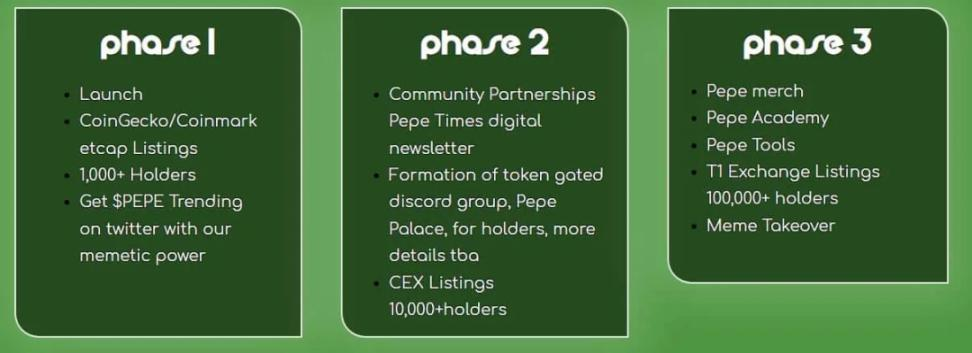
该页面显示,在阶段一路线包括:

发布

上线 CoinGecko/Coinmarketcap 市值排名

1 千 + 持有者

用 Meme 力量在推特上获取传播趋势

阶段二路线包括:

实现社区伙伴关系 Pepe 时报 数字通讯

组建持有者 Discord 社群等

CEX 上 1 万 + 持有者

阶段三路线包括:

PEPE 商品

PEPE 学院

PEPE 工具

上市 T1 交易平台

10 万 + 持有者

PEPE 收购

PEPE 总供应量为近 4207 亿(420,690,000,000,000),实际上,这个数字是在向流行的 Meme 数字 4:20 和 69 致敬(特定文化中这几个数字有特定含义)。

目前根据官方网站,93.1% 的 PEPE 供应已被发送到流动资金池,其余 6.9% 存放在一个多重签名钱包中,将用于未来在 CEX、LP 的上市,另外可以使用 ENS 名称「pepecexwallet.eth」跟踪此钱包。

4.PEPE Memecoin 生态系统

PEPE Memecoin 生态系统人数与日俱增。根据 Etherescan 的数据,在 5 月 1 日撰写本文时,也就是首次推出两周后,持有者人数已经拥超过 65,000 。
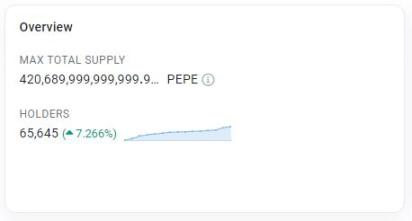
资料来源:Etherscan

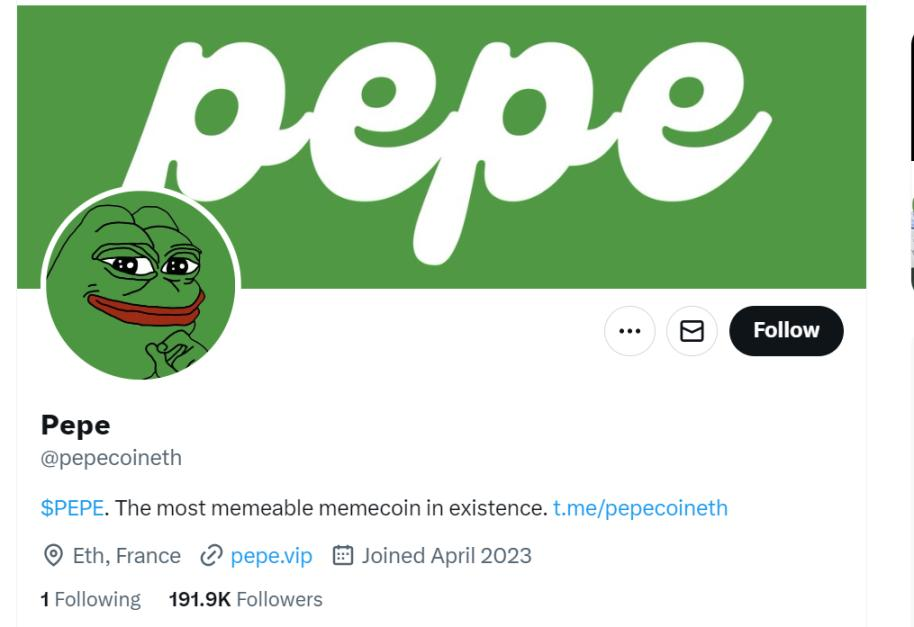
其官方 Telegram 群组拥有超过 25,000 名成员和每天数十万条的消息。它的官方推特虽然是在 4 月份创建的,但截止目前(5 月 3 日)已经拥有超过 19 万名粉丝。
风险与挑战

与大多数倾向于传播病毒的 Memecoin 一样,PEPE 也有一些风险和挑战。

1.市场波动

PEPE 自创建以来一直是最不稳定的加密资产之一,价格波动巨大。例如,5 月 1 日,它的价格翻了一番多,当天涨幅超过 100%。虽然这听起来特别有吸引力,但同样重要的是要注意它会带来一系列风险。

在加密领域有一句流行的说法是这样的:「价格上涨如爬楼梯,下跌如坐电梯。」

这表明,虽然 PEPE 看起来「只会上涨」,但也可能会很快失去所有全部价值。请注意,创作者自己已经说过它没有内在价值,所以它的价值基本上取决于人们愿意为此付出多少。这在圈内并非罕见,而且价值的概念本身就是一种社会建构,但风险尤其会随着新铸造的 Memecoin 而放大。

此外,许多 CEX 还存在缺乏必要的流动性来兑现收益相关的问题。这意味着即使有人能够完成一生中最重要的交易,他们也可能没有足够的流动性来弥补他们的头寸。

举个例子,某人将 27 美元的 PEPE 投资变成了惊人的 100 万美元,但由于各种与流动性相关的问题而无法完全兑现。

当然,如果 PEPE 经受住时间的考验,并在流动性往往更深的更集中的交易平台上市,这种担忧可能会消退。

2.安全风险

Memecoin 越受欢迎,相关骗局就越多。例如,这是来自官方 PEPE Telegram 群的消息:

一些社区成员就我们的部署程序钱包和 CEX 钱包中发生的 dusting/token scams(网络攻击)与我们联系:任何人都可以攻击交易并将这些 Token 发送到我们的钱包。如果真这样做的话,每一枚 Coin 都是骗局。许多黑客正在攻击我们的钱包,使其看起来像我们进行的 airdrop 或 Token 交易,以诱骗人们进行互动。谨记!不要购买任何这些 Token 或与不明合约互动,以免造成财产损失。

一般来说,无论何时与 DeFi 生态系统进行交互,遵循一些基本的加密资产安全都是绝对必要的,这样可以尽可能地避免被骗。

小结

在推出后的短短两周内获得了超过 4 亿美元的总市值,PEPE Memecoin 无疑成功地在加密资产市场引起了轰动。

许多人将 PEPE 与其他 Memecoin(例如 SHIB、DOGE、FLOKI 等)进行比较,但只有时间才能证明这种源于 Meme 的 Token 是否会继续存在。

Related Reads

Coinbase Vice President: The Wars Over Cryptocurrency Regulation Are Over

Coinbase's new Vice President, Ryan VanGrak, declared that regulatory wars in the cryptocurrency sector are over. Since taking office on July 9, 2026, he has shifted the company's approach from litigation and sanctions to focusing on growth and innovation. The industry can now concentrate on development rather than fighting for its right to exist. He highlighted that the Digital Asset Market Clarity Act (CLARITY Act), which aims to establish a clear federal regulatory framework dividing oversight between the SEC and CFTC, has gained significant momentum. This framework is intended to provide proper supervision, investor protection, and maintain U.S. leadership in digital assets. VanGrak's appointment marks a strategic shift from a "wartime" to a "peacetime" advisor, replacing former Chief Legal Officer Paul Grewal, who oversaw major litigation, including a dismissed 2023 SEC lawsuit. With his background at Citadel Securities and the SEC, VanGrak brings deep regulatory and institutional finance expertise as Coinbase expands beyond a simple exchange into a broader financial services provider, offering stocks, futures, prediction markets, and AI tools. For investors, bipartisan support for crypto legislation like the CLARITY Act represents a major shift from the enforcement-focused environment of 2023-2024. Lawmakers are now focused on *how* to regulate crypto, not *if* it should exist. However, risks remain, as the bill's passage is not yet guaranteed.

cryptonews.ru26m ago

Coinbase Vice President: The Wars Over Cryptocurrency Regulation Are Over

cryptonews.ru26m ago

Deep Dive into FWA: An Intriguing Experiment Turning NFTs into "On-Chain Gachapon"

A Deep Dive into FWA: The “On-Chain Gacha” Experiment for NFTs Fake World Assets (FWA), created by TokenWorks, introduces an innovative “NFT gacha machine” fully operating on-chain. Users can deposit eligible NFTs paired with ETH (called Backing) to create a Position, acting as a prize pool. Others can then pay a uniform Acquisition Price for a chance to win a random NFT from the pool. The core mechanism features a reverse probability system: Positions with lower Backing have a higher chance of being selected, serving as common prizes, while high-Backing Positions are rare “jackpots.” The acquisition price is calculated based on the harmonic mean of all Backings, keeping entry costs low. When a Position is won, the purchaser must choose: keep the NFT or accept the Standing Bid (85% of the Backing, claimable in ETH or $FWA tokens), returning the NFT to the original depositor. The protocol involves two main roles. Depositors provide liquidity (NFT + ETH), earning a share of fees from each draw, distributed equally per active Position, plus potential $FWA rewards. Purchasers pay to spin the gacha, receiving $FWA rewards for participation. A special “Crown” reward goes to the Position with the highest Backing. The $FWA token has a fixed supply and is initially obtainable only through protocol participation (depositing or purchasing), with external buying disabled early on to reduce sell pressure. Its value is supported by a built-in buy pressure: when purchasers opt for the $FWA settlement on a Standing Bid, the protocol uses the backing ETH to buy $FWA from the market. Revenue for the protocol comes from a 1% fee on each draw, a 1% settlement fee when an NFT is kept, and the 15% discount from Standing Bid settlements (currently allocated to the protocol). The design cleverly blends Uniswap-style liquidity provision, gacha mechanics, and tokenomics to create a novel, self-regulating marketplace for NFT liquidity and engagement.

marsbit40m ago

Deep Dive into FWA: An Intriguing Experiment Turning NFTs into "On-Chain Gachapon"

marsbit40m ago

10,000 Scientists Get 1 Year of Free Access: OpenAI Brings the Scientific Research Pipeline into ChatGPT

OpenAI has launched the "ChatGPT for Academic Researchers" program, offering free one-year access to its flagship models for 100,000 university researchers globally, with 10,000 spots available this summer. Selected institutions include prestigious centers like ENS Paris and the IAS at Princeton. The initiative provides an integrated research workspace within ChatGPT, bundling tools like ChatGPT, ChatGPT Work, and Codex, along with expanded Deep Research capabilities, higher usage limits, and specialized tools for life sciences. The suite connects to platforms like Zotero and GitHub, aiming to streamline the entire research workflow from literature review and coding to data analysis and manuscript drafting. OpenAI notes that about 1.3 million people already use ChatGPT weekly for advanced science and math. The program targets building long-term user dependency by embedding these tools into daily research habits. However, access comes with limitations: it does not include API credits or model weights, and eligibility is restricted to verified academic researchers from supported countries. This approach contrasts with Anthropic's "AI for Science" program, which offers API credits but not an integrated workspace. Both companies emphasize preventing misuse by withholding model weights, a point of contention for AI researchers seeking transparency. The core strategy remains clear: provide a powerful, integrated environment to foster user reliance ahead of the post-free period.

marsbit45m ago

10,000 Scientists Get 1 Year of Free Access: OpenAI Brings the Scientific Research Pipeline into ChatGPT

marsbit45m ago

What's Going On with Gigadevice? Major Shareholder Cashes Out 44 Billion, Then Announces 20 Billion Buyback

Gigadevice Innovation, a leading Chinese memory chip company, has executed a controversial financial maneuver. The company's controlling shareholder and chairman, Zhu Yiming, sold approximately 44 billion RMB worth of his shares between early May and mid-June 2026, capitalizing on a soaring stock price that peaked at 846.66 RMB on June 29th. Following a subsequent stock crash—plummeting to around 350 RMB in 22 trading days and erasing over 330 billion RMB in market value—Zhu announced a combined "market rescue" plan on July 29th. This plan includes his personal commitment to buy back at least 1 billion RMB in shares and a company proposal to repurchase 1 to 2 billion RMB worth of stock. This sequence of high-selling followed by a low-buying plan has confused and unsettled many of the company's 240,000 retail investors. The stock's dramatic decline was attributed to several factors: the successful IPO of its sister company, Changxin Technologies, which ended Gigadevice's status as a primary investment proxy for the domestic memory sector; a Morgan Stanley report warning of a potential peak in the memory chip cycle; and a severe loss of market confidence triggered by the chairman's massive sell-off. While the sell-off was procedurally compliant, its timing has been criticized. The company's fundamentals appear strong, with preliminary H1 2026 results showing revenue up 177% year-on-year to 11.5 billion RMB and net profit skyrocketing 1099% to 6.9 billion RMB, driven by a boom in memory chips and MCU demand. However, a significant portion (2.05 billion RMB) of this profit came from non-recurring gains like securities investment, and the memory industry is notoriously cyclical. Analysts highlight the company's role in the domestic substitution of niche DRAM and NOR Flash memory, with some maintaining bullish price targets. Yet, the recent events underscore key risks: its fabless model creates dependency on foundries like Changxin, and the chairman's actions have raised serious questions about management's alignment with minority shareholders. The promised buybacks cannot commence until December 13th due to a mandatory six-month cooling-off period following an insider sale, leaving the stock vulnerable in the interim.

marsbit45m ago

What's Going On with Gigadevice? Major Shareholder Cashes Out 44 Billion, Then Announces 20 Billion Buyback

marsbit45m ago

Trading

Spot
活动图片