
Bitcoin Price Struggles To Catch Up With Ethereum But Eyes More Upsides

newsbtcPublished on 2023-04-14Last updated on 2023-04-14

Abstract

Bitcoin price is moving higher above the $30,250 zone. BTC is struggling to gain bullish momentum like Ethereum but it could rally further above $31,000. Bitcoin started another increase above...

Bitcoin price is moving higher above the $30,250 zone. BTC is struggling to gain bullish momentum like Ethereum but it could rally further above $31,000.

  • Bitcoin started another increase above the $30,250 resistance.
  • The price is trading above $30,250 and the 100 hourly Simple moving average.
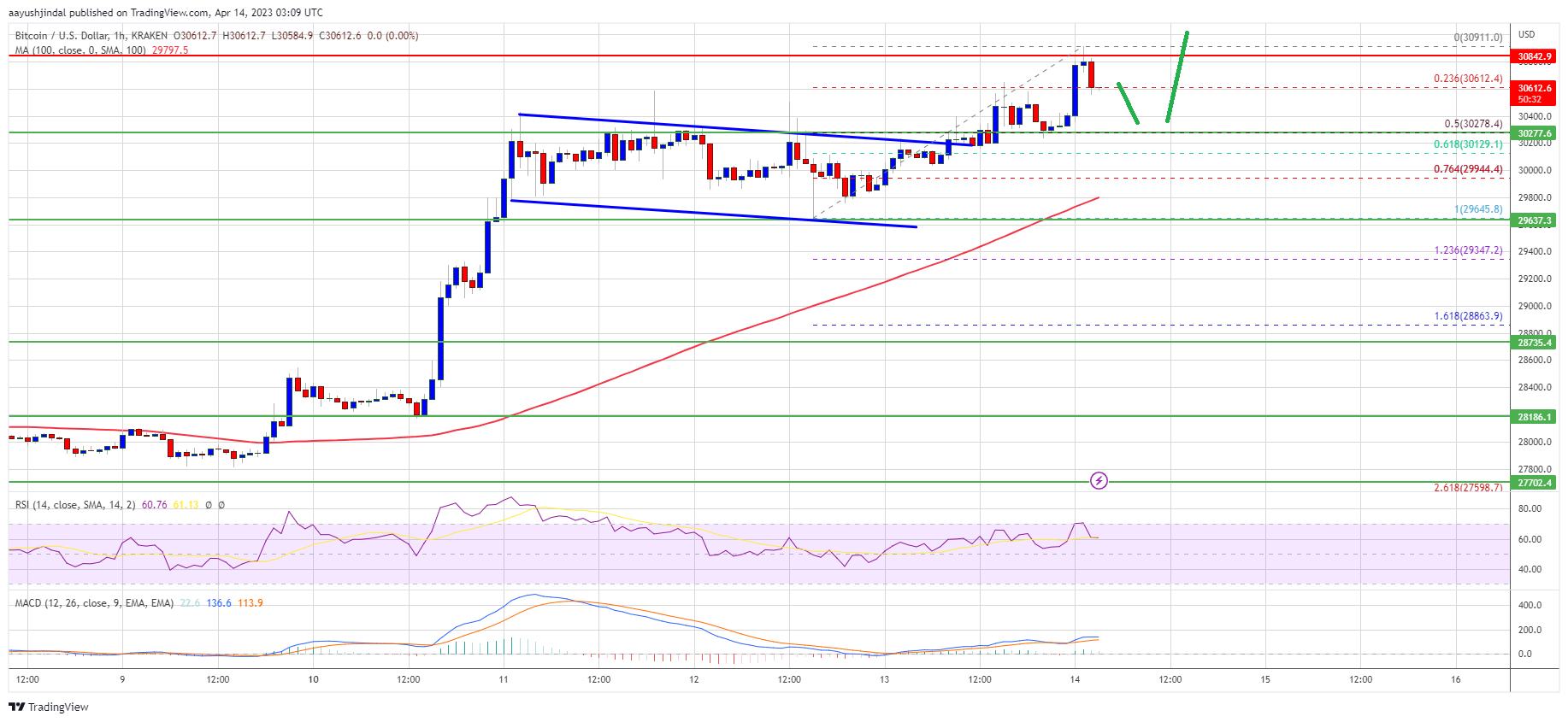
  • There was a break above a major declining channel with resistance near $30,200 on the hourly chart of the BTC/USD pair (data feed from Kraken).
  • The pair could consolidate gains before it starts a fresh increase toward $32,000.

Bitcoin Price Breaks Resistance
Bitcoin price remained well-bid above the $29,650 support zone. BTC started a fresh increase after there was an upside break in Ethereum.
The bulls were able to pump ETH above the $2,000 and $2,050 resistance levels. However, BTC failed to follow a similar pattern and climbed above the $30,250 resistance. There was a break above a major declining channel with resistance near $30,200 on the hourly chart of the BTC/USD pair.

Bitcoin price is now trading above $30,250 and the 100 hourly Simple moving average. It traded as high as $30,911 and is currently consolidating gains above the 23.6% Fib retracement level of the upward move from the $29,645 swing low to the $30,911 high.
Bitcoin Price


Source: BTCUSD on TradingView.com

Immediate resistance is near the $30,850 level. The next major resistance is near the $31,200 zone. A close above the $31,200 resistance might start another increase. In the stated case, the price may perhaps rise toward the $32,000 level. The next key resistance is near the $32,200 level, above which BTC could rise toward the $33,500 level.
Are Dips Supported in BTC?
If Bitcoin’s price fails to clear the $30,750 resistance, it could a downside correction. Immediate support on the downside is near the $30,400 level.
The next major support is near the $30,250 zone or the 50% Fib retracement level of the upward move from the $29,645 swing low to the $30,911 high. A downside break and close below the $30,250 support might push the price toward the $30,000 support. Any more losses could lead the price toward the 100 hourly Simple moving average.


Related Reads

Grayscale: These 15 Profitable Crypto Protocols Are Severely Undervalued

Grayscale Research identifies 15 top-revenue crypto protocols trading at significant valuation discounts, with many at single-digit or even 1x revenue multiples. Protocols like Pump.fun, PancakeSwap, and Meteora have market capitalizations roughly equal to their annual revenue. The report argues these financially-focused protocols (DEXs, lending, staking) are fundamentally undervalued and could benefit from the potential passage of the CLARITY Act, expected as soon as next month. This legislation aims to clarify digital asset regulation, potentially reducing institutional barriers and driving on-chain activity. The analysis breaks down the protocols into three groups: the "1x Club" (market cap ≈ revenue), mid-tier protocols with 3-9x multiples (e.g., Aave, Lido, Jupiter), and high-multiple protocols like Hyperliquid (15x) and Uniswap (37x), where valuation reflects future potential rather than current cash flows. Grayscale applies a traditional DCF model to Aave, suggesting a one-year price target of ~$175, representing ~130% upside from current levels. The report notes a risk-off macro environment since the Iran conflict has further compressed valuations, creating a potential entry window. The conclusion highlights that while the valuation data presents an intriguing opportunity, the investment thesis is contingent on the CLARITY Act's passage and subsequent institutional capital flows. Investors are cautioned to consider Grayscale's inherent conflict of interest as a crypto asset manager with products tied to these assets.

marsbit3m ago

Grayscale: These 15 Profitable Crypto Protocols Are Severely Undervalued

marsbit3m ago

Sam Altman's Personal Alchemy of Wealth: Investing in 400 Companies, Over 10 Deeply Tied to OpenAI

The article investigates Sam Altman's personal wealth strategy, centered around his investments in approximately 400 companies while serving as OpenAI's CEO. Despite not holding direct equity in OpenAI, Altman has built a vast portfolio, with at least 10 of his investments having commercial ties or ongoing negotiations with OpenAI. This creates a complex network of potential conflicts of interest, drawing scrutiny from U.S. congressional committees and state attorneys general. Key investments highlighted include the anti-aging startup Retro Biosciences (valued at $258 million for his stake as of late last year) and the chipmaker Cerebras, whose value soared following an OpenAI procurement deal. His most significant financial gain is linked to the nuclear fusion company Helion, where a recent funding round reportedly increased his stake's value to at least $4.1 billion. The article details a decade-long relationship between Altman, Helion, and OpenAI, including a controversial non-binding power purchase agreement and Altman's efforts to secure investments from OpenAI and its backer SoftBank for Helion. Other points include internal investigations at Tools for Humanity (developer of Worldcoin) and OpenAI's massive contracts with tech giants like Nvidia. According to Forbes, Altman's net worth is around $3.4 billion, ranking him 1251st globally—a rise of over 1400 places since 2024. OpenAI's board states that Altman's external dealings are transparent and potential conflicts are carefully managed.

Odaily星球日报23m ago

Sam Altman's Personal Alchemy of Wealth: Investing in 400 Companies, Over 10 Deeply Tied to OpenAI

Odaily星球日报23m ago

Former SpaceX Engineer Reconstructs Financial Execution System Using First Principles

Former SpaceX engineer Lex Li applies "First Principles Thinking" to financial infrastructure with Plan Execution Lab, recently raising angel funding at a $50M post-money valuation. The team argues that the core function of finance is capital allocation, and the critical gap is not in trading but in execution, which remains highly manual and fragmented. While assets, liquidity, and settlement have migrated on-chain, execution workflows (monitoring, risk management, liquidity coordination) are still human-native. In an era of accelerating AI agents, strategy decay is rapid, shifting the competitive edge from having the best strategy to having the most robust execution network. Plan Execution Lab introduces two core components: 1. **PlanX**: A Financial Execution Protocol designed as infrastructure for the migration from CEX to DEX, providing on-chain execution capabilities, liquidity access, risk management, and capital orchestration. 2. **Xgent**: An Autonomous Financial Runtime. Users define investment intents, risk preferences, and constraints; Xgent automatically constructs an execution graph, verifies it, and handles ongoing execution and optimization—streamlining the process from Intent to Autonomous Execution. The long-term vision is to create the "Bloomberg Terminal for Autonomous Finance"—a shared operating environment and execution network built collectively by participants like execution nodes, liquidity providers, and autonomous agents. The future of finance, they contend, belongs not to isolated algorithms but to open, collaborative execution networks.

marsbit58m ago

Former SpaceX Engineer Reconstructs Financial Execution System Using First Principles

marsbit58m ago

Former SpaceX Engineer Reconstructs Financial Execution System from First Principles

Plan Execution Lab, a financial infrastructure project founded by former SpaceX engineer Lex Li, has raised angel funding at a $50M post-money valuation. The startup is applying "first principles thinking" from Li's SpaceX experience to rethink financial market execution. Their analysis posits that while assets, liquidity, and settlement have moved on-chain, the execution layer remains fundamentally human-dependent and fragmented. In the era of AI Agents, strategy advantages decay rapidly, shifting the competitive edge from isolated algorithms to robust **execution networks**. Plan Execution Lab's solution is a two-part system: **PlanX**, a Financial Execution Protocol designed to facilitate the migration from centralized exchanges (CEX) to on-chain markets by providing core on-chain execution capabilities; and **Xgent**, an Autonomous Financial Runtime. Xgent allows users to define investment goals and constraints, then autonomously constructs and manages the execution logic—moving from **Intent to Execution Graph to Verification to Autonomous Execution**. The long-term vision is to create the "Bloomberg Terminal for Autonomous Finance"—an operating environment not for humans, but for agents and execution nodes. The future financial system, they argue, will be a collaborative network built by diverse participants contributing execution capabilities, not secret strategies. The core competition will shift to who builds the most powerful and adaptive execution network.

链捕手58m ago

Former SpaceX Engineer Reconstructs Financial Execution System from First Principles

链捕手58m ago

Trading

Spot
Futures
活动图片