Ethereum Shanghai unlock had minimal market impact – 84k ETH withdrawn

cryptoslatePublished on 2023-04-13Last updated on 2023-04-13

Abstract

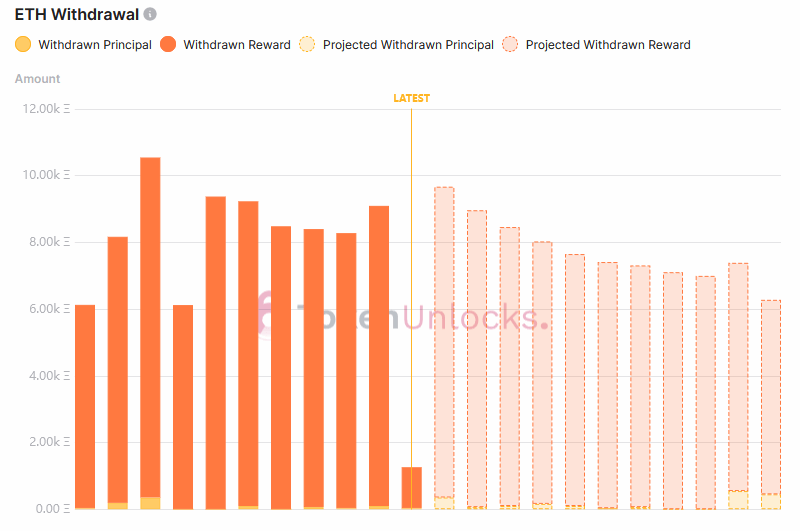
The chart below shows approximately 10,000 tokens are processed every hour. Interestingly, most withdrawals are attributed to “reward” rather than “principal” — indicating that the majority of individuals have chosen partial withdrawals to capitalize on staking profits but still plan to continue as validators.

Data from Token Unlocks showed validators had withdrawn 84,000 Ethereum at the time of press.

This was possible thanks to the Shanghai upgrade, which went live on April 12 at around 22:30 UTC — enabling ETH stakers to re-custody their tokens.

Ethereum withdrawals limited

Staking directly to the Beacon Chain contract required people to become network validators and delegate a minimum balance of 32 ETH. Shanghai allowed people to stop validating, exit the network, and unlock their staking balance plus the rewards accrued.

Those who delegated more than 32 ETH — and wish to unlock some tokens — can opt for a partial withdrawal and continue acting as network validators.

There was much speculation surrounding the upgrade. Some anticipated a surge of withdrawals, leading to a potential drop in the spot price. Meanwhile, others believed that enabling withdrawals would encourage more ETH holders to stake their tokens.

Per Ethereum’s FAQs, to manage outflows, the project has adopted an exit queuing system — with placement determined by the number of tokens requested for withdrawal.

“The exit queue depends on the size of the validator set in the network. This limit exists to regulate the rate of exit and entry into the beacon chain validator set.”

An initial analysis of the numbers shows the Shanghai upgrade had an insignificant impact on the market.

The numbers

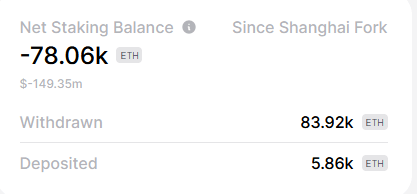
Token Unlocks showed a 2.7% fall in deposits to 17.52 million ETH, with 84,000 ETH withdrawn at the time of press. This figure far outweighed deposits post-Shanghai, leading to a net loss of 78,000 tokens. However, the total pending withdrawals are currently at 825,000 ETH.
Ethereum Shanghai withdrawal stats

Source: token.unlocks.app

The chart below shows approximately 10,000 tokens are processed every hour. Interestingly, most withdrawals are attributed to “reward” rather than “principal” — indicating that the majority of individuals have chosen partial withdrawals to capitalize on staking profits but still plan to continue as validators.w
Ethereum withdrawals

Source: token.unlocks.app

The price of Ethereum grew 3.9% to $1,944 over the past 24 hours. This performance was enough to lead the top 10 cryptocurrencies. Polygon placed second — up 2.8% over the same period.


Related Reads

Stocks Fell Even More Violently Than Crypto, Where Did the Money Go?

From June to late July 2026, global stock markets, particularly technology and semiconductor stocks, experienced severe declines, with South Korea's KOSPI index facing historic circuit breakers and shedding 40% from its June peak. Key catalysts included SK Hynix's earnings miss despite record profits and competitive pressures from China's CXMT IPO. A global forced deleveraging event unfolded, devastating highly leveraged instruments like the 2x leveraged SK Hynix ETF, which lost over 80% of its value. Surprisingly, Bitcoin showed relative stability during this period, rising roughly 15% from its July low. The article clarifies this wasn't due to an inflow of equity flight capital but because Bitcoin had already undergone a significant correction in May and June, with U.S. spot Bitcoin ETFs seeing record outflows. True safe-haven flows went to gold, severing Bitcoin's short-term "digital gold" narrative. The sell-off is characterized not as an AI story collapse but a liquidity-driven清算 of crowded leveraged positions, potentially halfway through according to some analysts. For substantial capital to return to Bitcoin, the article cites necessary conditions: eased global liquidity pressure, a soft-landing Fed rate cut, and regulatory clarity from the stalled U.S. CLARITY Act. The conclusion is that Bitcoin is not a current safe haven but a pre-cleared asset. Its decoupling from tech stocks highlights its potential future role as a non-correlated asset for institutional portfolios, positioning it favorably for when global capital reallocates post-crisis.

marsbit1h ago

Stocks Fell Even More Violently Than Crypto, Where Did the Money Go?

marsbit1h ago

Trading

Spot
活动图片