获得辉瑞投资的VitaDAO能否开启去中心化科学新叙事?

吴说区块链Published on 2023-02-01Last updated on 2023-02-01

Abstract

本文将以 VitaDAO 为例从生物科技领域出发,简析 DeSci 领域。

1 月 30 日,DeSci 赛道长寿初创公司 VitaDAO 宣布完成了融资 410 万美元,融资方包括 Coinbase 的前首席技术官 Balaji Srinivasan、全球最大的药企辉瑞的投资部门 Pfizer Ventures,这也是辉瑞在 Web3 领域的首笔投资。VitaDAO 将会利用这笔资金进一步资助长寿研究项目和将于明年从 DAO 中剥离出来的生物技术初创公司。受该消息影响,VitaDAO 治理 Token VITA 在短时间内上涨 60%。

“”

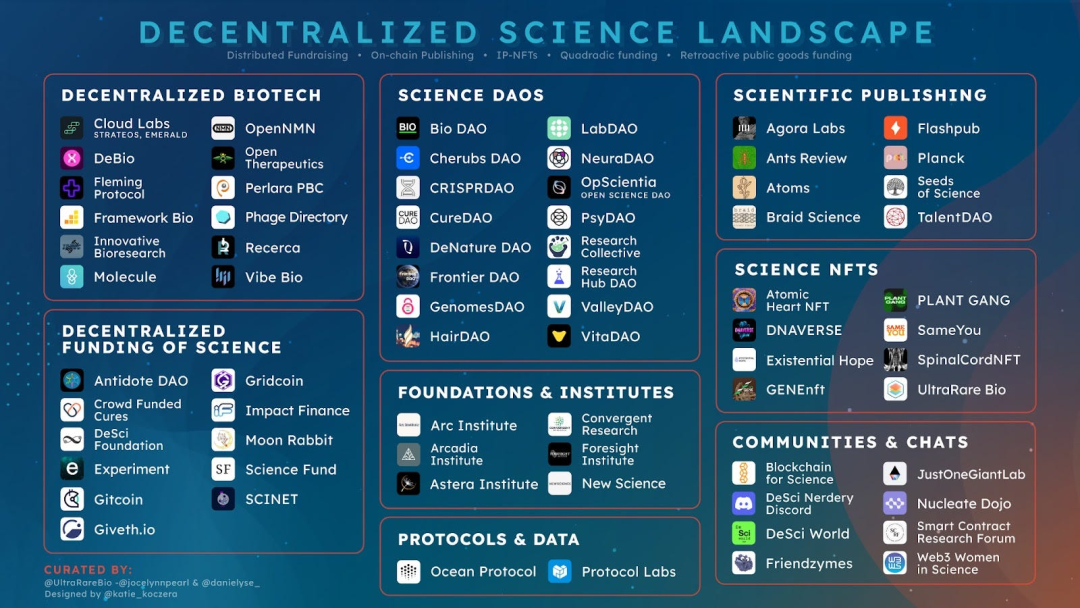
DeSci(Decentralized Science)是一项旨在建立公共基础设施以使用 Web3(包括 NFT、智能合约和 DAO 在内的工具)公平公正地资助、创建、审查、记入、存储和传播科学知识的行动。尽管人类在最近两百年经历了一波指数级别的科技发展,但在现实中还有各种资金、信息获取壁垒,科技与 Web3 的结合或是解决痛点的途径之一。以太坊创始人 Vitalik Buterin 也曾在一次关于去中心化科学的节目中谈到了利用二次方融资以及类似于 VitaDAO 等 DAO 工具来资助和组织科学项目。本文将以 VitaDAO 为例从生物科技领域出发,简析 DeSci 领域。
融资

“”

长期以来,许多生物科技组织只能通过股权融资、银行贷款、政府资助等传统渠道进行融资,但由于大部分生物科技初创公司或组织的研发程序繁琐,即使该组织最终取得成功也需要比较长的周期。如果在经济繁荣情景下,融资机构会保持足够的耐心,甚至大胆向一些只有概念无产品的初创公司大胆投资,但在过去一年美联储加息抑制货币流动性的背景下,热钱会流出这些高风险的初创公司。“木头姐” Cathie Wood 的生物科技基金 ARKG 在 2022 年糟糕的表现进一步佐证了资本对科学发展的限制,许多该领域公司唯有通过裁员、减少开发成本等手段减少支出以存活下来,但同时也会拖累了行业的发展。

“”

VitaDAO 在过去一年的时间里资助超过 15 个研究衰老疾病的项目总金额超过 350 万美元以上,而这些生物技术公司或组织在 Web3 领域尝试进行融资可以说是一项巨大革新。一方面可以体现在融资渠道的改变,初创公司通过 DAO 组织获得 Token 持有者大多数投票便可以获得融资。VitaDAO 通过传统的股权方式或通过发行并出售旨在代表知识产权的 NFT 为初创公司提供资金。作为对研究资金的回报,DAO 成员成为研究产生的知识产权的共同所有者。另一方面则是改善冷门项目研究状况,一改过去只能由机构的资本决定研究方向,更加偏向资助研发周期短或影响力大的项目,让一些冷门但可能是颠覆性的方向研发受阻的状况将会有所改善。
”“

信息交流

”“

当今科学信息输出或获取受限很大程度可以归根于企业、政府垄断信息数据,类似于知网、爱思唯尔付费门槛阻断人们的访问,而政府则有可能对科学信息进行政治干预,挫伤人们获取或输出知识的热情。

”“

去中心化模式不仅降低了组织的准入门槛,也降低个人输出或获取专业信息的难度,帮助消除信息孤岛。首先,DeSci 的出现可以帮助消除科研研究者和评审人之间的中间商,使知识传播更具有包容性。当信息不再具有垄断性时,不仅相关领域的专业人士受益,甚至没学习过相关领域知识的业余人士也可以获得信息,进一步促进了知识平权。其次,社区激励也会助推信息积极输出,VitaDAO 对于贡献数据或专业知识的研究人员和工作组,不仅会给予一定的 VITA Token 激励,还会提供额外的治理权限。此外,利用区块链的抗审查特性、去中心化存储技术,使科学家或特定的社区可以真正的拥有科学数据。

”“

过去我们只能看到 DeSci 更多出现在学术研究和出版领域,而 VitaDAO 与 Mantis Photonics 进行临床实验、获得哥本哈根大学的 Morten Scheibye-Knudsen 实验室和纽卡斯尔大学的 Victor Korolchuk 实验室的新数据等拓宽了 DeSci 的应用场景,使 DeSci 发展进入下一个阶段。随着 VitaDAO 、Antidote DAO、Dynamiculture 这些 DeSci 组织的规模壮大,未来我们不仅能看到场景进一步延伸,更有有机会看到跨国界、跨学界的合作项目。类似于能让全球受益的 Covid-19 疫苗,但被受困于种种因素的不能共享的项目也许在未来会有所突破。

”“

问题

”“

需要明确的是,DeSci 仍然处于初期阶段,该领域仍然存在“DeSci 最终会为谁的利益服务?”“DeSci 是否缺乏一套明确的共同价值观?”等普遍性问题。而这些问题中最需要深虑的是,人们构建 DeSci 最终目的是什么?正如认知神经科学家 Sarah Hamburg 所言,DeSci 只是为科学提供的工具,让科学家无缝集成到日常工作中。DeSci 应该专注于赋予科学家做好科学研究的能力,回归科学,而不是让人们过分关注这些新工具本身,让这些工具沦为被利用的炒作的金融产品。


Related Reads

How Risky is the "Death Spiral" of MSTR and STRC?

Summary: This article explores the perceived "death spiral" risk between MicroStrategy (MSTR), its Bitcoin holdings, and its perpetual preferred stock (STRC), drawing comparisons to the LUNA-UST collapse. While both systems feature price anchors, high yields for holders, and potential feedback loops, their core mechanisms differ fundamentally. The MSTR-STRC structure relies on continuous financing to sustain its high dividend payouts, primarily through stock ATM offerings. A negative feedback cycle could occur: falling MSTR stock price makes raising equity capital harder, increasing pressure to sell Bitcoin, which undermines STRC confidence and further depresses MSTR. However, unlike LUNA-UST's automated, direct linkage, the MSTR-STRC loop is weaker and has brakes: STRC dividends can be deferred or rates lowered, and STRC holders have a $100/share liquidation preference in bankruptcy, providing a price floor. The company's sustainability hinges on its ability to continue financing. Its current ~$900 million USD reserves cover only about 6.3 months of its ~$1.71 billion annual interest/dividend burden. The next six months are critical, aligning with both the potential bottom in Bitcoin's four-year cycle and the depletion timeline of its reserves. While a LUNA-style catastrophic collapse is deemed highly unlikely due to structural differences, the key question is whether MicroStrategy can navigate this period through healthy deleveraging to restart its capital engine.

Foresight News16m ago

How Risky is the "Death Spiral" of MSTR and STRC?

Foresight News16m ago

How Much Debt Does Strategy Really Have? Is There a Risk of Implosion?

MicroStrategy's Debt Risk: A Turning Point in the "Never Sell" Strategy As of June 3, 2026, MicroStrategy holds 843,706 bitcoins (valued at ~$53.1B) but faces significant financial obligations. Its capital structure includes $6.75B in convertible notes and $15.48B in perpetual preferred stock (led by the $8.5B STRC series), creating an annual payout burden of ~$1.71B. With software revenue at only ~$500M, interest and dividend obligations far exceed operating income. A critical shift occurred in late May 2026 when the company sold 32 bitcoins for ~$2.5M to cover dividends, breaking CEO Michael Saylor's long-standing "never sell" pledge. This symbolic move triggered a sharp decline in both Bitcoin's price and MSTR stock, reflecting market fears about cash flow sustainability. The core of the strain is the STRC perpetual preferred stock, designed as a "permanent loan" with no maturity date but requiring high monthly dividends (currently 11.5%). Its business model relies on a three-part cycle: issuing new STRC shares, using proceeds to buy more Bitcoin and fund a USD reserve, and using that reserve to pay dividends. This cycle depends on continuous investor demand for STRC and Bitcoin's price appreciation. Analysis shows Bitcoin needs to appreciate at least 2.3% annually to cover the $1.71B in yearly obligations at current holdings. With Bitcoin price down ~22% from March 2026 highs, this pressure has intensified. The company's $900M USD reserve can only cover about 7 months of payments if STRC issuance stalls. Key risks are not immediate bankruptcy or forced Bitcoin liquidation (as BTC is not collateral), but rather: 1) The erosion of MSTR's premium to its Bitcoin holdings (mNAV), which would cripple its ability to raise cheap capital; 2) A vicious cycle where stagnant Bitcoin prices reduce STRC demand, draining the USD reserve and forcing BTC sales, further depressing prices. The period from February 2027 to September 2028 is a crucial test, with over $5.9B in convertible notes facing put options or maturity. In essence, MicroStrategy has evolved from a simple Bitcoin holder into a complex financial entity acting like a "private Bitcoin bank," leveraging its BTC holdings to create layered financial products. Its survival depends on maintaining Bitcoin's price trend, its stock premium, and market appetite for its preferred shares. The recent token sale marks not a betrayal of its Bitcoin thesis, but an admission that the leveraged strategy must eventually be paid for.

marsbit27m ago

How Much Debt Does Strategy Really Have? Is There a Risk of Implosion?

marsbit27m ago

Anthropic Cries Wolf: Is the AGI Threat Real, or Just an IPO Story?

Anthropic has published an article titled "When AI builds itself," discussing the emerging concept of "recursive self-improvement," where AI begins to actively participate in designing, training, testing, and optimizing its own subsequent versions. The company presents internal data showing that by May 2026, over 80% of code merged into its codebase was written by Claude, its AI model. Claude's capabilities have expanded to handling complex, open-ended engineering tasks, achieving a 76% success rate in such areas, and even contributing to research processes, such as optimizing code performance and conducting AI safety experiments. Anthropic outlines an evolution from human-driven development to AI-assisted workflows, culminating in the current stage where AI agents can autonomously write, run, and delegate code. The company cautions that the path toward a "closed loop," where AI continuously improves itself, is becoming visible. It calls for coordinated global mechanisms to potentially slow or pause frontier AI development to allow safety research and societal structures to catch up. However, the timing of this warning coincides with Anthropic's preparations for an IPO, framing the narrative not just as a safety concern but also as a demonstration of Claude's advanced capabilities and its integral role in accelerating Anthropic's own R&D—creating a potential "flywheel" effect for competitive advantage. This contrasts with OpenAI's recent, more policy-oriented discussion of the same risks, highlighting the competitive dynamics in the AI industry as companies position themselves in both the technological and regulatory landscape.

marsbit1h ago

Anthropic Cries Wolf: Is the AGI Threat Real, or Just an IPO Story?

marsbit1h ago

Trading

Spot
Futures
活动图片



