[Featured Research] 2023 US Market Prediction

EconomistPublished on 2023-01-31Last updated on 2023-01-31

Abstract

Looking under the hood, the latest GDP report also confirms organic growth is rapidly trending down and heading below zero.

In 4-5 months, I expect the US to be in a recession.

Predictions without a timeframe are useless and not actionable.

Now, it seems most analysts ‘‘expect a recession’’.

Ok, but when will it hit and how hard will it be?

The answers to these two questions are very important for asset allocation in 2023.

First of all: shall we agree on what characterizes a recession in the first place?

While many refer to 2 consecutive quarters of negative GDP growth as the main signal for a recession, the NBER instead looks at consumer spending, the labor market and corporate earnings.

GDP reports are delayed and often subject to big revisions.

The NBER methodology is more robust, and it allows us to assess live whether we are in a recession or not mostly looking at consumers, the labor market and earnings growth.

So: let's do that.

Here are 4 leading macro indicators that can help assess when and how hard a recession could hit.

#1: The Global Credit Impulse

When Recession? - March/April 2023

How Bad? - Bad
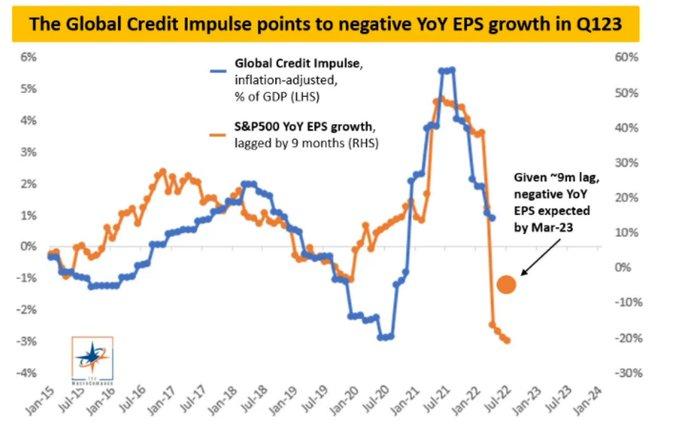
The global credit impulse (blue) leads S&P500 earnings growth (orange) by 9 months, and given its rapid decline in 2022 it’s now pointing to negative YoY EPS by March/April 2023

Rapid declines in the Global Credit Impulse have preceded YoY EPS contraction in the 10-20% area

#2: The Conference Board Leading Indicator Index

When Recession? - April/May 2023

How Bad? - On par with 2001 at least
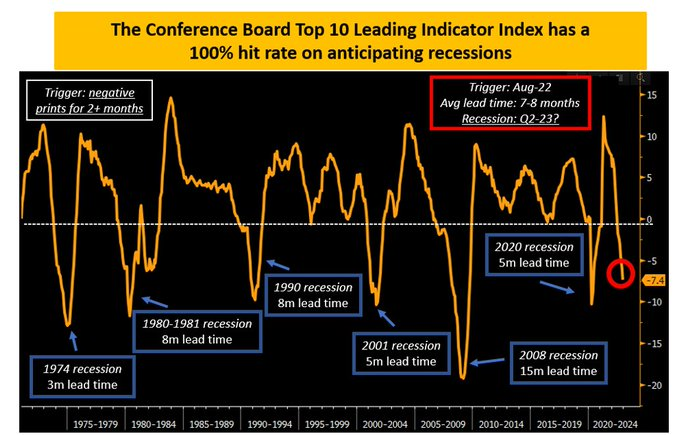
This index incorporates the top 10 statistically significant forward-leading indicators for the US economy.

Over the last 50+ years, every time the YoY series of this index prints in negative territory for 2+ consecutive months a recession is guaranteed.

The Housing Market

When Recession? - May 2023

How Bad? - Pretty bad, given unemployment rate is supposed to breach 7% by early 2024
In 2007 Edward Leamer of the University of California stated that the housing market IS the business cycle

I believe he is fundamentally right

Housing-related jobs and economic activity represent anything between 12-15% of US GDP and employment alone

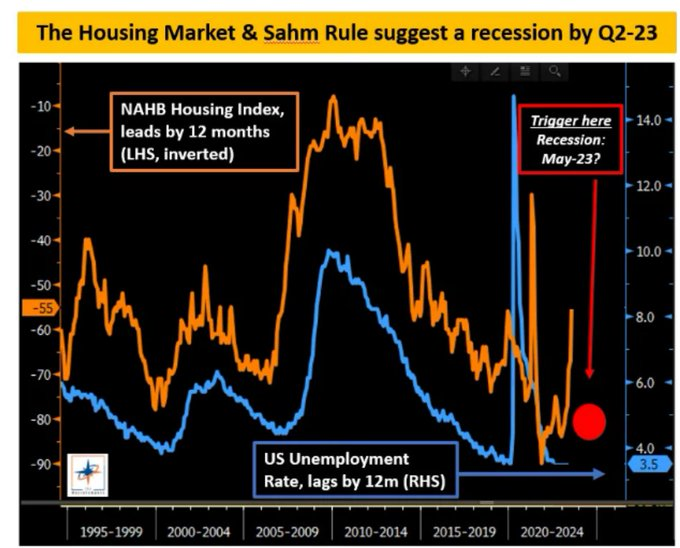
The NAHB housing index (orange, inverted) leads trends in US unemployment rate (blue) by roughly 12 months

According to the Sahm Rule, a recession starts when the 3-month moving average of the US unemployment rate rises by 50+ bps relative to its low during the previous 12m

#4: Philly Fed New Orders

When Recession? - May 2023

How Bad? - Too early to say, probably on par with 2001 at least
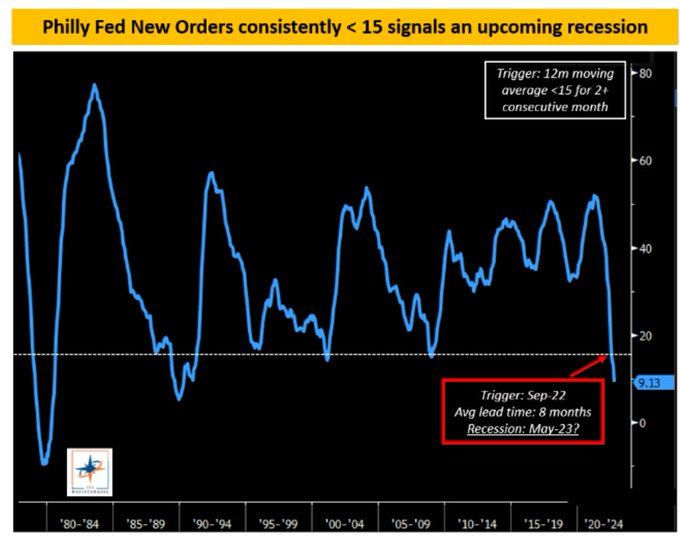
The survey goes out to 125 CEOs of relevant companies who tend to have a good grasp of where economic activity is headed.

Over the last 40 years, every time the 12m moving average of this index dropped below 15 for 2+ months, a recession always followed.

Conclusion: several leading macro indicators are pointing to a US recession starting in 4-5 months, and of a magnitude at least on par with 2001.

Looking under the hood, the latest GDP report also confirms organic growth is rapidly trending down and heading below zero.


Related Reads

The Full Story of How Crypto Unicorn Blockstream Is Mired in Serious Fraud Allegations

This article details serious allegations of fraud against Bitcoin infrastructure company Blockstream, founded by Bitcoin pioneer Adam Back. In June 2024, investigative account NatInfoSec published a report accusing Blockstream's mining note (BMN) program of potentially operating a multi-billion dollar scheme with Ponzi-like characteristics. The core allegations focus on Blockstream Mining Notes (BMNs), which offer investors fixed annual yields up to approximately 20% from Bitcoin mining. NatInfoSec's investigation raises several key issues: 1. **Suspicious Hashrate & Payout Capacity**: The analysis suggests Blockstream would need 20-45 EH/s of mining power to cover its BMN obligations, but its public dashboard shows only around 15 EH/s. Furthermore, no verifiable public evidence (e.g., grid connection records, import data) was found to support the massive mining operation required. 2. **Questionable Payout Source**: The BMN contract allows Blockstream to use Bitcoin from *any source* (Substitute Performance BTC) to fulfill investor payouts, raising concerns that payouts may not come from actual mining revenue. 3. **High-Risk, Fixed Returns**: Offering ~20% fixed yields in the volatile, cyclical Bitcoin mining industry is viewed as highly unusual and requires clear explanation. 4. **Undisclosed Criminal Record of Key Figure**: Christopher William Cook, a key figure in Blockstream's mining operations and CEO of spin-off Exacore, was found to have a federal felony conviction for mail fraud in 2008, a fact not disclosed in BMN offering documents. His background was also allegedly embellished. 5. **Potential Contagion to BSTR SPAC**: Questions were raised about whether these liabilities and Cook's record should have been disclosed in the SEC filings for Bitcoin Standard Treasury Company (BSTR), a separate Adam Back-associated firm planning a SPAC merger. The crypto community is divided. BitMEX Research validated Cook's criminal record and expressed concern over the high yields but found other evidence lacking or misleading, noting the legal separation between BMN, Blockstream, and BSTR. Blockstream defenders, like Samson Mow, argue the mining is real. Critics, however, emphasize the lack of independent, verifiable proof of the mining operation's scale and the true source of investor payouts. The article concludes that BMN remains shrouded in key unanswered questions regarding its actual size, the verifiability of its underlying mining assets and payouts, the source of its high yields, and the full role and disclosure concerning Chris Cook. Blockstream had not issued a comprehensive response at the time of writing.

marsbit5h ago

The Full Story of How Crypto Unicorn Blockstream Is Mired in Serious Fraud Allegations

marsbit5h ago

Trading

Spot
Futures
活动图片