【研报精选】CEX/DEX 比例持续走高,衍生品市场份额超过收益聚合器

TokenInsightPublished on 2023-01-29Last updated on 2023-01-29

Abstract

深入了解 CoinGecko 2022 年度 Crypto 行业报告的 8 大亮点。

整个世界目前处境艰难,在如此难顶的背景下,Crypto 行业在 2022 年遭受重大挫折后,重新找回其核心价值观乃是重中之重。至关重要的是,信任和信誉需要重新建立; 同时,需要加倍努力增加 Crypto 的用户相关性和可用性。2022 年很可能会被视为应该遗忘的一年,但它也应该标志了一个行业的重要转折点。虽然 2023 年对于全面复苏来说可能还为时过早,但我们相信漫长的寒冬过去终会迎来一个去中心化的春天。让我们一起坚持并 Buidl Crypto 的未来吧。

事实证明,2022 年对于 Crypto 行业的项目方和用户而言,是动荡的一年。 Crypto 寒冬已经来临,截至 2023 年 1 月 1 日,Crypto 总市值为 8,290 亿美元,比一年前下降 64%。 尽管 DeFi 代币价格和 NFT 的市场需求依然低靡,但开发者仍在继续开发创新的协议,在过去一年中引发了新趋势和新叙事。

我们的 2022 年度 Crypto 行业报告涵盖了从 Crypto 市场概览到分析比特币和以太坊、深入研究去中心化金融(DeFi)和非同质化代币(NFT)生态系统并且详细审阅了中心化交易所(CEX)和去中心化交易所(DEX)年度表现。

下文优先总结了本报告主要亮点,欢迎点击下载更完整的 49 张报告深入了解。

CoinGecko 2022 年度 Crypto 行业报告的 8 大亮点

以下是 2022 年 Crypto 行业的要点总结:

Crypto 市场在 2022 年第二季度之后一直在横盘整理,处于 1 万亿美元及以下的低位区间。

尽管稳定币主导地位增加,但市值仍缩水了 273 亿美元; 与此同时,USDC 和 BUSD 的市值有所上涨。

FTX 事件蔓延影响了大约超过 100 万用户、债权人和投资者,未来还会有更多。

除原油和美元外,主流资产全线表现不佳。 BTC 是表现最差的资产,下跌了 64.2%。

在以太坊升级 Merge 的推动下,截止 2022 年底,ETH 质押量季度稳定增长至 1,580 万枚。

DeFi 代币市值(不包括稳定币和 wrapped 代币)暴跌 72.9%,衍生品市场份额超过收益聚合器。

在 NFT 市场遭遇的首个寒冬里,OpenSea 的市场份额下滑至 65.4%,但仍占主导地位

现货交易量较 2022 年 1 月萎缩 67.3%,第 4 季度跌幅最大,达 21.2%。

在经历了残酷的第 2 季度后,Crypto 市场的交易量横盘在 1 万亿美元或更低的低位区间
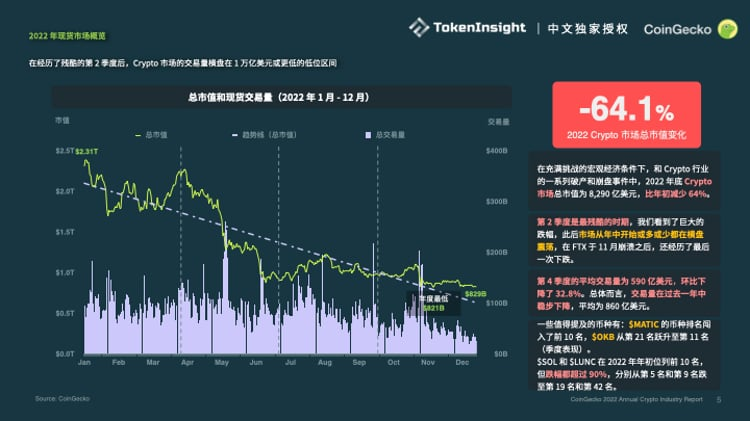
在充满挑战的宏观经济条件下,和 Crypto 行业的一系列破产和崩盘事件中,2022 年底 Crypto 市场总市值为 8,290 亿美元,比年初减少 64%。

第 2 季度是最残酷的时期,出现了巨大的跌幅。随后,市场一直在横盘震荡,直到 2022 年 11 月 FTX 崩盘。

第 4 季度的平均交易量为 590 亿美元,环比下降了 32.8%。总体而言,交易量在过去一年中稳步下降,平均为 860 亿美元。

Crypto 市场的走势与美国股市的走势密切相关,尤其是和 2022 年前三个季度的标准普尔 500 指数。然而在第四季度,这种相关性转为负值,由于 FTX 导致 Crypto 下跌,而股票则在年底出现了复苏。

稳定币市场份额所有增加,但市值缩水 273 亿美元;同时 $USDC 和 $BUSD 的市值有所增长
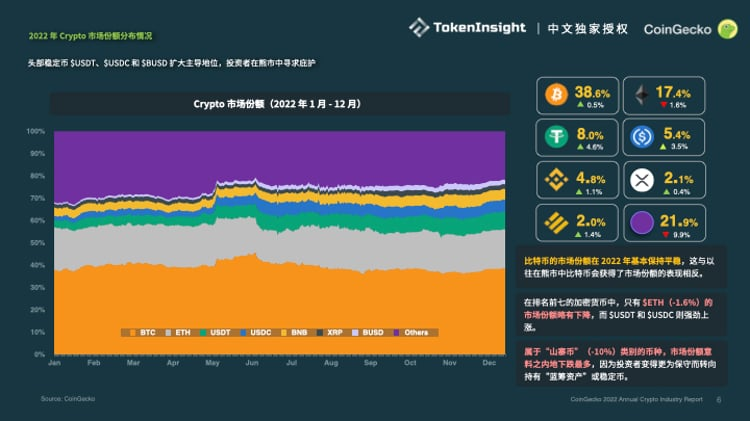
去年,Crypto 投资者转向更安全的资产,前三大稳定币 Tether(USDT)、USD Coin(USDC)和 Binance USD(BUSD)在 Crypto 市场的主导地位不断提高。然而,稳定币市场也未能幸免于资金外流,到年底共损失 273 亿美元(16.6%)。其中大部分损失是在 2022 年 5 月 TerraUSD(UST)崩盘期间产生的。此后该行业表现相对较好,尽管还有另一个脱锚事件导致的周期性的「黑谣言」。

最大的稳定币 $USDT 的市值下降了 16%,大约为 120 亿美元。相反,$USDC 和 $BUSD 各自有一定幅度的增长,各约 20 亿美元。

头部的去中心化稳定币 $DAI(-43%)和 $FRAX(-44%)的损失比例相近,不过绝对值上 $DAI 的 40 亿美元损失几乎是 $FRAX 的 5 倍。

在前 5 名之外,$USDN 在 11 月脱锚后跌出了前 15 名,由 $MIMATIC 取代了它的位置。$USDD 于 5 月推出,现在位于第 8 位,其市值自 6 月以来一直徘徊在 7,000 亿美元左右。

连锁反应使超过百万的用户、债权人及投资人在 FTX 事件中受损; 之后几个月中也出现了多米诺骨牌效应
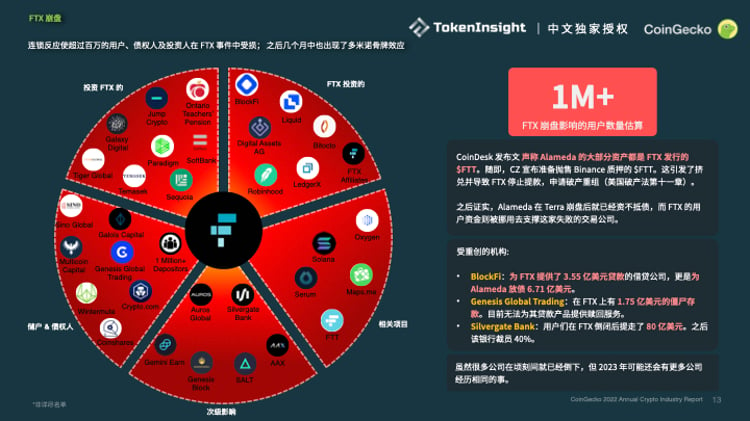
CoinDesk 发布文 声称 Alameda 的大部分资产都是 FTX 发行的 $FTT。随即,CZ 宣布准备抛售 Binance 质押的 $FTT。这引发了挤兑并导致 FTX 停止提款,申请破产重组(美国破产法第十一章)。之后证实,Alameda 在 Terra 崩盘后就已经资不抵债,而 FTX 的用户资金则被挪用去支撑这家失败的交易公司。

举例来说,一些受重创的机构包括:

BlockFi:为 FTX 提供了 3.55 亿美元贷款的借贷公司,更是为 Alameda 放债 6.71 亿美元。

Genesis Global Trading:在 FTX 上有 1.75 亿美元的僵尸存款。目前无法为其贷款产品提供赎回服务。

Silvergate Bank:用户们在 FTX 倒闭后提走了 80 亿美元。之后该银行裁员 40%。

虽然很多公司在顷刻间就已经倒下,但 2023 年可能还会有更多公司经历相同的事。

除原油和美元外,主要资产全线表现不佳; $BTC 是表现最差的资产,跌幅达 64.2%
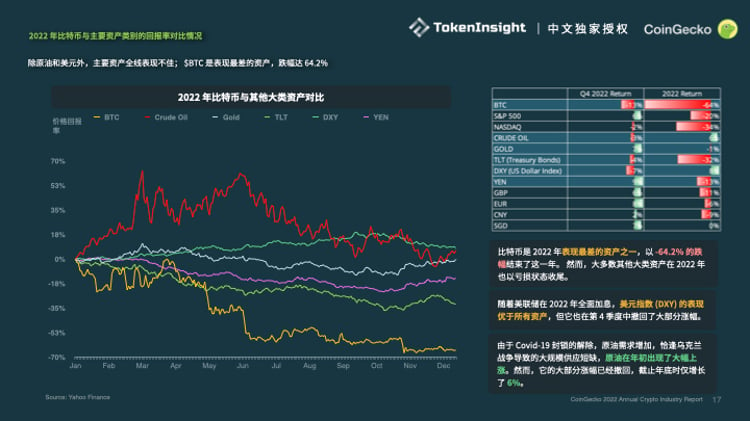
大多数资产,比如黄金和美债,在 2022 年以亏损状态收尾。比特币是这些资产中表现最差的,以 -64.2% 的跌幅结束了这一年。

随着美联储在 2022 年全面加息,美元指数(DXY)的表现优于所有资产。然而,随着加息的放缓,其大部分涨幅在第四季度丧失;DXY 季度环比下降了 -7.4%,年初至今的回报率仅为 8.0%。

由于 Covid-19 封锁的解除,原油需求增加,恰逢乌克兰战争导致的大规模供应短缺,原油在年初出现了大幅上涨。然而,它的大部分涨幅已经撤回,截止年底时仅增长了 6.4%。

在升级的推动下,以太坊质押量在 2022 年稳步增长到了 1,580 万
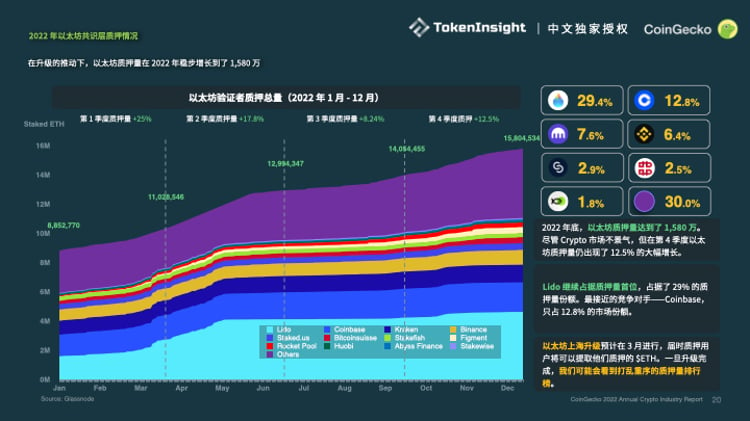
尽管 Crypto 市场不景气,以太坊(ETH)的总质押量呈现稳定的季度增长,在 2022 年第一季度增长了 25%,第二季度增长了 17.8%,第三季度增长了 8.2%,第四季度增长了 12.5%。到年底以太坊的总质押量从 880 万上升到 1,580 万。

2022 年上半年,质押 ETH 的验证者数量的上升可能是由于以太坊合并的看涨情绪所致。在 9 月中旬成功合并后,Crypto 社区开始期待即将到来的上海升级,因为之前的合并升级驱动了上个季度的显著增长。

Lido(LDO)继续占据质押量首位,占据了 29% 的质押量份额。最接近的竞争对手——Coinbase,只占 12.8% 的市场份额。

以太坊上海升级预计在 3 月进行,届时质押用户将可以提取他们质押的 $ETH。一旦升级完成,我们可能会看到打乱重序的质押量排行榜。

DeFi 通证市值暴跌 72.9%,衍生品的市场份额超过了收益聚合器
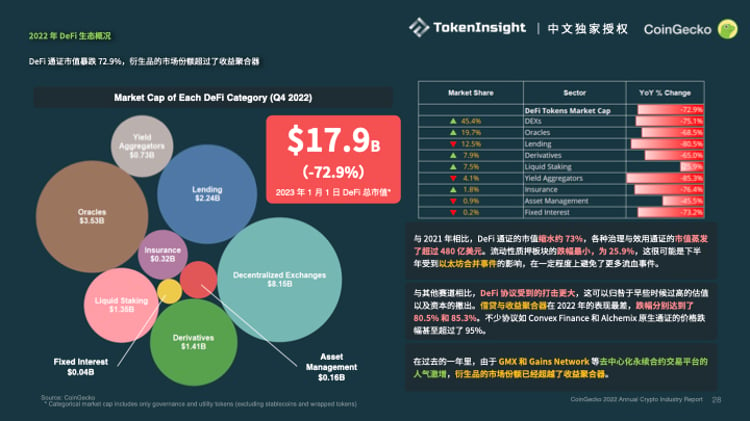
与 2021 年相比,DeFi 通证的市值缩水约 73%,各种治理与效用通证的市值蒸发了超过 480 亿美元。流动性质押板块的跌幅最小,为 25.9%,这很可能是受到第三季度以太坊合并事件的影响。

与其他赛道相比,DeFi 协议受到的打击更大,这可以归咎于早些时候过高的估值以及资本的撤出。借贷与收益聚合器在 2022 年的表现最差,跌幅分别达到了 80.5% 和 85.3%。不少协议如 Convex Finance 和 Alchemix 原生通证的价格跌幅甚至超过了 95%。

尽管同比下降了 65.0%,但衍生品的市场份额保持在 7.9%,使其超过了收益率聚合器——这归功于 GMX(GMX)和 Gains Network(GNS)等去中心化永续合约交易平台的人气激增。

NFT 市场遭遇的首个寒冬里,OpenSea 的市场份额下滑至 65.4%,但仍占主导地位
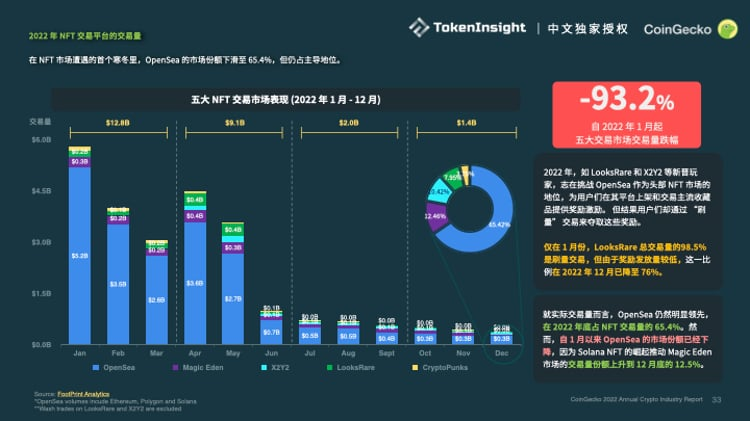
NFT 市场正处于第一个熊市周期——Top 8 链上 NFT 交易量从第一季度的 133 亿美元骤降至 2022 年第四季度的 15 亿美元,下降了 93.1%。同时,自今年年初以来,NFT 创作者的版税也同样减少了 95%。

在 NFT 寒冬中,OpenSea(OpenSea 交易量包括以太坊、Polygon 和 Solana)仍占主导地位,占 NFT 市场交易量的 65.4%,不包括刷量。虽然他们的市场份额自 2022 年 1 月以来减少了 24.3 个百分点,但 Solana NFT 的崛起推动了 Magic Eden 的交易份额,在 2022 年底上升到了 12.5%。

虽然 NFT 市场上出现了许多新的竞争者,例如 LooksRare(LOOKS)和 X2Y2(X2Y2),OpenSea 捍卫住了自己的主导地位。这些竞争者通过发放奖励激励用户在其平台上交易。但用户往往通过刷量来获得这些奖励。2022 年 1 月,LooksRare 上 98.5% 的 NFT 交易量是刷量。此后,由于奖励排放量减少,交易量也在 2022 年 12 月减少到了 75.5%。

现货交易量从 2022 年 1 月起缩水了 67.3%,其中 2022 年四季度的环比下降最多,为 21.2%
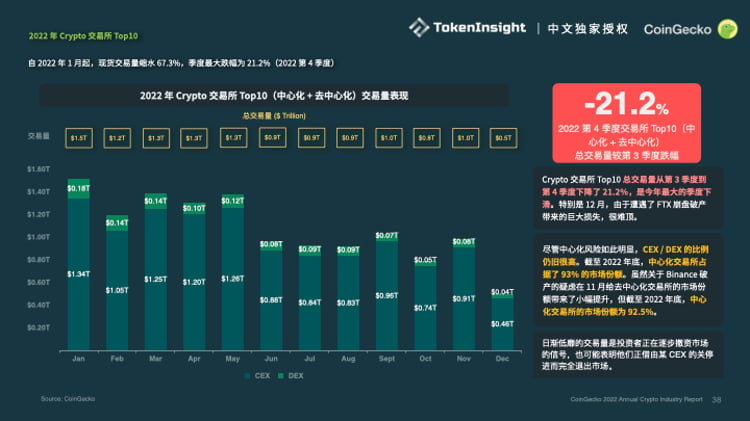
1 月份,Crypto 交易所 Top10 的现货交易量共计 1.5 万亿美元。但在 FTX 倒闭后,12 月的现货交易量下降 67.3%,达到 0.46 万亿美元的全年最低水平。最大的下降(环比)发生在最后一个季度,现货交易总量从第三季度的 2.9 万亿美元下降到 2022 年第四季度的 2.3 万亿美元,下降了 21.2%。

尽管公开展示了中心化的风险,CEX : DEX 的比例仍然持续走高。虽然 DEX 的市场份额在 11 月小幅提升,受益于市场对 Binance 可能会破产的顾虑,但截至 2022 年底,CEX 仍占据了 92.5% 的市场份额。

日渐低靡的交易量是投资者正在逐步撤资市场的信号,也可能表明他们正借由某 CEX 的关停进而完全退出市场。

Related Reads

55TB to 28TB? The Rumor and Panic Behind Rubin's Memory Being Halved

Title: 55TB to 28TB? The Rumor and Panic Behind the Potential Halving of Rubin's Memory. On June 4th, a report from SemiAnalysis suggested NVIDIA's next-gen Vera Rubin NVL72 AI rack may ship with roughly 28TB of SOCAMM DRAM per rack instead of the anticipated 55TB, primarily using 96GB modules. This sparked a market panic, causing Micron's stock to drop over 10% on fears of halved memory demand. However, the article argues this panic is misguided for several key reasons. First, SOCAMM modules are socketed and upgradeable, not soldered. Lower initial configuration doesn't mean permanent demand loss. Second, the primary driver is a severe 2026 LPDDR5X supply shortage, not diminished need. NVIDIA is likely prioritizing rack shipments with available components. Third, with fixed total LPDDR5X supply, using less per rack could allow NVIDIA to ship *more* racks, not necessarily reducing overall memory orders. Micron's sharp drop was also attributed to a broader semiconductor sell-off triggered by Broadcom's earnings, with the SemiAnalysis report providing a convenient narrative for profit-taking after Micron's massive rally. In summary: the report on lower default configurations is likely accurate, but interpreting it as a demand collapse is wrong. The real risk for Micron lies in its reportedly minimal HBM4 share for Rubin, not in potentially flexible SOCAMM demand. The sell-off appears more like a correction amplified by coinciding negative catalysts.

marsbit3m ago

55TB to 28TB? The Rumor and Panic Behind Rubin's Memory Being Halved

marsbit3m ago

Exclusive from Yingke | Tang Wenbin's 'Yuanli Lingji' Merges with Logistics Robotics Company, and Secures Investment from Zhipu, SenseTime, Jieyue, and Others

Exclusive report: Embodied AI company "Yuanli Lingji" recently completed a new round of financing from major AI model firms including Zhipu AI, Stepfun, and SenseTime, alongside continued investments from industrial backers like Huaqin and SAIC Hengxu. Founded in March 2025 by Tang Wenbin, former co-founder and CTO of Megvii, Yuanli Lingji is a general-purpose embodied AI model company. In a notable move, the company has merged with logistics robotics firm "Atomix" (formerly known as Yuanli Juhe) through a share acquisition. Atomix, which originated from Megvii's logistics robotics business led by Tang in 2016 and was spun off in July 2024, has grown to become the world's second-largest supplier of pallet shuttle robots, with annual revenue nearing 1 billion RMB and over 500 projects globally for clients like Uniqlo and CATL. This merger aims to break the industry's "data deadlock" by combining Atomix's extensive real-world operational data from more than 20 countries with Yuanli Lingji's model training capabilities. The company's embodied AI model "DM0" utilizes a cross-domain training approach, integrating internet semantics, autonomous driving rules, and robotics data to achieve hardware-agnostic, precise manipulation even with a compact 2.4B parameter size. The collective investment from key AI players and the strategic merger signal a shift in the competitive landscape, as major model companies pivot from language tokens to physical actions ("from Token to Action"). The industry is entering a consolidation phase where hardware, AI models, data, and application scenarios converge to scale embodied intelligence, a trend mirrored by recent moves from giants like ByteDance and Skild AI.

marsbit11m ago

Exclusive from Yingke | Tang Wenbin's 'Yuanli Lingji' Merges with Logistics Robotics Company, and Secures Investment from Zhipu, SenseTime, Jieyue, and Others

marsbit11m ago

U.S. Stock Market Trends: Dow Hits New High, Nasdaq Falls, Whom Did Broadcom's Slap Wake Up?

U.S. Stocks Split: Dow Hits Record High as Nasdaq Slips; Broadcom's Plunge Sparks Rotation On June 4, the U.S. stock market saw a sharp divergence. The Dow Jones surged 875 points (+1.73%) to a record high of 51,561.93, while the Nasdaq Composite edged down 0.09%. The S&P 500 rose 0.41%. The primary catalyst was a sharp sell-off in AI-related chip stocks, led by Broadcom (AVGO). Despite reporting a 143% year-over-year jump in AI semiconductor revenue to $10.8 billion, the company's shares plunged about 14%. This was triggered by its maintained long-term AI revenue target, which failed to meet heightened expectations for a stock that had gained 55% this quarter and traded at a high P/E ratio. The slide dragged down the broader semiconductor sector and the technology板块. Conversely, money rotated into sectors like Healthcare (+3.14%), Financials (+2.67%), and Real Estate (+1.87%). UnitedHealth and Goldman Sachs were major contributors to the Dow's gains. The rotation was attributed to a search for value outside overheated tech names and a slight dip in Treasury yields. In other major news, SpaceX confirmed its IPO for June 12, targeting a record $75 billion raise at a ~$1.75 trillion valuation. Additionally, initial jobless claims rose to a four-month high, adding nuance to the labor market narrative ahead of the key May non-farm payrolls report. The day's action signaled that while the AI growth story remains intact, excessive valuations are prompting a market reassessment. Funds are moving, at least temporarily, from high-flying tech to more defensive and value-oriented sectors. The sustainability of this rotation hinges on upcoming economic data, particularly the jobs report, and the market's absorption of the massive SpaceX IPO.

marsbit14m ago

U.S. Stock Market Trends: Dow Hits New High, Nasdaq Falls, Whom Did Broadcom's Slap Wake Up?

marsbit14m ago

From 'Old Dogs' to 'New Darlings': How AI is Revaluing Old Infrastructure, from Dell to Nokia

"Old Dogs" Become AI's New Darlings: Revaluing Legacy Infrastructure The AI investment narrative is shifting. Beyond the spotlight on core chipmakers like Nvidia, a new wave of interest is rising for legacy tech companies—Dell, HPE, Nokia, Cisco, Corning, Western Digital—once labeled as slow-growth, outdated stories. This resurgence stems from AI's evolution from model development to real-world deployment, creating massive demand for physical infrastructure. As AI moves into data center construction and enterprise adoption, the focus turns to who can actually build and deliver complex systems. These established players hold decades of experience in supply chains, integration, networking, and enterprise delivery—assets now critical for scaling AI. The revaluation can be grouped into three key infrastructure areas: 1. **Servers & Integration (e.g., Dell, HPE):** They are becoming essential system integrators, transforming GPUs into full-scale AI servers with networking, power, and cooling, then delivering them to clients. Strong recent earnings and AI-specific revenue/order growth for Dell and HPE underscore this shift. 2. **Networking & Connectivity (e.g., Corning, Nokia, Cisco):** As AI clusters grow, high-speed data transfer becomes paramount. Corning benefits from fiber demand for data center links, Nokia is exploring AI-integrated wireless networks (AI-RAN), and Cisco sees surging orders for data center switches—all critical for efficient AI operations. 3. **Storage (e.g., Western Digital, Seagate):** The AI data explosion requires vast capacity. Beyond high-speed memory (HBM), there's growing need for high-capacity HDDs to store training data, logs, video, and cold/archival data cost-effectively. This revaluation, however, is not a blanket endorsement. True reassessment requires concrete proof: AI-driven orders and revenue growth, upward revisions to company guidance, and sustainable improvements in profit quality, not just top-line sales. In essence, AI is not turning all old tech firms into high-growth stocks; it is selectively re-pricing the "old assets" of companies that are mission-critical for building the new AI infrastructure, transforming their legacy capabilities into renewed growth engines.

marsbit23m ago

From 'Old Dogs' to 'New Darlings': How AI is Revaluing Old Infrastructure, from Dell to Nokia

marsbit23m ago

Trading

Spot
Futures
活动图片




