Source: Weixi Zhibei
Yesterday morning, my social media feed was flooded with news about WeChat integrating OpenClaw as a plugin.
Phrases like "WeChat ends the game" started circulating again, just like when DeepSeek was integrated into WeChat Search.
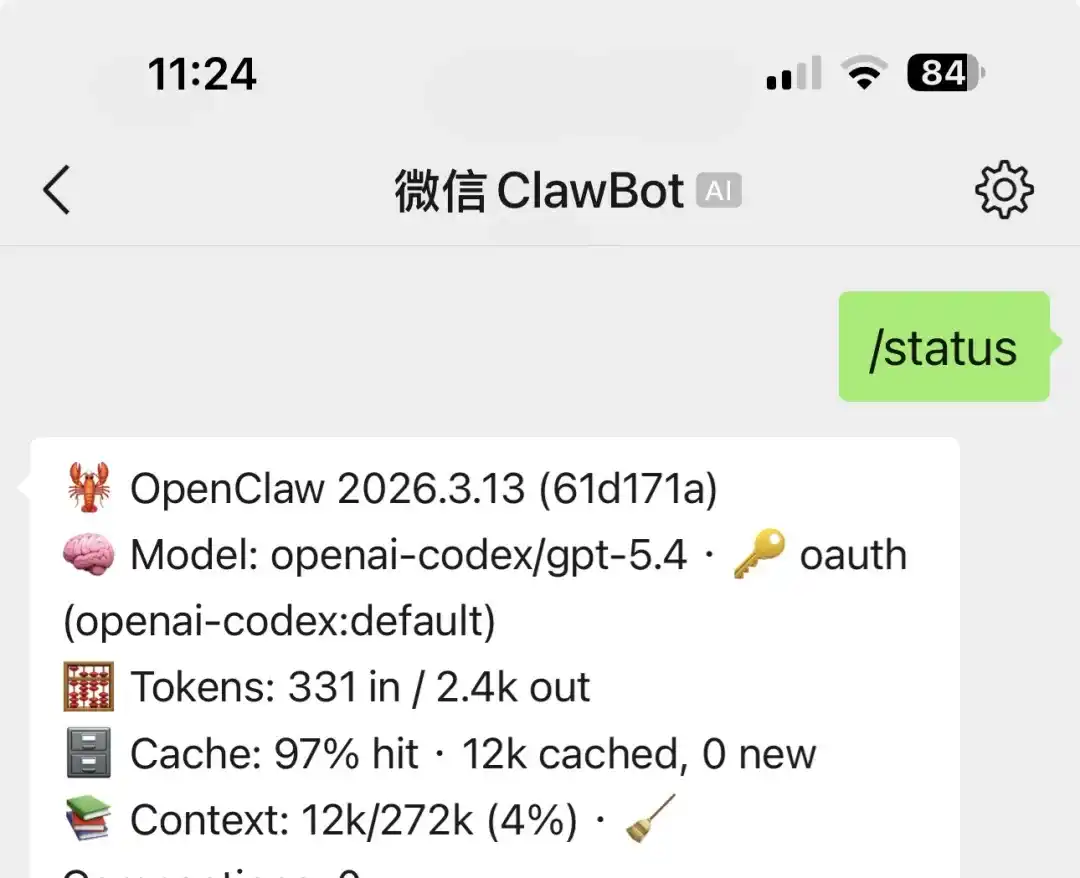
The first message I sent to my shrimp on WeChat
But what I want to say is: its impact might not be as significant as we imagine.
This is more of a minor, expected move by WeChat.
Below are my ten cold takes—
1. First, look at the features of WeChat's OpenClaw itself
First, it's not that WeChat has launched a new shrimp; rather, you already have your own shrimp, and now, officially, you can chat with it within WeChat.
Specifically, it exists as a plugin in WeChat. Official documentation
In this sense, WeChat's earlier plugin architecture was quite foresighted, allowing flexible support for many new, experimental features.
Lu Shuzan, an early member of the WeChat team, previously wrote an article titled "WeChat Team's Laboratory Culture," which is highly recommended reading.
It supports various versions of shrimp on the market, whether local, cloud-based, modified, or even knockoffs.
Theoretically, as long as the shrimp hasn't heavily modified the OpenClaw plugin module, WeChat supports it. Some have even used the protocol code of WeChat's plugin to create a project that allows WeChat to support ClaudeCode, CodeX, and any AI backend, not limited to shrimp. Project address: https://github.com/wong2/weixin-agent-sdk (This is important and will be discussed later.)
The entire integration process is very simple: install the plugin, scan the QR code with WeChat, and you're done. It takes just 2 minutes, even simpler than Telegram.
Now, let's look at some of its minor features—
1. Does not support group chats. (More for security reasons, which will be discussed later)
2. Does not support streaming output. (Domestically, only Feishu supports this, if I'm not mistaken)
3. Supports name changes but not avatar changes; can be pinned;
4. The Mac version doesn't seem to be updated yet; the "WeChat clawbot" contact isn't visible;
6. Supports OpenClaw's slash commands;
7. Supports file transfers;
8. When selecting a conversation, only supports copy, forward, quote, and delete; does not support multi-select, translate, efficiency, search, multi-select, or收藏; (Yuanbao supports all buttons, which is an interesting difference)
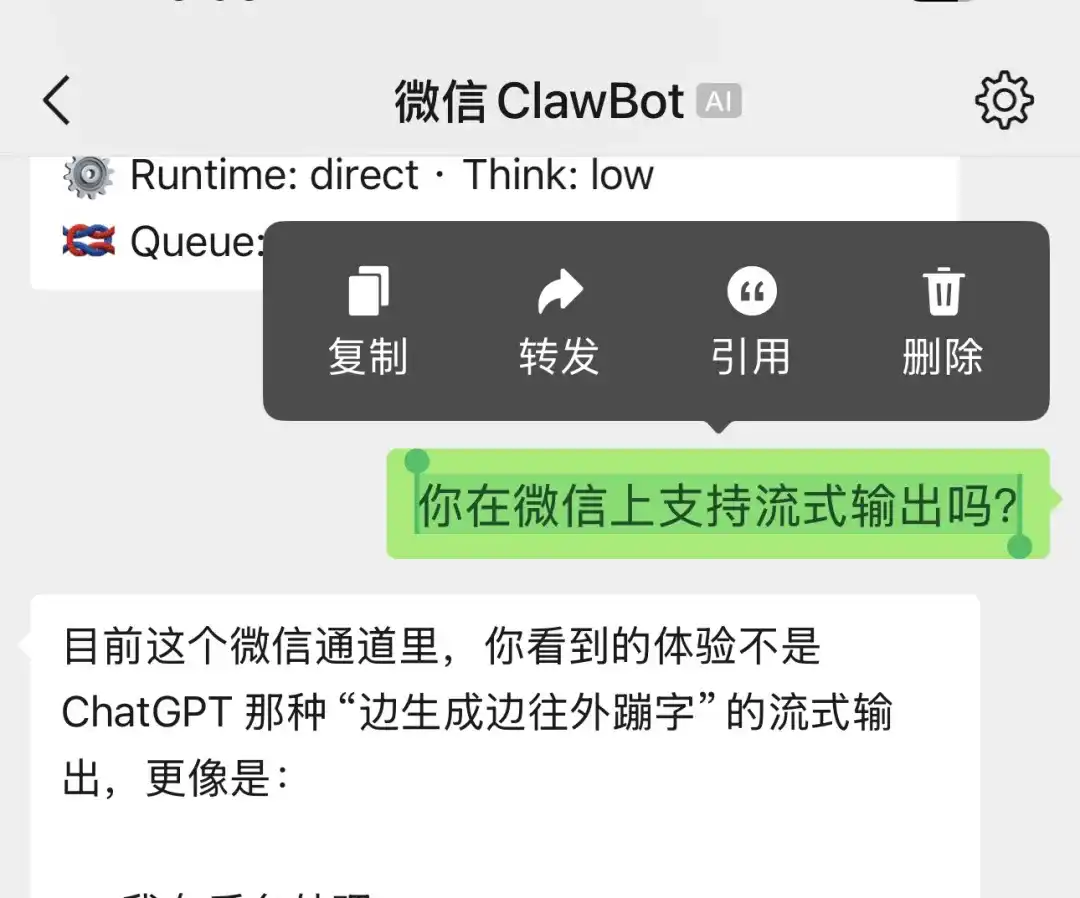
9. Only supports connecting one shrimp.
10. Poor support for Markdown formatting;
11. Does not support forwarding others' conversations to "WeChat clawbot." (This is puzzling; even Yuanbao in WeChat supports it)
So, frankly, quite a few features are missing, and the experience feels somewhat limited.
For example, what I can't accept is only supporting one shrimp. I created three sub-Agents in OpenClaw, and I can't communicate with them, whereas in Telegram, I just need to create a new bot.
2. WeChat's move isn't particularly fast
Some say WeChat acted quickly, but I think this move isn't that fast.
Let's compare briefly: when DeepSeek went viral a year ago, it was around January 25th (DeepSeek started supporting online search + deep thinking).
WeChat Search integrated DeepSeek on February 17th, meaning only 20 days passed in between.
This time, if we count from the Spring Festival, it's been over a month since WeChat officially acted. (This comparison is rough, but it at least shows it's not particularly fast)
Of course, modifying search and modifying WeChat's contact list are different. I understand it's more about security concerns. Development cost is definitely not the bottleneck for WeChat's launch.
When Brother Long acts, he ensures it's foolproof.
There are different opinions in the industry. Dachein on Jike believes WeChat has been quite aggressive—
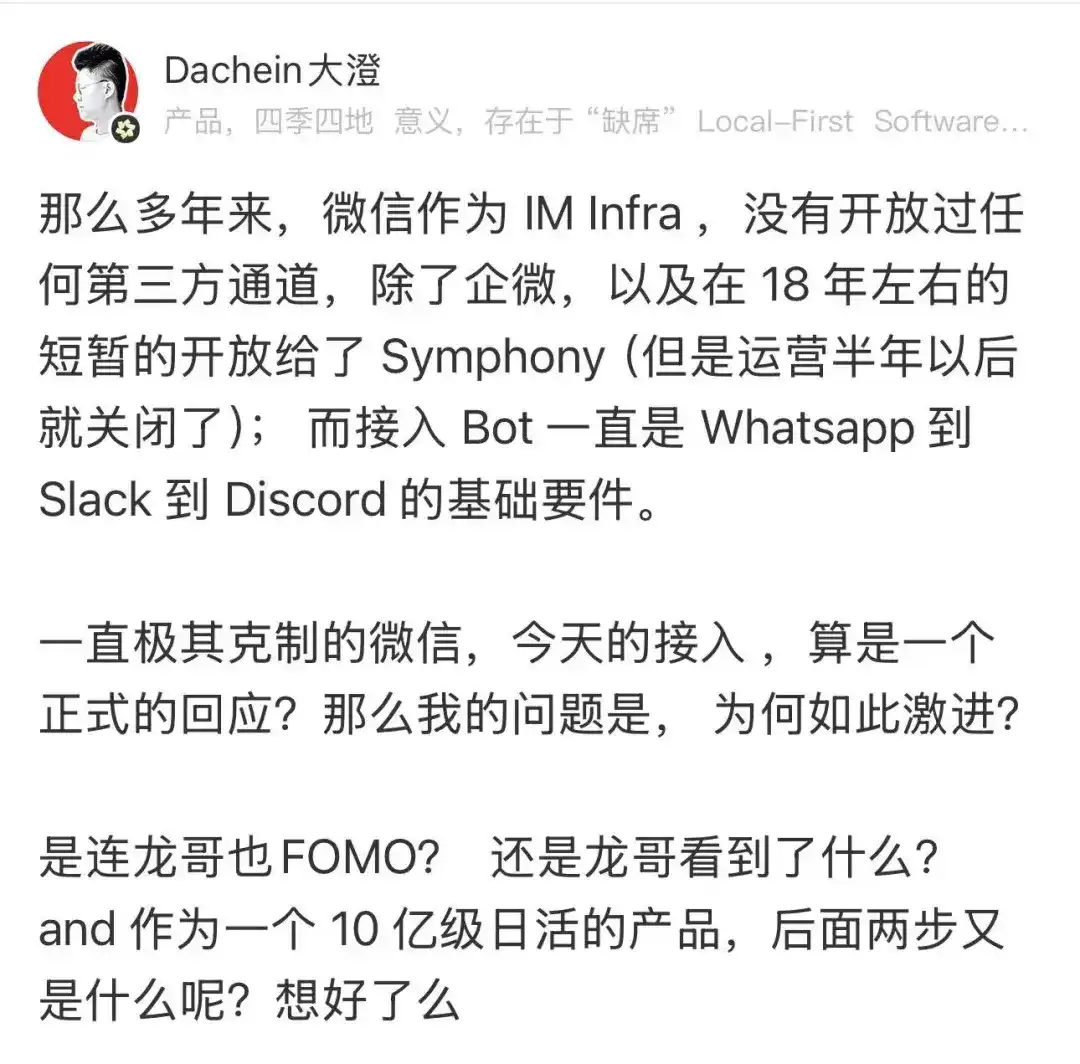
I personally don't agree with this view. Being a bit aggressive is fine; being overly conservative is what's worrying.
Apple's push into AI is an example—taking too long to produce something usable is concerning. (In fact, many in the industry have already compared WeChat and Apple in terms of AI.)
3. WeChat's solution is elegant
Previously, Tencent also launched several different shrimps, both local and cloud-based.
Their integration with WeChat was relatively awkward: some through mini-programs, some through WeChat's customer service messages. These weren't truly native support.
I initially thought this might be because the WeChat team felt these products hadn't fully proven themselves yet, and they would wait until one truly stood out before offering native support.
Now, it seems I underestimated Brother Long's vision.
Brother Long waved his hand and said, "I won't support each of you individually, but I'll support all of you—not just you, but everyone on the market."
What is top-level design?
This is top-level design.
WeChat only acts as a remote control—you send commands in WeChat, the shrimp executes them on your computer (or in the cloud), and the results are sent back to WeChat. WeChat's data boundaries remain intact.
It's a classic platform mindset.
4. WeChat likely won't add group chat functionality to OpenClaw for a long time.
For WeChat, security cannot be overemphasized.
Doubao Mobile was blocked by WeChat in less than two days because it used system-level permissions to simulate clicks across applications.
This is also an important reason why group chat wasn't included in this OpenClaw launch.
Clearly, from a technical perspective, adding group chat is trivial.
My judgment is that it probably won't be added for a long time, if ever.
After all, group chat involves security risks that are very uncontrollable.
I previously wrote an article titled "Your Shrimp Might Be Naked—Starting from a Chilling Research Paper," which told several fascinating stories (incidents).
The core idea is: once group chat is available, people will inevitably try to hack your shrimp, leading to endless security issues.
So WeChat will be extremely cautious.
After all, for WeChat, its 1.4 billion social connections are its core asset and its Achilles' heel.
It doesn't dare act recklessly.
5. WeChat's integration of OpenClaw itself doesn't lower the barrier to raising shrimp
Many might think that with WeChat's integration, the barrier to raising shrimp is lowered.
Wrong.
WeChat lowers the barrier to chatting with your shrimp, not the barrier to raising shrimp itself.
Those who have actually raised shrimp and made them more valuable than Chatbot already know—
The core bottleneck in raising shrimp isn't the tool used to communicate with it.
There are a series of costs beyond operation—
For example, the model used is crucial. Using a low-IQ model results in an experience worse than Doubao.
Then there's the setup of soul.md and user.md. Without proper setup, it's tasteless. And your familiarity with memory and skills.
There are also many hidden costs—understanding the boundaries of what an Agent can do is a matter of principle.
So, WeChat's integration of OpenClaw is certainly beneficial for many, reducing visible costs. But the most important thing is to consciously delegate more tasks to the Agent, using it more natively and maximally.
Truly treat it as leverage.
There's a saying that goes very well—
"At this point, if you're doing many things manually, it means your manual skills aren't great."
6. For WeChat, this is more like something it should have done
For WeChat and its users, this is certainly valuable and meaningful, but its impact might be smaller than we imagine.
Take Telegram, for example. OpenClaw has supported it since its inception, but how much has that contributed to Telegram?
It's hard to assess specifically.
User awareness is still about OpenClaw itself, not Telegram.
This should be understood more as: if you don't do it, it might benefit other IMs that do;
but if you do it, how much it benefits you is questionable.
After all, you're already the infrastructure.
So, I prefer to think—WeChat's integration this time is merely an endorsement of its role as a mainstream chat infrastructure.
However, this is clearly not good news for Feishu, Enterprise WeChat, and DingTalk, which have recently been keen on promoting one-click shrimp integration.
7. How much value it can deliver depends on OpenClaw's own value space
If you know how to raise shrimp, you can do it on Feishu, Enterprise WeChat, Telegram, or QQ.
If you don't know how to raise shrimp, even with WeChat integration, you still won't know how.
Simply put, Yuanbao also natively supports WeChat, but in reality, how often do we directly communicate with Yuanbao within WeChat?
Most people probably still prefer using Doubao or even opening Yuanbao's App. (Of course, it's not entirely useless. When I taught AI to seniors in Haidian's Wenquan Town, some preferred chatting with Yuanbao in WeChat because it was the only App they knew how to use. But OpenClaw's logic is completely different)
WeChat seems to have created a feature for everyone, but the actual audience—those who already raise shrimp—likely represents a small percentage of WeChat's total user base.
This brings us back to an old issue: tech circles think the world has changed, while ordinary users feel nothing happened.
Deeply understanding that technology penetration takes time is also important.
The 80/20 rule always applies. Feel this image again—

8. This integration is a purely tool-based addition, not integrated with other WeChat modules.
This integration essentially adds a separate角色 to your contact list, nothing more.
It can't read your朋友圈, can't order food for you.
In fact, anything you ask it to do has no direct relation to WeChat itself, except that the communication happens on WeChat.
Yes, it's glued on with transparent tape.
Let's look at another thing—
According to a March report by The Information, WeChat has long been secretly advancing its own AI Agent project, starting as early as 2025.
This project is much more ambitious—it aims to directly integrate with the vast number of mini-programs within the WeChat ecosystem, like ride-hailing, food delivery, grocery shopping, and ticket booking (somewhat similar to what Qianwen is doing). It's reported to begin灰度 testing around mid-2026.
In other words, what WeChat itself is building is completely different from this OpenClaw integration.
But these two things don't conflict.
The OpenClaw integration addresses the immediate needs of current shrimp raisers—they already need a place to talk to their shrimp.
If WeChat didn't do it, they'd go to Feishu, Telegram, or Enterprise WeChat, and WeChat would lose user engagement time.
But once WeChat's own Agent launches, that's the real show. If an AI Agent can directly调度 these mini-programs' capabilities, that's the full-powered version of WeChat AI.
So this pure tool integration is a prologue. WeChat first lets you get used to chatting with AI in your contact list. Once you're accustomed, it will gradually integrate other modules, making user acceptance much higher.
First make it normal, then make it useful.
Brother Long has always been like this.
9. We need to gradually get used to more non-human contacts appearing in WeChat
First came Yuanbao, then WeChat customer service messages some time ago, now OpenClaw, and later WeChat's own Agent.
Think about it: before this, every contact in WeChat's contact list was a real person. (Enterprise accounts and official accounts don't count; they're not in the contact list).
Now, WeChat officially acknowledges a new existence: your contact list can include a contact that isn't human.
This shift is quite subtle.
WeChat's core narrative has always been: connecting people. But from the moment OpenClaw was integrated, it is, in fact, also connecting people and AI.
This change might be more profound than functional changes.
Because once users accept that AI can exist in their contact list, what's next?
It becomes natural for AI to do certain things within WeChat.
This change might come faster than we think.
10. WeChat chose not to build its own shrimp, which is a significant product decision
Have you ever wondered: with the resources and technical capabilities of the WeChat team, WeChat could easily build its own shrimp—like Qclaw, built directly into WeChat, ready to use out of the box.
But WeChat didn't do that.
This decision not to do something is more worth analyzing than what was done.
If you build a shrimp, you're just one among thousands in the shrimp wars. If you build connections, you become the infrastructure.
WeChat isn't entirely avoiding building a shrimp; as mentioned in point 6, there's WeChat's internal AI Agent project, which is, in a sense, a shrimp with WeChat's DNA—a shrimp with无限 bandwidth communication with WeChat.
So the question is: when WeChat's own Agent officially launches, what will its relationship be with OpenClaw shrimp?
Once WeChat's own Agent is online, its entry point, promotion resources, and position in WeChat's interface will likely have much higher priority than OpenClaw shrimp.
After all, it's the亲儿子 (favored son).
This time, WeChat chose to support all shrimp compatible with the OpenClaw protocol, not just Tencent's own, positioning itself as a neutral platform.
How other shrimps will differentiate themselves and compete with WeChat's chosen one in the future is worth pondering.
Conclusion
We tend to overestimate the short-term impact of something and underestimate its long-term impact.
WeChat's integration of OpenClaw won't change much in the short term.
But looking back ten years from now, this might be the starting point for WeChat's shift from connecting people to people, to叠加 (overlaying) connections between people and AI.
Recall the history of QR code普及.
When WeChat added the Scan function in 2012, most Chinese had no idea what a QR code was. WeChat didn't do user education; it just placed Scan within WeChat.
Then users wondered: what can this thing do?
Then merchants started posting QR codes, and mobile payments followed.
Placing it within WeChat itself is what mattered.
Every step WeChat takes seems small, but in retrospect, each step is quite precise.
This time is no different.
It's just that Brother Long is never in a hurry.






