13 亿爆仓 + 18 亿 ETF 出逃,市场还有翻盘机会吗?

华尔街见闻Published on 2025-11-04Last updated on 2026-04-01

Abstract

若无法守住当前阵地,更深度的回调或将到来,交易员正密切关注9.6万美元这一关键支撑区域。

比特币价格失守10万美元的关键心理关口。


周二,比特币价格加速下挫,自6月以来首次跌破10万美元大关,一度下探至99932美元附近,并跌穿200日移动均线,创下年内第二大单日跌幅。市值排名第二的以太坊同样暴跌超10%,跌至3225美元附近。

(比特币跌穿200日均线)


据coinglass统计,过去24小时全网有34.2万人被爆仓,爆仓金额超过13亿美元,其中多头头寸占损失的85%。

(全网加密货币总爆仓数据)


分析认为抛售压力的背后,是美联储主席鲍威尔上周发表的鹰派言论。他淡化了市场对12月降息的预期,再次强化了利率将在“更长时间内保持高位”的叙事。这一转变推动美元走强,对比特币等非生息资产构成了直接压力。


与此同时,数据显示,投资者在过去四个交易日内从比特币和以太坊相关ETF产品中撤出了超过18亿美元,进一步加剧了市场的流动性紧张。


分析师警告称,若无法守住当前阵地,更深度的回调或将到来,交易员正密切关注9.6万美元这一关键支撑区域。


技术位告急与市场情绪恶化

十万美元不仅是心理关口,也是重要的技术支撑位。


市场分析师Damian Chmiel指出,如果比特币价格持续低于10万美元,可能会引发更急剧的抛售,下一个目标将是4月份接近7.4万美元的低点,这意味着较当前水平仍有约30%的潜在下行空间。


加密货币恐惧与贪婪指数滑入“极度恐惧”区间,也印证了市场普遍的悲观预期。

(市场陷入“极度恐惧”区间)


Ultima Markets资深分析师Elon Gu指出,从技术形态上看,比特币想要反转上行,首先要先夺回位于约11.1万美元的21日指数移动平均线(EMA)和成交密集区。在此之上,11.6万美元将是接下来的关键阻力位。


目前,比特币暂时与全球流动性的持续上升脱钩,其相对黄金的价格也回到了一个关键支撑水平。

(比特币与黄金比率再度回到25支撑价位附近)


宏观逆风与资金流出

当前加密货币市场正面临多重短期阻力。


据彭博报道,Caladan研究主管Derek Lim表示:


加密市场本就因10月份的大规模清算事件和一系列协议漏洞而显得脆弱不堪。

美联储的政策风向转变是压垮市场的又一根稻草。鲍威尔的言论打破了投资者对宽松货币政策的幻想,导致风险资产普遍承压。


资金流出是市场疲软的直接体现。除了现货ETF遭遇大规模赎回外,衍生品市场也出现明显降温。


数据显示,比特币永续期货的未平仓合约已从10月份的峰值下降了约30%,这表明交易员正在主动撤出杠杆头寸,市场投机热度迅速消退。


逆势布局者与多头希望

尽管市场一片风声鹤唳,但仍有坚定看多者选择在此时入场。


Strategy公司于早些时候宣布,其再次增持了397枚比特币,耗资约4560万美元,平均买入价为每枚114771美元。


根据其在2025年11月3日提交给美国证券交易委员会(SEC)的8-K文件,该公司目前共持有641205枚比特币,总采购成本达474.9亿美元,平均持仓成本为每枚74057美元。


与此同时,一些华尔街的知名多头也维持着乐观展望。


Fundstrat的Tom Lee表示,尽管近期市场动荡,他仍预测比特币到2025年底可能飙升至15万至20万美元。他指出,就在几周前,市场刚刚经历了比FTX事件规模更大的历史性清算,而这并未动摇他的长期信心。


一些链上指标也透出了一丝潜在的转机信号。


来自CryptoQuant的数据显示,稳定币供应比率(SSR)已回落至13-14的区间。从历史上看,这一水平曾多次标志着市场的流动性拐点——当稳定币余额相对增加时,意味着场外“购买力”正在积蓄。

(稳定币供应比例)


目前比特币交易于10万美元附近,较低的SSR暗示稳定币流动性可能正在悄然重建。分析认为,这可能为一轮报复性反弹或本轮周期的最后一段牛市行情铺平道路。


然而,值得警惕的是,历史数据显示,每一次SSR反弹的力度都在减弱,这表明虽然另一轮上涨仍有可能,但市场底层的流动性动能或已在逐渐衰减。

Related Reads

Rhythm X Zhihu Co-host Web4.0 Theme Event: When AI Agent Takes Over On-Chain Permissions

Most discussions about Web 4.0 miss the point. The real question is not whether it is a marketing trend, but rather: who is gaining control over the underlying permissions of the internet? Historically, each iteration of the web has involved a transfer of authority downward: Web 1.0 was read-only; Web 2.0 allowed users to write but platforms owned the data; Web 3.0 enabled true ownership through on-chain assets and private keys. Web 4.0 continues this trend, but the transfer is not to users—it is to AI Agents. The current infrastructure is human-centric, designed around human limitations like attention span and memory. But AI Agents don’t need intuitive UIs, password resets, or sleep. This creates a core tension: an internet built for humans is now being used by entities without human constraints. Two key shifts are underway: the decline of traditional front-end interfaces (replaced by API-driven machine communication) and the replacement of human-centric identity systems (like passwords) with granular, on-chain permissions. A critical enabler is crypto infrastructure. AI can make rapid decisions but lacks independent payment channels and asset sovereignty. Crypto fills this gap. Platforms like Hyperliquid offer 24/7 markets, ideal for non-stop Agent operation. When Agents control wallets and private keys, they can both decide and execute—forming complete economic entities. The real narrative of Crypto × AI isn’t just buzzword synergy—it’s the convergence of complementary infrastructures. The deeper shift is not which products will succeed, but how the rules of economic systems will change when AI becomes a primary on-chain participant, operating at scale and speed beyond human capability.

marsbit22m ago

Rhythm X Zhihu Co-host Web4.0 Theme Event: When AI Agent Takes Over On-Chain Permissions

marsbit22m ago

Embodied Intelligence Breakthrough: Amap Fully Open-Sources Universal Robot Base Model ABot-M0

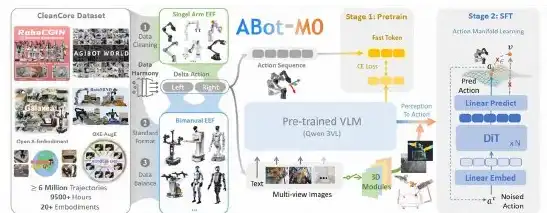
Embodied Intelligence Breakthrough: AutoNavi Open-Sources Universal Robot Base Model ABot-M0 AutoNavi has announced the full open-source release of ABot-M0, the world's first unified architecture-based embodied manipulation base model. This model is designed to enable "one general brain to adapt to multiple forms of robots," aiming to break down barriers between heterogeneous hardware and accelerate the adoption of embodied intelligence in industrial and household settings. ABot-M0 demonstrated exceptional performance in industry tests, achieving a task success rate of 80.5% on the Libero-Plus benchmark—a nearly 30% improvement over the previous benchmark, Pi0. It also set new state-of-the-art records on benchmarks like Libero and RoboCasa. The open-source release addresses long-standing challenges in the field, such as data isolation and deployment difficulties, by providing resources across three key dimensions: - **Data:** The UniACT dataset, the largest of its kind, with over 6 million real operation trajectories and full data pipeline tools. - **Algorithm:** The model architecture and training framework, featuring innovative components like Action Manifold Learning (AML) and a dual-stream perception architecture. - **Model:** End-to-end pre-trained models and a complete toolchain for out-of-the-box deployment, significantly lowering the barrier to adaptation. According to AutoNavi's ABot-M0 technical lead, this open-source initiative aims to build a bridge between academic research and industrial application, enabling robots of various forms to possess a smart, reliable, and universal "brain."

marsbit1h ago

Embodied Intelligence Breakthrough: Amap Fully Open-Sources Universal Robot Base Model ABot-M0

marsbit1h ago

Will Middle Management Be Replaced by AI? What Will the Future Company Structure Look Like

The article explores whether AI will eliminate middle management and reshape future corporate structures. It traces the historical evolution of organizations—from Roman military units to modern corporations—showing how hierarchical systems emerged to manage information flow under the constraint of limited "span of control." Middle management, matrix structures, and bureaucratic systems were all solutions to coordination challenges in information-scarce environments. AI, however, challenges this foundational premise. By enabling real-time modeling, understanding, and distribution of information, AI could replace human-centric coordination mechanisms. Examples like the AI firm "Moon Dark Side" illustrate radical experiments: no departments, titles, or traditional KPIs, with co-founders directly managing large teams and AI agents handling tasks from data processing to code generation. Block (founded by Jack Dorsey) is presented as a case study in building an "intelligent company." This model relies on two core components: a "company world model" (a real-time understanding of internal operations via digital traces) and a "customer world model" (built from real behavioral data, especially financial transactions). An intelligence layer uses these models to dynamically combine capabilities (e.g., payments, lending) to serve customers proactively, without pre-defined product roadmaps. In this structure, traditional roles shift. Middle managers are replaced by a system that handles coordination, while humans focus on individual contributions (ICs), direct responsibility (DRIs), or player-coach roles. The organization becomes flatter, faster, and more adaptive. The article concludes that AI is not just a tool for efficiency but a transformative force that could redefine organizational design, moving companies from human-led hierarchies to system-driven intelligence.

marsbit1h ago

Will Middle Management Be Replaced by AI? What Will the Future Company Structure Look Like

marsbit1h ago

Trading

Spot
Futures

Hot Articles

What is $BITCOIN

DIGITAL GOLD ($BITCOIN): A Comprehensive Analysis Introduction to DIGITAL GOLD ($BITCOIN) DIGITAL GOLD ($BITCOIN) is a blockchain-based project operating on the Solana network, which aims to combine the characteristics of traditional precious metals with the innovation of decentralized technologies. While it shares a name with Bitcoin, often referred to as “digital gold” due to its perception as a store of value, DIGITAL GOLD is a separate token designed to create a unique ecosystem within the Web3 landscape. Its goal is to position itself as a viable alternative digital asset, although specifics regarding its applications and functionalities are still developing. What is DIGITAL GOLD ($BITCOIN)? DIGITAL GOLD ($BITCOIN) is a cryptocurrency token explicitly designed for use on the Solana blockchain. In contrast to Bitcoin, which provides a widely recognized value storage role, this token appears to focus on broader applications and characteristics. Notable aspects include: Blockchain Infrastructure: The token is built on the Solana blockchain, known for its capacity to handle high-speed and low-cost transactions. Supply Dynamics: DIGITAL GOLD has a maximum supply capped at 100 quadrillion tokens (100P $BITCOIN), although details regarding its circulating supply are currently undisclosed. Utility: While precise functionalities are not explicitly outlined, there are indications that the token could be utilized for various applications, potentially involving decentralized applications (dApps) or asset tokenization strategies. Who is the Creator of DIGITAL GOLD ($BITCOIN)? At present, the identity of the creators and development team behind DIGITAL GOLD ($BITCOIN) remains unknown. This situation is typical among many innovative projects within the blockchain space, particularly those aligning with decentralized finance and meme coin phenomena. While such anonymity may foster a community-driven culture, it intensifies concerns about governance and accountability. Who are the Investors of DIGITAL GOLD ($BITCOIN)? The available information indicates that DIGITAL GOLD ($BITCOIN) does not have any known institutional backers or prominent venture capital investments. The project seems to operate on a peer-to-peer model focused on community support and adoption rather than traditional funding routes. Its activity and liquidity are primarily situated on decentralized exchanges (DEXs), such as PumpSwap, rather than established centralized trading platforms, further highlighting its grassroots approach. How DIGITAL GOLD ($BITCOIN) Works The operational mechanics of DIGITAL GOLD ($BITCOIN) can be elaborated on based on its blockchain design and network attributes: Consensus Mechanism: By leveraging Solana’s unique proof-of-history (PoH) combined with a proof-of-stake (PoS) model, the project ensures efficient transaction validation contributing to the network's high performance. Tokenomics: While specific deflationary mechanisms have not been extensively detailed, the vast maximum token supply implies that it may cater to microtransactions or niche use cases that are still to be defined. Interoperability: There exists the potential for integration with Solana’s broader ecosystem, including various decentralized finance (DeFi) platforms. However, the details regarding specific integrations remain unspecified. Timeline of Key Events Here is a timeline that highlights significant milestones concerning DIGITAL GOLD ($BITCOIN): 2023: The initial deployment of the token occurs on the Solana blockchain, marked by its contract address. 2024: DIGITAL GOLD gains visibility as it becomes available for trading on decentralized exchanges like PumpSwap, allowing users to trade it against SOL. 2025: The project witnesses sporadic trading activity and potential interest in community-led engagements, although no noteworthy partnerships or technical advancements have been documented as of yet. Critical Analysis Strengths Scalability: The underlying Solana infrastructure supports high transaction volumes, which could enhance the utility of $BITCOIN in various transaction scenarios. Accessibility: The potential low trading price per token could attract retail investors, facilitating wider participation due to fractional ownership opportunities. Risks Lack of Transparency: The absence of publicly known backers, developers, or an audit process may yield skepticism regarding the project's sustainability and trustworthiness. Market Volatility: The trading activity is heavily reliant on speculative behavior, which can result in significant price volatility and uncertainty for investors. Conclusion DIGITAL GOLD ($BITCOIN) emerges as an intriguing yet ambiguous project within the rapidly evolving Solana ecosystem. While it attempts to leverage the “digital gold” narrative, its departure from Bitcoin's established role as a store of value underscores the need for a clearer differentiation of its intended utility and governance structure. Future acceptance and adoption will likely depend on addressing the current opacity and defining its operational and economic strategies more explicitly. Note: This report encompasses synthesised information available as of October 2023, and developments may have transpired beyond the research period.

363 Total ViewsPublished 2025.05.13Updated 2025.05.13

What is $BITCOIN

Discussions

Welcome to the HTX Community. Here, you can stay informed about the latest platform developments and gain access to professional market insights. Users' opinions on the price of BTC (BTC) are presented below.

活动图片