Original | Odaily Planet Daily (@OdailyChina)
Author | Ding Dang (@XiaMiPP)
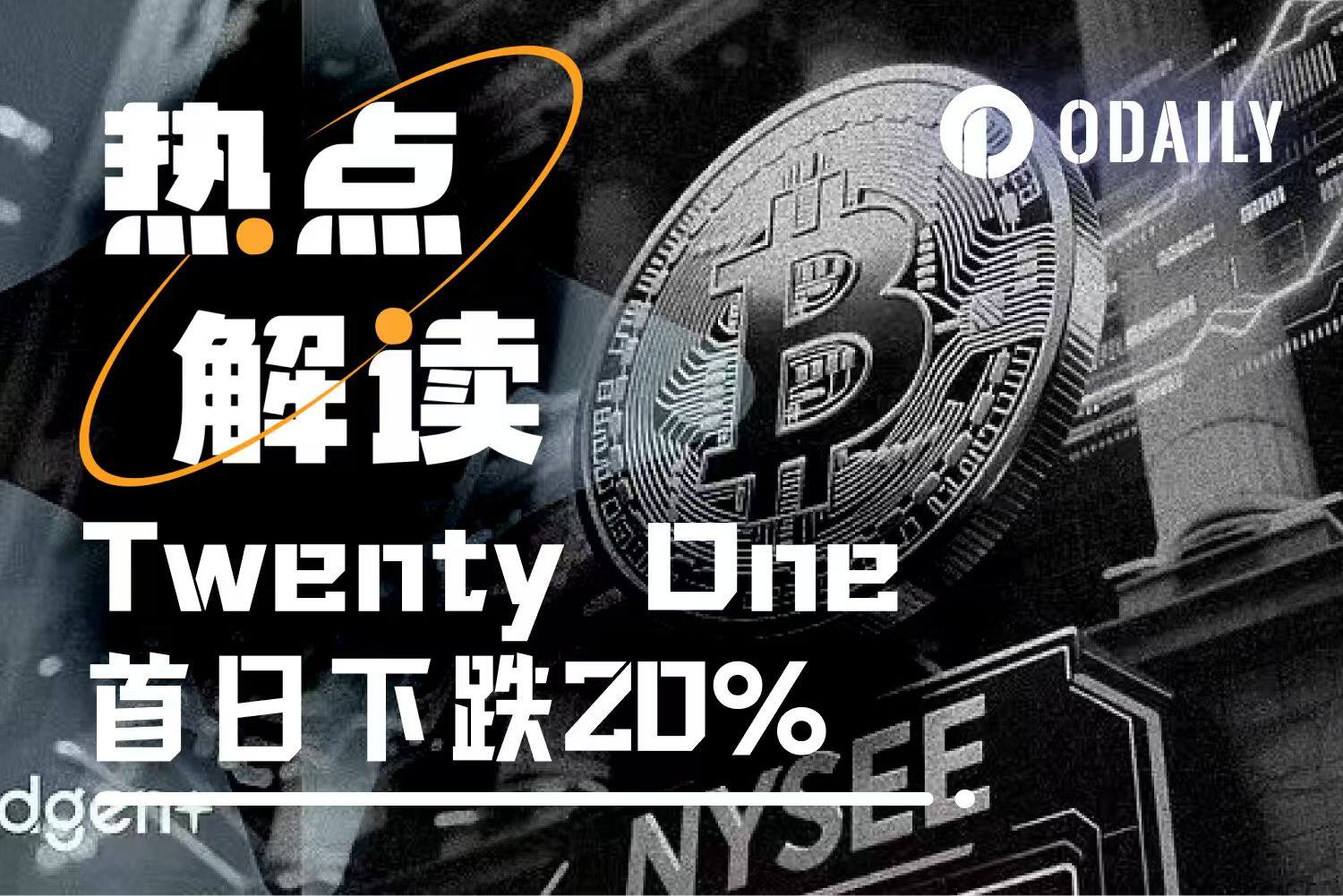
Twenty One Capital (NYSE: XXI), a "Bitcoin asset reserve company" backed by stablecoin giant Tether and Japanese conglomerate SoftBank Group, officially listed on the New York Stock Exchange on December 9. However, in stark contrast to its resource advantages of "heavy assets" and "strong backing," the stock price plummeted immediately after the first day's opening, with a intraday drop of nearly 20%. The capital market's initial report card was not friendly.
Twenty One was founded in early 2025 and is led by Strike founder and CEO Jack Mallers. It is positioned as a company with Bitcoin as its core asset allocation. It has strong backing from stablecoin issuer Tether, Japan's SoftBank Group, and Wall Street investment bank Cantor Fitzgerald.
It is important to note that Twenty One did not undergo a traditional IPO but instead completed a backdoor listing by merging with Cantor Equity Partners (a SPAC), officially listing on the NYSE on December 9. Cantor Equity Partners is a key platform under Cantor Fitzgerald. The company is headed by Brandon Lutnick, son of the U.S. Secretary of Commerce, who personally led this merger. He emphasized in the announcement that Cantor's partnership was key to engaging innovative participants like Tether and SoftBank. This relationship adds a "dimension of institutional prestige" to Twenty One Capital, especially in the context of the Trump administration's promised crypto-friendly policies.
But market sentiment is clearly more complex. The company initially under the ticker CEP saw its stock price surge from $10.2 to a high of $59.6 after the announcement, a gain of nearly 6 times. The initial enthusiasm for the "Bitcoin reserve company" narrative was almost written on the K-line chart. However, as speculative sentiment faded, the price quickly fell back and is currently hovering around $11.4, erasing almost all of the premium.
This forms an extremely strong contrast with its massive Bitcoin holdings. As of the listing, Twenty One held 43,514 BTC, with a market value of approximately $4.03 billion, ranking third in the global corporate Bitcoin holdings list, behind only Strategy and MARA Holdings.
Valuation Puzzle: Causes Behind the Extreme Discount
What truly puzzles the market is its valuation structure. At the current stock price level, Twenty One's overall market capitalization is only about $186 million, with a market multiple (mNAV) as low as 0.046. This means the capital market is only willing to price its Bitcoin assets at about 4.6% of their book value. Why such an extreme discount?
A deep dive into its asset acquisition method reveals that Twenty One's Bitcoin reserves were not primarily formed through long-term purchases on the open market but highly relied on a "shareholder infusion" model: its initial reserve of approximately 42,000 BTC came from a direct capital injection by Tether. Subsequently, on May 14, 2025, the company added 4,812 BTC through Tether, costing about $458.7 million at the time, corresponding to a cost of about $95,300 per coin; and before the listing, it completed an additional plan to acquire about 5,800 BTC through PIPE financing and convertible bond mechanisms.
The advantage of this model is its high efficiency, avoiding the lengthy process of building positions in the secondary market and allowing for scaled-up reserves in a short time; but the cost is equally obvious: assets are highly concentrated from a few related parties, making it difficult for investors to fully penetrate its internal transaction structure, custody form, and potential agreement constraints. Transparency and sustainability naturally become important discount factors in market pricing.
Collective Dilemma of the "Digital Asset Reserve Company" Model
From an industry perspective, Twenty One's problem is no longer an isolated case. According to defillama.com data, there are currently over 70 "crypto-stock companies" (i.e., listed companies holding crypto assets) globally. Among the top 20 holders, the mNAV of most companies has fallen below 1, including Strategy, which pioneered this model.
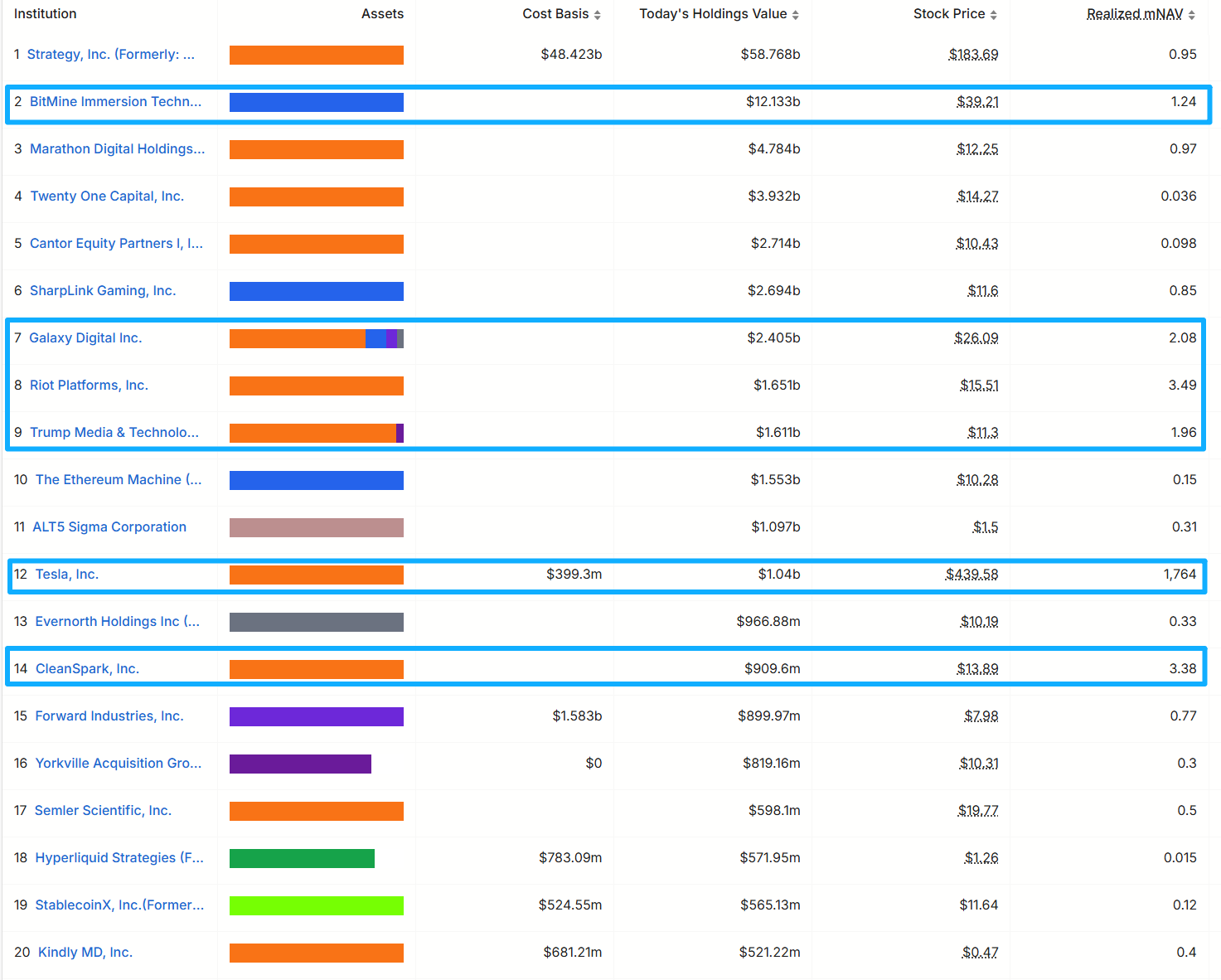
As the overall crypto market retreats, these "crypto-stock companies" have gradually retreated from being the core of the narrative to marginal assets in risk models. The current valuation of these crypto asset reserve companies has generally turned cautious.
However, there is an order of magnitude difference between Strategy and Twenty One. Strategy currently holds about 660,600 Bitcoin, accounting for about 3% of the total Bitcoin supply, a scale more than 15 times that of Twenty One. This size not only gives it stronger market influence but also a certain symbolic meaning of "systemic anchoring." When Strategy's mNAV falls below 1, the market naturally raises deeper questions: Will it be forced to sell coins? Could its debt structure trigger a stampede? Has the DAT model lost its logical foundation in the face of the macro cycle?
In fact, with the significant retreat of the crypto market in 2025, the DAT model faces severe tests. The core of this model is to accumulate Bitcoin through debt and equity financing, treating it as the "ultimate asset" to hedge against inflation and currency devaluation. But when Bitcoin's price volatility significantly amplifies, the stability of this model begins to waver. Some companies, despite holding large amounts of BTC, face valuation pressure due to operational costs and market sentiment. Twenty One's extreme discount, while related to its asset acquisition method, is also a concentrated reflection of the market's risk pricing for the entire DAT model.
Conclusion: The Narrative Remains, But the Market Needs Time
At the Binance Blockchain Week on December 4, Michael Saylor provided a broader perspective. In his speech titled "Why Bitcoin Remains the Ultimate Asset: The Next Chapter of Bitcoin," he reiterated his core judgment about Bitcoin's next decade: Bitcoin is transitioning from an investment product to the "basic capital" of the global digital economy, and the rise of the digital credit system will reshape the traditional $300 trillion credit market. From policy shifts and changes in bank attitudes, to the institutional absorption of ETFs, and the explosive growth of digital credit tools, Saylor描绘s a new financial order accelerating into being: digital capital provides energy, digital credit provides structure, and Bitcoin will become the underlying asset supporting it all.
From this perspective, companies like Twenty One do possess a potential for being "correct in the long term"—if Bitcoin ultimately completes its migration from a high-risk asset to "digital gold," then these companies may become core carriers in this migration process.
But the problem is, "correct in the long term" does not automatically equate to "reasonably priced in the present." The market still needs time to verify Bitcoin's true role in the macro system, and it also needs time to reassess the resilience of the DAT model under different cycle conditions.
Related reading: "Full Text of Saylor's Dubai Speech: Why Bitcoin Will Become the Underlying Asset of Global Digital Capital"