Texas grid is heating up again, this time from AI, not Bitcoin miners

cointelegraphPublished on 2025-12-11Last updated on 2025-12-11

Abstract

Texas is rapidly becoming a major hub for AI-driven energy demand, with a significant surge in large-load power requests—now dominated by AI data centers rather than Bitcoin miners. ERCOT, the state’s grid operator, reports a queue of 226 gigawatts of new power requests, 73% of which are linked to AI facilities. While the supply side has 1,999 generation proposals totaling 432 GW, mostly solar and battery projects, these sources can't provide the 24/7 power AI data centers need, creating potential reliability issues. Regulators are adapting with new rules for large power users and increased transmission projects. Meanwhile, Bitcoin miners, once major energy users, are shifting toward AI computing to capitalize on growing demand, as seen in projects like Galaxy’s $460 million conversion of a Texas mining site into an AI data center.

Texas is rapidly emerging as an epicenter of artificial intelligence-driven energy demand, with an unprecedented surge in large-load power requests, a wave now dominated by AI data centers rather than Bitcoin miners.

The figures, highlighted in The Miner Mag’s latest newsletter and drawn from ERCOT’s new System Planning and Weatherization Update, point to a grid facing a fundamentally different kind of growth.

ERCOT, the Electric Reliability Council of Texas, which operates the state’s independent power grid and oversees reliable electric service for about 90% of Texans, reported that its large-load interconnection queue has ballooned to 226 gigawatts of new requests, roughly 73% tied to AI facilities.

Developers have already filed 225 large-load requests this year, and on the supply side, ERCOT is reviewing 1,999 generation proposals totaling 432 GW, according to The Miner Mag.

However, the load is growing faster than the supply. While the generation queue is massive, it remains dominated by solar and battery projects, which are resources that don’t provide the around-the-clock power that AI data centers require. That mismatch is setting up future reliability and investment challenges.
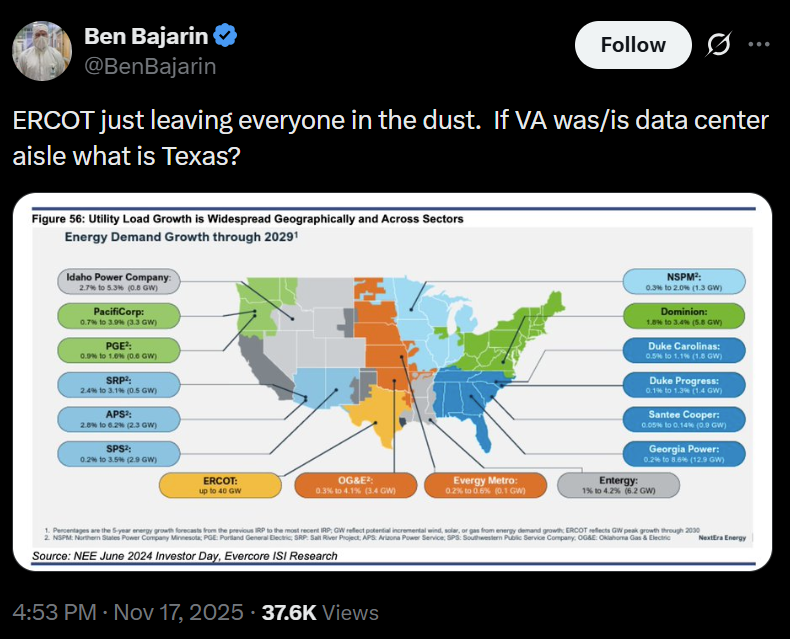
Source: Ben Bajarin

State regulators are racing to adapt, The Miner Mag reported. New rules are being developed to classify any customer requesting 75 MW or more as a “special handling” case, and ERCOT has more than doubled the number of transmission projects under review.

Related: Bitcoin miners gambled on AI last year, and it paid off

What about Bitcoin miners?

The Miner Mag report drew a contrast between today’s surge in AI-driven power demand and the earlier boom from Bitcoin (BTC) miners, noting that Texas’ emerging grid crunch is now being fueled by AI, not crypto.

Bitcoin miners were once among the largest new power users in the state. Their impact was arguably positive: Miners frequently curtailed operations during peak demand and, according to a January study by the Digital Asset Research Institute, helped bolster grid stability and save the state an estimated $18 billion.
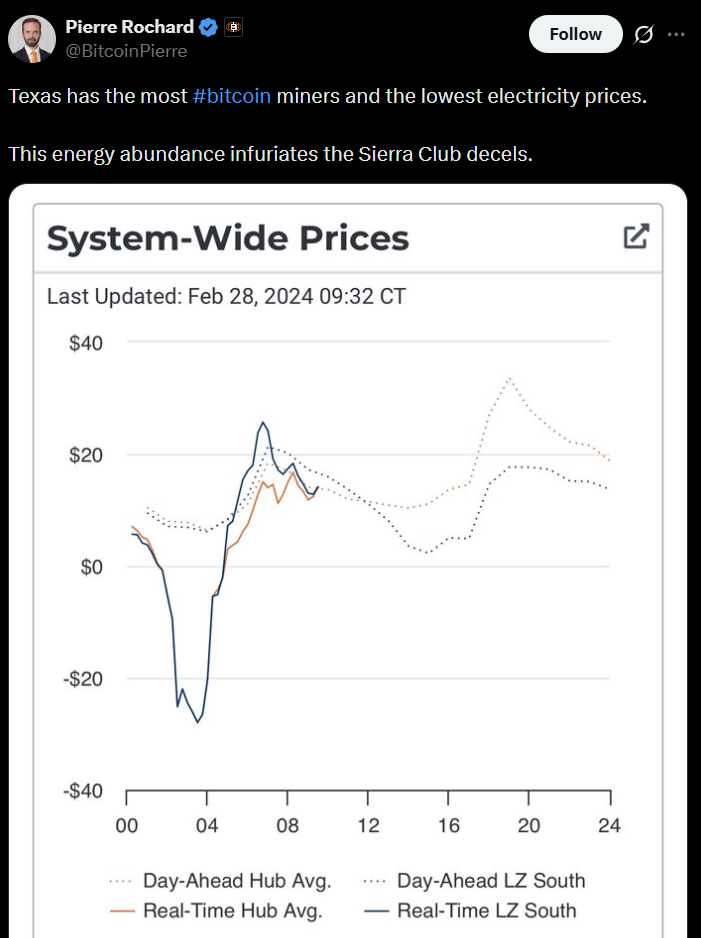
Source: Pierre Rochard

However, the landscape is shifting. Many miners and digital asset operators are reallocating their infrastructure toward AI computing to capitalize on the soaring demand for GPU capacity.

A recent example is Mike Novogratz’s Galaxy, which secured $460 million to convert its former Texas Bitcoin mining site into a large-scale AI data center.

Related: Bitcoin miners enter ‘harshest margin environment of all time’

Related Reads

Fed Chair Race Takes a Surprising Turn: Warsh Overtakes Hassett, Trump's Interest Rate Gambit Places a New Piece

US Federal Reserve Chair Race Shifts: Warsh Surpasses Hassett as Trump's Top Pick In a surprise turn of events, President Trump confirmed to The Wall Street Journal that former Fed Governor Kevin Warsh has become the leading candidate for the next Federal Reserve Chair, overtaking previously favored Kevin Hassett. This shift followed a 45-minute meeting where Warsh aligned with Trump’s desire for lower interest rates. Warsh’s Wall Street experience and previous role at the Fed during the 2008 financial crisis distinguished him from the more academic Hassett. Market probabilities reflected the change, with Hassett’s odds dropping from 85% to 52%, while Warsh’s rose to 38%. Trump has repeatedly criticized current Chair Jerome Powell for not cutting rates aggressively enough, and even suggested the Fed should consult the president on rate decisions—a direct challenge to the central bank’s independence. Other candidates include Fed Governors Christopher Waller and Michelle Bowman, and BlackRock’s Rick Rieder. Historical parallels were drawn to Nixon-era political pressure on the Fed, which led to high inflation. ECB President Christine Lagarde warned that political interference poses a “very serious threat” to global economic stability. Wall Street reacted cautiously, with Jamie Dimon noting both candidates' strengths but acknowledging Warsh’s potential to be an “outstanding chair.” Powell, whose term ends in May, aims to hand over a stable economy but has consistently resisted Trump’s calls for deeper rate cuts. The outcome of this selection will significantly influence global financial markets and test the Fed’s independence in the years ahead.

marsbit2h ago

Fed Chair Race Takes a Surprising Turn: Warsh Overtakes Hassett, Trump's Interest Rate Gambit Places a New Piece

marsbit2h ago

Trading

Spot
Futures
活动图片