Chips, Open-Source Models, and $50 Trillion: Joe Tsai Reassesses Alibaba Once Again

marsbitPublished on 2026-06-22Last updated on 2026-06-22

Abstract

Alibaba Executive Chairman Joe Tsai recently outlined the company's comprehensive AI strategy in a public discussion. He believes AI represents a massive opportunity, estimating its potential economic impact at up to $50 trillion, stemming from the automation of human intelligence and productivity. Tsai detailed Alibaba's four-layer investment approach across the AI stack: starting from the chip level, moving to cloud infrastructure (Alibaba Cloud), then the model layer with its open-source Qwen model, and finally applications within its vast digital ecosystem (e-commerce, logistics, etc.). The company avoids the energy layer due to China's efficient infrastructure. This broad strategy is designed to ensure Alibaba captures value regardless of where it ultimately concentrates in the AI value chain. He dismissed concerns about an AI investment bubble, pointing to the enormous $50 trillion opportunity. While acknowledging U.S. cloud giants' higher capital expenditure, he argued Chinese firms, including Alibaba (funded by its cash-generative e-commerce core), need to invest more in AI infrastructure. A key theme was technological sovereignty. Tsai positioned open-source models like Qwen as a solution for companies, especially in Europe, seeking independence from proprietary U.S. models and greater data privacy control. He contrasted this with the trend of U.S. giants keeping their models closed-source. Tsai highlighted Alibaba's collaborations with European manufacturers lik...

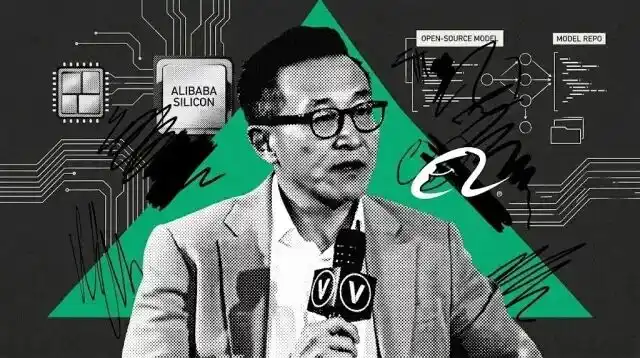
Alibaba Group Chairman Joe Tsai. Image processed via AI.

At this year's VivaTech conference, Alibaba Chairman Joe Tsai systematically outlined the company's long-term AI vision during a "fireside chat." This marks his second public reassessment of Alibaba following a summit at Yale University in late May.

"From a macro perspective, we are going all-in on AI. The logic is simple."

Tsai stated that global GDP exceeds $100 trillion, with at least half coming from human intelligence and productivity contributions. "This $50 trillion is the total addressable market for AI, far larger than any company's IT budget or the software market."

Everyone is talking about going all-in on AI, and Tsai is no exception. He summarized Alibaba's strategic approach as covering almost all layers except the energy layer, encompassing chips, cloud infrastructure, models, and applications.

"We are primarily investing in four layers, but we are not touching the bottommost energy layer because China's energy efficiency is high and costs are relatively low."

In Tsai's view, this near-full-stack strategy stems from future uncertainty, as no one can accurately predict where the ultimate value will settle—whether in chips, cloud infrastructure, or the model layer. "We choose to participate comprehensively, so no matter where the value ultimately lands, we are present."

Compared to Alibaba, U.S. cloud giants are even more aggressive, investing across the entire infrastructure stack, with a combined capital expenditure of $800 billion by 2027, which short-sellers have criticized as a "bubble." Tsai not only disagrees with the bubble theory but also emphasizes that Chinese companies need to increase their infrastructure investments.

"The investment numbers are indeed staggering," Tsai said. "But we need to go back to that $50 trillion total market. That's the reason for optimism."

Discussing open source, Tsai first mentioned the recent suspension of Anthropic's most advanced model by the Trump administration, bluntly stating this is the consequence of "putting all your eggs in one basket." In his view, models from Google, OpenAI, and Anthropic are now all closed-source, while the open-source path is currently being pursued by Chinese companies.

"You truly cannot base trust on the assumption that a third-party government will never act against your interests."

Below is an edited version of Joe Tsai's interview:

01. The $50 Trillion "Market"

Q: Alibaba has changed significantly over the years, with achievements like its open-source large model. But many still see you primarily as a B2B/B2C platform. Can you talk about the group's evolution?

Joe Tsai: When Alibaba started in 1999, it was indeed a B2B platform. The idea was simple: to bring small Chinese manufacturers and trading companies online, helping them wholesale products globally. Later, we entered the B2C space with Taobao, now China's largest consumer e-commerce platform.

Q: How many consumers does this serve?

Joe Tsai: 820 million Chinese consumers. Moreover, this platform helps European companies and brands sell approximately €30 billion worth of goods to Chinese consumers annually. But the story doesn't end there. We are heavily investing in AI and cloud.

We started investing in cloud technology 17 years ago, but out of necessity. Our e-commerce business was generating massive amounts of data daily. If we kept relying on others' database and storage technologies, eventually all our profits would go to the tech vendors. So we decided to build our own proprietary technology to manage this data, and that's how our cloud business began.

From a macro perspective, we are now going all-in on AI, and the logic is simple.

If you ask me how big the AI market is, I'd say it's far larger than any company's IT budget or the software market. Because AI is essentially about producing human intelligence and productivity. Global GDP today is over $100 trillion, with at least half ($50 trillion) related to human productivity and intelligence. That's the total AI market. So we must go all-in.

Q: Do you really believe AI can boost productivity? Many have invested heavily without seeing results yet.

Joe Tsai: Many CEOs will tell you that engineers are consuming a huge number of tokens, and costs are rising. But I'd say we are on the cusp of a real productivity explosion.

Take our company. Some engineers are super-users of AI. They not only use programming tools for their core work but also explore new uses. Give engineers a toy, and they'll find more ways to play with it, sometimes without realizing the company is paying for these usage costs. That's the current reality.

But I am deeply convinced—it's more like a belief, a conviction that artificially produced intelligence units can add value to human intelligence. It's close to a kind of faith. I don't want to try to convince you this will definitely happen, but we ourselves firmly believe it.

02. The Logic of Going All-In on AI

Q: Returning to Alibaba's layout, which AI layer do you invest the most in? Infrastructure, models, or cloud services?

Joe Tsai: We primarily invest in four layers, but we skip the bottommost energy layer because China's energy efficiency is high and costs are low.

We really started at the chip layer—that's the first layer. The second is the infrastructure layer, corresponding to our cloud business. The third is the model layer, like Qwen, which is now one of the world's hottest open-source models. The fourth is the application layer, where we have a complete digital life ecosystem—e-commerce, food delivery, local services, travel, maps, etc. These are all scenarios where AI capabilities can be directly embedded to serve users.

The advantage of this approach is that we are not betting on a single track.

Today, pure model companies have high valuations, making it seem like all the value is in the model layer. But looking five or ten years ahead, no one can say for sure whether the value will settle in chips, cloud infrastructure, models, or applications. We choose comprehensive participation so that, no matter where the value ultimately lands, we are there.

Q: Speaking of AI infrastructure, when you see such massive investments, do you think there's a bubble? Do we really need this much computing power? Some models are more efficient and don't require as many resources.

Joe Tsai: I don't think it's a bubble. The investment numbers are indeed staggering. Just looking at the U.S. hyperscale cloud providers, the combined capital expenditure of the top four or five companies next year exceeds $800 billion, potentially over a trillion the year after. Investments at this scale naturally raise concerns about overcapacity.

But we must return to that $50 trillion total market. That's the reason for optimism.

Moreover, in China, our investment in AI infrastructure and the supply chain is actually insufficient. Theoretically, all Chinese companies should increase their investments. Of course, we won't reach the investment level of the U.S. hyperscale players, but our investment intensity is already quite substantial.

Q: Why can't you reach U.S. levels?

Joe Tsai: Sometimes there are funding constraints, depending on how much free cash flow you can generate. Fortunately, Alibaba is one of the few companies with a core e-commerce business that generates about $25 billion in annual free cash flow, which can support our AI investments. So we are in a relatively good position.

Q: Currently, does the e-commerce platform business still account for 80% to 85% of Alibaba's total revenue?

Joe Tsai: Yes, e-commerce platform revenue still accounts for over 80%. This generates stable cash flow, allowing us to invest in the future, primarily in AI and cloud.

03. Open Source and the Second Basket

Q: Qwen is an open-source model. Who are your main customers, and how do you help them?

Joe Tsai: In recent weeks in Europe, I've spoken with many company executives, CEOs, and scientists. One word that came up most frequently was "sovereignty."

But what is sovereignty?

Ask ten Europeans, and you might get twelve different answers. For me, the core is two things.

First, technological independence. Everyone is worried about the risk of a "one-click shutdown," the fear of relying too heavily on technology from a single country that could flip a switch at any time. We just saw a vivid example of this in recent days.

Second is data privacy. People want to use AI technology but want their data to belong entirely to them, used within their own environment, with a firewall to protect it.

I believe open source addresses both these issues. It is essentially free software; you can download it to your own data center, even onto a laptop. At that point, it has little to do with the original manufacturer—we can't even figure out how to charge for it. That achieves independence.

More importantly, with an open-source model, you can use your own data for further training, fine-tuning, or post-training. The entire process and all data remain entirely confidential within your firewall. This point is crucial for European companies.

But I want to emphasize that open source is not a panacea or the only path, but it is a practical route to achieving a certain degree of sovereignty.

Interestingly, the open-source movement today is largely being driven by Chinese companies, while the major U.S. players have closed their models. They want you to call them via APIs; you have no idea where the data goes. When you converse with a chatbot, your most private questions and thoughts enter their data pool to further train the model. The data flow is completely opaque to you.

Q: Honestly, European sovereignty is a huge concern right now. We've just realized we were too dependent on U.S. technology. I acknowledge the benefits of open source, but I still worry about the risk of future access being cut off to models. That's a significant risk for Europe.

Joe Tsai: You're right; that concern cannot be completely eliminated. Simply put, you truly cannot base trust on the assumption that a third-party government will never act against your interests. But the problem is, right now, all your eggs are in one basket.

Why not choose a second basket and put some eggs there? Even if Europe might develop its own basket in the long term, at least for now, you have two baskets.

04. AI in the Factory

Q: That's true. How do you cooperate with German companies and what do you help them do?

Joe Tsai: These German manufacturing companies are very interesting. In the Chinese market, they are all Alibaba Cloud customers. We collaborate with them in manufacturing, covering areas like design, testing, and quality control.

I believe this will be a very important field in the future. Because most AI applications today are either consumer products like ChatGPT or tools for programmers and knowledge workers like Copilot. But in the future, these manufacturing companies will be extremely valuable because they accumulate their own unique, high-quality data from the production process, which can be used to train proprietary models to improve manufacturing processes.

We have collaborations with companies like BMW, Siemens, and Bosch. Last week, I attended the Bosch ConnectedWorld conference. They are using AI to develop driver assistance and autonomous driving technologies, requiring massive computing power.

A lot of interesting things are happening in manufacturing.

Q: Can I understand it this way: The U.S. export controls on high-end chips have actually created an opportunity for you?

Joe Tsai: You could put it that way. There are two paths here:

First, they directly adopt our open-source model and deploy it on their own infrastructure, like a data center. But our infrastructure is developed in tight integration with our models, achieving high efficiency and helping customers train models. If they use our open-source model, they can also procure computing power from us. The model and infrastructure have a symbiotic relationship. That's one path.

The other path is the emergence of inference platform companies that can offer users multiple model choices. You don't necessarily have to use Qwen. As long as there is an agreement between the model provider and the platform to open the weights in a private environment, customers can use models on these platforms.

05. AI, Agents, and Humanity

Q: A more philosophical question. What's your view on the balance between AI, large language models, and humanity, even the future of human nature? What state will humanity be in ten years from now?

Joe Tsai: Earlier today, I was chatting with colleagues at our Paris office. We just moved into a new office on the upper floors of a beautiful building. I looked out the window; there was a café outside. The weather was nice, people were sitting outdoors drinking coffee, enjoying life.

I pointed to the scene and told my colleagues, "This is the future of AI."

You might think they're just drinking coffee, having fun, seemingly not working. But in reality, they have already deployed agents to work for them. While you sleep, agents are working for you. Think about that productivity boost—having "someone" working for you 24/7.

Q: This sounds similar to some ideas in Silicon Valley, where many people might not need to work, as agents and robots will do it for them.

Joe Tsai: I believe this will definitely free up human time to enjoy life, spend time with family, and engage in more entertainment. That's also why I place great importance on live entertainment. When people spend less time in the office, where will they go? They won't just stay at home; they'll want to go to concerts, watch football, watch basketball games.

Q: The Chinese are known for their diligence. Chinese engineers, even with agents and AI, still work very long hours.

Joe Tsai: There will always be people who work harder than others. But I believe most people, deep down, wish to enjoy life a bit more and spend more time with their families.

This article is from WeChat public account "Tencent Technology," author: Su Yang.

Trending Cryptos

Related Questions

QAccording to Joseph Tsai, what is the total market opportunity he sees for AI, and why?

AJoseph Tsai sees a total market opportunity of 50 trillion dollars for AI. He argues that global GDP exceeds 100 trillion dollars, and at least half of it comes from human intelligence and productivity contributions. Since AI essentially produces human-like intelligence and productivity, its total addressable market is this 50 trillion dollar share of global GDP.

QWhat are the four layers of AI that Alibaba is investing in, according to Joseph Tsai?

AAccording to Joseph Tsai, Alibaba is investing in four layers of AI: 1) The chip layer, 2) The infrastructure/cloud layer, 3) The model layer (e.g., the Qwen open-source model), and 4) The application layer (integrating AI into Alibaba's digital ecosystem like e-commerce, food delivery, and travel). He stated they do not invest in the foundational energy layer due to China's high energy efficiency and low costs.

QWhy does Joseph Tsai argue that open-source models, like Alibaba's Qwen, are crucial for technological sovereignty, particularly in Europe?

AJoseph Tsai argues open-source models address two core aspects of technological sovereignty: 1) Independence from a single-point-of-failure or 'kill switch' risk, as companies can download and run the model independently, and 2) Data privacy, as companies can train, fine-tune, and use the model entirely within their own secure firewalls. He contrasts this with closed-source models from US companies, where data flows opaquely to the provider's servers.

QHow does Joseph Tsai respond to concerns about a potential bubble in massive AI infrastructure investments by cloud giants?

AJoseph Tsai does not believe it is a bubble. While acknowledging the staggering scale of investment (e.g., US hyperscalers planning $800 billion+ in capex), he argues it must be viewed in the context of the massive 50 trillion dollar AI opportunity. He further states that Chinese companies, including Alibaba, actually need to invest more in AI infrastructure and supply chains, though likely not reaching US levels due to different free cash flow realities.

QWhat is Joseph Tsai's vision for how AI will change human life and work in the future?

AJoseph Tsai envisions AI, particularly intelligent agents, will liberate human time. He believes agents will work continuously, even while people sleep, dramatically boosting productivity. This will free people to enjoy life more, spend time with family, and engage in entertainment and leisure activities like attending live sports or concerts, shifting the balance from work to life enjoyment.

Related Reads

After Three Consecutive Quarters of Decline, Can the Crypto Market Find a Window for Stabilization in Q3?

The cryptocurrency market has just concluded its worst-performing quarter since 2022, with total capitalization dropping 12.6% to $2.1 trillion. All core metrics indicate capital is leaving the sector, not just rotating within it. Bitcoin fell 14.2% and Ethereum dropped 25.4% in Q2, breaking their previous correlation with US tech stocks. A key driver is the reversal in US spot Bitcoin ETF flows, which saw a net outflow of approximately $4.67 billion in Q2, including a record monthly outflow near $4.5 billion in June. While recent data suggests long-term holders are accumulating again, sustained ETF outflows mean continued selling pressure. Market focus is now singularly on the Federal Reserve. The upcoming July FOMC meeting is seen as the most critical event for Q3. A dovish signal could support Bitcoin reclaiming a $68,000-$84,000 range, while a hawkish stance might establish a new trading band around $50,000-$56,000. Additionally, regulatory uncertainty persists, with the progress of the crucial *CLARITY Act* stalling in the Senate, reducing its perceived 2026 passage probability to 40-45%. Despite the broad downturn, a few sectors showed growth. Prediction markets saw nominal volume surge 48.7% year-over-year to $113.8 billion, and tokenized collectibles transaction volume rose 143% quarterly to $1.4 billion. The Real-World Asset (RWA) tokenization sector also continued steady growth, now representing ~$28.1 billion in on-chain value. The market's foundation for an extreme crash appears limited, with Bitcoin price hovering near its 200-week moving average. However, the trading paradigm has shifted from narrative-driven speculation to decisions based on price action, policy developments, and interest rate expectations, making a broad sentiment-driven rally unlikely in the near term.

marsbitYesterday 08:36

After Three Consecutive Quarters of Decline, Can the Crypto Market Find a Window for Stabilization in Q3?

marsbitYesterday 08:36

BIT Trading Moment: BTC Still Suppressed by Weekly 200 EMA, Rejection May Restart Decline; Storage and Semiconductors that Surged Last Night Begin Falling in Evening Trading

**Crypto & Stock Market Wrap: Bitcoin Tests Resistance, Stocks Retreat After AI Surge** Bitcoin consolidates around $66,000, facing key resistance near $68,000—an area seen as a major psychological and technical hurdle where previous rallies have failed. Analysts note the cryptocurrency is caught between its 200-week moving average (~$63,333) and 200-week EMA (~$68,328). A clear break above $68k is needed to signal a stronger bullish trend, while a rejection could lead to a retest of $63k support. Market sentiment remains cautious, with low futures open interest pointing to a low-liquidity rebound rather than a full bull market. Bitcoin spot ETFs saw another $203 million inflow. US stock futures pointed lower after a strong Tuesday session led by a massive rebound in semiconductors and memory stocks. The rally was fueled by renewed optimism about AI-driven hardware demand, with Micron, SanDisk, and SK Hynix surging. However, those gains reversed in pre-market trading. Super Micro Computer (SMCI) soared over 20% after hours on strong guidance and a record backlog. Other standouts included Rocket Lab and nuclear energy plays Oklo and X-Energy. Rising oil prices (Brent above $91) and climbing Treasury yields (10-year near 4.64%), however, are reigniting inflation concerns and acting as a headwind for equities. In Asia, markets were mixed. South Korea's KOSPI pared early gains to close slightly higher as semiconductor stocks like SK Hynix gave back initial surges. Japan's Nikkei edged lower as the yen hit a fresh 38-year low against the dollar, raising fears of potential market intervention. Key events to watch include the Samsung Galaxy launch, AMD's AI event, and a slew of major tech earnings from Alphabet, Tesla, and IBM after the close on Wednesday, followed by the ECB meeting and Intel's earnings on Thursday.

marsbitYesterday 08:28

BIT Trading Moment: BTC Still Suppressed by Weekly 200 EMA, Rejection May Restart Decline; Storage and Semiconductors that Surged Last Night Begin Falling in Evening Trading

marsbitYesterday 08:28

Former CFTC Chairman, Circle President Tarbert: Preaching Long-Termism While Cashing Out $30 Million Himself

Former CFTC Chairman and Circle President Heath Tarbert has consistently advocated for a long-term vision in public, urging patience from investors as Circle’s stock price has fallen significantly from its peak. However, it has been revealed that since Circle’s IPO, Tarbert has continuously sold his CRCL shares through pre-arranged trading plans, cashing out approximately $30 million, without making any public market purchases. This contrast between his public messaging and personal actions has drawn criticism. Tarbert joined Circle in July 2023 as Chief Legal Officer, leveraging his regulatory experience to help guide the company through its IPO and expansion. Despite promoting stablecoins as long-term infrastructure, he established a 10b5-1 trading plan just before Circle went public, leading to substantial stock sales over the following year. In March 2026, he initiated another plan to sell more shares. His career trajectory highlights a pattern of moving between high-level regulatory roles and influential positions in the financial sector. After resigning as CFTC Chairman in early 2021, he joined Citadel Securities as Chief Legal Officer just 27 days later, during a period of intense regulatory scrutiny for the firm. He later joined Circle, aiding its efforts to navigate regulatory challenges for its public listing. While Tarbert's expertise in policy and compliance is valuable to companies like Circle, his actions—advocating long-term confidence while personally divesting—raise questions about the alignment between his public statements and his private financial decisions, leaving investors who followed his advice to bear the market risks.

marsbitYesterday 08:06

Former CFTC Chairman, Circle President Tarbert: Preaching Long-Termism While Cashing Out $30 Million Himself

marsbitYesterday 08:06

Gate Research Institute: The 'Wall Street-ization' Wave of Crypto Financial Products – Competition or Integration?

The article titled "Gate Research Institute: Are Crypto Financial Products Sparking a 'Wall Street' Wave—Competition or Convergence?" explores the evolving relationship between the crypto ecosystem and traditional finance (TradFi). The piece begins by reflecting on Bitcoin's original 2009 vision of decentralization, disintermediation, and moving away from banks. It then contrasts this with the 2024 landscape, where key crypto assets like Bitcoin are increasingly held through Wall Street products like ETFs issued by giants like BlackRock. The article questions whether this signifies that TradFi is systematically taking over the rights to issue, price, custody, and distribute crypto financial assets. The core argument is that this is not a zero-sum takeover but rather a bidirectional convergence where each side addresses the other's weaknesses. Crypto offers 24/7 global markets, programmable settlement, and open access but lacks compliant channels, institutional-grade custody, deep fiat liquidity, and mainstream distribution. TradFi possesses these but is constrained by legacy systems, limited operating hours, and slow settlement. Two primary convergence paths are highlighted: * **Path A (CEX to TradFi):** Exemplified by Gate, which has progressed from offering tokenized stocks and CFDs to providing direct, real stock trading (US, Hong Kong, South Korea) within its platform, using USDT. * **Path B (TradFi to Crypto):** Exemplified by Robinhood, which has integrated crypto trading, acquired exchanges like Bitstamp, and is moving traditional assets like stocks onto the blockchain via tokenization and its own Layer 2. Both paths are ultimately competing to become the next-generation, unified financial account—a "super account" where users can seamlessly trade cryptocurrencies, stocks, ETFs, RWA (Real World Assets), and tokenized treasury products in one interface. The growth of RWA and tokenized treasuries (e.g., BlackRock's BUIDL) is presented as the asset-layer fusion, providing stable, yield-bearing assets on-chain and acting as a bridge between the two worlds. In conclusion, the "Wall Street-ization" of crypto is framed as a mutual transformation. Decentralized ideals persist in the protocol layer, while at the application layer, a more efficient, global, and accessible unified capital market is emerging from this convergence. The future competition lies not between crypto exchanges and stockbrokers, but between platforms vying to offer the most comprehensive asset coverage, liquidity, and user experience within a single account.

marsbitYesterday 08:01

Gate Research Institute: The 'Wall Street-ization' Wave of Crypto Financial Products – Competition or Integration?

marsbitYesterday 08:01

Trading

Spot

Hot Articles

How to Buy JOE

Welcome to HTX.com! We've made purchasing TraderJoe (JOE) simple and convenient. Follow our step-by-step guide to embark on your crypto journey.Step 1: Create Your HTX AccountUse your email or phone number to sign up for a free account on HTX. Experience a hassle-free registration journey and unlock all features.Get My AccountStep 2: Go to Buy Crypto and Choose Your Payment MethodCredit/Debit Card: Use your Visa or Mastercard to buy TraderJoe (JOE) instantly.Balance: Use funds from your HTX account balance to trade seamlessly.Third Parties: We've added popular payment methods such as Google Pay and Apple Pay to enhance convenience.P2P: Trade directly with other users on HTX.Over-the-Counter (OTC): We offer tailor-made services and competitive exchange rates for traders.Step 3: Store Your TraderJoe (JOE)After purchasing your TraderJoe (JOE), store it in your HTX account. Alternatively, you can send it elsewhere via blockchain transfer or use it to trade other cryptocurrencies.Step 4: Trade TraderJoe (JOE)Easily trade TraderJoe (JOE) on HTX's spot market. Simply access your account, select your trading pair, execute your trades, and monitor in real-time. We offer a user-friendly experience for both beginners and seasoned traders.

2.9k Total ViewsPublished 2024.03.29Updated 2026.06.02

How to Buy JOE

Discussions

Welcome to the HTX Community. Here, you can stay informed about the latest platform developments and gain access to professional market insights. Users' opinions on the price of JOE (JOE) are presented below.

活动图片