Worldcoin hits 6-month low: Will $0.20 be WLD’s next support level?

ambcryptoPublished on 2026-03-28Last updated on 2026-03-28

Abstract

Worldcoin (WLD) has extended its bearish trend, falling 9.03% to a six-month low of $0.2701 and breaching the $0.30 support level. The decline was accompanied by significant capital outflows, with its market cap dropping to $876 million and over $4.26 million in long positions being liquidated. Adding to the selling pressure, the Worldcoin team transferred 89.65 million WLD (worth $26.17 million) to a new wallet and then to multiple centralized exchanges, a move that often signals potential token sales or liquidity provision. Market data shows strong dominance by sellers, with sell volume exceeding buy volume on Binance and futures netflow turning negative at -$18.98 million, indicating aggressive exits. Technical indicators, including the RSI nearing a bearish crossover, suggest further downside risk. A drop to the $0.20 support level appears likely unless WLD can reclaim and hold above the $0.30 resistance.

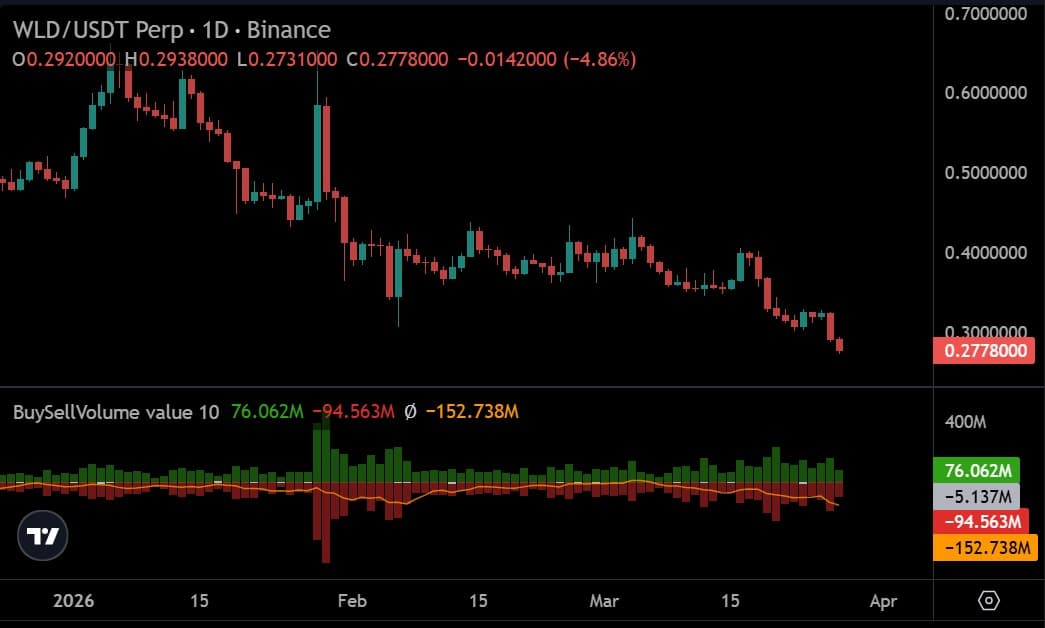
Worldcoin [WLD] has traded within a strong downtrend since it fell below $1. In fact, the altcoin has closed at lower lows since January, reflecting strong bearish pressure.

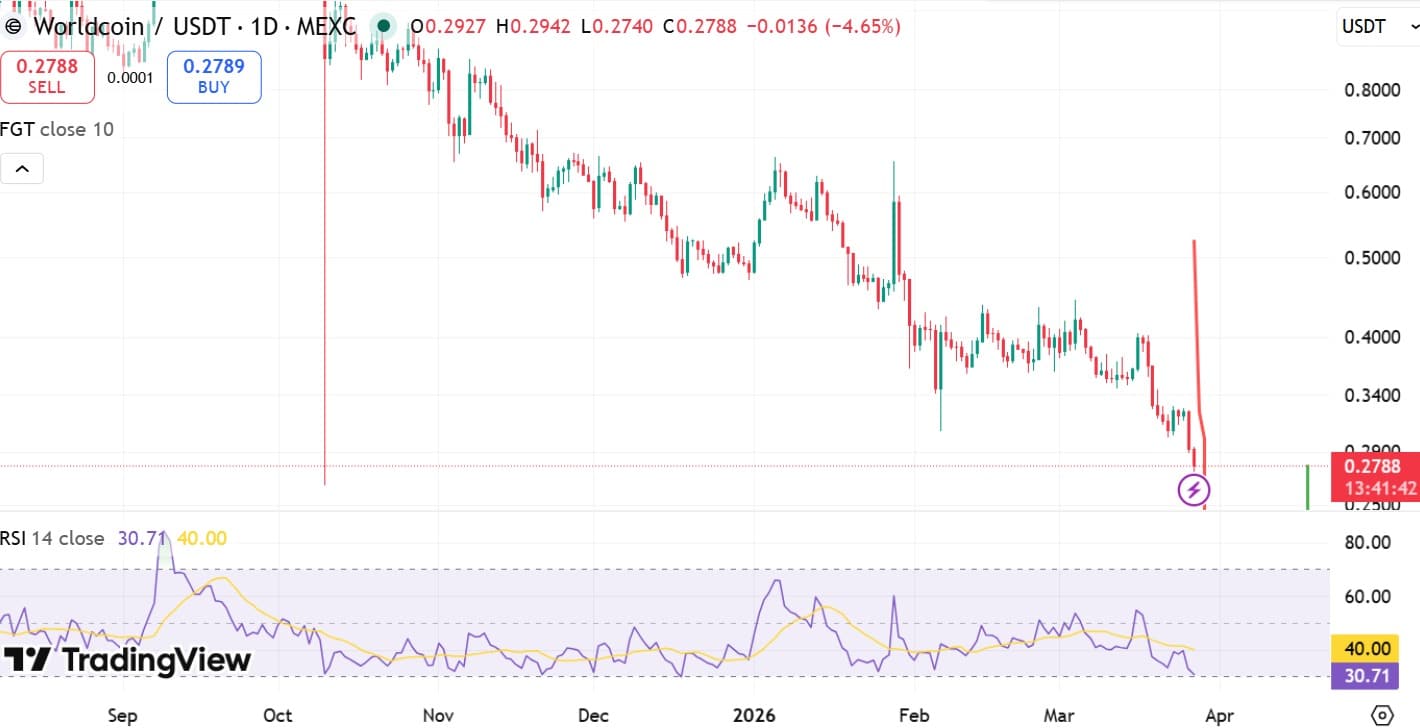
Worldcoin extended its bearish streak, breaching the $0.3 support and dropping to a 6-month low of $0.2701. At press time, WLD traded at $0.282, down 9.03% on the daily charts.

Over the same period, the altcoin’s market cap dropped from $1 billion to $876 million, indicating massive capital outflows. Following this market slip, liquidation levels soared with over $4.26 million in long positions liquidated, further stretching the downtrend.

Amid this market weakness, the Worldcoin team has moved significant funds into exchanges.

WLD team moves 89.65M tokens

Onchain Lens reported that the WorldCoin Team sent 89.65 million WLD, worth $26.17 million, to a new wallet. After the transfer, the team later began sending funds to multiple centralized exchanges (CEXs).
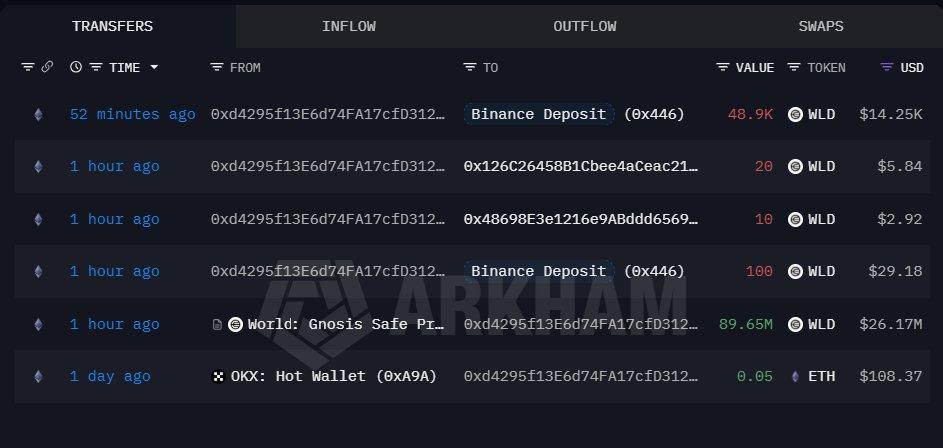
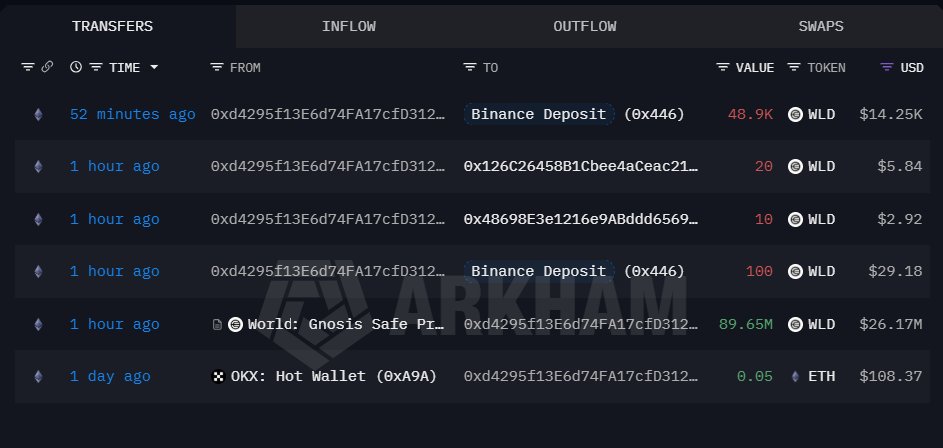
Source: Onchain Lens

When a team’s wallet makes such transfers, it could mean two important things. Firstly, moving funds to exchanges could mean that tokens are being prepared for sale.

Usually, this move is inflationary, causing short-term bearish pressure and leading to a price decline. However, sometimes teams move funds to exchanges to provide liquidity, supporting market stability by avoiding higher slippage.

Although less bearish, it could also create downside pressure if the demand is weak. Combined, either move could result in bearish pressure, leading to lower prices.

WLD faces strong bearish pressure

In addition to the team’s token transfers, Worldcoin has faced significant pressure from other market participants.

On the spot side, sellers have largely dominated the market, as evidenced by Buy Sell Volume on Binance. A the time of writing, Sell Volume rose to 94 million, while Buy Volume dropped to 76 million as of writing, with net market delta holding at -152 million.
Source: Coinalyze

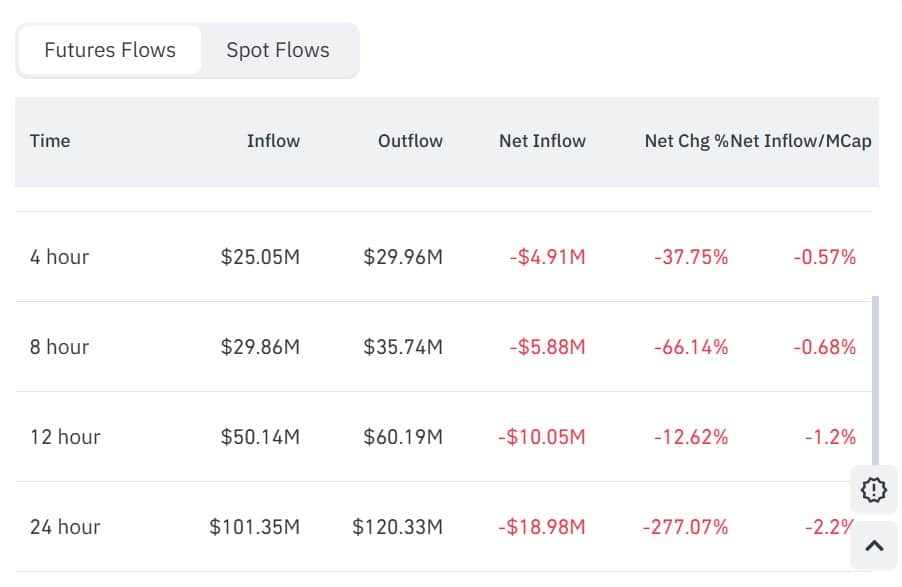
The same market behavior was observed on the Futures side. According to CoinGlass data, Futures Inflow dropped to $101 million while outflows jumped to $120.3 million.

As a result, Futures Netflow dropped 277% to -$18.98 million, a clear sign of aggressive exits in the futures market. Such market conditions suggest increased risk-off sentiment with traders reducing exposure.
Source: CoinGlass

More losses ahead for WLD?

Worldcoin has faced significant downside pressure, and the latest team’s token transfer exacerbated the downtrend.

At press time, the altcoin’s Relative Strength Index (RSI) dropped deeper into the bearish zone and was nearing an bearish crossover. Often, when this momentum indicator drops to such levels, it suggests that sellers have outpaced buyers.
Source: TradingView

Traditionally, a drop into oversold territory has preceded lower prices. In fact, the Future Grand Trend indicator indicated a continued market decline, with a likelihood of dropping below the $0.2 support.

For a potential trend reversal, WLD needs to reclaim the $0.3 resistance and flip it into support.


Final Summary

  • Worldcoin team moves 89.65 million WLD, worth $26.17 million, to multiple exchanges.
  • WLD declined 9.03%, breaching the $0.3 support to a 6-month low of $0.27.

Trending Cryptos

Related Questions

QWhat was the recent price movement of Worldcoin (WLD) and what support level did it breach?

AWorldcoin declined 9.03% and breached the $0.3 support level, dropping to a 6-month low of $0.2701.

QWhat significant action did the Worldcoin team take that contributed to the bearish pressure?

AThe Worldcoin team moved 89.65 million WLD, worth $26.17 million, to a new wallet and then began sending funds to multiple centralized exchanges (CEXs).

QWhat does the negative Futures Netflow of -$18.98 million indicate about market sentiment?

AThe -$18.98 million Futures Netflow, a drop of 277%, is a clear sign of aggressive exits in the futures market, indicating an increased risk-off sentiment with traders reducing their exposure.

QAccording to the technical analysis, what is the potential next major support level for WLD if the downtrend continues?

AThe Future Grand Trend indicator suggests a likelihood of the price dropping below the $0.20 support level if the downtrend continues.

QWhat would need to happen for a potential trend reversal in WLD's price?

AFor a potential trend reversal, WLD needs to reclaim the $0.30 resistance level and flip it into support.

Related Reads

Beyond the Model Lies the Harness: Deepseek Enters the Arena, Why Has the Main Battlefield of China's AI Competition Shifted?

In mid-to-late May 2026, Deepseek internally established a new Harness team focused on code agent products, internally benchmarked against Anthropic's Claude Code. This move, marked by the formula "Model + Harness = Agent" in their job postings, signals a major shift in China's AI competition: the main battlefield is transitioning from developing large models to building toolchains and achieving workplace integration. Deepseek's direct involvement in Harness development aims to secure control over interface design and training data feedback loops, moving beyond open-sourcing powerful models. Harness, the runtime infrastructure for AI agents, handles everything beyond model reasoning—task orchestration, tool calling, context management, safety checks, and error recovery. It is crucial because agent products are not just outputs of model capability but also training grounds for it. Real-world task failures recorded by Harness can feed back into model training, creating a flywheel effect. Engineering Harness is more critical than optimizing prompts, as poor context management or error handling can drastically reduce agent success rates in multi-step, real-world scenarios. This shift is not isolated. Other major Chinese tech companies are also pursuing differentiated toolchain strategies. Tencent leverages its enterprise ecosystem (WeChat Work, Tencent Cloud) to build connectors for organizational-level AI collaboration and complex task delivery. Alibaba focuses on lowering automation barriers on the web with a front-end, browser-based GUI Agent framework, PageAgent. This diversification shows the industry recognizes that success lies not in a perfect general agent, but in vertically focused solutions built with robust engineering. The trend is validated by overseas success, such as Poland's Viktor, an AI coworker on Slack achieving $20M ARR by autonomously executing complex, multi-step tasks. This proves a shift in enterprise willingness to pay—from "AI-assisted generation" to "AI-autonomous execution." As Harness matures to provide safety guards and reliability, AI transitions from a human-supervised intern to an independent outsourcer. The competition now faces key engineering challenges: preventing "token explosion" through intelligent context compression, and building "thick frameworks" with features like sandbox isolation and checkpoint recovery for enterprise-grade stability. Geopolitical restrictions on tools like Claude Code further create a significant market vacuum for domestic solutions like Deepseek's Harness. For enterprises and developers, the focus must shift from comparing model benchmarks to evaluating a vendor's engineering capabilities, error recovery mechanisms, context management, and ecosystem compatibility when choosing AI products and platforms.

marsbit16m ago

Beyond the Model Lies the Harness: Deepseek Enters the Arena, Why Has the Main Battlefield of China's AI Competition Shifted?

marsbit16m ago

Soaring Export Data for Memory Chips, Market Is Redefining the Valuation Anchor for Memory Stocks

Korean storage export data for the first 20 days of June shows substantial year-on-year increases in both value and price-per-kilogram for categories like DRAM, NAND, and SSDs. This signals a potential shift beyond simple demand recovery, indicating rising prices and a product mix shift towards higher-value items, possibly influenced by AI infrastructure needs. A key point is that the surge in price-per-kilogram is not simply a uniform chip price hike. It reflects a combination of actual price increases and, more importantly, an export structure increasingly dominated by high-value-density products like HBM (High-Bandwidth Memory) and advanced DRAM, which are critical for AI servers. This suggests AI-driven demand may be spilling over from just HBM into broader memory markets. SK Hynix stands to benefit directly due to its leading HBM position. For Samsung and Micron, the implication is potential for greater margin elasticity if the tightness in high-end memory spreads to enterprise SSD and NAND prices. However, the storage sector remains cyclical. Risks include supply expansion, inventory changes, and potential slowdowns in broader AI capital expenditure. Ultimately, while the strong export data supports upward revisions for storage company earnings and fuels discussion of an "AI infrastructure bottleneck premium," a definitive valuation shift from a cyclical to a structural story depends on upcoming quarterly reports. Investors need confirmation from SK Hynix, Samsung, and Micron that improvements in average selling prices, product mix, and, crucially,毛利率 are sustained over multiple quarters.

marsbit1h ago

Soaring Export Data for Memory Chips, Market Is Redefining the Valuation Anchor for Memory Stocks

marsbit1h ago

Trading

Spot
Futures

Hot Articles

How to Buy WLD

Welcome to HTX.com! We've made purchasing Worldcoin (WLD) simple and convenient. Follow our step-by-step guide to embark on your crypto journey.Step 1: Create Your HTX AccountUse your email or phone number to sign up for a free account on HTX. Experience a hassle-free registration journey and unlock all features.Get My AccountStep 2: Go to Buy Crypto and Choose Your Payment MethodCredit/Debit Card: Use your Visa or Mastercard to buy Worldcoin (WLD) instantly.Balance: Use funds from your HTX account balance to trade seamlessly.Third Parties: We've added popular payment methods such as Google Pay and Apple Pay to enhance convenience.P2P: Trade directly with other users on HTX.Over-the-Counter (OTC): We offer tailor-made services and competitive exchange rates for traders.Step 3: Store Your Worldcoin (WLD)After purchasing your Worldcoin (WLD), store it in your HTX account. Alternatively, you can send it elsewhere via blockchain transfer or use it to trade other cryptocurrencies.Step 4: Trade Worldcoin (WLD)Easily trade Worldcoin (WLD) on HTX's spot market. Simply access your account, select your trading pair, execute your trades, and monitor in real-time. We offer a user-friendly experience for both beginners and seasoned traders.

4.5k Total ViewsPublished 2024.03.29Updated 2026.06.02

How to Buy WLD

Discussions

Welcome to the HTX Community. Here, you can stay informed about the latest platform developments and gain access to professional market insights. Users' opinions on the price of WLD (WLD) are presented below.

活动图片