Three Canadian soldiers arrested for plotting a cryptocurrency kidnapping

cryptonews.ruPublished on 2026-10-16Last updated on 2026-10-16

Abstract

Three members of the Canadian Armed Forces (CAF) have been arrested in connection with a 'cryptojacking' plot in Toronto. According to the Toronto Police Service report, the three CAF members—Talarambage Fernando, James Morrow, and Jack Mailey—were part of a seven-person group that attempted to kidnap an unidentified victim in July with the goal of seizing their cryptocurrency assets. Toronto Police Chief Myron Demkiw stated the investigation established links between the three suspects and the incident. Chief Superintendent Joe Matthews added that the initial cryptojacking probe expanded into investigations involving firearms, drugs, and broader criminal activities.

Three members of the Canadian Armed Forces (CAF) have been arrested on suspicion of involvement in a cryptojacking in Toronto.

According to a report from the Toronto Police Service, Talarambage Fernando, James Moro, and Jack Mailey — three CAF members — were part of a seven-person group that attempted to kidnap an unidentified victim in July in order to seize their cryptocurrency assets.

Toronto Police Chief Myron Demkiw stated that the investigation established a link between the three suspects and this incident. Chief Superintendent Joe Matthews also explained that the cryptojacking investigation expanded into investigations related to firearms, drugs, and broader criminal activities.

Related Questions

QHow many Canadian Armed Forces (CAF) members were arrested in connection with the cryptojacking plot in Toronto?

AThree Canadian Armed Forces (CAF) members were arrested in connection with the cryptojacking plot in Toronto.

QWhat were the three arrested individuals accused of planning, according to the Toronto police report?

AAccording to the Toronto police report, the three individuals were part of a seven-person group that attempted to kidnap an unidentified victim in July with the intent to seize their cryptocurrency assets.

QWhat broader criminal activities did the investigation expand into, as stated by Chief Superintendent Joe Matthews?

AAs stated by Chief Superintendent Joe Matthews, the cryptojacking investigation expanded into investigations involving firearms, drugs, and broader criminal activities.

QWhat is the alleged motive behind the kidnapping plot described in the article?

AThe alleged motive behind the kidnapping plot was to seize the victim's cryptocurrency assets.

QWho is Myron Demkiw in the context of this police investigation?

AIn the context of this investigation, Myron Demkiw is the Chief of the Toronto Police Service, who confirmed the connection of the three suspects to the incident.

Related Reads

BTC Short-Term Bottoming and Gathering Momentum, HYPE Triple Support Faces Critical Test | Guest Analysis

Last week, the crypto market was driven by news. On Nov 4, midterm election news sparked a 3.92% Bitcoin rally above $80K, but a day later, US stock declines triggered a 5.48% drop to ~$75,222, a new low since Sept 21, with fear index near 25. HYPE also fell 15.19% weekly, erasing prior gains and returning to ~$75. Key points: Bitcoin has held above the 52-week MA for eight weeks, satisfying the "price breakout principle," but the pullback confirmation signal is not yet issued and the 52-week MA (~$76,110) remains downward-sloping. The rebound from the July 1 low of $57,820 is still classified as an oversold bounce, not a confirmed bull market. On the daily chart, price remains in a descending channel, has broken below the key MA crossover (~$77,200), but holds above the 0.382 Fibonacci level ($76,130). The correction (wave i) has run 48 trading days with a max drawdown of 15.9%; a wave ii rebound is expected but not yet started. The "Shijie Ribbon" model still signals a long market. Strategy: mid-term stay in cash; short-term use 30% position for range trading, favoring buying dips near $72,500–73,500 with strict stops. HYPE: the weekly bearish engulfing candle was driven by external shocks, not fundamentals. Three support layers: the ribbon upper band (~$74.05, lower ~$71), the box lower edge (~$75, which triggered a 20% bounce on Oct 24), and the long-term uptrend line (~$68). Key support zones: $74–75 (ribbon upper + box bottom), $71 (ribbon lower), $68 (long-term trendline). Strategy: if price stabilizes at $74–75 or $68–71, consider light long positions (≤30%) with strict stops. Special rules: set initial stop at entry; move to breakeven at +1% profit; trail stop 1% per 1% gain. All analysis is personal technical opinion, not investment advice; markets carry risk.

Odaily星球日报12m ago

BTC Short-Term Bottoming and Gathering Momentum, HYPE Triple Support Faces Critical Test | Guest Analysis

Odaily星球日报12m ago

Canton Foundation Launches Official Daml 3 Certification, Expanding Developer Access and Establishing Institutional Finance Standards

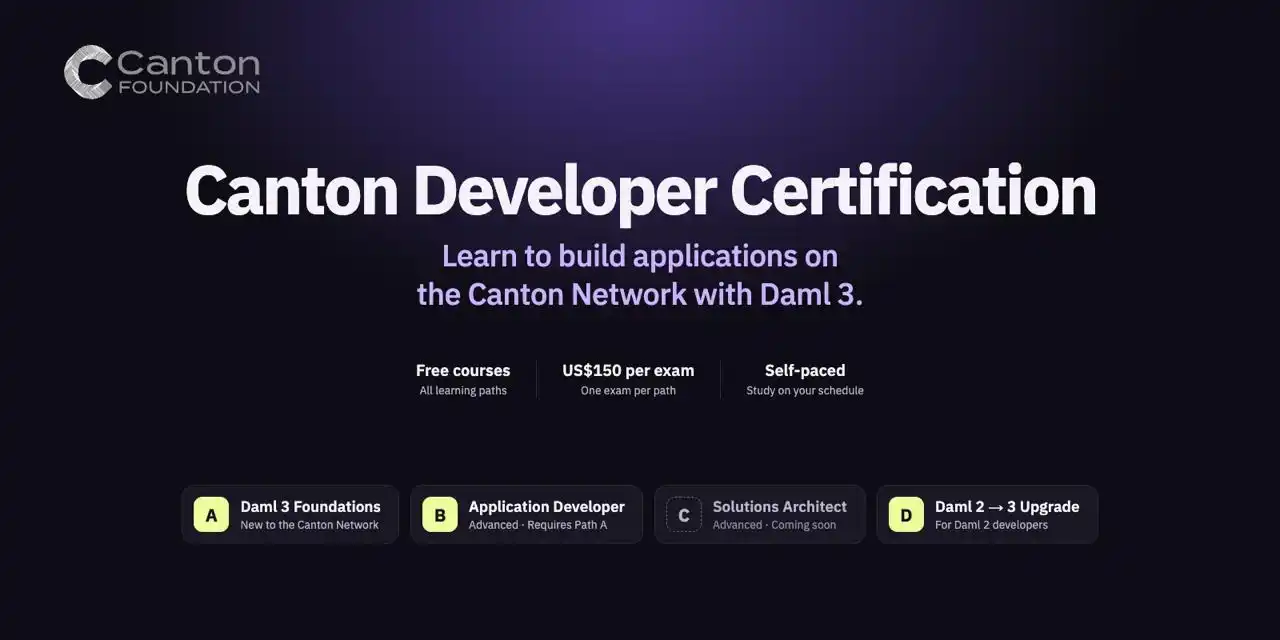
Canton Foundation has launched the Canton Developer Certification, an official certification program for Daml 3, the smart contract language of the Canton Network. Combining a self-paced course with a certification exam, it offers developers worldwide a structured path to building applications for regulated financial markets. Canton Network is a public, permissionless blockchain designed for regulated finance, with over $6 trillion in on-chain assets processed by its supported applications. Daml is built to manage who may act on a contract and who may access its terms; the certification validates practical mastery of these authorization and privacy principles, establishing a recognized standard intended to strengthen institutional confidence in applications built on the network. The program is based on Daml 3 and Canton 3.x, the current technology underlying the network, letting newcomers start on the latest stack, helping production engineers deepen expertise, enabling institutional architects to design and integrate Canton deployments, and allowing existing Daml 2 developers to migrate their skills and codebases to Daml 3, unifying the community on a single, current platform. For ecosystem partners—financial institutions, application providers, system integrators, and validators—the certification provides a common technical foundation and a consistent way to assess developers' understanding of authorization and privacy requirements. Canton Foundation COO Amanda Martin said financial institutions need confidence that the applications they rely on are built by developers who understand regulated market requirements, and that the program both opens opportunities for developers globally and establishes a shared professional standard, building a stronger foundation for Canton's future growth by bringing the community together on Daml 3. The certification is now live at certification.canton.foundation; the course is self-paced and free to all developers, and the exam costs $150 per attempt. Canton Foundation is an independent nonprofit responsible for the governance and long-term development of Canton Network's shared infrastructure, supporting transparent and decentralized governance, ecosystem coordination, and broad participation by Global Synchronizer operators and network stakeholders, while working with financial institutions, technology providers, developers, and other participants to support the network's continued global growth and adoption.

marsbit23m ago

Canton Foundation Launches Official Daml 3 Certification, Expanding Developer Access and Establishing Institutional Finance Standards

marsbit23m ago

Nvidia Faces Independent Investigation, Bernstein Maintains $400 Target Price

Nvidia's board has launched an independent investigation following reports about CEO Jensen Huang's contacts with Megaspeed executive Alice Huang, though it says there is no reason to believe U.S. national security or company secrets were compromised. Three Republican House committee chairs have requested Huang attend a closed-door briefing on November 18 to explain the contacts and Nvidia's internal procedures for countering foreign intelligence activities, and Democratic Senator Chris Coons said Congress will investigate. Some reports suggested Alice Huang may have influenced Huang's lobbying to ease chip export restrictions to China, a claim Bernstein doubts, noting Huang has long publicly pushed to expand sales in China and that revenue from mainland China and Hong Kong has fallen sharply since export controls. Only H20 and limited H200 chips were approved for China sales, well behind Nvidia's most advanced products, and Bernstein sees limited room for recovery as Chinese customers prioritize domestic alternatives. Regulatory pressure may persist, with hawkish lawmakers potentially revisiting export limits. Bernstein maintains an Outperform rating and a $400 target price, about 114% above the November 6 close of $186.64, citing data center demand and earnings growth. It projects adjusted EPS of $4.77 for FY2026, $9.20 for FY2027 and $15.80 for FY2028. The target is based on average FY2028-2029 non-GAAP EPS of $19.04 at about 21x. Bernstein also flags Huang's succession as a key risk, given his central role and roughly 60 direct reports.

marsbit33m ago

Nvidia Faces Independent Investigation, Bernstein Maintains $400 Target Price

marsbit33m ago

Two Blocks Hit in 7 Hours: Two Retail Miners Take on the Entire Network's Hashrate and Walk Away with $476,000

Two individual solo miners using home mining rigs hit two Bitcoin blocks within seven hours on November 7, earning a combined $476,000. One miner using a Canaan AvalonQ home miner with roughly 80–87 TH/s earned about $239,000; the other earned roughly $237,000. A CKPool solo platform took about 2% (0.0629 BTC) as a service fee, with the rest going directly to the miners' wallets. Given current network difficulty of about 148.4 trillion, such a rig would normally need over a century to find a block, making the win a luck value of over 10,000%. This is part of a broader trend: in 2026 so far, solo miners have found 36 blocks, nearly one lucky winner per week. Earlier examples include a 6.5 TH/s Avalon Nano 3S worth a few hundred dollars earning $250,000 on October 27, another Nano 3S earning $232,000 on May 30, and a $150 Bitaxe Gamma earning $200,000 on July 10. Home solo mining is often called "plug-in lottery": a 1.2 TH/s mini miner has about a 1-in-16,000 annual chance of winning, far better than Powerball's 1-in-292 million, but rigs cost thousands of dollars and electricity runs $400–$1,100 monthly, with zero income until a block is found. Each viral win serves as free advertising for the industry. Rig manufacturers sell the dream of "maybe I'll win too"; solo pool platforms collect a steady ~2% fee from any winner; and the Bitcoin network preserves its "anyone can participate" narrative despite mining being dominated by large farms. The people paying for it all are ordinary buyers who purchase miners and pay electricity bills hoping for a life-changing jackpot.

marsbit49m ago

Two Blocks Hit in 7 Hours: Two Retail Miners Take on the Entire Network's Hashrate and Walk Away with $476,000

marsbit49m ago

NYSE Picks Avalanche, Why AVAX May Not Capture the Settlement Flow

On November 9, Ava Labs announced that a tokenized securities trading platform affiliated with the NYSE had selected Avalanche to provide core ledger technology for its clearing firm. The platform is a regulated alternative trading system (ATS) designed for 24/7 trading, clearing, and settlement, pending regulatory approval. The Wall Street Journal reported a stronger version: the NYSE would "exclusively" use Avalanche to settle tokenized stocks, with matching still handled by existing technology and a Q4 launch target—though Ava Labs' announcement gave no launch date and did not name the clearing firm. Markets traded the headline first, with AVAX rising roughly 8–11% to near $9 intraday. But the announcement places Avalanche at the clearing-ledger layer, not the main board on a public chain—a distinction that determines whether AVAX captures narrative or verifiable demand. Matching (who trades with whom at what price) stays on the NYSE's Pillar engine; settlement (how cash and securities transfer) goes to the blockchain ledger. Ava Labs said it provides core ledger tech for the clearing firm of the NYSE-affiliated ATS, without disclosing the firm's identity, contract value, or timeline. Tokenized stocks involve three layers: issuance, matching, and settlement. NYSE digital issuance head Dennis Lee said the platform will support stocks listed across multiple chains, but the settlement ledger must be fast, reliable, permissioned, and cost-predictable. Issuance can be multi-chain; settlement converges on one controlled system. The "exclusive" label refers to the settlement ledger, not the whole value chain. ICE previously said the platform combines Pillar with blockchain post-trade systems supporting multi-chain settlement and custody. Ava Labs CBO John Nahas said the NYSE will run a custom Avalanche-based chain tailored to regulatory needs, not use the public Avalanche chain—two very different things. A permissioned chain lets the exchange control access, node deployment, and fee pricing. Founder Emin Gün Sirer cited round-the-clock atomic settlement, predictable performance and cost, and regulatory control. This explains why AVAX's price reaction outpaced fundamental certainty: brand association arrived first, while fee capture remains undisclosed—whether the custom chain uses AVAX for pricing, staking, or fees was not answered. Charles Schwab's same-day addition of AVAX to retail trading offers a competing explanation for the gains. Three unresolved variables determine the significance: regulatory approval (no public status), the clearing firm's identity (unnamed legal entity), and token economics. AVAX's economic link is distant—a custom chain does not equal public-chain lockup or AVAX becoming a settlement asset. Issuer willingness also matters; the NYSE recently expanded transfer agents for issuer-sponsored tokenized securities to six, with Broadridge handling on-chain voting and governance, but whether tokenized equities enter this ATS depends on liquidity, compliance costs, and shareholder communication. Until the platform launches and the clearing firm appears, vendor selection is a necessary step, not realized demand.

marsbit52m ago

NYSE Picks Avalanche, Why AVAX May Not Capture the Settlement Flow

marsbit52m ago

Trading

Spot
活动图片