Tether, Kazakhstan cenbank mull tenge stablecoin and asset tokenization

cointelegraphPublished on 2026-10-08Last updated on 2026-10-08

Abstract

Tether has signed a memorandum of understanding with Kazakhstan's central bank and the Alatau City Authority to explore the issuance of a tenge-pegged stablecoin and the tokenization of real-world assets. The parties will study stablecoin models, identify use cases, and develop a pilot for a Kazakh tenge-backed stablecoin, while also creating a framework for asset tokenization potentially using Tether's Hadron platform. Workshops on stablecoin issuance and tokenization are also planned. Kazakhstan's central bank emphasized that financial stability and investor protection are priorities in this exploration. This move is part of Kazakhstan's broader push into digital assets, which includes a government-approved development plan covering tokenization, digital payments, and crypto mining. The country ranks seventh among governments for Bitcoin holdings, with its National Strategic Crypto Reserve valued at $700 million.

Tether has signed an agreement with Kazakhstan’s central bank and the Alatau City Authority to explore a tenge-pegged stablecoin and the tokenization of real-world assets.

Under the memorandum of understanding, the parties will study international stablecoin issuance models, identify potential use cases and develop a proposal for a tenge-backed stablecoin pilot, according to Tether.

The agreement also calls for the development of an asset tokenization framework, including identifying assets for potential tokenization and launching a pilot project in Alatau that could use Tether’s Hadron platform.

Tether, the National Bank of Kazakhstan and the Alatau City Authority will also hold workshops and training programs covering stablecoin issuance, reserve management and real-world asset tokenization.

National Bank of Kazakhstan Deputy Governor Binur Zhalenov said the central bank plans to study international approaches to stablecoin issuance and tokenization while prioritizing financial stability, transaction transparency and investor protection.

Related: Balaji’s Network School turns to Kazakhstan amid Malaysia setback

Kazakhstan expands digital asset push

Kazakhstan, the world’s largest landlocked country, has accelerated its push into digital assets this year, rolling out initiatives including stablecoins, tokenization, crypto payments and mining.

In September, the government approved a 65-measure plan across 10 areas aimed at developing the country’s digital asset industry. The plan includes measures to expand real-world asset tokenization, digital payments, international settlements and crypto mining.

The government also instructed the Energy and Digital ministries to develop a mechanism for using gas- and coal-fired power generation to supply mining centers. Kazakhstan ranked among the world’s top 10 countries for Bitcoin production in 2025, according to the government.

Kazakhstan’s National Strategic Crypto Reserve, meanwhile, has reached $700 million, while 34 digital asset projects have completed testing in the central bank’s regulatory sandbox, according to the announcement.

BitcoinTreasuries.net ranks Kazakhstan seventh among governments in its database for Bitcoin holdings, with an estimated 3,544 BTC worth about $294 million.
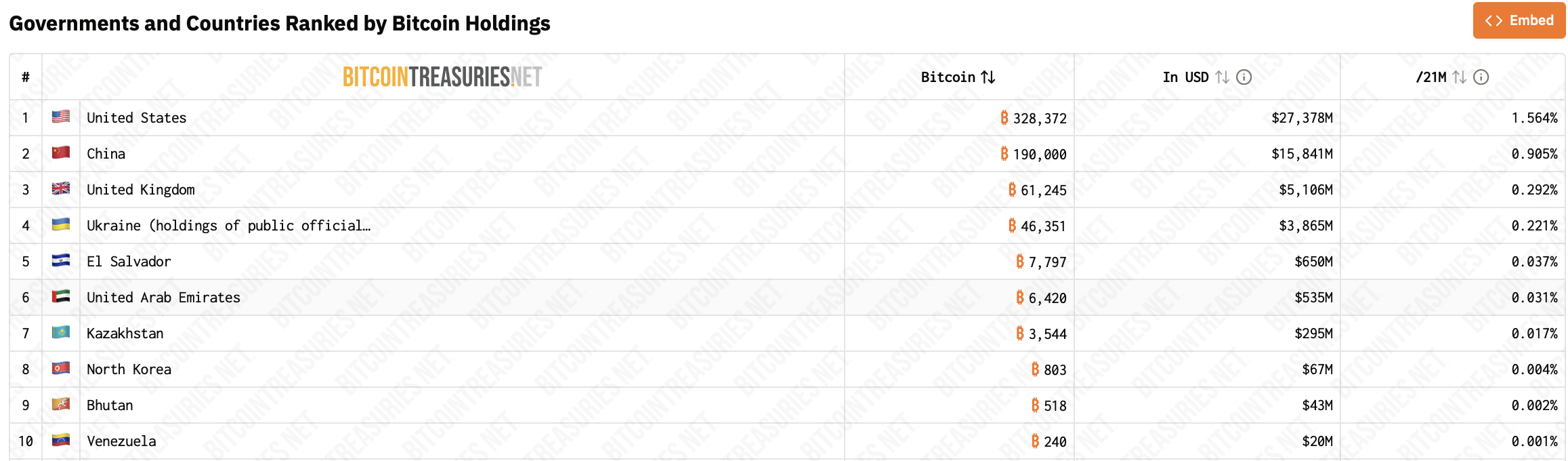
Source: BitcoinTreasuries.NET

Magazine: Capital starting to rotate back to crypto from AI: Raoul Pal

Related Questions

QWhat is the main purpose of the agreement signed between Tether and Kazakhstan's central bank?

AThe main purpose is to explore the development of a tenge-pegged stablecoin and the tokenization of real-world assets.

QBesides stablecoin issuance, what other key area will the partnership study and develop?

AThe partnership will also study and develop an asset tokenization framework, potentially using Tether's Hadron platform for a pilot project in Alatau.

QWhat are the National Bank of Kazakhstan's priorities in its study of stablecoins and tokenization?

AThe priorities are financial stability, transaction transparency, and investor protection.

QAccording to the article, how does Kazakhstan rank globally in Bitcoin production?

AKazakhstan ranks among the world's top 10 countries for Bitcoin production.

QWhat is the estimated value of Bitcoin held by the Kazakh government according to BitcoinTreasuries.net?

AThe Kazakh government is estimated to hold about 3,544 BTC worth approximately $294 million.

Related Reads

OpenAI launches AI payments in ChatGPT with Visa, Mastercard and Amex

OpenAI launched a feature letting AI agents make purchases for users directly within ChatGPT through existing payment networks, in partnership with American Express, Mastercard, and Visa. The wallet uses biometric verification like facial recognition or fingerprints to authorize transactions, and payment networks generate tokenized card credentials for each approved purchase, keeping users' actual card details from merchants and AI agents. The service is rolling out to ChatGPT Pro subscribers in the US with eligible US-issued cards, with plans to eventually support purchases within preset spending limits and other restrictions without requiring approval for each transaction. The launch reflects AI companies moving beyond product recommendations into executing transactions, potentially changing how consumers interact with online merchants. OpenAI is working with payment processors and fraud prevention firms to support AI purchases through existing checkout systems. It joins a growing field: Google introduced its Agent Payments Protocol in 2025, Visa and Mastercard have launched AI transaction initiatives, and crypto companies like Coinbase (x402 protocol), Circle (Agent Stack), and Crossmint are building payment infrastructure for AI agents. Global agentic commerce transaction value is expected to reach $1.5 trillion by 2030, up from an estimated $8 billion in 2026, according to Juniper Research.

cointelegraph1h ago

OpenAI launches AI payments in ChatGPT with Visa, Mastercard and Amex

cointelegraph1h ago

Kraken parent Payward gains market share as slower trading weighs on earnings

Kraken parent Payward nearly doubled its share of global crypto spot trading to 6.5% in September from 3.3% a year earlier, even as weaker trading activity weighed on earnings. The market-share gain reflects a larger portion of spot trading relative to competitors rather than increased activity; the company handled $353 billion in transactions in Q3, down 30% year over year. Adjusted EBITDA fell to $60 million from $178.6 million a year earlier, and total platform margin fell 12% to $487 million. Payward has spent two years expanding beyond its core exchange through acquisitions in derivatives, proprietary trading, tokenized assets and payments, including NinjaTrader, Breakout, Bitnomial and Reap. Derivatives contracts with per-contract fees rose 84% to 66 million, and margin from subscriptions and other paid services rose 59% to $125 million. Results improved from Q2, with total transaction volume up 22% and platform margin up 12% to $487 million from $436 million. Margin from customer-held assets, including staking, rose 26% to $128 million, accounting for roughly half the quarterly increase. Adjusted EBITDA climbed to $60 million from $23 million, though it remained down 66% year over year. Asset- and access-based services accounted for 52% of total platform margin, up from 46%. Payward confidentially filed for a US IPO in November 2025 but paused plans in March; the earliest potential listing window under consideration was Q2 2027.

cointelegraph2h ago

Kraken parent Payward gains market share as slower trading weighs on earnings

cointelegraph2h ago

Metaplanet swings to $170M loss as Bitcoin sale hits earnings

Metaplanet, the world's second-largest publicly traded corporate Bitcoin holder, reported a net loss of 27.16 billion yen (about $170 million) in the first nine months of 2026, compared with a profit of 13.53 billion yen ($84.6 million) a year earlier. The loss was driven by a 19.17 billion yen ($119.8 million) loss on the sale of 10,000 BTC and an 8.04 billion yen ($50.3 million) loss from a decline in the value of its Bitcoin holdings, which outweighed gains in its operating business. During the quarter, Metaplanet sold 10,000 BTC for 124.7 billion yen, temporarily held the proceeds in cash, stablecoins and other liquid assets, then spent 149.9 billion yen to buy 11,000 BTC at an average price 9.3% higher per coin. The company said the sale was intended to demonstrate to rating agencies and bond investors that it could convert Bitcoin into cash to meet financing obligations. Holdings ended September at 44,000 BTC, a net increase of 1,000 coins. Metaplanet borrowed against its Bitcoin during the quarter, raising its credit line debt to $649.5 million at the end of September from $414 million at the end of June. It funded purchases from the second quarter onward with borrowed funds, bond proceeds, exercised stock acquisition rights and revenue from its Bitcoin options business. Interest expense rose 56% quarter over quarter to 1.36 billion yen ($8.5 million), and short-term borrowings and bonds payable totaled 110.5 billion yen ($691 million). For the nine months through September, revenue rose 30.5% to 5.9 billion yen ($36.9 million) and operating profit increased 26.5% to 3.48 billion yen ($21.8 million). The company cut its full-year revenue forecast to 6.5 billion yen ($40.6 million) from 16 billion yen ($100 million). The results come as Bitcoin treasury companies face pressure from falling prices and index removals; MSCI confirmed Strategy, Metaplanet and Upexi will be removed from its equity indexes at the Nov. 30 market close. Bitcoin fell below $70,000 on Friday, trading around $68,600, down about 9% over the previous week.

cointelegraph5h ago

Metaplanet swings to $170M loss as Bitcoin sale hits earnings

cointelegraph5h ago

Trading

Spot
活动图片