Strategy Spent $16 Billion in Rescue Funds, Preferred Stock STRC Buyback Loop Faces Liquidity Test?

marsbitPublished on 2026-10-16Last updated on 2026-10-16

Abstract

MicroStrategy (now Strategy) launched a high-yield preferred stock, STRC, with a 12% annual dividend, designed to raise funds by issuing shares at or above their $100 face value to finance continuous Bitcoin purchases. However, since mid-May, STRC's price fell below par, dropping as low as $74.57 in late June, halting new issuances. To restore the $100 benchmark and restart this funding channel, Strategy initiated an aggressive weekly buyback program in late July, spending a cumulative $1.6 billion to repurchase STRC. Last week's buyback hit a record $192.4 million—approximately nine times its Bitcoin purchases for the same period. This massive effort has pushed STRC's price back to $99.90. The funding for these repurchases primarily comes from selling MSTR common stock in the open market. At the current spending rate, the authorized buyback budget could be exhausted in about two weeks, though the board may increase it again. The company's available liquidity could also be depleted in just over three weeks at this pace. This situation represents a significant shift in Strategy's capital strategy. Instead of using raised funds to leverage Bitcoin acquisitions, a substantial portion is now being diverted to support STRC's price. The company even sold some Bitcoin this summer to fund the repurchases. While financially accretive if MSTR trades above ~$131, this activity effectively reduces MSTR's leverage to Bitcoin's price. Market data shows Strategy's buybacks accounted for ...

Author: Jeff Albus, Unchained

Compiled by: Deep Tide TechFlow

Deep Tide Introduction: Deep Tide Introduction: MicroStrategy (Strategy) once designed the preferred stock STRC with an annual dividend as high as 12%, aiming to provide a continuous flow of U.S. dollar ammunition for ongoing Bitcoin purchases through premium public offerings. However, since STRC fell below its $100 face value in May, this fundraising channel has been completely paralyzed. To pull the stock price back to $100, the company initiated a large-scale buyback at the end of July, having cumulatively spent a staggering $16 billion. This buyback tug-of-war not only costs the company nine times more per week to buy preferred shares than its Bitcoin purchases but also forces the company to subsidize the effort by selling MSTR shares and even Bitcoin. With the buyback quota nearly depleted, how much longer can this self-recycling model hold up?

Featured Image: Michael Saylor's MicroStrategy (Strategy) is facing a balance in capital operations between preferred and common stock.

To raise funds for its continuous Bitcoin acquisition plan, MicroStrategy (now renamed Strategy) meticulously designed STRC: a high-yield preferred stock paying an annual dividend as high as 12%. According to the original design, when STRC trades at or above its $100 face value in the market, the company could continuously issue new shares, pay dividends to investors every half-month, and use all the raised cash to buy Bitcoin.

However, this fundraising machine has been completely stalled since mid-May.

In late June, STRC once fell to a historic low of $74.57, a deep discount of nearly 25% from its $100 benchmark face value. To rescue this core fundraising vehicle, Strategy launched a costly weekly buyback campaign at the end of July. According to statistics from the company's weekly regulatory disclosures, Strategy has so far spent a cumulative $16 billion in the secondary market to prop up and buy back shares. As of Tuesday's close, STRC traded at $99.90, just 10 cents away from its $100 target price.

Last week became the most intense week for Strategy's STRC buyback in history: the weekly buyback expenditure reached $192.4 million, approximately nine times its Bitcoin purchase expenditure during the same period (about $21 million). According to the company's established policy, it will not issue any new STRC shares in the market until STRC solidly stands above $100.

Where Does the Buyback Money Come From? How Long Can the Cash Pool Last?

So, is this expensive buyback loop depleting cash?

The answer is: Not yet depleted, but the time window is rapidly narrowing.

Currently, the preferred stock buyback budget approved by the company's board, if continued at last week's nearly $200 million procurement speed, will be completely exhausted in about two weeks. Of course, the board has full authority to, as it did in September, once again pass a resolution to double the buyback authorization to a higher scale (previously increased from $10 billion to $20 billion).

A more realistic constraint lies in cash reserves. At last week's cash consumption rate, the company's existing available liquidity can only last a little over three weeks. It is worth noting that Strategy's primary channel for paying this exorbitant buyback cost is through continuously issuing and selling MSTR common stock in the public market, or using the cash pool accumulated from previous MSTR sales. As long as MSTR's secondary market liquidity and stock price remain strong, the company can continue to raise funds by selling shares.
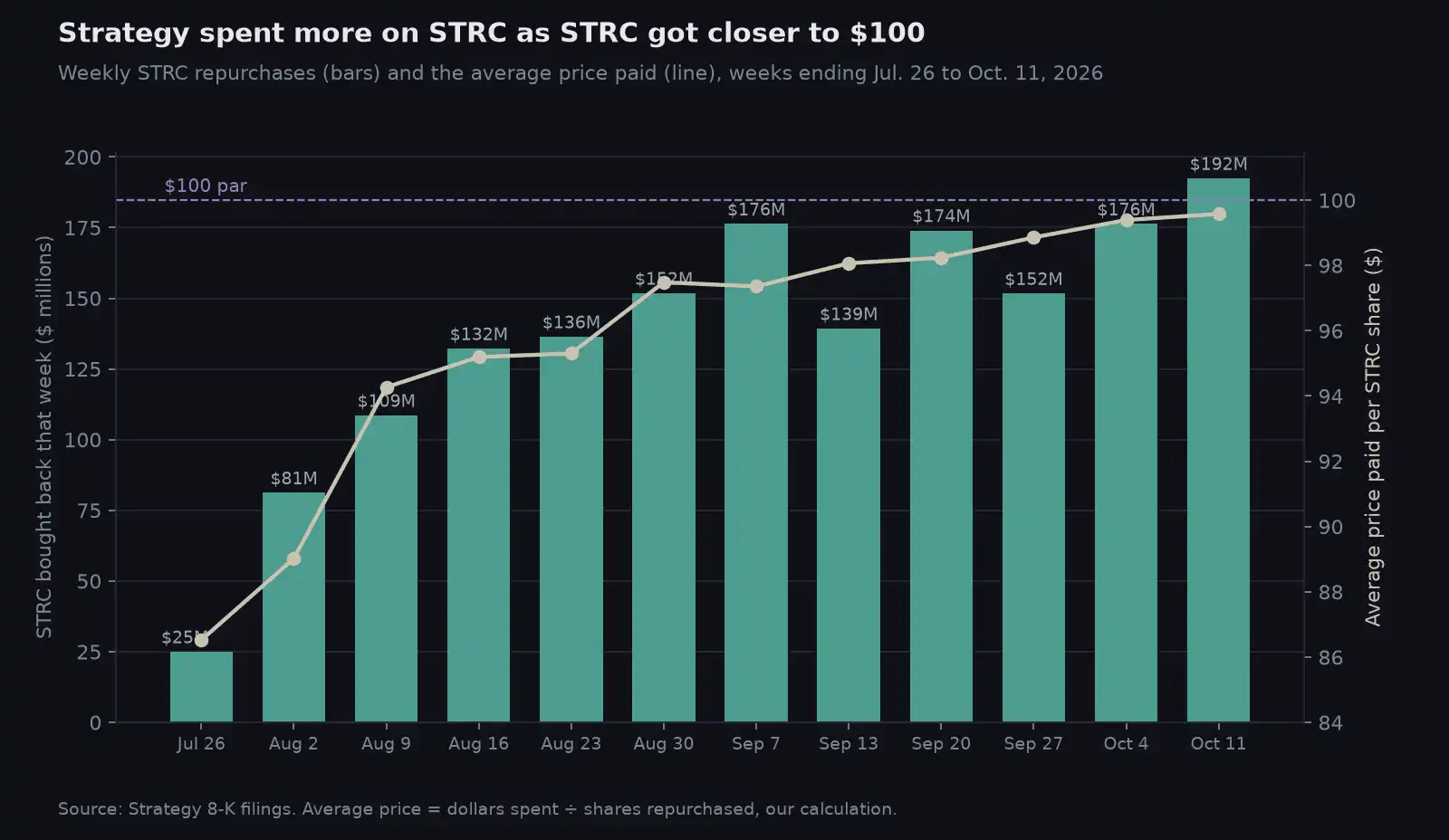
Chart: Comparison of Strategy's weekly STRC buyback amount and STRC market price climb since July.

From a Bitcoin Leverage Tool to a Burden Requiring Massive Funding

Strategy's growth into the world's largest corporate Bitcoin reserve is built on two pillars: First, the U.S. dollar will inevitably continue to depreciate over the long term; second, the global capital market is extremely eager for a compliant, high-leverage Bitcoin allocation tool. To this end, the company launched a series of preferred stock instruments, attempting to build a perpetual buying flywheel.

However, currently, STRC has evolved into a heavy burden that the company must spend huge sums to barely prop up.

Over the past few months, the vast majority of funds raised from selling MSTR shares have not flowed into the Bitcoin market but have been diverted to buy back and retire STRC. Even this summer, to raise enough buyback funds, the company was forced to sell part of its Bitcoin holdings.

From a pure financial calculation model, as long as MSTR common stock trades above approximately $131, issuing MSTR at a high price to buy back and retire STRC at a discount does not materially dilute the net asset value (NAV) per share for existing MSTR shareholders.

However, in terms of investment logic and capital structure, this operation brings an extremely subtle qualitative change: it is substantially reducing MSTR's leverage elasticity relative to Bitcoin. The capital engine originally used for aggressive Bitcoin purchases is now deeply mired in patching the financial hole of internal preferred stock discounts.

Details of the Buyback Operation and Market Dependency Risks

Strategy disclosed its strategy for supporting STRC in its Q2 earnings report: as long as the STRC price is below $100, the company will continuously intervene, "increasing purchases when the discount is large and gradually narrowing when the price approaches face value."

In the first week of late July, the company's entry was quite restrained, buying only about $25 million worth of STRC on the open market at an average price of about $87. But subsequently, as the price climbed, the weekly check amounts expanded exponentially. Last week, Strategy's average buyback price reached $99.58, fully entering the target resistance range of $99 to $100 defined by the company.

This sustained large-scale buying has made Strategy itself the largest absolute liquidity provider in the STRC market. On-chain and order book monitoring data from crypto market maker Keyrock indicates that in September, Strategy's proprietary buybacks accounted for one-fifth to one-quarter (20% to 25%) of STRC's overall weekly trading volume.

Keyrock bluntly pointed out that existing data cannot estimate how much genuine independent buy-side support would remain in the market once Strategy achieves its $100 target and withdraws its buyback support funds. If external buying power is weak, causing STRC to detach and fall below face value again, this multi-billion dollar self-rescue loop will be forced to restart.


Related Questions

QWhat is the primary purpose of MicroStrategy's (Strategy's) STRC preferred shares, and why has that mechanism stalled?

AThe primary purpose of MicroStrategy's (Strategy's) STRC preferred shares was to raise funds by issuing them at or above their $100 par value. The proceeds were then used to purchase Bitcoin, creating a continuous funding flywheel. This mechanism has stalled because since mid-May, STRC's market price has fallen below its $100 par value, preventing the company from issuing new shares for fundraising.

QHow much has Strategy spent on repurchasing STRC shares to prop up its price, and what was the spending ratio compared to its Bitcoin purchases in the most recent week mentioned?

AStrategy has spent a cumulative total of $1.6 billion repurchasing STRC shares. In the most recent week mentioned, the company spent approximately $192.4 million on STRC repurchases, which was about nine times the amount it spent on Bitcoin purchases (around $21 million) during the same period.

QWhat are the main sources of funding for Strategy's STRC repurchase program, and what are the constraints on these sources?

AThe main sources of funding for Strategy's STRC repurchase program are: 1) Proceeds from selling MSTR common stock in the public market, and 2) Utilizing cash reserves from previous MSTR stock sales. The constraints include the limited remaining board-approved repurchase budget, which could be exhausted in about two weeks at the recent spending rate, and the company's available cash liquidity, which could last just over three weeks at the current burn rate. Additionally, the strategy relies on maintaining strong market liquidity and price for MSTR stock to continue selling shares.

QAccording to the article, how has the role of STRC evolved from its original design, and what negative impact is this having on Strategy's core business strategy?

AOriginally designed as a leverage tool to fund continuous Bitcoin purchases, STRC has evolved into a significant financial burden that requires massive capital infusions to prop up its price. This negative impact diverts capital away from the company's core strategy of aggressive Bitcoin accumulation. Most funds raised from selling MSTR stock are now used to repurchase STRC instead of buying Bitcoin, and the company was even forced to sell some Bitcoin holdings to fund the repurchases. This operation is effectively reducing the leverage MSTR provides relative to Bitcoin.

QWhat does market data from Keyrock suggest about the sustainability of STRC's price once Strategy stops its repurchase program?

AMarket data from Keyrock suggests that Strategy has become the largest single liquidity provider for STRC, accounting for 20% to 25% of its weekly trading volume in September. The data indicates it is impossible to measure how much genuine independent buy-side demand would remain to support STRC's price once Strategy achieves its $100 target and withdraws its repurchase support. If external buying is insufficient and STRC's price falls below par again, the costly self-rescue cycle would likely have to restart.

Related Reads

CPI and AI Earnings Dominate Market Rhythm: This Week's Hot Assets Preview | WEEX VIP Weekly Report (November 2 – November 8, 2026)

The article discusses market developments for the week of November 2–8, 2026, highlighting how CPI data and AI earnings dominate market节奏. Last week, Democratic midterm election gains triggered concerns over tighter AI regulation and data center policies, causing a sharp tech selloff—the Nasdaq fell over 5% in a single day and entered technical correction. Crypto markets moved in tandem with cross-asset risk aversion: Bitcoin briefly dropped below $76,000 before showing resilience, with BTC and ETH posting weekly losses of about 4.5% and 6.5% respectively. Spot ETFs saw significant outflows, and the Fear & Greed Index stayed in "fear" territory for six days. Total crypto market cap fell from about $2.7 trillion to $2.54 trillion. In traditional markets, the 10-year Treasury yield hovered at 4.84%–4.95%, gold rebounded above $4,000, while oil plunged over 11%. Tech and semiconductor stocks were hit hard—the Philadelphia Semiconductor Index fell 12% in one day, with AMD down over 17% and Nvidia down over 9%. Defensive sectors outperformed. This week's focus is Tuesday's October CPI release, with headline CPI expected at 3.3%–3.5% and core CPI at 3.1%–3.2%. PPI, Fed speakers, and earnings from AMAT and CSCO are also key. Crypto token unlocks include RAIN (~$121 million), ALLO, JCT, and AZTEC. Investors are advised to maintain defensive positioning, reduce high-beta tech exposure, and wait for inflation data and AI earnings signals before adjusting risk allocations.

marsbit39m ago

CPI and AI Earnings Dominate Market Rhythm: This Week's Hot Assets Preview | WEEX VIP Weekly Report (November 2 – November 8, 2026)

marsbit39m ago

SEC Greenlights On-Chain US Stocks: Five-Year Regulatory Exemption, Uniswap v4 Targets $79 Trillion Market

The SEC's innovation exemption, effective September 17, 2026, creates a new category called Tokenized Securities Venues (TSVs), granting qualifying venues a five-year exemption from registration as exchanges or ATSs, provided they trade tokenized NMS stocks through permissioned liquidity pools on public blockchains. Liquidity providers meeting the order's conditions would also avoid dealer registration. Over $20 billion in tokenized stocks has already traded on Uniswap, and the US equity market represents $79 trillion. AMMs automate much of the work of professional market makers, letting anyone supply liquidity via smart contracts, broadening participation and competition. Pools run 24/7, support trading pairs beyond USD (e.g., NVIDIA paired with tokenized S&P 500 funds), and reach global distribution through thousands of frontends. On TSVs, trading and settlement occur atomically on-chain without a central counterparty, and listed companies must receive 30-day notice with an opportunity to object. To meet compliance requirements such as fee disclosure, access controls, listing and volume limits, and trading halts, Uniswap v4 hooks—especially Permissioned Pools—provide the infrastructure. Uniswap has processed over $4.5 trillion across 30+ chains without core contract exploits. Uniswap Labs invites TSV operators, asset issuers, and LPs to collaborate, while noting it does not operate any TSV and that the exemption is temporary and conditional.

marsbit49m ago

SEC Greenlights On-Chain US Stocks: Five-Year Regulatory Exemption, Uniswap v4 Targets $79 Trillion Market

marsbit49m ago

Polkadot’s first batch of parachain champions can’t hold on either: Acala and Karura plan to halt their chains in February next year

Acala, the flagship DeFi parachain on Polkadot, has submitted governance referendum Acala #195 proposing to shut down the network, with sister chain Karura launching Karura #137 in parallel. If passed, both chains will stop producing blocks on February 10, 2027. In a letter to the community, the team said Polkadot's multi-parachain architecture has deeply fragmented ecosystem funds, leaving DeFi liquidity severely insufficient, with node and network maintenance costs persistently exceeding actual revenue. The exit of a flagship network after seven years of building and operation raises direct questions about application sustainability under the multi-chain vision. The shutdown plan sets clear cross-chain withdrawal deadlines. Holders must move DOT, KSM, and bridged assets such as USDT and USDC to other networks before February 10, 2027. Native assets ACA and KAR cannot be exported cross-chain and will remain permanently in their respective ledgers after the shutdown. Liquid staking products have staggered unbonding deadlines: Polkadot's standard unbonding takes 28 days, and LDOT bound to specific validators requires an additional 28 days, so applications must be filed by December 16, 2026; the unbonding deadlines for regular LDOT and LKSM are January 12 and February 2, 2027, respectively. The early clearing window is driven by technical security concerns: after the shutdown, network code and historical state ledgers will be public, and any third party could recompile and restart the chain. With AI-assisted code audit tools becoming widespread, legacy systems lacking ongoing maintenance are prone to exposing governance vulnerabilities, so clearing retained assets early can block potential theft of stranded funds. Looking back at Polkadot's first parachain auction in November 2021, Acala won the network's first slot, attracting over 81,000 on-chain addresses to participate in the crowdloan and locking more than 32.5 million DOT. The 96-week lease term secured shared security from the relay chain but also caused massive funds to sit idle for long periods, constraining capital turnover efficiency. Five years later, most of the first batch of winning projects have exited or stalled. Moonbeam stopped producing blocks around July 31, 2026 and migrated GLMR to Base; Parallel Finance closed its products after a security incident; Clover also left its original parachain identity, leaving only Astar still actively maintained and upgraded. The multi-chain structure and separate cross-chain wallet interactions worsen the fragmented experience, and scarce on-chain liquidity is continually diluted. Although Polkadot has now shifted to the elastic coretime model described in its Agile Coretime documentation and is advancing the parallel computing upgrade outlined in the JAM protocol gray paper, early ecosystem funds that flowed out are unlikely to return in the short term. The shutdown plan is currently at the signaling vote stage. Subsquare on-chain data shows Acala Referendum #195 has about 23.1 million ACA in favor and Karura Referendum #137 about 1.28 million KAR in favor, with zero opposing votes so far. After the signaling vote passes, the team will initiate an on-chain execution proposal to implement the shutdown. The team pledges to maintain node operation and coretime availability before the shutdown; external assets not withdrawn by the deadline will be returned to the corresponding Asset Hub addresses on a best-effort basis without a full guarantee, while treasury external assets are planned to be donated to the corresponding relay chain treasury.

marsbit1h ago

Polkadot’s first batch of parachain champions can’t hold on either: Acala and Karura plan to halt their chains in February next year

marsbit1h ago

Trading

Spot
活动图片