Russia Introduces Protocol for Seizing Crypto Assets, Already Applied in Practice

cryptonews.ruPublished on 2026-10-12Last updated on 2026-10-12

Abstract

Russian authorities have reportedly used a new protocol for seizing crypto assets in a practical case. According to a published investigative action protocol (from October 10, 2026), an investigator in the Republic of Tatarstan seized $6,328 in digital currency. The funds were transferred from a trading account on the RoboForex platform, converting them to USDT and sending them to a specified TRON network address. The procedure was conducted with the participation of the account owner, a defense lawyer, and a specialist, following a court order to seize property. This case aligns with new Russian legislation effective from March and July 2026, which regulates the seizure and storage of digital assets as property in criminal proceedings. The rules establish a framework for transferring seized crypto to special state-controlled addresses. It is noted that the action described constitutes an arrest to secure the assets, not a final confiscation, which would require a separate court ruling. The authenticity of the specific protocol could not be independently verified.

  • An investigator from the Main Investigative Department of the Russian MVD in the Republic of Tatarstan seized digital currency amounting to $6328.
  • From a previously confiscated laptop, he initiated a withdrawal from a RoboForex trading account, choosing to receive the funds in $USDT via the TRON network.

A purported protocol of the investigative action has been published online, showing how the new Russian mechanism for seizing and storing digital assets can work in practice.

According to the document dated October 10, 2026, an investigator from the Main Investigative Department of the Russian MVD in the Republic of Tatarstan

The Happy Coin News editorial team was unable to confirm the authenticity of the published protocol; however, the procedure described in it aligns with the rules for handling seized digital currency that came into force this year.
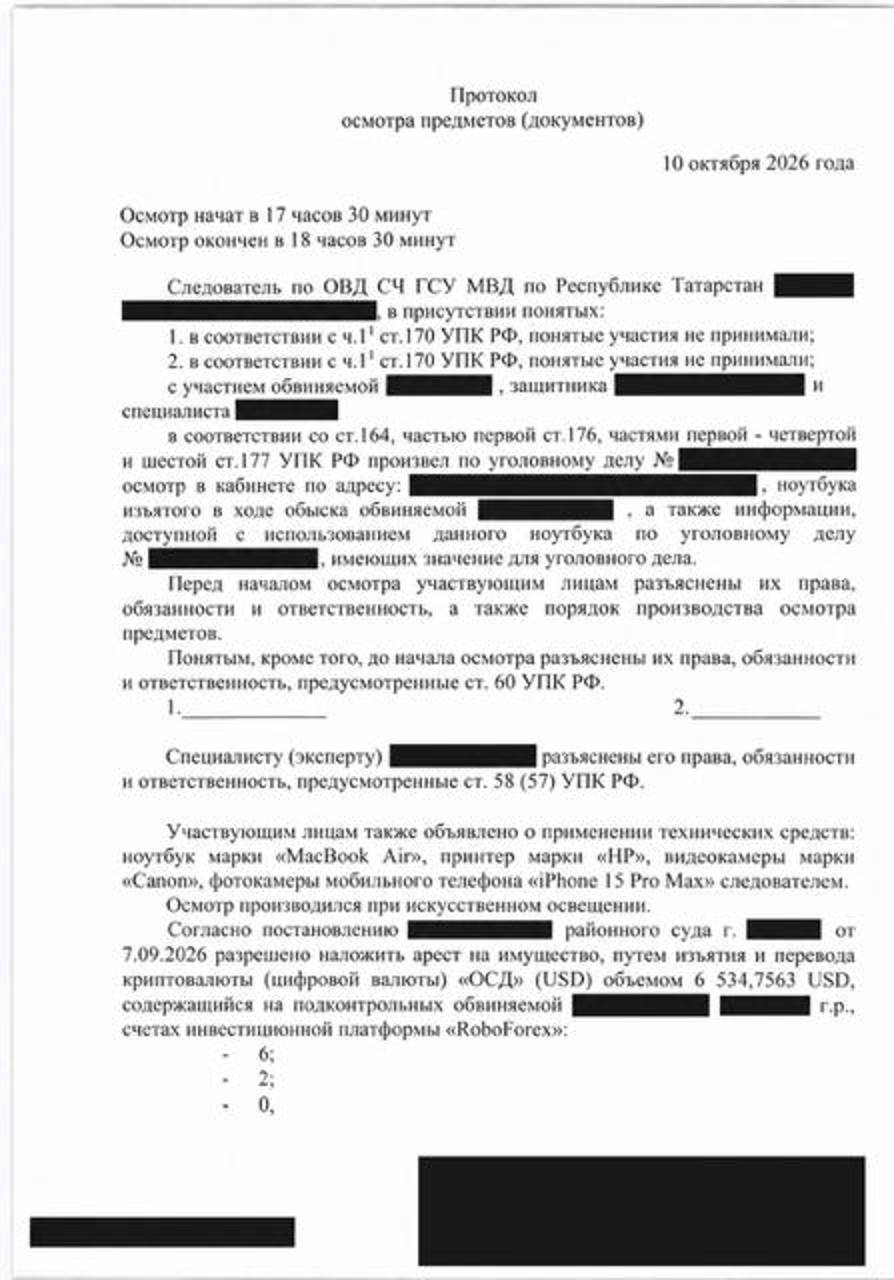
A fragment of the published protocol

How the Investigator Withdrew Funds via RoboForex

It follows from the document that the object of inspection was an HP Pavilion x360 Convertible laptop, previously seized during a search. The basis for the actions was a ruling by a district court in Kazan dated September 7 to seize property.

The accused provided access to the laptop and phone and, according to the protocol, voluntarily confirmed consent to the transfer of funds as part of cooperation with the investigation. Thus, the document does not describe account hacking or bypassing security; the investigative action was conducted with the participation of the owner of the credentials, a defense lawyer, and a specialist.

After logging into RoboForex, the account displayed a balance of $6641.84. The investigator opened the withdrawal section and specified an amount of $6328.

The subsequent operation went through the Difinex payment service. According to the data recorded in the protocol, the interface showed the receipt of approximately 6331.33 $USDT, a commission of 3 $USDT, and the option to choose a blockchain. The investigator specified TRON and entered the recipient address provided to him.

The official RoboForex instructions confirm the general procedure for such operations: the user selects a trading account and payment system, enters a password and amount, after which the selected service may require additional data or confirmation.
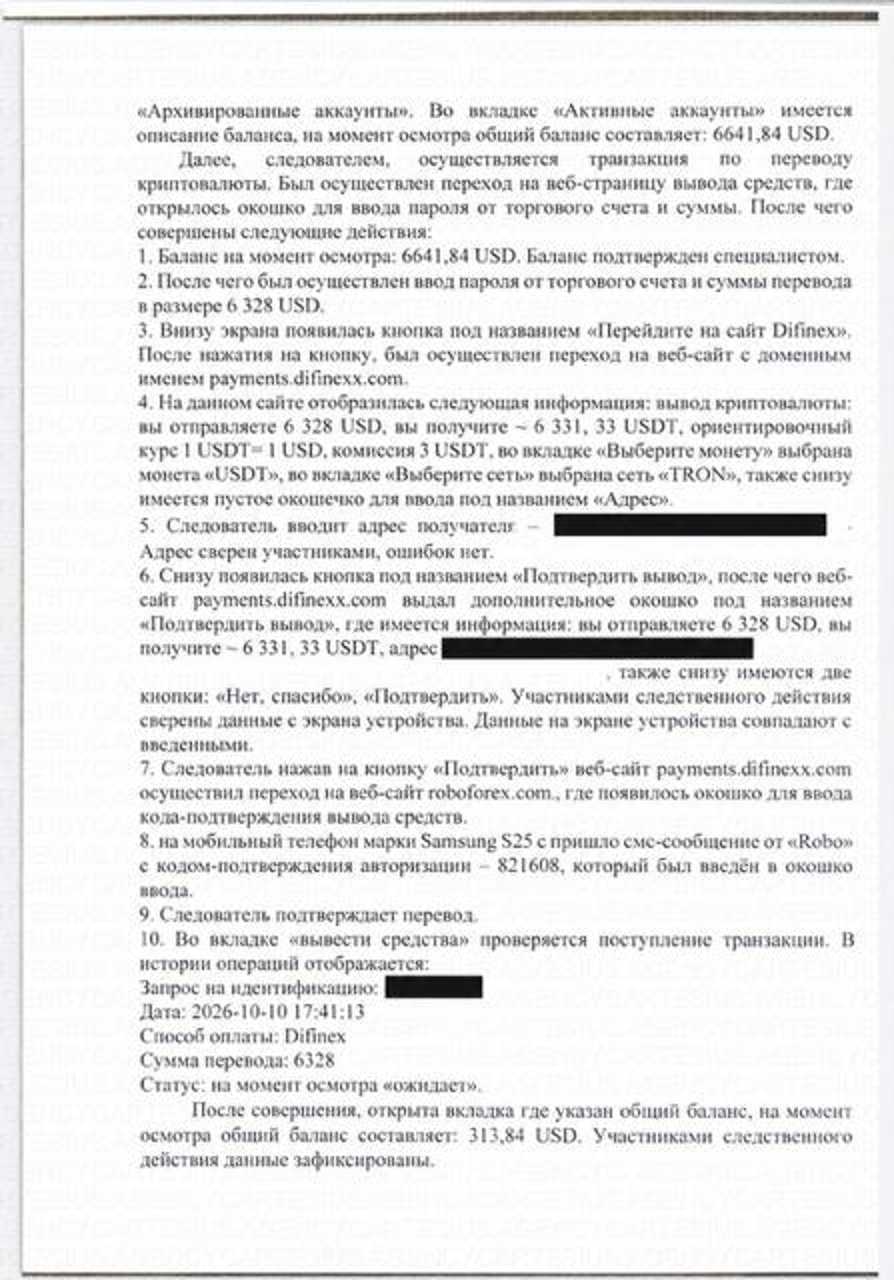
The investigator initiated a withdrawal of $6328 from RoboForex, receiving $USDT via the TRON network. At the time the inspection ended, the transaction was pending

After additional SMS confirmation, the request appeared in the RoboForex transaction history, and the account balance decreased to $313.84.

However, there is a crucial detail here: at the time the inspection was completed, the transfer had not yet been confirmed as received at the final address. Its status in the protocol is designated as "currently pending," with a processing time from five seconds to three days.

New Rules Only Came into Effect This Summer

The practical significance of the document is linked to changes in Russian legislation. Since March 3, 2026, Article 164.2 of the Criminal Procedure Code separately regulates the seizure of digital currency. Investigative actions must be conducted with the participation of a specialist, and to preserve the assets, they are allowed to be transferred to a special identifier address when technically possible. The protocol must record the type and quantity of digital currency, the sender and recipient addresses, and data allowing identification of the transaction.

Since July 3, government-approved Rules for the Storage, Transfer, and Accounting of Digital Currency in Criminal Proceedings have been in effect. They provide for an infrastructure in which a state agent bank, together with an authorized organization, provides identifier addresses for the MVD, FSB, Investigative Committee, Prosecutor's Office, FSSP, Federal Customs Service, and other agencies.

The published protocol fits well into this scheme: the investigator received an address for storing the asset, the participants verified it, after which it was used as the destination address for withdrawing $USDT.

However, it is impossible to determine the owner of the specific TRON address from the document—it is obscured in the published image.

This is Seizure for Now, Not Confiscation

Another important distinction concerns the legal status of the funds. Since March 2026, digital currency has been recognized as property for the purposes of criminal legislation, so it can be seized, including to secure a civil claim, a fine, or possible subsequent confiscation.

But seizure is not the same as confiscation. The latter implies the forced transfer of property into state ownership based on a corresponding court decision. The presented protocol records an investigative action to ensure the preservation of assets, not their final transfer to the state.

Risk Warning:

The information on the site is for informational and educational purposes only and is not investment advice or financial guidance. Cryptocurrencies and digital assets involve a high level of risk, including potential loss of capital. The editorial team is not responsible for decisions made based on published materials. It is recommended to conduct your own research (DYOR) before making investment decisions. Review the editorial policy at https://happycoin.news/about/


Related Questions

QWhat is the main topic and practical significance of the Russian protocol discussed in the article?

AThe article discusses the practical application of a new Russian protocol for seizing and storing cryptocurrency assets. Its significance lies in showcasing the operational mechanics of Russia's recently implemented legal framework, which allows law enforcement to officially arrest and transfer seized digital assets to government-controlled crypto addresses during criminal investigations.

QBased on the protocol, how did the investigator from Tatarstan transfer the cryptocurrency?

AThe investigator accessed a previously seized laptop and, with the owner's cooperation, logged into a RoboForex trading account. From there, he initiated a withdrawal of $6,328. Using the Difinex payment service, he chose to receive the funds in USDT via the TRON blockchain and sent them to a specific recipient address that was provided to him, likely a government-held 'identifier address' as per new regulations.

QWhat are the key differences between 'arrest' and 'confiscation' of cryptocurrency under the new Russian laws mentioned in the article?

AAccording to the article, 'arrest' is a provisional measure to secure and preserve assets during an investigation, ensuring they are available to satisfy potential future civil claims, fines, or confiscation orders. It does not transfer ownership. 'Confiscation' is a final court-ordered penalty where the property is forcibly transferred to state ownership. The described protocol documents an arrest, not a confiscation.

QWhich two key legal changes in 2026 established the framework for the procedure described in the protocol?

A1. Effective March 3, 2026: Amendments to Article 164.2 of the Russian Criminal Procedure Code (УПК РФ) officially recognized cryptocurrency as property for criminal law purposes and established procedures for its seizure, requiring specialist participation and allowing transfer to special storage addresses. 2. Effective July 3, 2026: Government-approved 'Rules for the storage, transfer, and accounting of digital currency in criminal proceedings' created the infrastructure, involving a state agent bank and an authorized organization to provide 'identifier addresses' for law enforcement agencies to hold seized assets.

QWhat crucial detail about the transaction's status was noted at the end of the on-site inspection in the protocol?

AAt the conclusion of the on-site inspection documented in the protocol, the USDT transfer from RoboForex was still pending final confirmation on the blockchain. Its status was recorded as 'currently awaiting' processing, with an estimated completion time ranging from five seconds to three days. The funds had left the trading account but had not yet been confirmed as received at the destination wallet.

Related Reads

"Strictest Ever" Wet-Lab Prediction Benchmark Released: Maxed-Out Reasoning and 5x Compute Still Won't Cut It

UniPat AI has launched Science Prediction Universe (SPU), a new benchmark that evaluates whether AI models can predict the outcomes of real wet-lab experiments before they are conducted. The benchmark covers 116 tasks and 4,207 wet-lab experiments across chemistry, materials science, biology, and medicine, drawing on recent papers and unpublished collaborations with institutions such as Stanford, Cornell, and Harvard. Models are given eight hours, an H20 GPU, internet access, and scientific software, and must submit a ranked prediction of experimental results, which is then scored against hidden ground-truth data using the Spearman correlation coefficient. To prevent memorization, evaluation runs in isolated, offline containers and screens outputs for paper identifiers. Results show that even leading models like Opus 5.5 and GPT-6 Astra remain far from reliable prediction: the best average score was 0.486, and only about half of tasks exceeded the random baseline. The study also found that increasing reasoning effort fivefold barely improved accuracy, since models often settled on an answer early and spent the rest of the time on minor adjustments. Likewise, more tool use and GPU calls did not reliably help. Performance varied sharply by measurement target, and API costs ranged 300-fold across configurations. SPU aims to give researchers and model developers a unified way to measure and improve AI's scientific judgment before investing in costly experiments.

marsbit1h ago

"Strictest Ever" Wet-Lab Prediction Benchmark Released: Maxed-Out Reasoning and 5x Compute Still Won't Cut It

marsbit1h ago

From Harshly Criticizing Stablecoins to Building an L1: Airwallex's Jack Zhang Isn't "Converting" — the Battle for the Settlement Layer Has Begun

In June 2025, Airwallex CEO Jack Zhang publicly questioned stablecoins, arguing that fiat conversion costs outweighed their cross-border payment benefits and that crypto had failed to solve real-world problems for 15 years. Yet just 17 months later, in November 2026, Zhang emerged as co-founder of Alta, a blockchain project that raised $80 million (a $47.5 million Series A led by Index Ventures plus a $32.5 million seed round). Rather than a change of heart, the move reflects commercial necessity: a battle over the stablecoin settlement layer is underway, and payment giants that stay out risk becoming mere interfaces atop someone else's chain. Alta is not a general-purpose public chain but a compliant Layer 1 built for banks and licensed payment institutions. Co-founder Loong Wang, previously of Ren Protocol, says existing chains like Ethereum and Solana cannot simultaneously meet institutional demands for privacy, compliance, integration with local financial systems, and liquidity. Alta uses recursive zero-knowledge proofs to enable on-chain compliance checks without exposing identities or transaction amounts, and builds in programmable compliance modules, native identity authorization, and anti-airdrop protections. Co-founder Catherine Porter previously led Meta's Libra (Diem) partnerships. Airwallex itself is Alta's key advantage: with $287 billion in annualized volume, $1.3 billion in revenue, 200 countries, and 90 currencies, it will channel enterprise clients onto the new chain. Zhang's apparent reversal is consistent: he criticized stablecoins as cheap remittance tools, but now bets on tokenized fiat settlement infrastructure. Competitive pressure comes from Stripe, which acquired Bridge for $1.1 billion, bought Privy, and incubated the Tempo chain (raising $500 million at a $50 billion valuation, with OpenAI, Shopify, Deutsche Bank, and Visa as partners). Circle's Arc, Fireblocks, and Canton Network are also competing. With stablecoin market cap exceeding $320 billion and 2025 on-chain volume surpassing $33 trillion, the real contest is over who controls minting, clearing, and fiat redemption. Success will depend less on technology than on three factors: genuine adoption by traditional financial institutions, compliance adaptation across jurisdictions, and efficient on- and off-ramps to real banking systems. The paradigm has shifted: instead of disrupting banks, fintech giants now aim to build infrastructure that lets traditional finance voluntarily move on-chain. Pragmatism, not ideology, now dominates the race.

marsbit4h ago

From Harshly Criticizing Stablecoins to Building an L1: Airwallex's Jack Zhang Isn't "Converting" — the Battle for the Settlement Layer Has Begun

marsbit4h ago

"Everyone is too conservative with AI!" Head of Claude Code: My approach is more ambitious

Felix Rieseberg, who leads Claude Code's desktop app, argues that most people use AI too conservatively and should set more ambitious goals. His central trick: set unreasonably aggressive targets and insist they're achievable—for example, instead of cutting website load time from 10 seconds to 5, aim for 0.2 seconds, and when the model protests, keep telling it the problem is solvable and to try again. He organizes ambition into four categories: speed (doing the same work faster), height (raising the abstraction level to focus on desired outcomes rather than individual tasks), depth (working like top experts, using their real tools, data, and methods), and breadth (drawing on ideas from other fields). For height, he suggests asking what you ultimately want to happen and what the goal behind the goal is—e.g., instead of fixing single crashes, require the app to never crash. For a quarterly business review, move from filling in a template to understanding what changed and why, identifying the most urgent decisions, and redesigning the review process itself. For depth, he advises insisting on the tools top professionals actually use (databases and statistical models rather than Markdown tables), setting "unreasonable" targets, challenging your own assumptions against raw data, hunting for new knowledge, and using external validation rather than letting the model grade itself. A useful prompt asks the model what top experts would do that you haven't requested, what raw materials and tools they'd use, and what besides the model and you could prove the result correct. For breadth, he recommends replacing nouns with verbs (not "make a PPT" but "in 30 minutes, convince busy people of an explanation and drive a decision under uncertainty"), assembling cross-disciplinary teams, and using multi-agent setups—while avoiding mere role-play in favor of adopting other fields' actual methods. He closes with self-efficacy research: people given clear, challenging goals outperform those told to do their best, and believing difficult things are possible—as with the four-minute mile—unlocks achievement. In an era of rapid capability gains, updating our beliefs about what's possible matters more than ever.

marsbit4h ago

"Everyone is too conservative with AI!" Head of Claude Code: My approach is more ambitious

marsbit4h ago

Trading

Spot
活动图片