Polygon Price Prediction for 2026–2032: Will POL Soon Recover Its All-Time High?

cryptonews.ruPublished on 2026-10-12Last updated on 2026-10-12

Abstract

This article presents a price forecast for Polygon's native token, $POL, for the years 2026 to 2032. The current price is noted as approximately $0.1, with the token facing bearish pressure. Technical analysis indicates a potential short-term correction to $0.09262 but suggests buyers are attempting to push the price toward $0.1, with key resistance at $0.11111 and support at $0.09574. For 2026, the price is projected to reach a maximum of $0.28. The forecast extends to 2032, where the maximum price is expected to be $1.19, contingent on market conditions and adoption. The analysis considers Polygon's technological advantages, such as high transaction throughput and lower costs compared to competitors, alongside strategic partnerships with companies like Starbucks, Adidas, and Mastercard as positive long-term factors. The report includes specific monthly and yearly projections, with a detailed price history from 2019 through 2026, highlighting past volatility and key market events. It concludes that while $POL faces competition, its ecosystem development makes it a potentially viable long-term investment.

Key Takeaways:

  • The price of $POL faces bearish pressure towards $0.1.
  • The Polygon price forecast for 2026 suggests the $POL price will rise to $0.28.
  • By 2032, we expect the maximum $POL price to be $1.19.

Polygon, an Ethereum sidechain and Layer-2 scaling solution, has experienced significant growth in popularity among enterprises and industries over the past year. As a result, many analysts eagerly await the future valuation of its native cryptocurrency, $POL. The question arises: Can the $POL price reach $1?

This Polygon price forecast examines factors such as ecosystem trends, adoption rates, underlying technology, and technical analysis to project the $POL price prediction for the period from 2026 to 2032.

Overview

Cryptocurrency Polygon
Ticker $POL
Rank 58
Current Price $0.1
24H Price Change +4%
Market Capitalization $982.8 million
Circulating Supply 10.56 billion $POL
24h Trading Volume $72.25 million (+26.4%)
All-Time High $1.29, March 14, 2024
All-Time Low $0.08142, April 13, 2026

$POL Price Forecast: Technical Analysis

Metric Value
Current Price $0.1051
Price Forecast $0.09262 (-10.63%)
Fear & Greed Index 69 (Greed)
Market Sentiment Neutral
Volatility 6.92% (High)
Green Days 17/30 (57%)
50-Day SMA $0.1034
200-Day SMA $0.08965
14-Day RSI 48.47 (Neutral)

Polygon Technical Analysis: $POL Price Experiences Bullish Pressure Towards $0.1

  • $POL price analysis shows a bullish trend towards $0.1
  • Resistance for $POL is observed at $0.11111
  • Support for $POL/USD is observed at $0.09574

The $POL price analysis for October 12 confirms increased volatility amid a move towards the $0.1 mark. Buyers are currently aiming for a bullish rally.

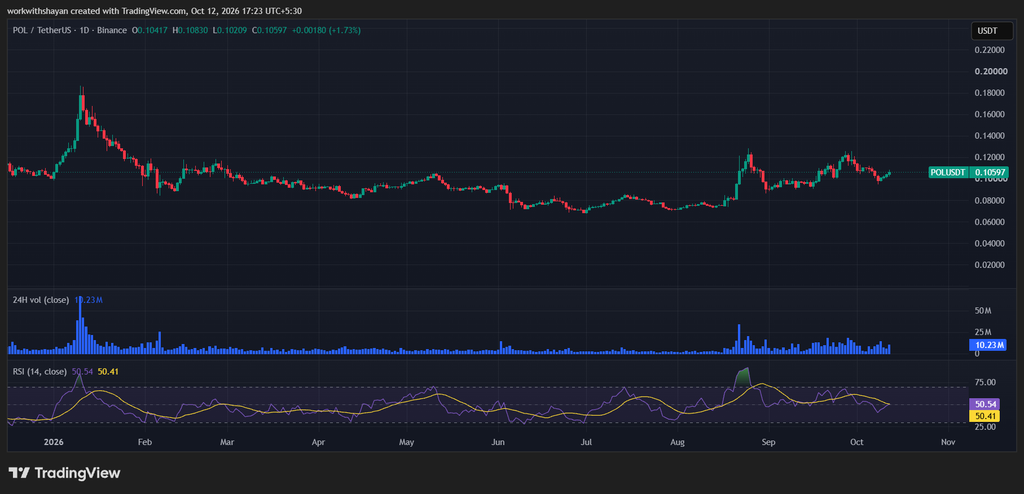
$POL Price Analysis on Daily Chart: Polygon Experiences Buyer Pressure Around $0.1

The $POL price shows an uptick thanks to buyer activity pushing the price towards $0.1. $POL is seeking consolidation near immediate resistance levels, preparing to hold above $0.1. The 24-hour trading volume has increased to $10.2 million, indicating heightened trading activity. The $POL price is $0.1, showing a gain of over 4% in the last 24 hours.
POLUSDTchart by TradingView

The RSI-14 trend line has risen from its previous level and sits above the midline around the 50 mark, indicating buyers' efforts to control price momentum. The SMA-14 level suggests volatility in the coming hours.

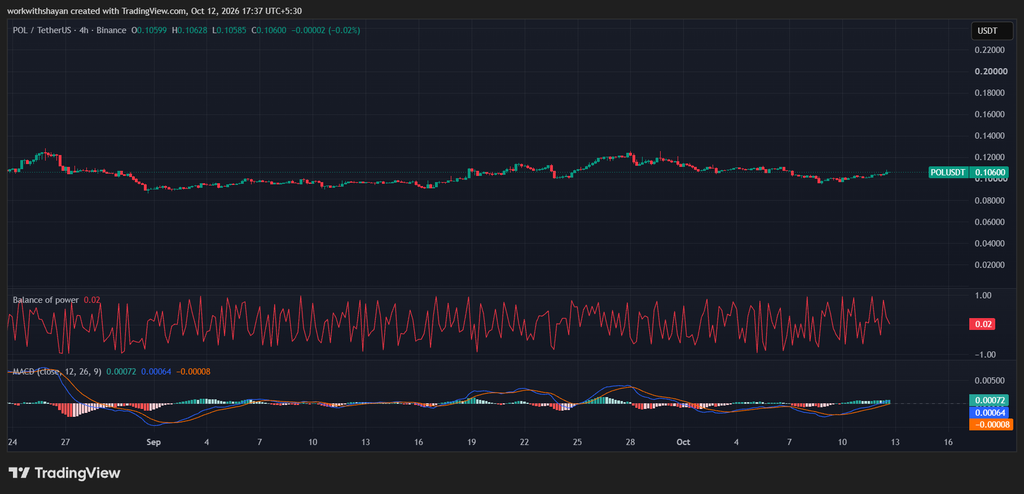
$POL/USD 4-Hour Price Chart: Bulls Aim to Hold Price Above EMA Trend Lines

The 4-hour $POL price chart suggests that $POL continues to experience bearish activity around the EMA lines, creating a negative sentiment on the price chart. As the price continues to face resistance near Fibonacci levels, bulls are preparing for dominance, holding the price above the EMA20 trend line.
POLUSDTchart by TradingView

The BoP indicator is trading in positive territory at 0.02, hinting that buyers are attempting to create pressure near resistance levels and enhance the upward correction.

Furthermore, the MACD trend line has formed green candles above the signal line, and the indicator is aiming for a positive dynamic, reinforcing bullish positions.

$POL Technical Indicators: Levels and Actions

Daily Simple Moving Average (SMA)

Period Value Action
SMA 3 $0.1019 BUY
SMA 5 $0.1012 BUY
SMA 10 $0.1048 BUY
SMA 21 $0.1087 SELL
SMA 50 $0.1034 BUY
SMA 100 $0.09147 BUY
SMA 200 $0.08965 BUY

Daily Exponential Moving Average (EMA)

Period Value Action
EMA 3 $0.1025 BUY
EMA 5 $0.1028 BUY
EMA 10 $0.1045 BUY
EMA 21 $0.1054 SELL
EMA 50 $0.1015 BUY
EMA 100 $0.09637 BUY
EMA 200 $0.1007 BUY

What to Expect from the $POL Price Analysis Next?

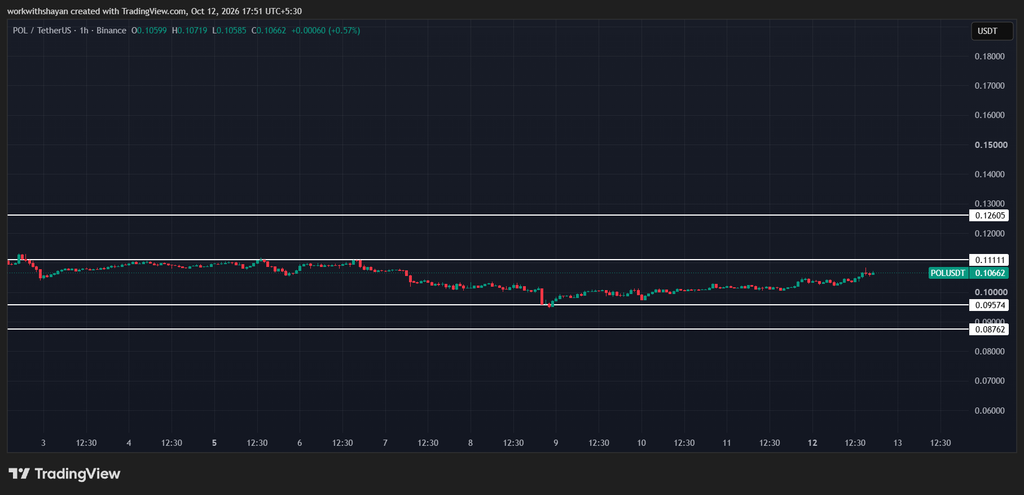
The hourly chart confirms that bears are making efforts to prevent an immediate $POL price rise. However, if the $POL price successfully breaks above the $0.11111 level, it could rise further and reach resistance at $0.12605.
POLUSDTchart by TradingView

If bulls fail to initiate an uptrend, the $POL price could fall below the nearest support line at $0.09574, leading to a correction to $0.08762.

Is $POL a Good Investment?

The $POL token could be a good long-term investment option as the project develops its roadmap for the Polygon 2.0 version. Polygon is collaborating with various industries to enhance adoption levels, focusing on $NFT solutions and Ethereum scalability. Partnerships include Starbucks for an $NFT loyalty program and collaborations with Adidas, Prada, and Disney for developing $NFT offerings.

Why Is the $POL Price Rising Today?

Following overall market volatility, the $POL price faced intensified buyer pressure around the $0.1 level. Consequently, buyers are holding the price around $0.1.

What Is the $POL Price Prediction for 2026?

The Polygon price forecast for 2026 suggests that the $POL price will reach a maximum level of $0.28.

Will the $POL Price Touch $1?

Yes, the $POL price could reach the $1 mark by the end of 2032. However, this depends on future market sentiment and buyer demand.

Will the $POL Price Reach $10?

If everything goes well and $POL gains regulatory recognition, its price could exceed $10 by 2040.

Is $POL a Good Long-Term Investment?

As Polygon continues to expand its offerings, it holds a significant position in the altcoin market. Consequently, $POL could be a good long-term investment option.

Latest News / Opinions on $POL

Polygon partners with Mastercard to launch Agent Pay, aiming to simplify operations for machines by introducing structure, governance, and trust to this new payment class.

$POL Price Prediction for October 2026

Analysts expect steady growth in the crypto market in October. We forecast that the minimum $POL price will be $0.07, the maximum $0.13, and the average $0.1 in October.

$POL Price Prediction Potential Low Potential Average Potential High
$POL Price Prediction for October 2026 $0.07 $0.1 $0.13

$POL Price Prediction for 2026

Ethereum fees surge dramatically during a bull market, making them too expensive for regular crypto users. That's why Polygon gained popularity during the last bull market. But this time, in 2026, Polygon faces tougher competition from Arbitrum, Optimism, and Starknet.

However, Polygon's Proof of Stake (PoS) network can handle up to 65,000 transactions per second (TPS) and is cheaper than networks like Arbitrum and Optimism. Consequently, growing adoption could lead to its price increasing in 2026.

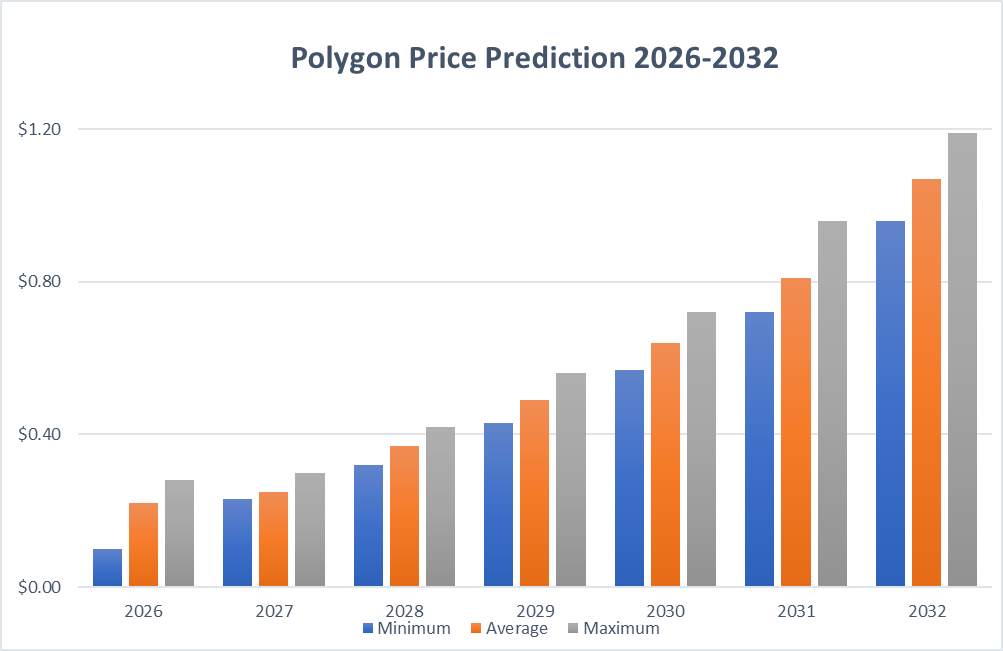
In 2026, the Polygon price is projected to reach a minimum level of $0.07. It is expected to reach a maximum level of $0.28, with an average price of $0.22 throughout the year.

$POL Price Prediction Potential Low Potential Average Potential High
$POL Price Prediction for 2026 $0.07 $0.22 $0.28

$POL Price Predictions for 2027-2032

Year Minimum Price Average Price Maximum Price
2027 0.23 0.25 0.3
2028 0.32 0.37 0.42
2029 0.43 0.49 0.56
2030 0.57 0.64 0.72
2031 0.72 0.81 0.96
2032 0.96 1.07 1.19

Pol Price Prediction for 2027

Polygon has made Polygon zkEVM available to everyone, becoming one of the first ZK Rollups to do so. This is a major step forward for Polygon and gives it an advantage.

With growing business usage, innovative technology, and past success, Polygon could reach a new all-time high in 2027.

According to forecasts and technical analysis, the Polygon price is expected to reach a low of $0.23 in 2027. The maximum price projection is $0.30, with an average of $0.25.

Polygon ($POL) Price Prediction for 2028

In 2028, the minimum price of one Polygon is expected to be $0.32. The maximum $POL price projection is $0.42, and the average price for the year will be $0.37.

Polygon Price Prediction for 2029

In 2029, the Polygon price is forecast to reach a minimum of $0.43. The maximum price could rise to $0.56, and the average trading price during the year will be $0.49.

Polygon Price Prediction for 2030

In 2030, the minimum Polygon price is expected to be $0.57. The highest possible $POL price level could reach $0.72, and the average forecast price is $0.64.

Polygon ($POL) Price Prediction for 2031

In 2031, the Polygon price is expected to reach a low of $0.72. The maximum projection is $0.96, and the average trading price is $0.81.

Polygon Price Prediction for 2032

In 2032, the Polygon price is forecast to reach a minimum of $0.96. The maximum price could rise to $1.19, and the average trading price during the year will be $1.07.
$POL Price Prediction for 2026-2032

$POL Price Prediction from Experts

Company Name 2026 2027
Coincodex $0.3294 $0.2629
CoinDCX $0.42 $0.5

$POL Price Prediction from Cryptopolitan

Cryptopolitan is optimistic about the future market potential of $POL. In 2026, the Polygon price is expected to reach a minimum level of $0.07. The maximum level is expected to be $0.28, with an average price throughout the year of $0.22.

By the end of 2032, the $POL price is expected to rise to a high of $1.19, with an average trading price of $1.07.

$POL Historical Market Sentiment
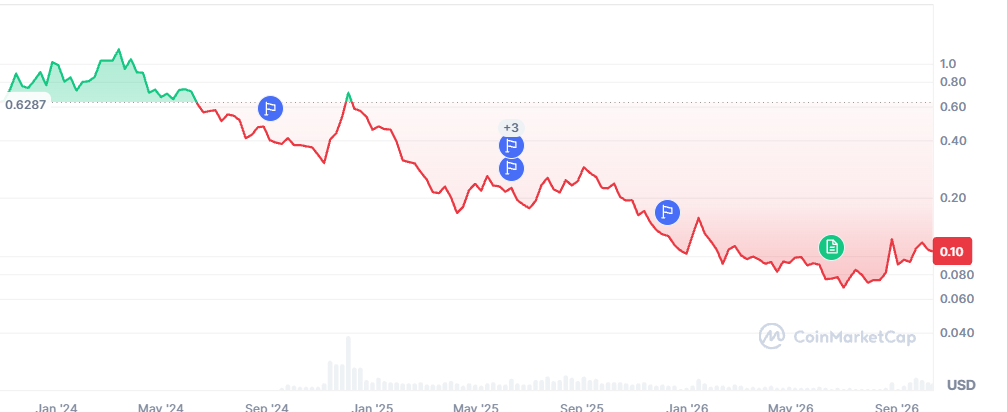
$POL Price History | Coinmarketcap
  • $POL debuted in 2019, initially priced below a cent.
  • For the next two years, the price remained stable around $0.02.
  • The rebranding of $POL to Polygon in 2021 fueled growth: the price exceeded $1 in May and reached an all-time high of $2.92 on December 27.
  • In 2022, $POL struggled: the price fell below $1 in May, below $0.50 in June, briefly recovered above $1 in August, and ended the year at $0.7585, down 70%.
  • The following year, 2023, Polygon showed mixed results: the price exceeded $1 in February but fell to $0.5593 after news from Crypto.com in June. In July, it peaked at $0.8775, declined to $0.4946 in September, and recovered to $0.9789 by November.
  • In January, $POL rose from $0.8514 to $1.4 in March but fell below $0.8 by May, reaching a low around $0.4 in June and July. In August and September, the price consolidated in the $0.4–$0.6 range, briefly rising above $0.45.
  • In October, the price dropped to $0.39, but in November, following Donald Trump's victory, it surged sharply to $0.63, ending December on bearish ground at $0.477.
  • At the beginning of January 2025, $POL opened the market at $0.4511; in February, the price fluctuated in the $0.3068–$0.3455 range.
  • However, by the end of February, the $POL price had dropped to around $0.25.
  • In March, the $POL price fell sharply, dropping below the crucial $0.2 level.
  • In April, the $POL price continued to fluctuate below $0.2. However, as the trade war between the US and China eased, the $POL price broke through resistance levels and reached a high of $0.26 by the end of April.
  • In early May, the Polygon price dropped slightly, falling to $0.21. However, later in mid-May, it surged sharply to a high of $0.27.
  • In early June, the $POL price dropped sharply to the $0.2 level. By the end of June, the $POL price had fallen to $0.17.
  • In July, the $POL price rose to $0.26, but in early August, it dropped sharply to $0.19.
  • The $POL price rose to $0.26 in August. However, later in September, it consolidated around the $0.25 level.
  • In early October, the Polygon price rose to a high of $0.25. The $POL price ended the month on bearish ground around $0.17.
  • By the end of November, the $POL price had fallen to $0.12.
  • The $POL price ended 2025 on bearish ground, falling to the $0.1 level.
  • In January 2026, the $POL price fell further, reaching a low around $0.08 in February. In early April, the price fluctuated around $0.09. By the end of April, the $POL price had risen to $0.1.
  • In May, the $POL price fell to $0.088.
  • By the end of June, the Polygon price had fallen to $0.08. In July, the $POL price fluctuated around $0.08.
  • In August, the $POL price rose to $0.13. In September, the price fluctuated around $0.12.

Related Questions

QAccording to the article, what is the price forecast for $POL in the year 2026?

AThe price forecast for $POL in 2026 is a maximum of $0.28, with a minimum of $0.07 and an average of $0.22.

QWhat is the projected maximum price for $POL by the year 2032 based on the analysis?

ABy 2032, the projected maximum price for $POL is $1.19, with an average trading price of $1.07.

QWhat does the technical analysis suggest about the current price movement of $POL near the $0.1 level?

AThe technical analysis suggests that the $POL price is experiencing bullish pressure towards the $0.1 level, with buyers actively pushing the price up and encountering resistance near $0.11111.

QName two major partnership deals mentioned in the article that Polygon has secured.

AThe article mentions that Polygon has partnered with Mastercard to launch Agent Pay, and with Starbucks for an NFT loyalty program. It also mentions collaborations with Adidas, Prada, and Disney for NFT offerings.

QWhat was the all-time high (ATH) price for $POL and when was it achieved according to the article?

AThe all-time high price for $POL was $1.29, achieved on March 14, 2024.

Related Reads

Vitalik "Exposes the Shortcomings" of Burn Efficacy, ETH Value Narrative Shifts

Vitalik Buterin argues that Ethereum should focus more on ETH's store-of-value property rather than relying on fee burning to support its valuation. He explains that fee-burning-based valuation rests on a net present value logic—market cap equals annual burned fees divided by discount rate—but this has never provided a truly solid floor. Much of the past burning came from activity within the crypto ecosystem itself, so if ETH's price fell sharply, that revenue would fall too. Only demand from outside crypto can make such a valuation floor convincing, and while RWA growth may help, mature businesses are unlikely to recreate the massive fee consumption seen during speculative frenzies. He also warns of the costs of pursuing fee burning: to justify ETH's ~$270bn market cap through burning, Ethereum would need to operate like a world-class corporation such as L'Oréal—requiring sustained R&D spending (potentially ~700k ETH per year, cutting validator income by roughly two-thirds), active governance, and higher gas prices that could exclude users most in need of privacy and security. Maximizing "price × usage" conflicts with letting as many people as possible use the network within safe resource limits. As a store-of-value asset, the most important metric is survival. Users value decentralization and CROPS (censorship and capture resistance, open source, privacy, security), which also matter to institutions. Ethereum should make prudent security tradeoffs, address quantum computing and AI risks, stabilize the core protocol, push innovation to layer 2, resist complexity and capture-prone reward mechanisms, and support privacy tools, account abstraction, FOCIL, and reduced infrastructure dependence. Store-of-value and application growth are synergistic: more native RWA and decentralized assets on L1 increase ETH's usefulness. Ethereum's social meaning is broad access to decentralization, privacy, and security—and ETH's value comes from these guarantees.

marsbit25m ago

Vitalik "Exposes the Shortcomings" of Burn Efficacy, ETH Value Narrative Shifts

marsbit25m ago

US Stock Market Trends (November 9): Nasdaq Rebounds 1% on Friday, Nvidia Launches Investigation into Jensen Huang Over the Weekend

US stocks closed mixed on Friday, November 6: the Nasdaq rebounded 1.09% to 24,579.42, the S&P 500 rose 0.31% to 7,376.86, and the Dow fell 237.33 points (-0.46%) to 51,285.73. Chip stocks partly recovered after Thursday's selloff, with Micron up about 5%, Nvidia up nearly 3%, AMD up as much as 9%, and Intel up nearly 7% intraday. For the week, the Nasdaq fell 3.4%, the S&P 500 lost 2.7%, and the Dow dropped 0.9%; the tech sector ETF (XLK) had its worst week since early April 2025, down about 8%. October nonfarm payrolls came in at 165,000, far above the 59,000 expected, while unemployment fell to 4.1%. Markets priced a roughly 76.8% chance of a 25-basis-point rate hike at the December 8-9 meeting. WTI settled at $90.83 a barrel, up 0.34%, but fell about 13% for the week; Brent settled at $98.32 and fell over 16% weekly. The 10-year Treasury yield closed at 4.86%. Over the weekend, Nvidia's board launched an independent investigation into reports that CEO Jensen Huang may have been a target of foreign intelligence activity. The board said there is no reason to believe national security or company secrets were compromised, and Huang will remain CEO. Huang admitted to an extramarital affair and apologized. On Monday in Asia, Japan's Nikkei 225 rose about 2% and Taiwan's weighted index gained over 2%, while US futures were mixed, with Nasdaq 100 futures down about 0.2%. Key upcoming events include US inflation data and Nvidia's Q3 earnings on November 17.

marsbit25m ago

US Stock Market Trends (November 9): Nasdaq Rebounds 1% on Friday, Nvidia Launches Investigation into Jensen Huang Over the Weekend

marsbit25m ago

Vitalik 'Exposes' the Limitations of Burning, ETH Value Narrative Shifts

Vitalik Buterin argues that Ethereum should focus more on ETH's store-of-value property rather than relying on fee burning to support its valuation. He explains that fee-burn-based valuation rests on a net present value logic—market cap equals annual burned fees divided by a discount rate—but notes this never provided a truly solid floor. Much of the burning during 2021–2023 came from within the crypto ecosystem itself, so if ETH's price fell, that revenue would fall too. Only demand from outside crypto can make such a valuation floor more convincing, and while RWA growth may help, mature businesses are unlikely to replicate the massive fee consumption seen during speculative manias. He warns that relying on fee burning to justify ETH's ~$270B market cap would require Ethereum to operate like a world-class corporation (roughly L'Oréal's scale), needing sustained R&D spending—perhaps ~700K ETH annually—and highly interventionist governance, both of which create political problems and undermine decentralization and anti-capture properties. Pursuing burning also implies pursuing higher gas prices, potentially excluding users who most need privacy and security; maximizing "price × usage" differs from maximizing safe access for as many people as possible. As a store-of-value asset, the most important metric is survival. Users most value decentralization and CROPS (censorship and capture resistance, open source, privacy, security), which also matter to institutions for risk management and compliance. Ethereum should make prudent security tradeoffs, address quantum computing and AI risks, stabilize the core protocol while shifting innovation to upper layers, and resist complexity-adding features and capture-prone reward mechanisms. Users should be able to hold assets safely and privately, with confidence transactions won't be blocked. Reducing dependence on infrastructure providers matters—he can run a node on a laptop, syncing in under six hours with about one-eighth of disk space, better than 2019. Store-of-value and application growth are synergistic: more native RWA and decentralized assets on L1 increase what holding ETH enables—trustless swaps or using ETH as collateral—boosting its utility, with tradeoffs smaller than maximizing fees.

Odaily星球日报35m ago

Vitalik 'Exposes' the Limitations of Burning, ETH Value Narrative Shifts

Odaily星球日报35m ago

ICLR 2027 First Round Review: Quite a Few Pain Points

ICLR 2027's first-round reviews have sparked widespread complaints among researchers, with many sharing examples of poor-quality or clearly AI-generated feedback on social media. One reviewer asked an author to explain what "standard deviation" means; another review began with the telltale chatbot opener "Certainly! Here is a review of the paper," while two other reviews appeared to be near-identical copies of the same template. One author received criticism for using AI-assisted writing despite having properly disclosed it, and another reviewer openly admitted lacking the expertise to evaluate the paper—prompting debate over whether the real fault lies with reviewer assignment rather than the reviewer. A recurring concern, raised by Jiaxin Pei of UT Austin, is that AI reviewers cannot distinguish between a paper's ordinary limitations and the critical flaws that actually undermine its core contributions. Large language models can list hundreds of limitations for any paper, including the best ones, but they cannot judge which issues truly matter. As a result, reviews grow longer and demand more experiments while the real determinants of paper quality get buried. ICLR 2027 organizers have acknowledged the strain: rapid growth in submissions, a shortage of qualified reviewers, and AI lowering the barrier to paper production. They introduced measures including submission caps, stricter reciprocal review obligations, and rules permitting limited, disclosed AI use in reviewing—with penalties for low-quality or hallucinated AI-generated reviews. Author-reviewer discussion runs until November 18, with final decisions expected December 16.

marsbit1h ago

ICLR 2027 First Round Review: Quite a Few Pain Points

marsbit1h ago

Without Warning, OpenAI Suddenly Mass-Bans Accounts

OpenAI has abruptly banned a large number of ChatGPT accounts without prior notice or email warnings, deleting accounts outright. Affected users see only an error message stating their account has been deleted or deactivated. The purge heavily targets accounts in the Philippines and Turkey, low-cost Team plans, and accounts using reverse proxy relays, and even long-standing paying users with months of subscription have been hit. Free API accounts, shared team accounts, and $200/month Pro accounts were all affected. Developers report losing years of conversation history and personal data locked in the cloud, with appeals unsuccessful. Some speculate OpenAI is cracking down on account stacking to prevent users from exploiting cheap subscriptions. OpenAI's status page showed elevated error rates for some US commercial Mastercards, though OpenAI characterized the incident as a payment channel issue rather than account bans. Users are advised to appeal via OpenAI's official form with account details and Request ID. This move follows earlier steps: OpenAI previously merged ChatGPT and Codex into a single token pool and, five days ago, imposed device and payment card limits, preventing multiple paid subscriptions on one card or device. Starting November 20, new usage policies require third-party API gateways to obtain official written authorization, and from December, Plus, Pro, and Business plans will share a single quota calculated by token consumption. Users are advised to regularly back up cloud conversations and sync Codex projects locally, as the era of freely exploiting AI compute appears to be over.

marsbit1h ago

Without Warning, OpenAI Suddenly Mass-Bans Accounts

marsbit1h ago

Trading

Spot
活动图片