PhotonPay Obtains UK EMI License, Advancing Global Payment Operating System Layout

marsbitPublished on 2026-10-17Last updated on 2026-10-17

Abstract

PhotonPay has obtained an Electronic Money Institution (EMI) license from the UK Financial Conduct Authority (FCA), marking a significant milestone in its global compliance strategy. With this license, PhotonPay can issue electronic money and provide payment services within the UK regulatory framework, strengthening its local financial capabilities and supporting global businesses with broader fund-flow solutions. The UK is a key financial hub connecting Europe and global markets, and as enterprises expand internationally, their financial needs are shifting from single cross-border transactions to integrated management of accounts, payments, foreign exchange, cards, and treasury. The EMI license reinforces PhotonPay's UK localization, enabling connections with local banks, payment networks, and financial partners. PhotonPay's Global Chief Compliance Officer JP noted that this license is a key step in building a global payment operating system backed by solid local regulatory foundations. PhotonPay is developing a next-generation payment operating system that unifies fragmented financial infrastructure across markets, allowing businesses to manage global accounts, collections, payments, FX, cards, and embedded finance more efficiently. Built on real business fund flows, PhotonPay continues to expand regulatory qualifications, banking partnerships, payment networks, and technology. To date, PhotonPay has secured nearly 30 payment licenses and regulatory qualifications worldwide...

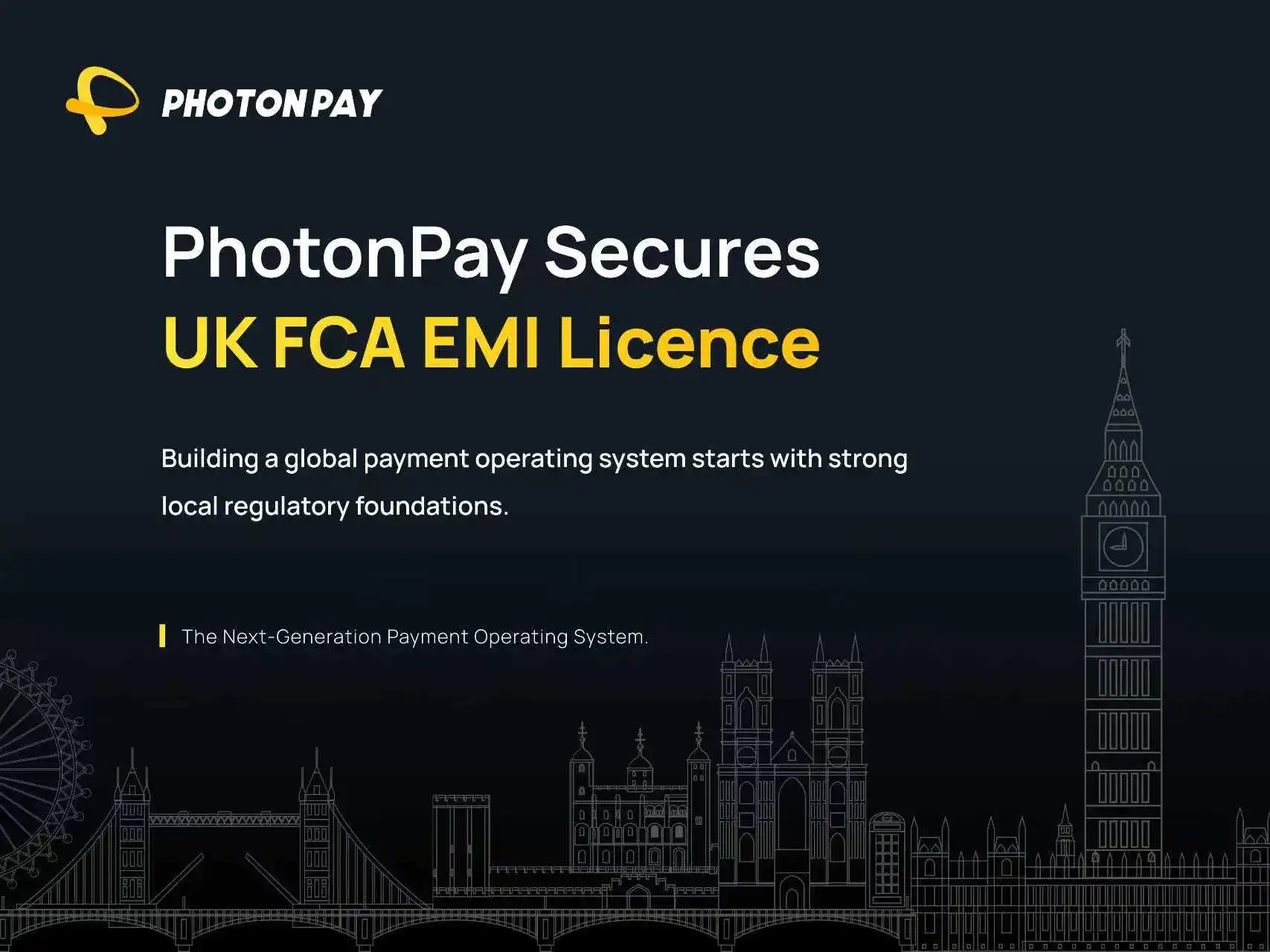
PhotonPay, the next-generation payment operating system, has announced that it has officially obtained an Electronic Money Institution (EMI) license issued by the UK Financial Conduct Authority (FCA).

With this license, PhotonPay can issue electronic money and provide related payment services within the UK regulatory framework and authorized scope, further expanding its local financial service capabilities in the UK market and providing global enterprises with payment and fund management services covering more capital flow scenarios.

The UK is an important global financial and commercial hub, as well as a key node for many international enterprises connecting Europe with global markets. As enterprises continue to expand into more countries and regions, their financial needs are gradually shifting from completing single cross-border transactions to integrated management of accounts, collections and payments, foreign exchange, cards, and fund management capabilities.

For PhotonPay, entering a market means not only providing products and services, but also establishing a financial foundation that complies with local regulatory requirements and can support enterprise operations over the long term. Obtaining the EMI license will further strengthen PhotonPay's localized capabilities in the UK and provide important support for its continued connection with local banks, payment networks, and other financial ecosystem partners.

JP, Global Chief Compliance Officer of PhotonPay, said: "Obtaining the UK EMI license is an important milestone in PhotonPay's continued expansion of its global compliance footprint. Building a global payment operating system cannot be separated from a solid local regulatory foundation. This license further strengthens our foundation for long-term local financial capability building in the UK, and will also support PhotonPay in connecting more markets, currencies, and payment networks, providing global enterprises with a more complete and efficient payment and fund management experience."

The operational boundaries of global enterprises are continuing to expand, but the financial infrastructure behind them remains highly fragmented. Different markets have different account systems, payment networks, currencies, and regulatory requirements. When expanding global business, enterprises often need to connect with multiple financial institutions, payment service providers, and systems simultaneously.

PhotonPay is building a next-generation payment operating system around this complexity, connecting local financial capabilities in different markets through a unified technology platform, enabling enterprises to manage global accounts, collections and payments, foreign exchange, cards, and embedded finance more centrally, and reducing the operational complexity caused by multiple markets, currencies, and systems.

Real commercial activity is the foundation of this operating system. Centering on the real capital flows that occur during enterprises' global operations, PhotonPay continues to build regulatory qualifications, banking partnership networks, payment networks, and underlying technological capabilities, enabling financial infrastructure to continuously expand as enterprise business enters more markets.

Since its establishment, PhotonPay has continued to advance global compliance and localization capability building, and has established corresponding regulatory and service foundations in major global markets through different entities under the group. At present, PhotonPay has obtained nearly 30 payment licenses and related regulatory qualifications worldwide, with business capabilities covering multiple scenarios such as global accounts, collections and payments, foreign exchange, cards, and embedded finance, providing unified financial infrastructure support for enterprises' global operations.

The acquisition of the UK EMI license further improves PhotonPay's global compliance network. In the future, PhotonPay will continue to strengthen local regulatory and financial service capabilities in key markets, connect more markets, currencies, and payment networks, and continue to advance the building of the next-generation global payment operating system.

About PhotonPay

PhotonPay is committed to building the next-generation payment operating system, providing integrated financial capabilities for global enterprises around scenarios such as global accounts, collections and payments, foreign exchange, cards, and embedded finance. By connecting global banks, payment networks, and local financial infrastructure, PhotonPay helps enterprises operate and manage global funds more efficiently and supports their continued global business expansion.


Related Questions

QWhat license has PhotonPay obtained from the UK Financial Conduct Authority?

APhotonPay has officially obtained an Electronic Money Institution (EMI) license issued by the UK Financial Conduct Authority (FCA).

QWhat can PhotonPay do in the UK after receiving the EMI license?

AUnder the UK regulatory framework and within its authorized scope, PhotonPay can issue electronic money and provide related payment services, further expanding its local financial service capabilities in the UK market and offering global enterprises payment and fund management services covering more fund flow scenarios.

QWhy is the UK market important to PhotonPay's global strategy?

AThe UK is a major global financial and commercial hub and an important node for many international companies connecting Europe with global markets. Entering this market means establishing a financial foundation that complies with local regulatory requirements and can support long-term business operations.

QHow many payment licenses and regulatory qualifications has PhotonPay obtained globally so far?

APhotonPay has obtained nearly 30 payment licenses and related regulatory qualifications globally, covering scenarios such as global accounts, collections and payments, foreign exchange, cards, and embedded finance.

QWhat is PhotonPay's broader vision behind building its global payment operating system?

APhotonPay is building a next-generation payment operating system that connects local financial capabilities across different markets through a unified technology platform, helping enterprises manage global accounts, payments, foreign exchange, cards, and embedded finance more centrally while reducing operational complexity caused by multiple markets, currencies, and systems.

Related Reads

From Crypto VC to Traditional VC: The Three Essential Capabilities of Venture Capital

In this article, Big Brain Holdings investor Derrick Cui reflects on his transition from crypto venture capital to traditional VC in AI, reindustrialization, and space, contrasting crypto's short liquidity cycles and narrative-driven token prices with traditional VC's decade-long capital lockups and illiquid equity. He explains why LPs still allocate to venture despite poor average returns and illiquidity: each year produces rare companies capable of returning an entire fund; business success defies checklists, rewarding subjective judgment; consensus is often wrong, so non-consensus bets offer asymmetric upside; and top investors can repeatedly generate excess returns across cycles. He describes the investor's job as deal sourcing, diligence, and pitching, noting AI tools have lowered sourcing barriers but顶级 deals still come from genuine relationships, and that likability is an underrated professional asset. He then details three core capabilities: (1) Data—separating verifiable facts from founder promises, using third-party validation to pierce polished narratives; (2) Context—building comparative, industry-wide knowledge to judge talent and technical bottlenecks, now accelerated by reasoning models that shift the key skill from reading papers to asking higher-quality questions; and (3) Storytelling—constructing a rigorous "Right to Win" narrative that explains why a company prevails across multiple possible futures, sometimes via systematic cluster bets (e.g., SMRs for AI energy demand) rather than single-company wagers. He also admits past mistakes: being "nerd-sniped" by technical brilliance that doesn't equal a great business, chasing non-consensus ideas for their own sake, and rejecting the "spray and pray" mentality. Finally, he warns that fundraising incentives—DPI substitutes, markups, co-investment halo, hot-round chasing—can distort investment decisions, and concludes that VC is a trainable skill built on data capture, better questions, and credible winning narratives.

marsbit7m ago

From Crypto VC to Traditional VC: The Three Essential Capabilities of Venture Capital

marsbit7m ago

Research Report Interpretation | Space Fund Scale Grew to $18 Billion in One Year, but In-Orbit Direct Investment Accounts for Only 3%

Barclays analysts Katherine Ogundiya and team published a 61-page report on November 16 introducing an "in-S.P.A.C.E." framework for the in-orbit economy, screening 37 commercial space activities down to 15 priority areas and 3 wildcard sectors. Global space-themed fund assets grew from $1.24 billion in Q2 2024 to over $18 billion by Q2 2026, yet only 3% is directly invested in in-orbit operations, while 47% sits in semiconductors, components, and software. Private markets are more direct: of 33 space unicorns worth about $92 billion, 9 in-orbit operators account for roughly $26 billion, or 28%. Global government space spending reached $141 billion in 2025, up 7.4%. The report identifies five physical bottlenecks—launch concentration, spectrum and network routing, orbital congestion, in-orbit servicing standards, and regulatory approval—noting China and the U.S. accounted for over 82% of orbital launch attempts from 2024 to July 2026, with SpaceX and CASC together near 71%, and Starlink performed over 207,000 collision-avoidance maneuvers between December 2025 and May 2026. Among the highest-scoring priority tracks, GEO satellite life extension offers clear economics: about 85% of GEO satellites retire from fuel depletion, and extending life five years costs roughly $65 million versus $150–300 million for a replacement. Orbital AI computing and data centers scored only 8, ranking as a wildcard due to unresolved thermal, power, and economic challenges. Barclays maps over 350 companies across four investment paths: integrated launch and space systems players like Rocket Lab (RKLB) and Firefly (FLY), bottleneck-breaking specialists such as Astroscale, MDA Space, Mynaric, and Thales, "picks and shovels" suppliers including Linde (LIN) and Air Liquide, and downstream applications like Planet Labs (PL) and AST SpaceMobile (ASTS). A heavy-lift rocket launch now consumes about 8,000 tonnes of liquid oxygen, five times a traditional large rocket's 1,600 tonnes, with Linde projecting about $1 billion in annual space revenue by 2030.

marsbit1h ago

Research Report Interpretation | Space Fund Scale Grew to $18 Billion in One Year, but In-Orbit Direct Investment Accounts for Only 3%

marsbit1h ago

The AI Bubble Has Already Burst, Yet Retail Investors Are Still Frantically Buying the Dip: A Hedge Fund Veteran Warns Nvidia's Risks Are Far From Over

Former hedge fund trader Tom Thornton warns that the AI bubble has already burst, yet retail investors remain trapped in "buy the dip" muscle memory while institutions steadily reduce tech exposure. He points to record single-week inflows into QQQ (~$13.4 billion) even as prices fell—a classic topping pattern where dip-buying eventually fails and confidence collapses. Thornton argues AI's boom rests on a fragile chain of circular financing deals that must unfold perfectly; several links are already cracking. On Nvidia, he stresses that DOJ and congressional investigations aren't short-term noise—any evidence of knowingly bypassing export controls could trigger criminal, not just civil, liability and hammer the business model and valuation. He expects management to spin earnings positively, but even a slight guidance cut could crush the stock and wash out retail dip-buyers, making 2027 a tougher year for markets. Thornton is watching DeMark indicators on the Nasdaq 100 and Mag 7 for true capitulation, noting defensive sectors like staples and utilities are now flashing sell signals. He remains long gold, has started buying silver and gold miners (GDX), is baffled by Anthropic IPO valuations, exited Alibaba on Nvidia-related news, would short a SpaceX-Tesla merger on antitrust grounds, and says the ultimate contrarian buy signal is a front-page photo of a floor trader with his head in his hands.

marsbit1h ago

The AI Bubble Has Already Burst, Yet Retail Investors Are Still Frantically Buying the Dip: A Hedge Fund Veteran Warns Nvidia's Risks Are Far From Over

marsbit1h ago

World Bank Joins Forces with Citi and Circle: Global Aid Funds Poised for On-Chain Settlement via USDC

On November 18, the World Bank Group announced a strategic collaboration with Citi and Circle to explore using the regulated USD stablecoin USDC and blockchain networks to supplement existing cross-border official development assistance (ODA) disbursement systems. The pilot aims to reduce correspondent banking fees, shorten cross-border settlement times, and enhance transparency, starting with borrower countries where digital asset use is legally permitted. Under the division of roles, Circle provides compliant stablecoin infrastructure, minting and clearing USDC on designated blockchains with each token backed 100% by USD cash and short-term Treasuries. Citi leverages its global treasury and trade finance network to bridge traditional fiat payment rails and blockchain networks, validating settlement models interoperable with central banks and local banking systems while ensuring sovereign funds remain fully regulated. Traditional ODA flows rely heavily on SWIFT and多层 correspondent banks, with infrastructure projects in developing countries often routed through three to four intermediary banks, taking three to five business days per transfer, incurring high fees, FX spread losses, and delays from time-zone mismatches and manual reviews. Regulated stablecoin settlement enables near-real-time peer-to-peer on-chain delivery after compliance approval, cutting intermediary layers and sending funds directly to licensed institutions in borrower countries. The initiative builds on the World Bank's FundsChain consortium blockchain, which as of November 18 has connected over 350 sovereign and multilateral development projects across 96 countries, averaging about 3.6 on-chain projects per recipient country. Every transaction—from initial disbursement to treasury receipt to supplier settlement—is recorded on-chain in real time, allowing donors and auditors to verify usage and prevent fund diversion. This marks the first time a core multilateral development institution has formally introduced a regulated stablecoin in sovereign development aid disbursement alongside a major international bank, setting a benchmark for institutional RWA settlement and cross-border payment infrastructure. Next steps include joint testing on central bank FX and digital asset regulatory exemptions, technical standards for commercial bank clearing node access, and automated reconciliation between on-chain stablecoin flows and the FundsChain ledger.

marsbit1h ago

World Bank Joins Forces with Citi and Circle: Global Aid Funds Poised for On-Chain Settlement via USDC

marsbit1h ago

Licenses Are in Hand—So Why Is Crypto Payment Still Not Working?

Why do crypto payment businesses still stall even after obtaining licenses? The core problem is not the number of licenses but whether customers, assets, fiat money, and liability are aligned on a single executable business chain. A license only answers whether a given entity may conduct a regulated activity; it does not resolve who onboards the customer, who controls the stablecoin, who pays out euros, why the bank accepts the funds, or who handles refunds and freezes. Projects often list all group licenses together, assuming they cover the whole business, yet a US MSB registration is not a nationwide money transmission license, and an EU CASP passport under MiCA does not automatically grant payment or e-money institution permissions. Three paths must be reconstructed for any transaction: the customer relationship path (which group company contracts with the client), the crypto asset control path (whose address, whose keys, who decides execution), and the fiat funds path (whose account receives converted funds, whether the bank permits such use, and who pays the merchant). Banks may refuse accounts not because they reject crypto generally but because the proposed account use is unacceptable—licensing does not guarantee banking. With many partners (wallets, KYC providers, liquidity, payment institutions), responsibility easily fragments; MiCA Article 73 makes clear that outsourcing does not transfer regulatory responsibility. Compliance must be continuous—ongoing KYC, transaction monitoring, Travel Rule compliance, sanctions and fraud controls—and must cover before, during, and after a failed transaction. Before launch, projects should stress-test one representative transaction end-to-end, answering who contracts, who controls assets, whose account receives funds, why the bank accepts them, and who is liable when things go wrong. Planning should proceed in three stages: design the business then choose the regulatory path; design licenses, accounts, and fund flows together; and validate the structure through real transactions. The goal is not the most licenses but a complete operating structure in which every payment follows a lawful, clear, sustainable path.

marsbit1h ago

Licenses Are in Hand—So Why Is Crypto Payment Still Not Working?

marsbit1h ago

Trading

Spot
活动图片