Micron and SanDisk Lead the Decline, Storage Sector Continues Adjustments: What's Happening?

marsbitPublished on 2026-10-13Last updated on 2026-10-13

Abstract

U.S. and Asian memory chip stocks, led by Micron and SanDisk, are undergoing a sharp correction. Micron closed down 3.88%, nearing a technical bear market from its June high, while SanDisk fell 5.97%. The sell-off was triggered by a triple impact: South Korean markets' post-holiday catch-up decline, the early termination of Samsung and SK Hynix's massive buyback programs, and news that China's ChangXin Memory Technologies (CXMT) made a key breakthrough in its next-generation 4F² DRAM architecture, planning to launch server memory products by year-end. Despite exceptionally strong current fundamentals—exemplified by Nanya Tech's soaring Q3 results—investors are already pricing in peak earnings and focusing on longer-term risks. The core market concern is a potential supply-demand reversal around 2027-2028, driven by simultaneous capacity expansions from Chinese manufacturers and new South Korean fabs. Analysts note that while memory stocks now appear cheap as value plays, the market's growth-focused momentum has shifted, leading to concentrated selling in the sector. Key upcoming events from TSMC, ASML, and SEMICON West may provide further directional signals.

Author: Dong Jing


The storage sector is experiencing a concentrated sell-off triggered by multiple overlapping pressures. Micron closed down 3.88% on Monday, while SanDisk fell deeper by 5.97%. These two bellwether stocks have declined in six out of the last seven trading sessions. Micron is down nearly 20% from its June peak, approaching a technical bear market.
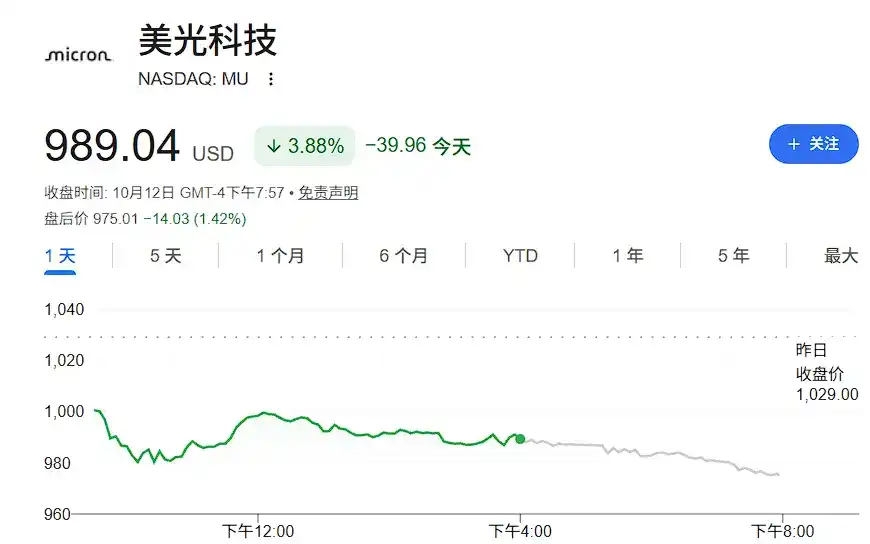
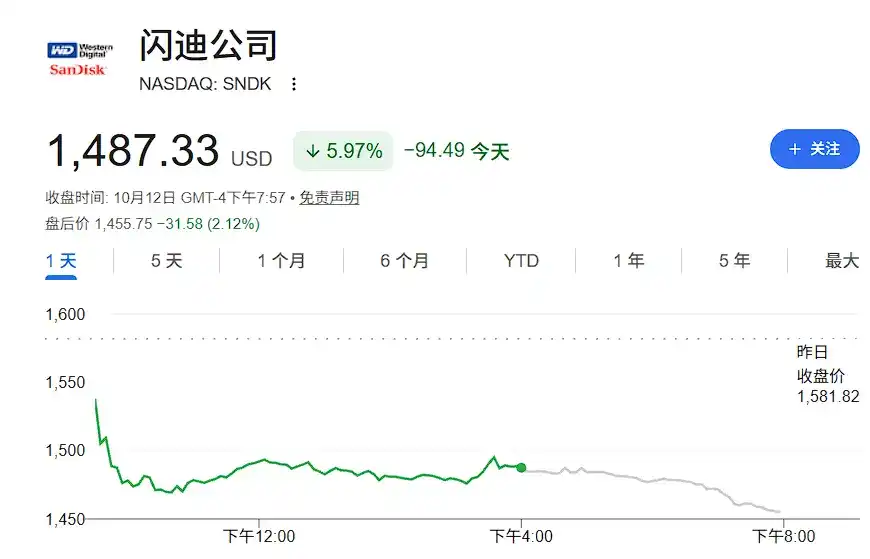
The trigger for this round of adjustment comes from three shocks: a catch-up decline in the South Korean market post-holiday, the early termination of the historically largest share buyback plans by Samsung and SK Hynix, and the key progress announced by Changxin Memory Technologies (CXMT) in Shanghai regarding its new 4F² DRAM architecture with plans to launch server memory products by year-end. Goldman Sachs EMEA Trading Head Rich Privorotsky summarized this situation as "storage remains the epicenter," pointing directly to the market's core concern: despite the extremely strong recent fundamentals, fears about peak earnings are suppressing valuations.

However, the market's paradox lies in the fact that the fundamentals of the storage industry have never been stronger, yet investors have already turned their gaze to 2027-2028: when the continued expansion of Chinese storage capacity and the simultaneous production of new Korean wafer fabs may reverse the supply-demand balance. As Pictet's Jon Withaar puts it, storage stocks "have become value stocks, cheaply valued based on current earnings," but "retail investors and fast-money hedge funds are chasing growth, not value."

South Korean Market Catch-up Decline, Buyback Support Disappears

The Korea Composite Stock Price Index (KOSPI) plunged 3.65% on Monday, closing at 6384.2 points, just above the 200-day moving average support at 6376 points. The tech-heavy KOSDAQ fell 4.8%, and the semiconductor index KRXSEMI dropped 5.2%. SK Hynix and Samsung each fell about 4.5%. According to Goldman Sachs' Seoul trading desk, the day's movement was "a one-way decline from the opening bell."
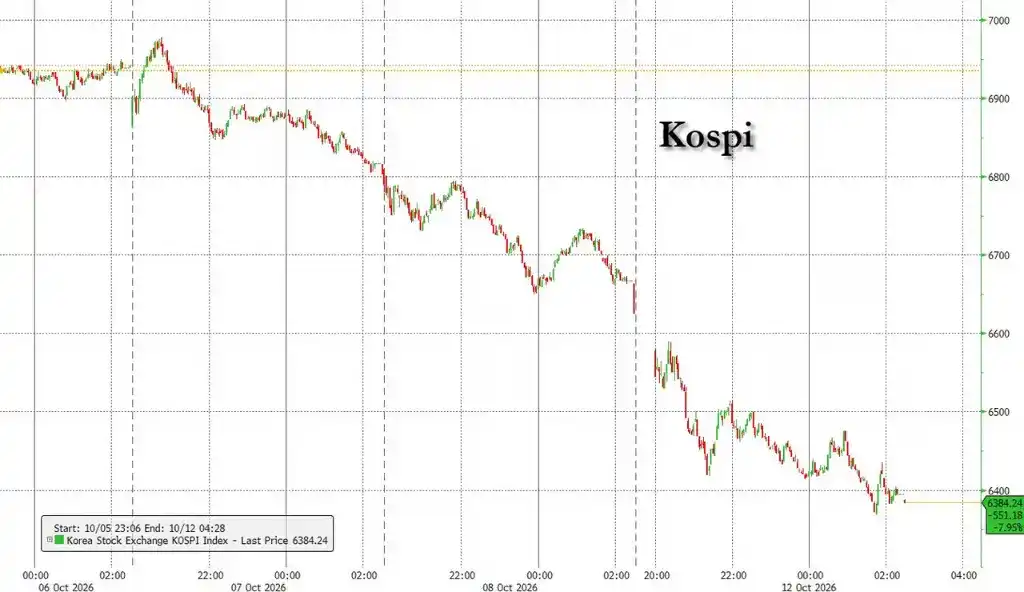
The direct cause of this catch-up decline was the South Korean market needing to digest the losses of U.S. chip stocks from the previous two trading days after being closed for the Hangul Day holiday. Foreign capital was a net seller for the fifth consecutive day, with net selling in the tech sector reaching $1.3 billion in a single day, including $782 million from SK Hynix and $415 million from Samsung. Retail investors bought on the dip, net buying $710 million in Samsung, but Goldman Sachs notes that the scale of net buying by retail investors is showing a declining trend.

A deeper structural issue is the disappearance of buyback support. As previously reported, the combined buyback plans of Samsung and SK Hynix totaling approximately 55 trillion won (about $400 billion) – the largest in South Korean history – ended weeks earlier than planned, with Samsung's buyback effectively ceasing on October 6. In the three trading days since the buyback ended, the KOSPI has fallen about 8%. The KOSPI is now down about 30% from its historical high on June 22, with SK Hynix falling even deeper by 45%.
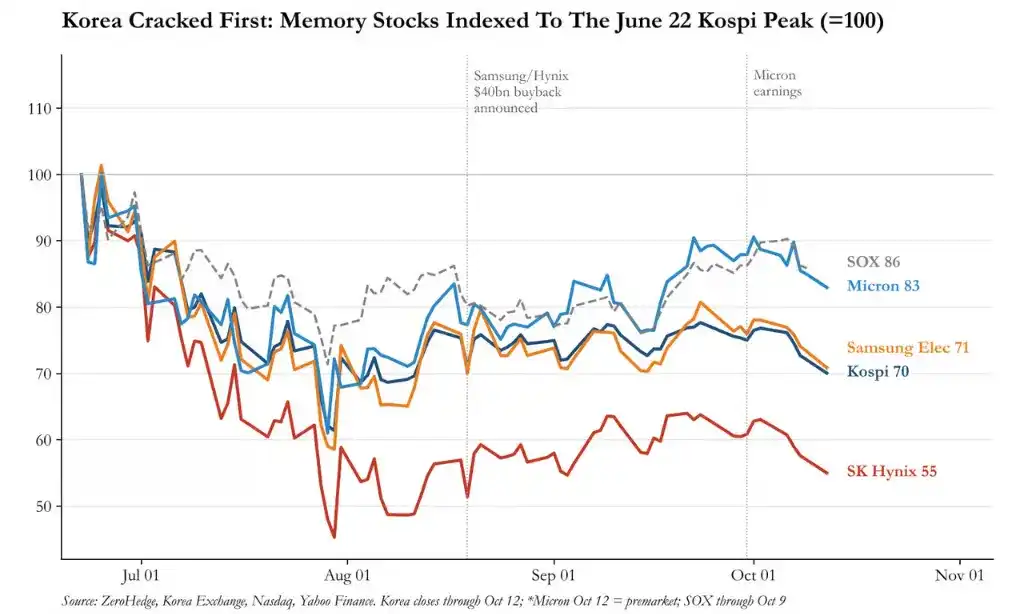
Analysis suggests that the South Korean market, which led the rally during the storage upcycle, is now breaking down first in the downcycle, potentially playing the role of a leading indicator once again.

Changxin's 4F² Breakthrough Heats Up Long-term Supply-Side Concerns

News from Shanghai over the weekend became a significant catalyst for this round of selling. According to a report by the Shanghai Securities News, at the 4th Integrated Chips and Chiplets Conference held from October 9-10, Changxin Memory Technologies (CXMT) President Cao Kanyu announced that the company had made key progress in its 4F² architecture development and officially stated it expects to launch a new generation of DDR5 RDIMM products integrating the 4F² architecture and hybrid bonding by the end of the year, directly targeting the server memory market.

The core significance of the 4F² architecture lies in its density leap. The current mainstream in the DRAM industry is the 6F² architecture, where each memory cell occupies an area six times the square of the minimum feature size. 4F² means the area per cell is reduced by about one-third, theoretically enabling about a 50% increase in storage density on the same wafer area and at the same process node. The core innovation of Changxin's 4F² architecture is its self-developed VSG (Vertical Surrounded Gate) transistor, which enhances gate control through a vertical surrounding channel structure, addressing both leakage and short-channel effects, while achieving area scaling through the transistor's vertical layout.

The transition from 6F² to 4F² is essentially a fundamental change from a horizontal to a vertical transistor channel layout, requiring integration of entirely new process flows and cannot rely on the design and manufacturing systems of the 6F² era. Changxin has also decoupled DRAM from CMOS processes, achieving high-speed interconnects through wafer-level hybrid bonding, which is seen as a key turning point for DRAM technology moving from 2D scaling to 3D integration.

It is reported that Changxin initiated 4F² research and patent layout upon its establishment, with over 300 disclosed patent families, reportedly leading peers both domestically and internationally. The company published papers related to the 4F² architecture in 2021 and continued to disclose R&D progress in 2023 and 2025. In 2025, Changxin also presented a paper at IEDM, reporting the successful experimental verification of DRAM and CMOS wafer-level bonding on a 12-inch wafer platform.

For Samsung and SK Hynix, this timeline presents direct pressure. SK Hynix only announced its 4F² roadmap in 2025. According to reports by Korean media The Elec, Samsung's target is to achieve mass production of sub-10nm DRAM based on this architecture in 2028. If Changxin successfully delivers 4F² DDR5 RDIMM products by year-end as planned, it will lead the two Korean giants by about two years at the cell architecture level.

Recent Fundamentals Strong, But Market Already Pricing the Peak

The fundamental data for the storage industry remains exceptionally strong, which is precisely the market's dilemma – the robust numbers are already fully priced in, and investors are beginning to discount longer-term risks.

Taiwan's Nanya Technology's third-quarter results were described by Goldman Sachs' Taipei trading desk as "another stunning quarter": revenue reached NT$133.6 billion, up 62% quarter-on-quarter and soaring 612% year-on-year; gross margin was 85.7%, up 6.2 percentage points quarter-on-quarter; operating profit margin was 80%; blended average selling price increased over 60% quarter-on-quarter, with more than half of the increase coming from contract resets on long-term agreements expiring in 2025. Management expects that contract prices in 2027 can still achieve double-digit increases, and maintaining a gross margin above 80% is "expected."

However, Goldman Sachs' Taipei trading desk was blunt in its commentary: "There are insufficient near-term catalysts to drive further re-rating." Samsung's near nine-fold growth in third-quarter operating profit should have restarted the storage rally, but instead triggered selling – this itself illustrates where market expectations currently stand.

Goldman Sachs Prime Book data shows that last week, the U.S. Information Technology sector abruptly shifted from being the sector with the largest net buying in four out of the previous five weeks to the sector with the largest net selling, marking the fastest selling pace in seven weeks. Technology hardware, storage & peripherals, and semiconductors were the most heavily sold sub-sectors.

The pressure on storage stocks does not come from deteriorating fundamentals, but from the market's premature pricing of the cycle peak.

Simultaneously, the market's core narrative has shifted from "how strong are the near-term fundamentals" to "what will the supply-demand landscape be like in 2028." Goldman Sachs Korea research team listed six key points for Samsung's earnings call on October 29, with the top one being: whether the company will explicitly state, like Micron, that storage supply will become tight in 2028.

Furthermore, Acer CEO Jason Chen previously stated publicly that "the supply shortage issue has completely disappeared" and expects storage prices to peak around mid-2027. Acer, HP, and Asus have already adopted Changxin chips in their PC products. ASML reportedly raised spare parts prices for Korean customers by about 10%, which Samsung and SK Hynix have accepted, effective from January 2027.

The market will also face several important milestones this week: TSMC will report earnings on Thursday, ASML will release its report on Wednesday, and SEMICON West will also be held – these events will provide new directional signals for the chip sector.

Related Questions

QWhat are the three main triggers that led to the recent sell-off in the memory stock sector, as mentioned in the article?

AThe three main triggers are: 1) A catch-up decline in the South Korean market after a holiday. 2) The early termination of Samsung and SK Hynix's massive share buyback programs, which removed a key market support. 3) Longsheng Technology's (CXMT) announcement of a key breakthrough in its next-generation 4F² DRAM architecture and its plan to launch server memory products by year-end.

QWhat is the core paradox or dilemma facing memory stocks according to the article's analysis?

AThe paradox is that the memory industry's current fundamentals are extremely strong, yet investors are already looking ahead and discounting future risks, fearing a peak in profitability. As a result, stocks are priced as value stocks despite strong earnings, but the market's speculative capital chases growth, not value.

QWhat significant technological advancement did Longsheng Technology (CXMT) announce, and why is it a concern for competitors like Samsung and SK Hynix?

ALongsheng Technology announced a key breakthrough in developing a 4F² DRAM architecture and plans to launch new DDR5 RDIMM products for the server memory market by year-end. This is a concern because the 4F² architecture reduces the cell area by about one-third compared to the mainstream 6F², theoretically boosting density by about 50%. If successful, CXMT could gain a roughly two-year lead over Samsung and SK Hynix in this fundamental architecture shift.

QAccording to the article, why did the strong third-quarter earnings of companies like Nanya Tech and Samsung fail to boost memory stock prices?

AThe strong earnings failed to boost prices because the market had already priced in the robust near-term fundamentals. The focus has shifted from 'how strong are current fundamentals' to 'what will the supply-demand landscape look like in 2028.' Investors are now preemptively pricing in the peak of the cycle and future risks of oversupply.

QWhat role did the end of share buyback programs in South Korea play in the market decline?

AThe end of Samsung and SK Hynix's combined approximately 55 trillion won (about $40 billion) buyback programs—the largest in South Korean history—removed a significant artificial support that had been propping up stock prices. The KOSPI index fell about 8% in the three trading days following the actual end of the buybacks.

Related Reads

Vitalik 'Exposes' the Limitations of Burning, ETH Value Narrative Shifts

Vitalik Buterin argues that Ethereum should focus more on ETH's store-of-value property rather than relying on fee burning to support its valuation. He explains that fee-burn-based valuation rests on a net present value logic—market cap equals annual burned fees divided by a discount rate—but notes this never provided a truly solid floor. Much of the burning during 2021–2023 came from within the crypto ecosystem itself, so if ETH's price fell, that revenue would fall too. Only demand from outside crypto can make such a valuation floor more convincing, and while RWA growth may help, mature businesses are unlikely to replicate the massive fee consumption seen during speculative manias. He warns that relying on fee burning to justify ETH's ~$270B market cap would require Ethereum to operate like a world-class corporation (roughly L'Oréal's scale), needing sustained R&D spending—perhaps ~700K ETH annually—and highly interventionist governance, both of which create political problems and undermine decentralization and anti-capture properties. Pursuing burning also implies pursuing higher gas prices, potentially excluding users who most need privacy and security; maximizing "price × usage" differs from maximizing safe access for as many people as possible. As a store-of-value asset, the most important metric is survival. Users most value decentralization and CROPS (censorship and capture resistance, open source, privacy, security), which also matter to institutions for risk management and compliance. Ethereum should make prudent security tradeoffs, address quantum computing and AI risks, stabilize the core protocol while shifting innovation to upper layers, and resist complexity-adding features and capture-prone reward mechanisms. Users should be able to hold assets safely and privately, with confidence transactions won't be blocked. Reducing dependence on infrastructure providers matters—he can run a node on a laptop, syncing in under six hours with about one-eighth of disk space, better than 2019. Store-of-value and application growth are synergistic: more native RWA and decentralized assets on L1 increase what holding ETH enables—trustless swaps or using ETH as collateral—boosting its utility, with tradeoffs smaller than maximizing fees.

Odaily星球日报5m ago

Vitalik 'Exposes' the Limitations of Burning, ETH Value Narrative Shifts

Odaily星球日报5m ago

ICLR 2027 First Round Review: Quite a Few Pain Points

ICLR 2027's first-round reviews have sparked widespread complaints among researchers, with many sharing examples of poor-quality or clearly AI-generated feedback on social media. One reviewer asked an author to explain what "standard deviation" means; another review began with the telltale chatbot opener "Certainly! Here is a review of the paper," while two other reviews appeared to be near-identical copies of the same template. One author received criticism for using AI-assisted writing despite having properly disclosed it, and another reviewer openly admitted lacking the expertise to evaluate the paper—prompting debate over whether the real fault lies with reviewer assignment rather than the reviewer. A recurring concern, raised by Jiaxin Pei of UT Austin, is that AI reviewers cannot distinguish between a paper's ordinary limitations and the critical flaws that actually undermine its core contributions. Large language models can list hundreds of limitations for any paper, including the best ones, but they cannot judge which issues truly matter. As a result, reviews grow longer and demand more experiments while the real determinants of paper quality get buried. ICLR 2027 organizers have acknowledged the strain: rapid growth in submissions, a shortage of qualified reviewers, and AI lowering the barrier to paper production. They introduced measures including submission caps, stricter reciprocal review obligations, and rules permitting limited, disclosed AI use in reviewing—with penalties for low-quality or hallucinated AI-generated reviews. Author-reviewer discussion runs until November 18, with final decisions expected December 16.

marsbit40m ago

ICLR 2027 First Round Review: Quite a Few Pain Points

marsbit40m ago

Without Warning, OpenAI Suddenly Mass-Bans Accounts

OpenAI has abruptly banned a large number of ChatGPT accounts without prior notice or email warnings, deleting accounts outright. Affected users see only an error message stating their account has been deleted or deactivated. The purge heavily targets accounts in the Philippines and Turkey, low-cost Team plans, and accounts using reverse proxy relays, and even long-standing paying users with months of subscription have been hit. Free API accounts, shared team accounts, and $200/month Pro accounts were all affected. Developers report losing years of conversation history and personal data locked in the cloud, with appeals unsuccessful. Some speculate OpenAI is cracking down on account stacking to prevent users from exploiting cheap subscriptions. OpenAI's status page showed elevated error rates for some US commercial Mastercards, though OpenAI characterized the incident as a payment channel issue rather than account bans. Users are advised to appeal via OpenAI's official form with account details and Request ID. This move follows earlier steps: OpenAI previously merged ChatGPT and Codex into a single token pool and, five days ago, imposed device and payment card limits, preventing multiple paid subscriptions on one card or device. Starting November 20, new usage policies require third-party API gateways to obtain official written authorization, and from December, Plus, Pro, and Business plans will share a single quota calculated by token consumption. Users are advised to regularly back up cloud conversations and sync Codex projects locally, as the era of freely exploiting AI compute appears to be over.

marsbit45m ago

Without Warning, OpenAI Suddenly Mass-Bans Accounts

marsbit45m ago

Young People Flocking to Semiconductors: Two Years of Dividends Equal a Lifetime for Others

The article explores the surge of young graduates rushing into China's semiconductor industry, drawn by lucrative salaries and long-term career prospects amid a cooling internet sector and cautious civil-service tracks. At a job fair, semiconductor booths are overwhelmed with applicants, while internet giants' stalls stand empty. The industry's appeal is clear: average starting salaries for R&D roles reach 523,000 yuan, far above the 353,000 yuan for core internet positions, with companies like ChangXin earning 54.4 billion yuan in a single quarter—matching Baidu's decade-long profits. The boom has rewritten traditional hiring hierarchies, with microelectronics students receiving offers almost instantly and even "lesser" majors like materials and chemical engineering landing high-paying roles. Yet the article stresses this is a "slow dividend" rather than a short-term windfall: semiconductor manufacturing is capital-intensive, requiring years of process expertise, and offers no "35-year-old crisis" like the internet sector, where youth and speed are prioritized over accumulated experience. A process engineer's career curve is gradual—five years to lead projects, eight to become a technical authority. However, the pressure is intense: long hours, constant client demands, rapid product iterations, and the risk that a single mistake can damage a company's reputation. Some newcomers burn out and leave, only to return. With a talent gap exceeding 300,000 and projected to reach 500,000 by 2030—especially in high-end R&D—the structural mismatch will persist. Many graduates now accept "get on board first, choose your seat later," betting on the industry's long-term growth as China's semiconductor push, less than a decade old, continues to ride tailwinds from AI computing, HBM, and advanced packaging.

marsbit1h ago

Young People Flocking to Semiconductors: Two Years of Dividends Equal a Lifetime for Others

marsbit1h ago

Trading

Spot
活动图片