Just Now, Meta's Flagship Model Crushes GPT-6 and Opus! Leaps Back into World's Top Three Overnight

marsbitPublished on 2026-10-13Last updated on 2026-10-13

Abstract

Meta has launched its most powerful flagship AI models yet, Muse Wonder and Muse Wonder Full, positioning them as a historic leap toward "personal superintelligence." Benchmark results show these models are now competitive with leading counterparts from OpenAI and Anthropic. On the Artificial Analysis index, Muse Wonder Full scored 56, placing it in the global top tier alongside Claude Sonnet 5.5 and surpassing GPT-6 Astra. In long-context programming tasks like SWE-Marathon, both Wonder and Wonder Full outperformed Claude Opus 5.5 and GPT-6 Astra. Key new capabilities include "Active Memory" for retaining user information across conversations and "Active Focus" for autonomous problem-solving and plan adjustment. The models show significant gains over the previous Muse Spark 1.3, with the Full version improving by 8 points on the Artificial Analysis index in just six weeks. In professional tasks like legal and financial analysis, Wonder Full exceeded Opus 5.5 in 8 out of 14 tests. It also demonstrated improved efficiency, solving more math problems while reducing output tokens by 40%. Developed using Meta's gigawatt-scale "Prometheus" supercomputing infrastructure, the models feature a 1 million token context window and native multimodal support. Pricing starts at $4 per million tokens for input and $20 for output via API for the standard Wonder model, while Wonder Full is available through Muse Code subscriptions at $50 or $200 per month.

Zuck has really caught up this time!

Late at night, Meta unveiled two large models in one breath: Muse Wonder and Muse Wonder Full.

Officially, it was unapologetically defined as Meta's most powerful model to date, and a historic leap towards "Personal Super Intelligence."


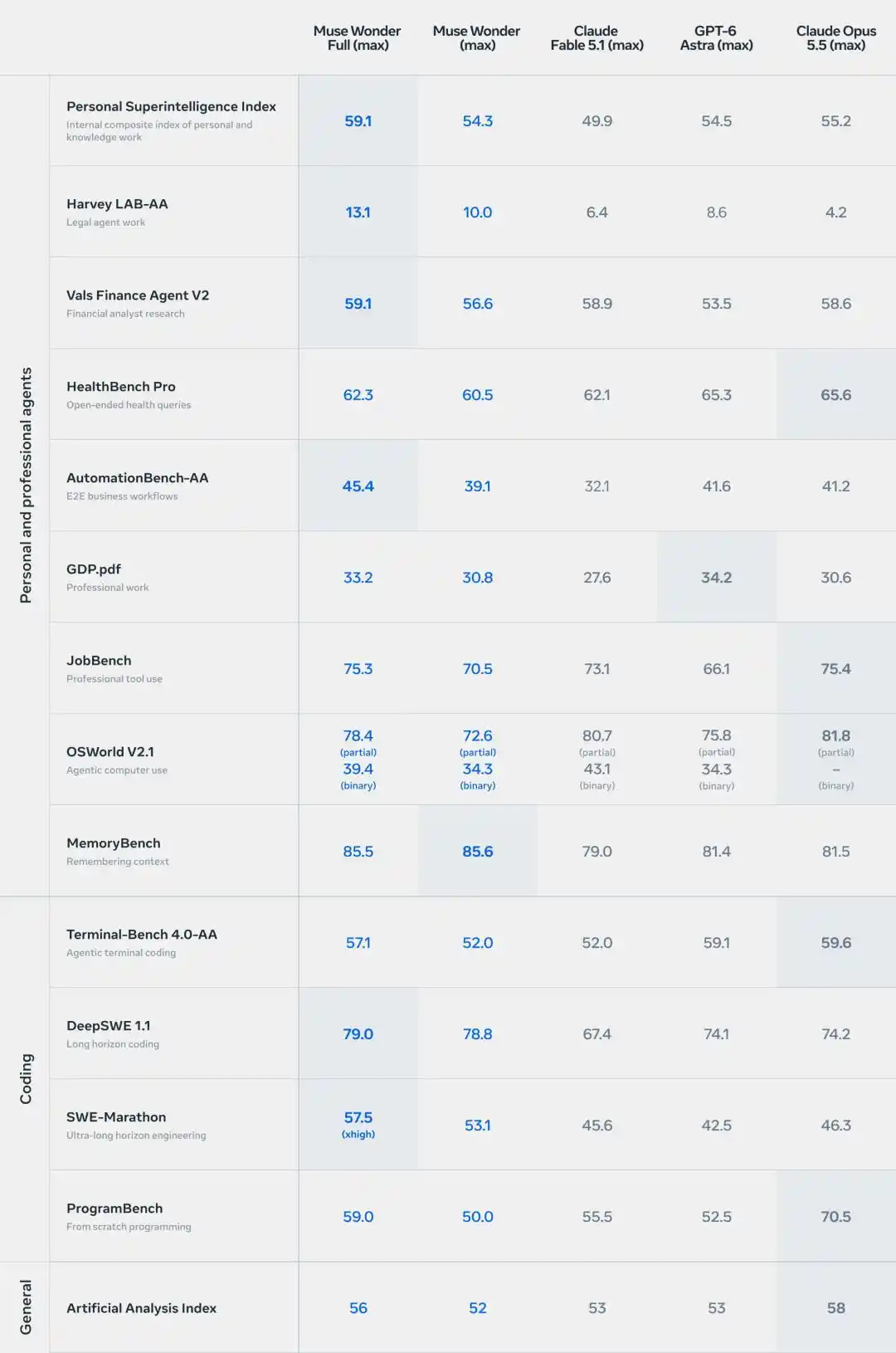
In various benchmark tests, Meta's "Double Punch" can finally compete head-to-head with Claude and GPT.

The current strongest models, Claude Fable 5.1 and GPT-6 Astra, were almost directly stepped on by Muse Wonder.
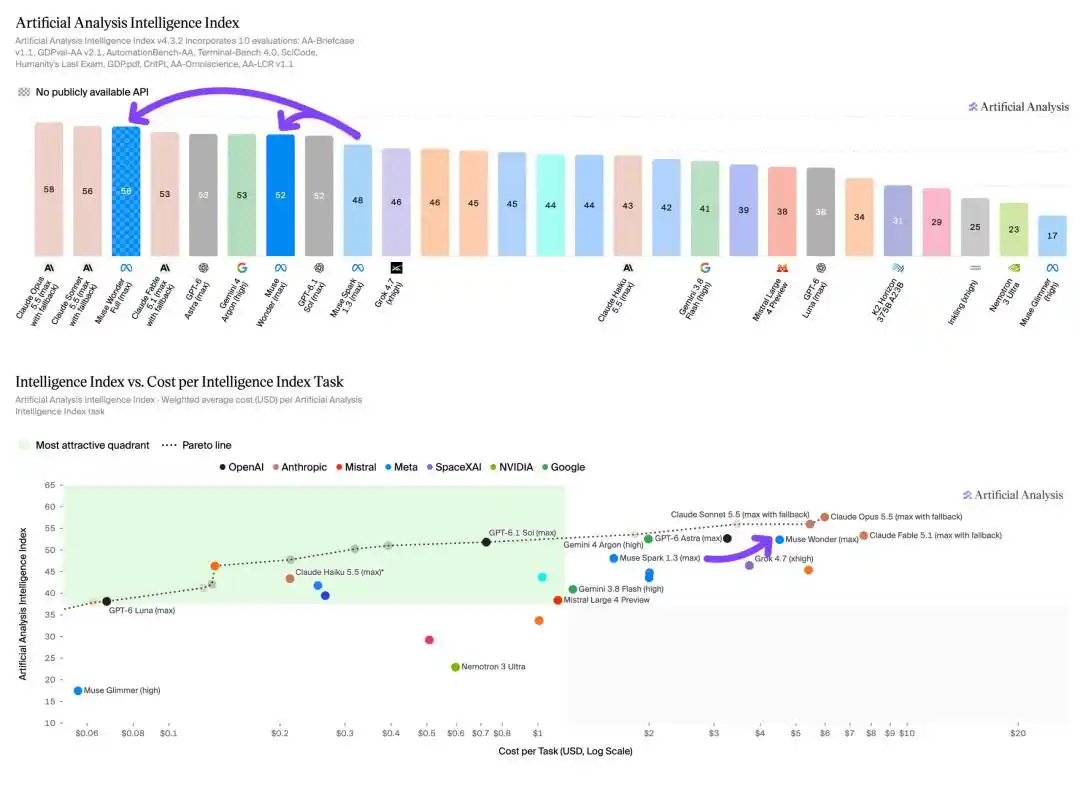
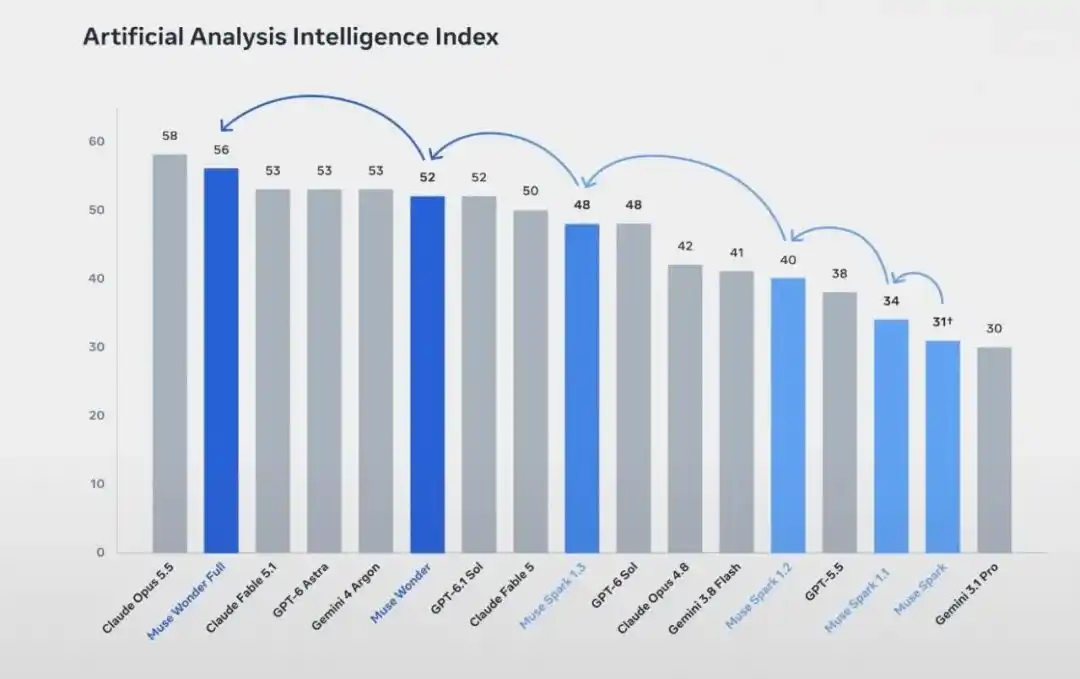
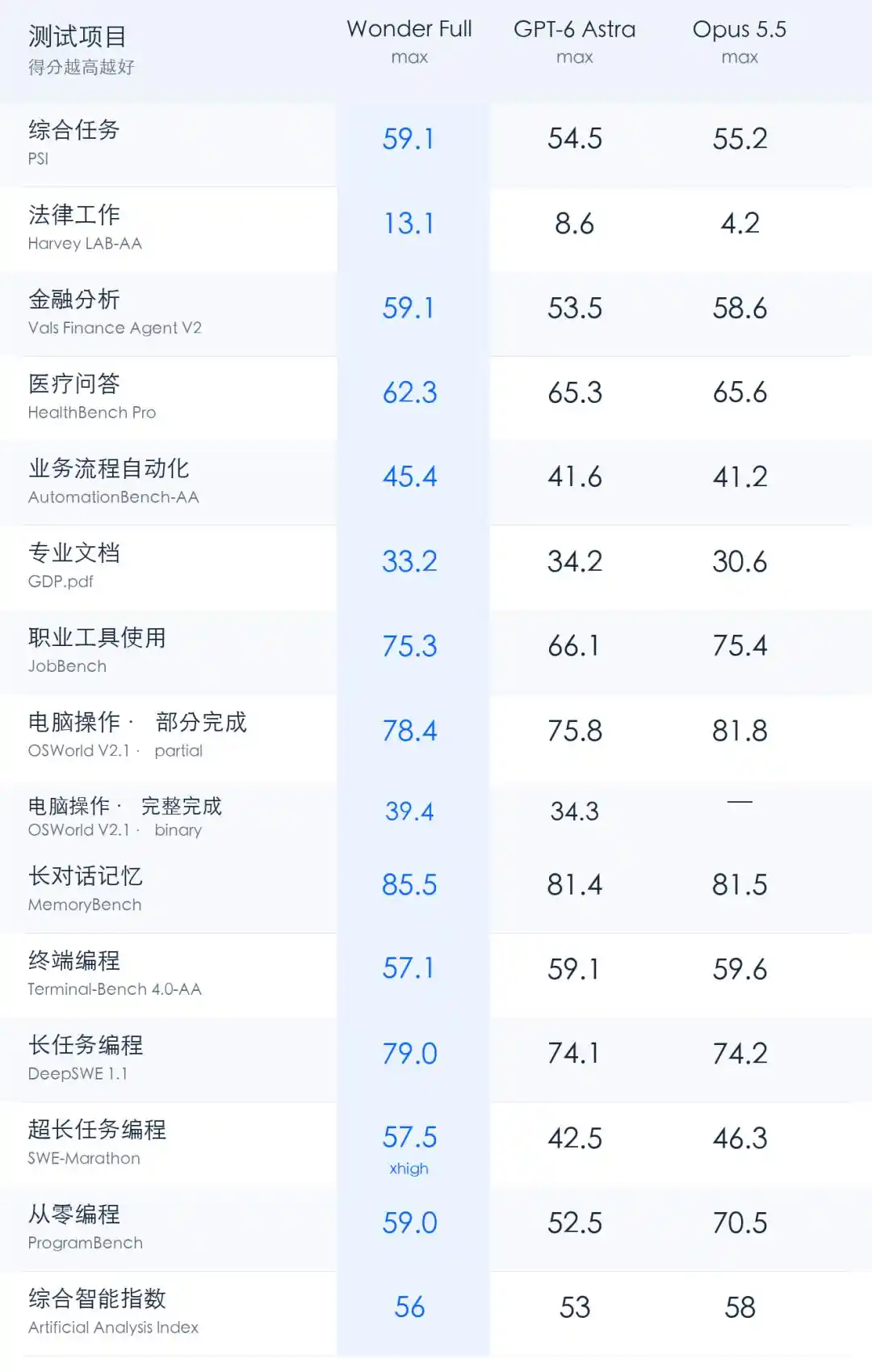
On Artificial Analysis, Muse Wonder Full scored 56 points, securing a spot in the global first tier, keeping pace with Sonnet 5.5 and surpassing GPT-6 Astra.

Muse Wonder also scored 52 points, comprehensively overtaking the previous generation Muse Spark 1.3.
In long-task programming, Meta even surpassed Opus and Astra. Not only did the top-tier Full win, but the standard Wonder also won!

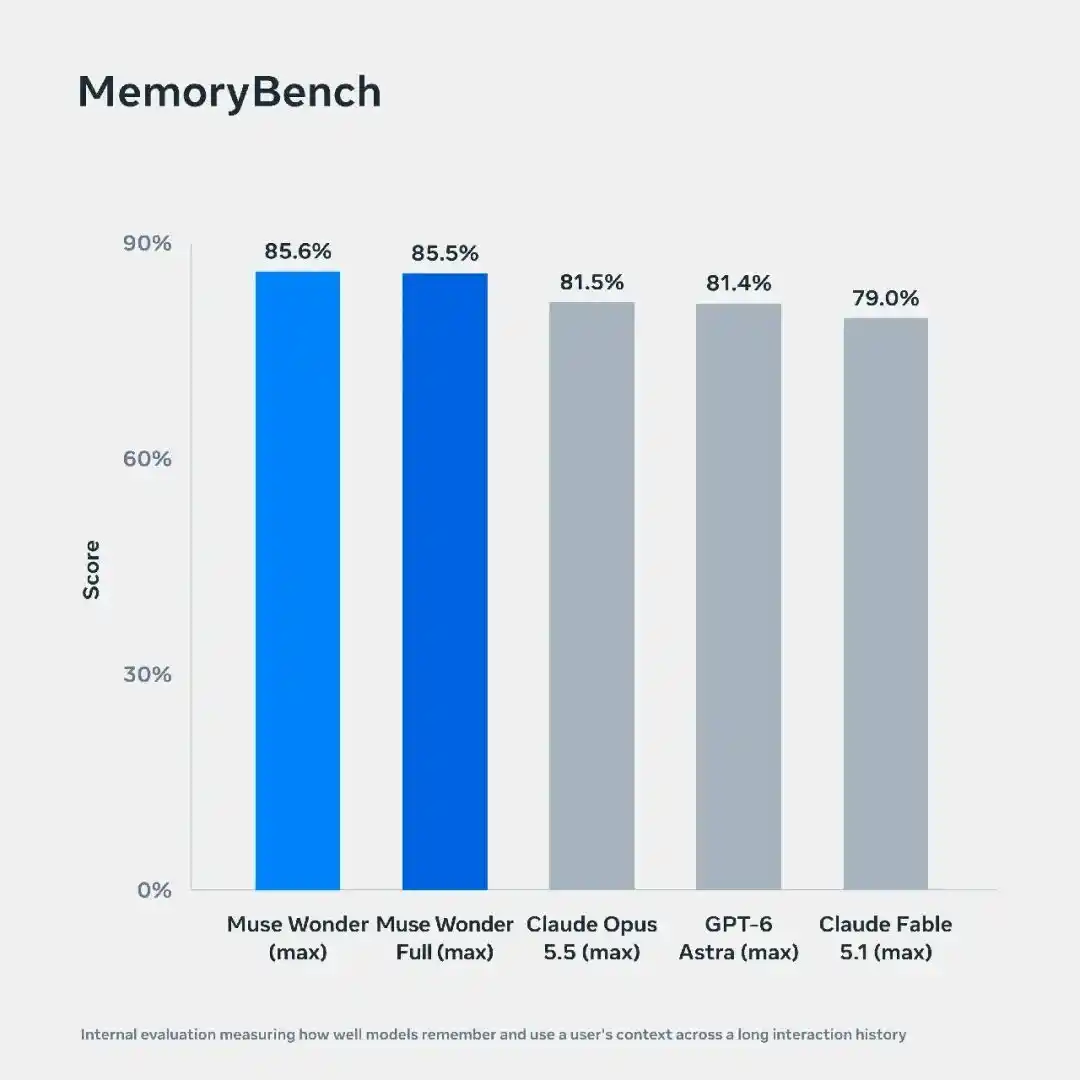
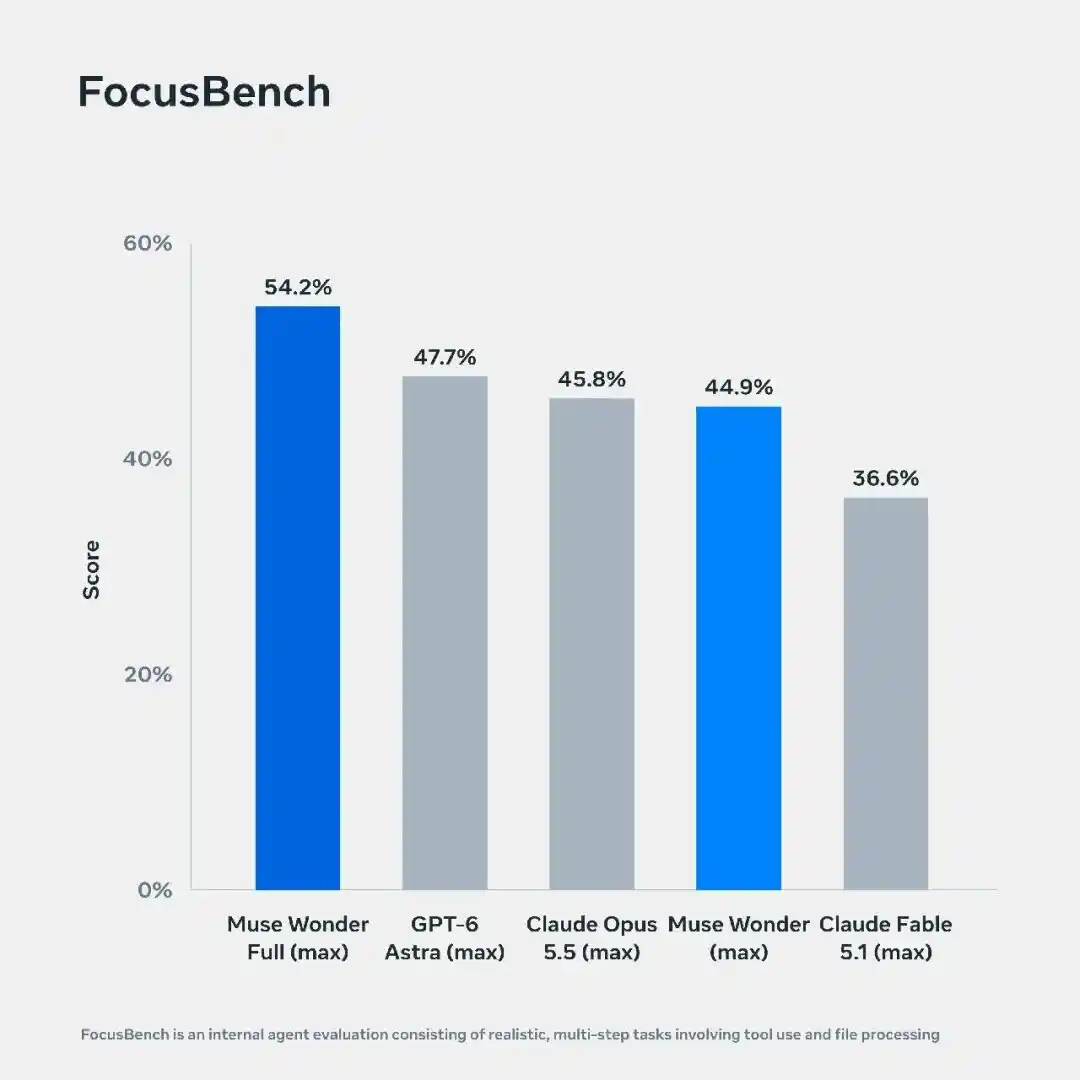
It holds two major trump cards: Active Memory + Active Focus.

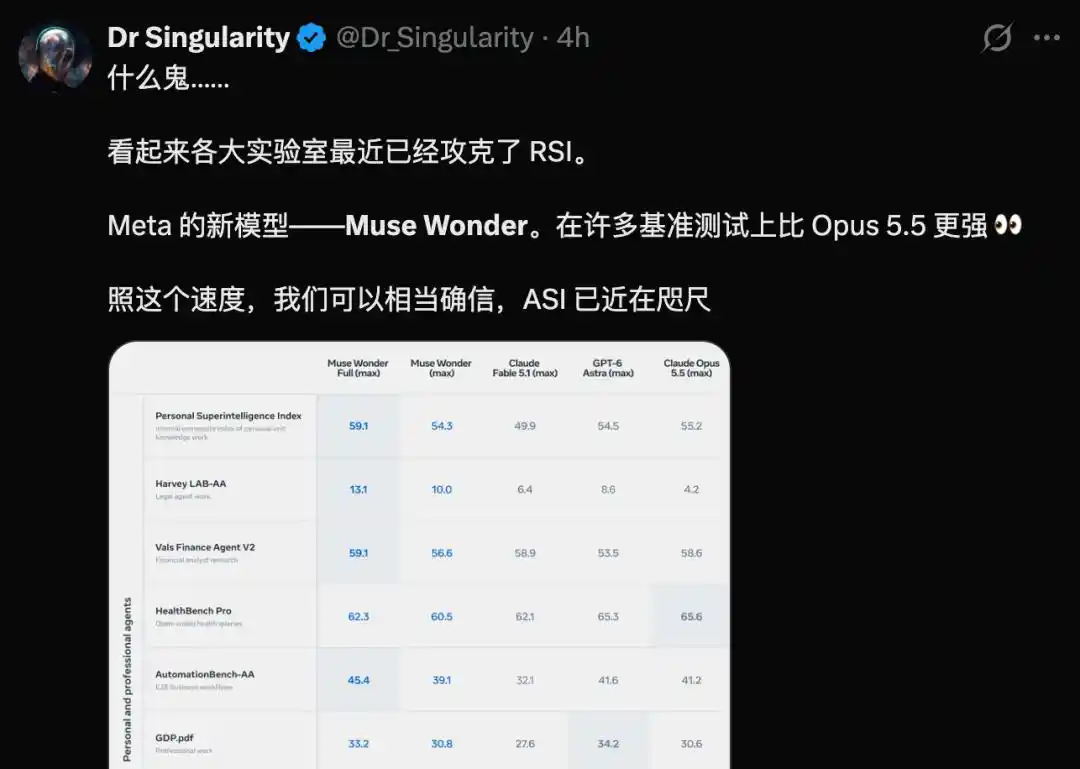
For a moment, many were amazed, thinking that major labs have already conquered RSI.
Key highlights of this upgrade across all capabilities —

Programming enters the first tier: Muse Code equipped with Full ties with Claude Sonnet on the AA Programming Agent leaderboard; both Wonder models exceed Opus and Astra in long task tests.

Remembers you across conversations, resumes long tasks: Active Memory retains your important information; Active Focus lets the model change approach when encountering obstacles, check after errors, and adjust plans when receiving new requirements.

Catches up in professional work: In 14 tests covering law, finance, memory, and continuous execution capabilities, Full surpasses Opus 5.5 in 8 and GPT-6 Astra in 11.

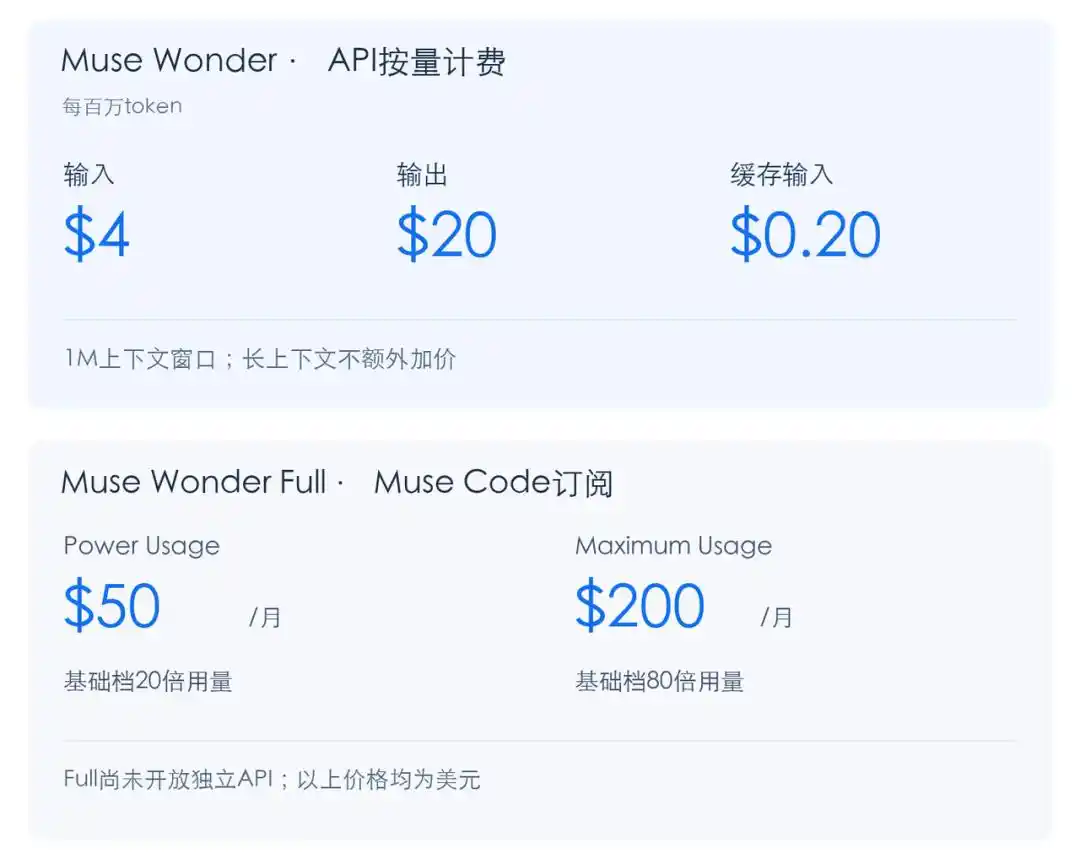
Pricing: Standard version API costs $4 per million tokens for input, $20 for output; Full is available through Muse Code subscription at $50 or $200 per month.
Jumped 8 Points in Six Weeks, Wins All Ten Tests Against Predecessor!

According to Artificial Analysis, only six weeks passed between the release of Muse Spark 1.3 and the new models.

The Intelligence Index surged from 48 points to 56 points, a full 8-point jump!
All ten tests surpass Spark 1.3; six enter the top three, two take first place!

In scientific reasoning CritPt and professional document GDP.pdf, Full scored 33%, ranking first on the AA current leaderboard! In professional knowledge work GDPval-AA v2.1, Full scored 1857 Elo, ranking second.

Three other third-place finishes: knowledge work AA-Briefcase, business process automation AutomationBench-AA, and scientific programming SciCode.

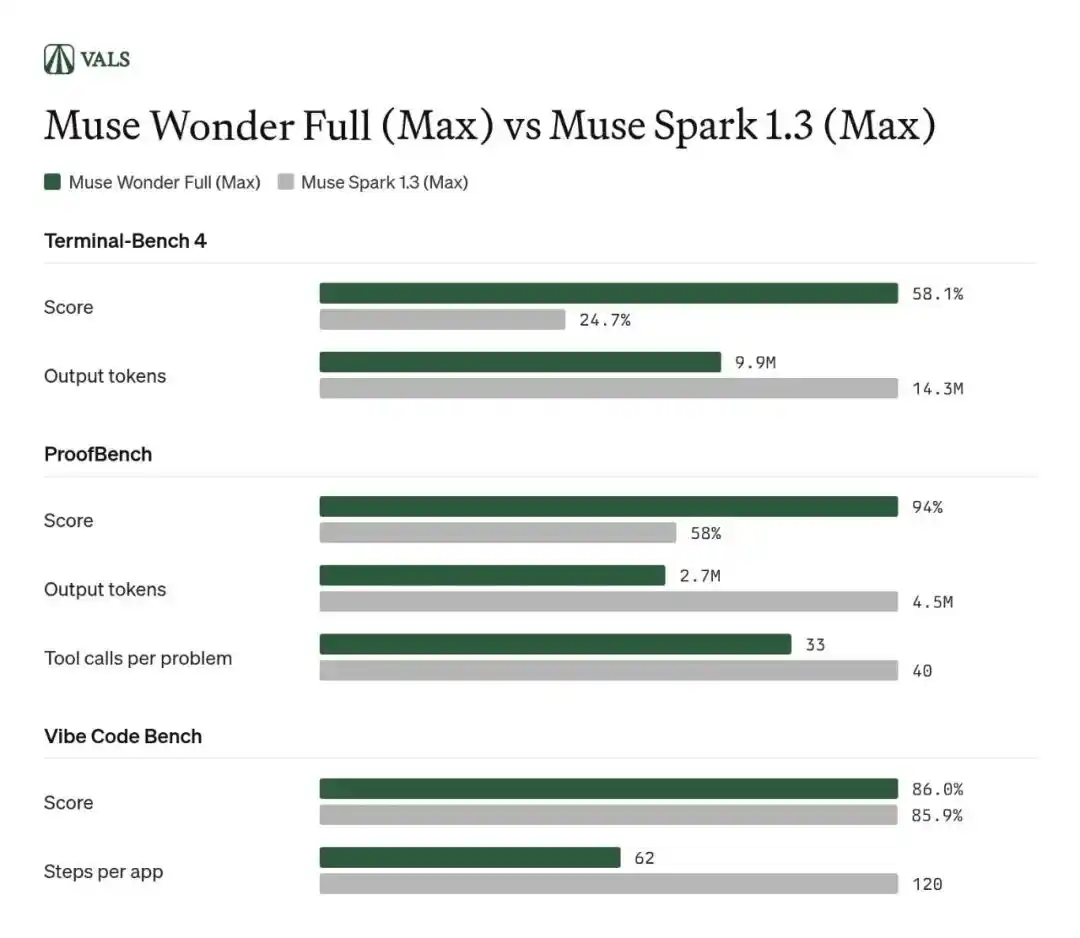
Terminal-Bench 4.0 requires AI to read files, type commands, and handle errors itself. Spark could only complete 33% of tasks, while Full achieves 57%, a 24-percentage-point leap!

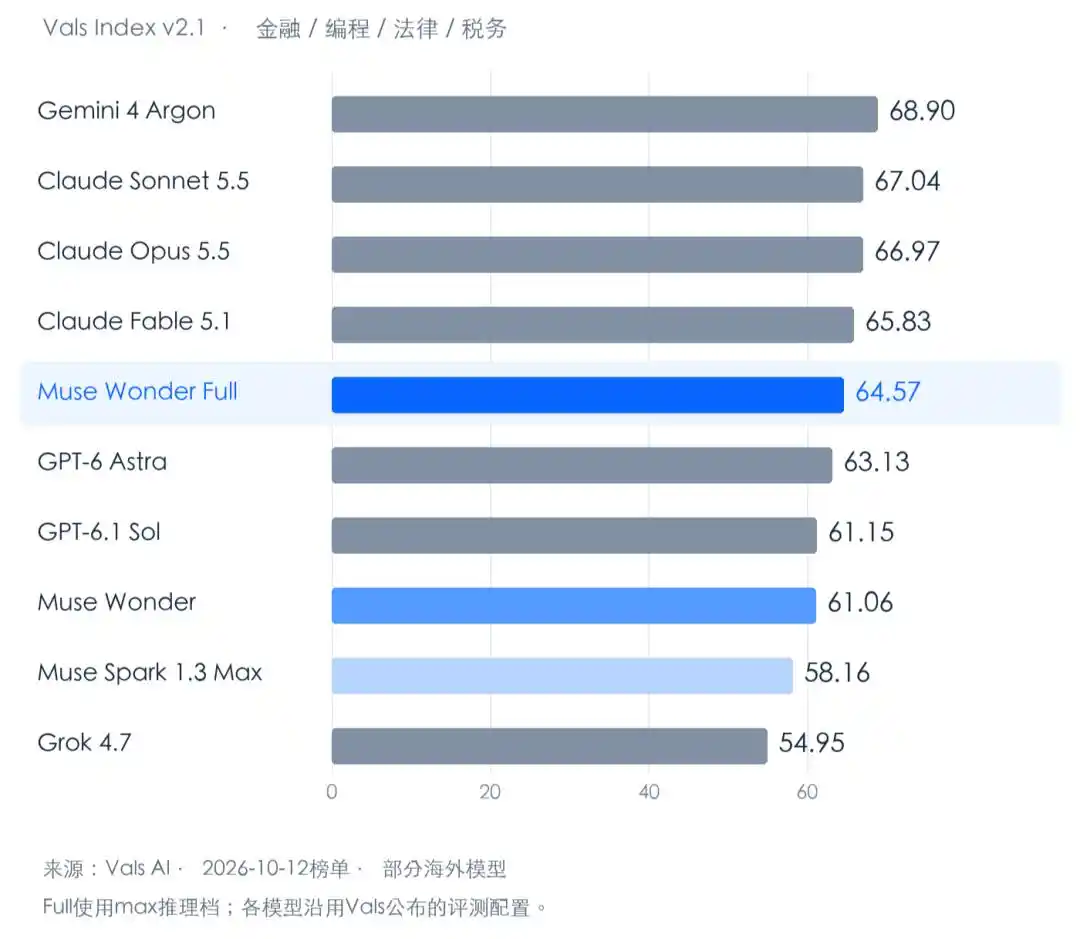
Another evaluator, Vals, also released new results.

On the Vals Index comprehensive benchmark covering finance, programming, law, and tax work, Wonder Full scored 64.57 points, ranking fifth and surpassing all OpenAI models on the list!
Beyond benchmarks, Conductor developer Charlie Holtz has already integrated Wonder into his codebase.

Unexpectedly, Muse found a real security vulnerability in one go, which other Agents had previously missed.

He even praised its design and visualization, CLI speed, and voice mode, boldly stating "Meta is now at the forefront!"

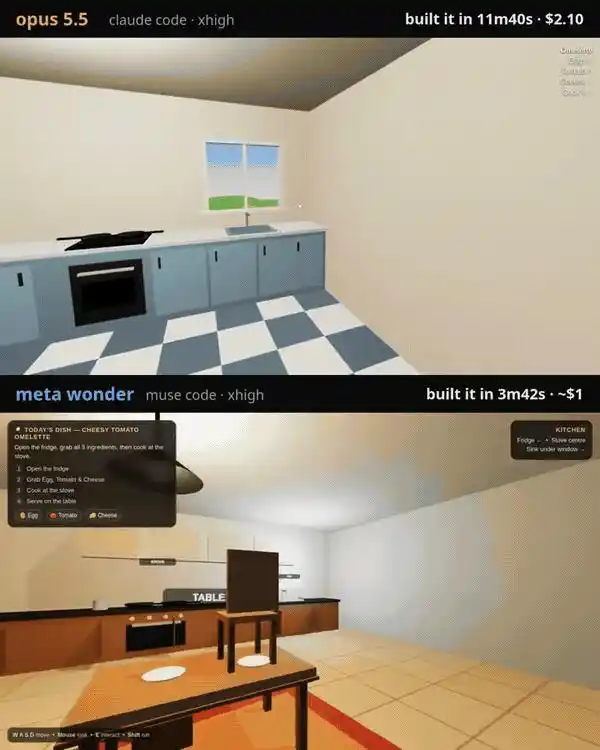
In another test, developer Yair conducted a same-topic comparison, having Wonder and Opus 5.5 create a first-person 3D game.

Claude Code with Opus 5.5 took 11 minutes 40 seconds, while Muse Code with standard Wonder only took 3 minutes 42 seconds, not even four minutes!
Surpasses Opus in Long Tasks, Programming Lands Heavy Blows on Astra

On the SWE-Marathon benchmark for long-term tasks, Full scored 57.5%, Opus 5.5 scored 46.3%, Astra scored 42.5%.

The lead margins are 11.2 and 15 percentage points respectively!

Even without using Full, the standard Wonder scored 53.1%, also surpassing these two flagships.
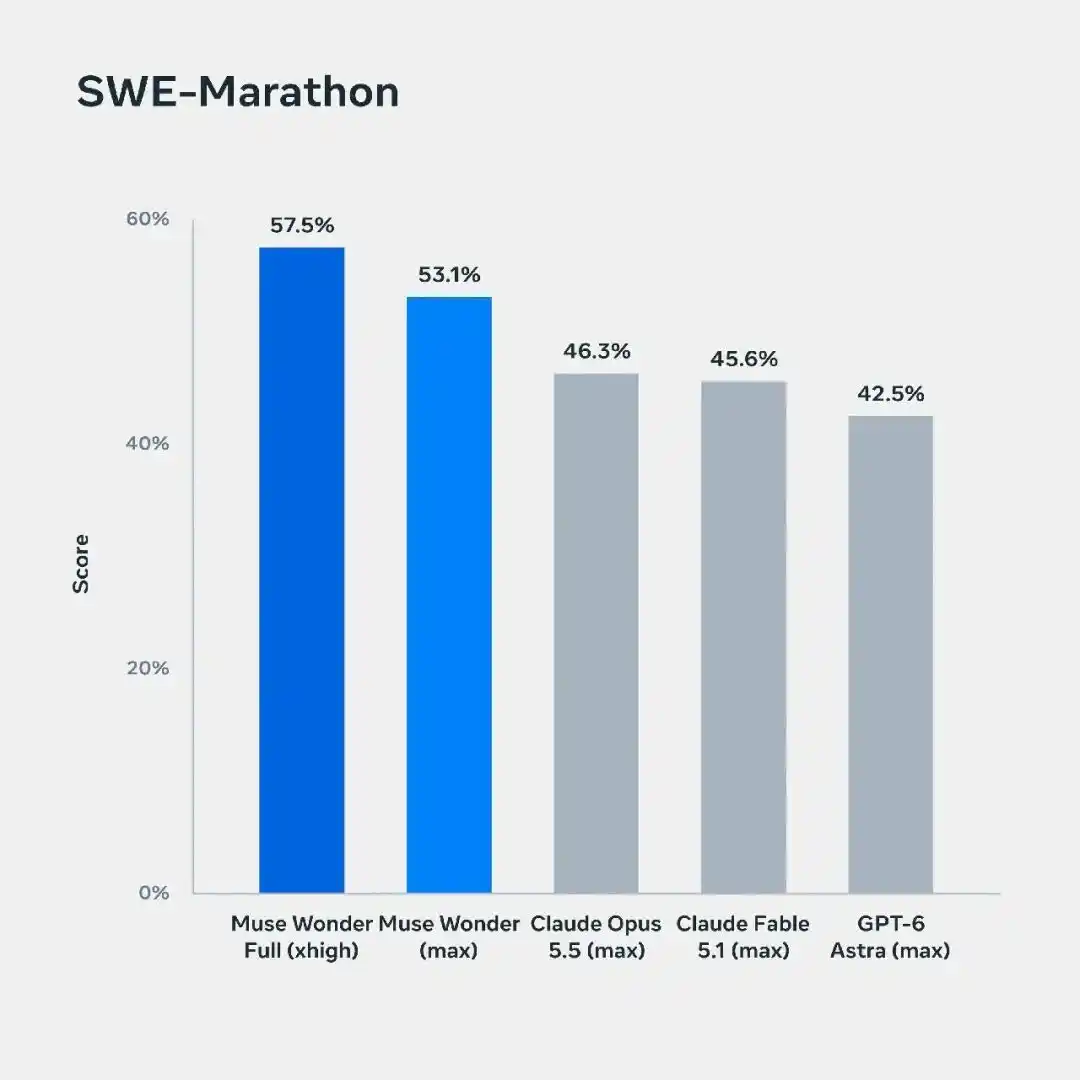
SWE-Marathon requires AI to continuously complete software projects: read requirements, modify multiple files, run tests, find reasons after errors, and continue modifying.

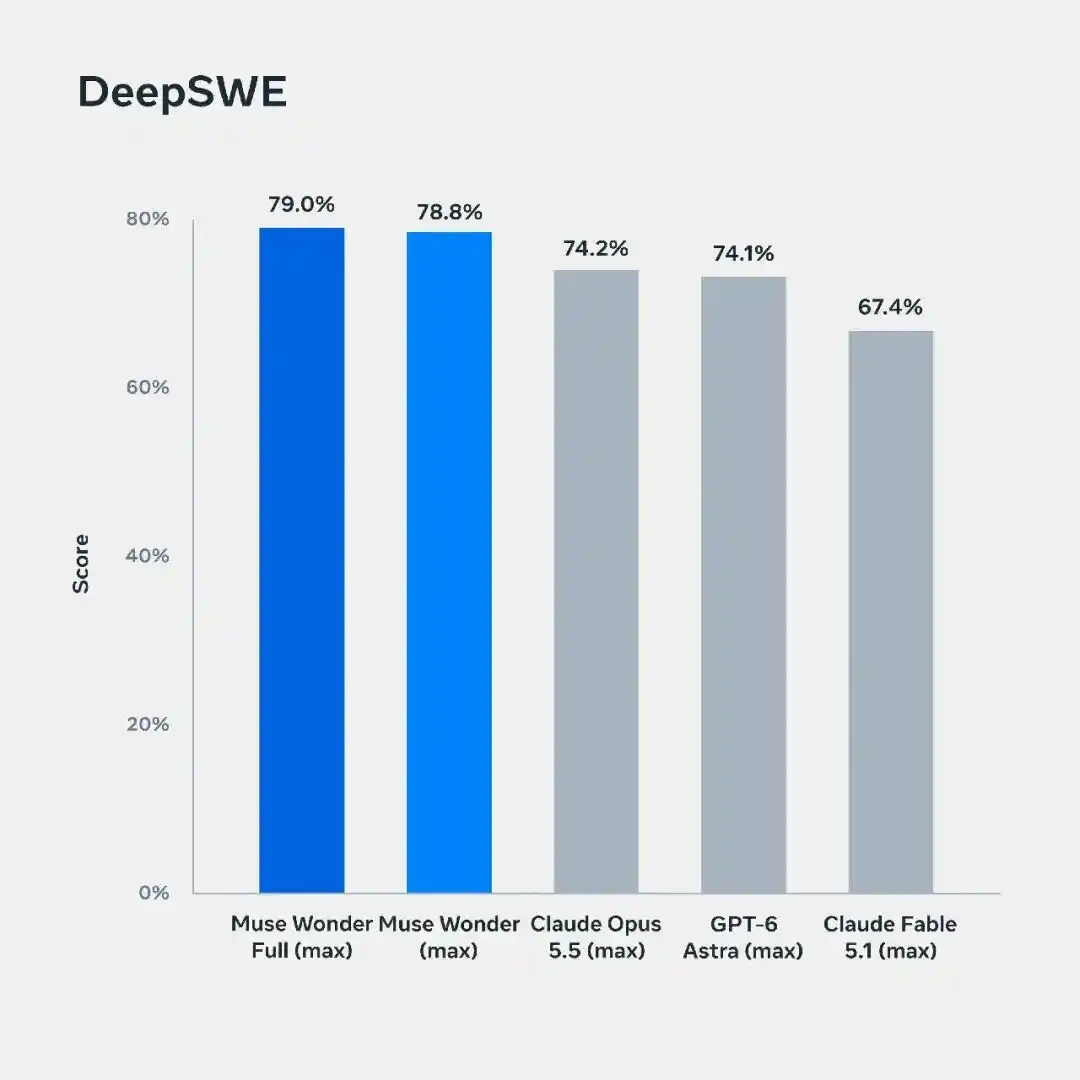
DeepSWE v1.1 contains 113 tasks, involving 91 code repositories and five programming languages.

In Meta's aggregated scores, Full achieved 79.0%, Wonder 78.8%, with Opus and Astra at 74.2% and 74.1% respectively.
Looking at AA's Programming Agent leaderboard (Coding Agents Index), Muse Code with Full scored 68 points, tying Claude Code with Sonnet, and surpassing the 66 points with Opus.

The previous generation Muse Code with Spark 1.3 only scored 54 points. Switching to Full directly increased by 14 points! With standard Wonder, it also scores 63 points.
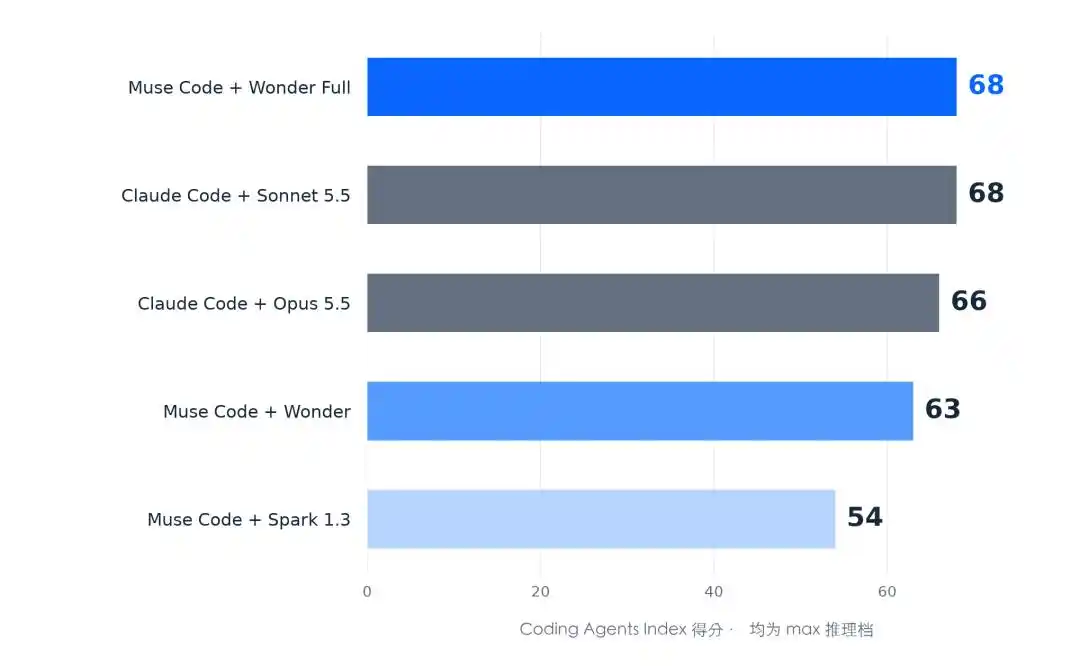
Artificial Analysis programming agent test results for Muse Code and Claude Code.

In zero-shot programming ProgramBench, Full scored 59.0, higher than Astra's 52.5; Opus scored 70.5.

Terminal programming scores: Full 57.1, Astra and Opus 59.1 and 59.6 respectively.

Additionally, results from a larger-scale vulnerability test are in.

The maintainer of VulnPR-100 assigned Wonder 1.0 100 code changes with known vulnerabilities, each with a one-hour time limit.

It found 46, tying with GPT-6 Astra. The total cost was $284.88, averaging $6.19 per vulnerability.

Solves 36 More Math Problems, Uses 40% Fewer Tokens

On Vals AI's ProofBench, Full correctly solved 94 math proof problems, 36 more than the previous generation; on the same list, Opus solved 100, Astra 99.

Solved more problems, yet output tokens dropped from 4.5 million to 2.7 million, 40% less! On application problems, the score remained around 86%, with average steps decreasing from 120 to 62.
Exceeds Opus in 8 of 14 Areas, Law Score Reaches 3.1x

In the legal task Harvey LAB-AA, Full scored 13.1 points, Opus 4.2 points, the former being 3.1 times the latter! In finance tasks, it scored 59.1 points, surpassing Opus's 58.6 and Astra's 53.5.

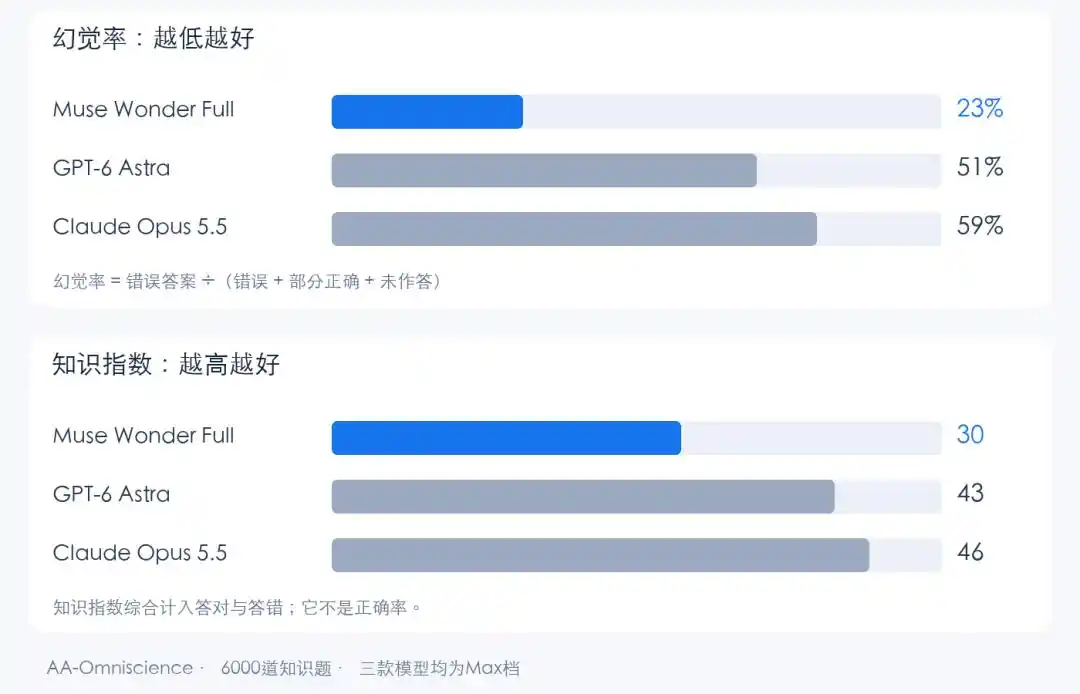
For professional work, fabricating fewer answers is crucial. On AA's 6000 knowledge questions, Full's hallucination rate was 23%, Astra 51%, Opus 59%; this statistic refers to the proportion of incorrect answers still provided among questions not answered correctly.

Full is less likely to force an answer, but its knowledge index is still 30, lower than Astra's 43 and Opus's 46.
Gigawatt-Scale Training

The "Ultimate Beast" from Prometheus

The terrifying strength of Muse Wonder stems precisely from the gigawatt-scale supercomputing behind it.

Fourteen months ago, Meta quietly initiated a complete overhaul of its entire AI infrastructure and R&D paradigm.

The birthplace of this Muse Wonder is the long-rumored gigawatt-scale Prometheus super data center.

Meta continued to scale up pretraining and reinforcement learning here: pretraining builds broad foundational capabilities, and reinforcement learning adjusts the model's behavior based on task feedback.

Even more astonishing are its base capability specifications:

1 million Token massive reasoning context: Whether it's a complete large codebase, hundreds of pages of complex M&A contracts, or several hours of audio/video recordings, it can swallow them all in one go;

Native multimodal input support: Integrates text, high-resolution images, long videos, and continuous audio;

Qualitative change in "Big Model Smell": Meta specifically addressed the AI community's skepticism about model "generalization ability" in its blog.

To ensure models can complete complex projects, Meta incorporated a vast number of diverse, longer-duration tasks into training. Taking programming as an example, models must remember requirements, modify multiple files, undergo rounds of testing and revisions, continuously advancing the project.

A stronger foundation model must also apply learned capabilities to new problems.

Meta incrementally increased computational allocation during inference; both model generations' scores on unfamiliar tasks improved accordingly. When they achieved similar scores on tasks heavily covered during post-training, Full still performed better on tasks not heavily covered.
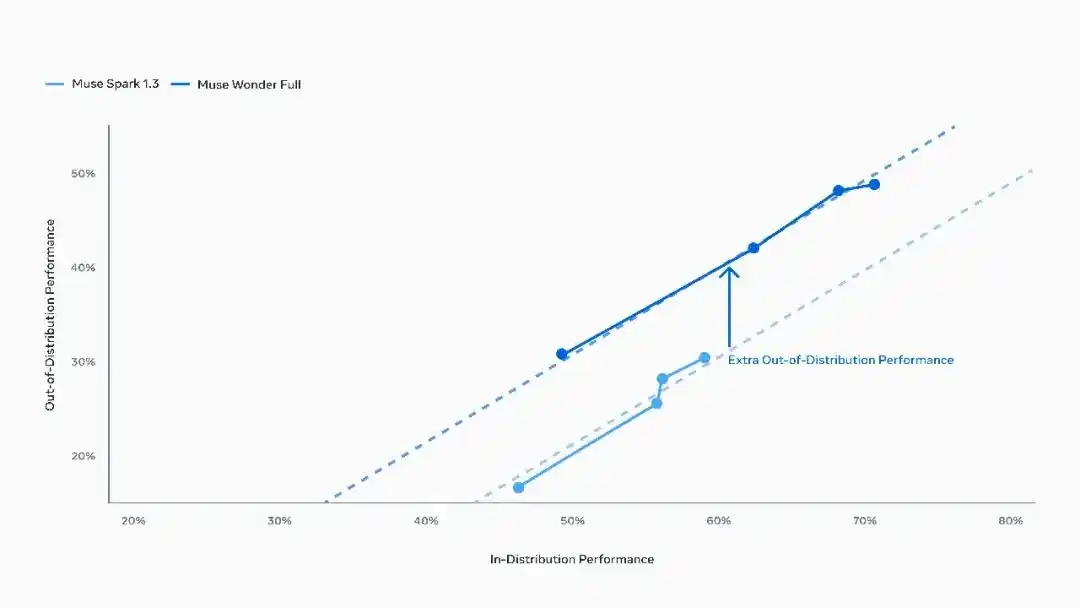
Horizontal axis: Tasks heavily covered in post-training. Vertical axis: Tasks not heavily covered.

After 14 Months of Rebuilding, Zuck Has Finally Fought Back!

Now, the standard Wonder is already available on the Meta Model API and Muse Code.

API usage pricing: $4 per million tokens for input, $20 for output, cached input $0.20. Context window reaches 1 million tokens, with no extra charge for long context.

Full is currently only available through Muse Code subscription: Power Usage is $50/month, Maximum Usage is $200/month, offering 20x and 80x the base usage tier respectively. Independent API is not yet available.

The personal assistant Muse will also integrate Wonder, rolling out first to subscribers as per the official plan.

Although initial users encountered quota anomalies, Alexandr Wang stated the team is fixing it and promised to reset quotas after repair.

Now, Meta is also coming for the territory of Claude Code and Codex!

References:

https://research.meta.ai/blog/muse-wonder/

https://research.meta.ai/static/muse-wonder-model-card

This article is from the WeChat public account "Xin Zhi Yuan", author: ASI Apocalypse
Trending Cryptos

Related Questions

QWhat are the two new large language models recently announced by Meta, and what are they described as?

AMeta recently announced two new large language models: Muse Wonder and Muse Wonder Full. They are described as Meta's strongest models to date and a historic leap towards 'personal superintelligence'.

QWhat key technical capabilities are highlighted as major strengths of the new Muse models?

AThe major technical strengths highlighted for the new Muse models are their 'Active Memory' and 'Active Focus' capabilities, which help the model retain user information and improve its approach when encountering obstacles.

QHow do the new Muse models perform in long-task programming benchmarks according to the article?

AIn the long-task programming benchmark SWE-Marathon, the Muse Wonder Full scored 57.5%, outperforming Claude Opus 5.5 (46.3%) and GPT-6 Astra (42.5%). The standard Muse Wonder also scored 53.1%, surpassing both competitors.

QWhat is the price structure for accessing the Meta Muse Wonder models?

AThe standard Muse Wonder API costs $4 per million tokens for input and $20 per million tokens for output. The Muse Wonder Full model is available through Muse Code subscriptions at $50 or $200 per month, which provide 20x and 80x the base usage, respectively, and is not available as a standalone API yet.

QWhat significant infrastructure project is mentioned as the backbone for training these new powerful models?

AThe models were trained using Meta's massive Prometheus super data center, a gigawatt-scale computational infrastructure, which enabled the extensive pre-training and reinforcement learning necessary for their advanced capabilities.

Related Reads

Aave's Half-Year Report Card: A 97-Person Team Burned $20 Million in Half a Year, What Is the DeFi Leader Up To?

Aave Labs' 180-day report (Q2–Q3 2026) reveals a 97-person team that logged ~100,000 hours, completed 6,096 tracked items, shipped 28 product or protocol deployments, and spent nearly $19.48 million (excluding token compensation), while the Aave protocol generated about $44.58 million in revenue. Total deposits grew roughly 40% in Q3 to $33.8 billion, but this followed a sharp Q2 decline driven by the rsETH bridge exploit and a broader DeFi contraction, so the rebound was largely a partial recovery. Protocol revenue actually fell about 37% quarter-over-quarter, from $27.29 million to $17.29 million, as high Q2 liquidation fees (including Chainlink SVR) dropped sharply and borrowing interest income declined, even though GHO interest, swap fees, and stablecoin utilization improved. The report also signals Aave's expansion beyond crypto-native lending. Aave V4, launched in March, reached $1.34 billion in deposits by October 1, and now supports tokenized equities via an Equities Hub on Base, custody-based institutional lending with Anchorage and Chainlink, and externally operated independent instances such as EtherFi and Sentora that share revenue with the DAO. Aave Labs is also pursuing consumer and enterprise distribution through the Aave App (over $45 million in user balances), Stable Vaults for embedded yield, and an MCP Server letting AI assistants read protocol data and prepare—but not sign—transactions. Under the Aave Will Win Framework, the DAO funds development and receives gross brand-product revenue. The core open questions are growth quality, whether new businesses generate durable revenue, and balancing concentrated execution against DAO dependence on a key service provider.

marsbit52m ago

Aave's Half-Year Report Card: A 97-Person Team Burned $20 Million in Half a Year, What Is the DeFi Leader Up To?

marsbit52m ago

Circle Partners With DBS to Expand Institutional USDC Access Across Asia

Circle, the issuer of the USDC stablecoin, has partnered with Singapore-based DBS Bank to expand institutional access to USDC across Asia. Announced on November 18, the agreement allows eligible institutional clients to mint and redeem the dollar-backed stablecoin directly through DBS, with near-instant settlement between US dollars and USDC available 24 hours a day. This gives institutions another way to access USDC without relying entirely on cryptocurrency exchanges and other secondary-market liquidity providers, supporting corporate treasury operations, payment settlement and liquidity management. Institutions can convert between dollars and USDC without being restricted by conventional banking hours or payment cut-off times. Access is limited to eligible institutional clients rather than retail customers. The agreement builds on DBS and Circle's participation in Project BLOOM, an industry initiative led by the Monetary Authority of Singapore focused on developing infrastructure for the safe and scalable use of tokenised money. DBS reported that 88% of large corporations surveyed were already deploying or piloting tokenised money applications, with more than three in five adopting or planning to adopt stablecoins. Evy Theunis, head of digital assets at DBS's Institutional Banking Group, said the partnership would give institutions more choice in managing and transferring value, while Circle Chief Commercial Officer Kash Razzaghi said it would help expand institutional access to USDC across Asia. Transaction limits, fees and a detailed country-by-country rollout schedule were not disclosed.

TheNewsCrypto1h ago

Circle Partners With DBS to Expand Institutional USDC Access Across Asia

TheNewsCrypto1h ago

From Crypto VC to Traditional VC: The Three Essential Capabilities of Venture Capital

In this article, Big Brain Holdings investor Derrick Cui reflects on his transition from crypto venture capital to traditional VC in AI, reindustrialization, and space, contrasting crypto's short liquidity cycles and narrative-driven token prices with traditional VC's decade-long capital lockups and illiquid equity. He explains why LPs still allocate to venture despite poor average returns and illiquidity: each year produces rare companies capable of returning an entire fund; business success defies checklists, rewarding subjective judgment; consensus is often wrong, so non-consensus bets offer asymmetric upside; and top investors can repeatedly generate excess returns across cycles. He describes the investor's job as deal sourcing, diligence, and pitching, noting AI tools have lowered sourcing barriers but顶级 deals still come from genuine relationships, and that likability is an underrated professional asset. He then details three core capabilities: (1) Data—separating verifiable facts from founder promises, using third-party validation to pierce polished narratives; (2) Context—building comparative, industry-wide knowledge to judge talent and technical bottlenecks, now accelerated by reasoning models that shift the key skill from reading papers to asking higher-quality questions; and (3) Storytelling—constructing a rigorous "Right to Win" narrative that explains why a company prevails across multiple possible futures, sometimes via systematic cluster bets (e.g., SMRs for AI energy demand) rather than single-company wagers. He also admits past mistakes: being "nerd-sniped" by technical brilliance that doesn't equal a great business, chasing non-consensus ideas for their own sake, and rejecting the "spray and pray" mentality. Finally, he warns that fundraising incentives—DPI substitutes, markups, co-investment halo, hot-round chasing—can distort investment decisions, and concludes that VC is a trainable skill built on data capture, better questions, and credible winning narratives.

marsbit1h ago

From Crypto VC to Traditional VC: The Three Essential Capabilities of Venture Capital

marsbit1h ago

Trading

Spot

Hot Articles

How to Buy NIGHT

Welcome to HTX.com! We've made purchasing Midnight (NIGHT) simple and convenient. Follow our step-by-step guide to embark on your crypto journey.Step 1: Create Your HTX AccountUse your email or phone number to sign up for a free account on HTX. Experience a hassle-free registration journey and unlock all features.Get My AccountStep 2: Go to Buy Crypto and Choose Your Payment MethodCredit/Debit Card: Use your Visa or Mastercard to buy Midnight (NIGHT) instantly.Balance: Use funds from your HTX account balance to trade seamlessly.Third Parties: We've added popular payment methods such as Google Pay and Apple Pay to enhance convenience.P2P: Trade directly with other users on HTX.Over-the-Counter (OTC): We offer tailor-made services and competitive exchange rates for traders.Step 3: Store Your Midnight (NIGHT)After purchasing your Midnight (NIGHT), store it in your HTX account. Alternatively, you can send it elsewhere via blockchain transfer or use it to trade other cryptocurrencies.Step 4: Trade Midnight (NIGHT)Easily trade Midnight (NIGHT) on HTX's spot market. Simply access your account, select your trading pair, execute your trades, and monitor in real-time. We offer a user-friendly experience for both beginners and seasoned traders.

7.5k Total ViewsPublished 2025.12.08Updated 2026.06.02

How to Buy NIGHT

Discussions

Welcome to the HTX Community. Here, you can stay informed about the latest platform developments and gain access to professional market insights. Users' opinions on the price of NIGHT (NIGHT) are presented below.

活动图片