Jensen Huang: AGI Has Arrived, OpenAI Astra Runs on NVIDIA, 400K GPUs Coming Online

marsbitPublished on 2026-09-07Last updated on 2026-09-07

Abstract

NVIDIA CEO Jensen Huang declared that the era of Artificial General Intelligence (AGI) has arrived, crediting OpenAI's new flagship model Astra—trained on over 100,000 NVIDIA Grace Blackwell NVLink72 chips—for this milestone. He further announced that "400K GPUs are coming online," signaling a major expansion in NVIDIA's computing power supply and reinforcing its dominant position as the core infrastructure provider for leading AI companies. The announcement follows OpenAI's release of Astra, which it calls the world's most intelligent and human-aligned model, capable of handling the most demanding professional tasks. OpenAI President Greg Brockman stated, "Welcome to the era of AGI," defining it as a highly autonomous system outperforming humans in most economically valuable work. However, the declaration faces skepticism. AI researcher Gary Marcus criticized Huang for lacking evidence or a clear definition of AGI, arguing that Astra meets only a few of ten key criteria. OpenAI CEO Sam Altman also expressed caution, calling AGI a "poorly defined term" and somewhat of a "meaningless marketing buzzword." Despite the debate, NVIDIA's role as the foundational compute provider is undisputed. OpenAI, Meta, Anthropic, and Google heavily rely on NVIDIA's high-end chips. This demand has fueled NVIDIA's financial performance, with quarterly revenue reaching $96.2 billion, driven largely by its $89 billion data center business. The impending deployment of 400,000 GPUs underscores th...

Author: Xu Chao, Wallstreetcn.com

NVIDIA CEO Jensen Huang declared the era of Artificial General Intelligence officially open, attributing this historic milestone to OpenAI's latest flagship model Astra—a model trained on NVIDIA chips. This statement once again positions NVIDIA as the dominant force in AI infrastructure and hints at a significant upcoming expansion in computational power.

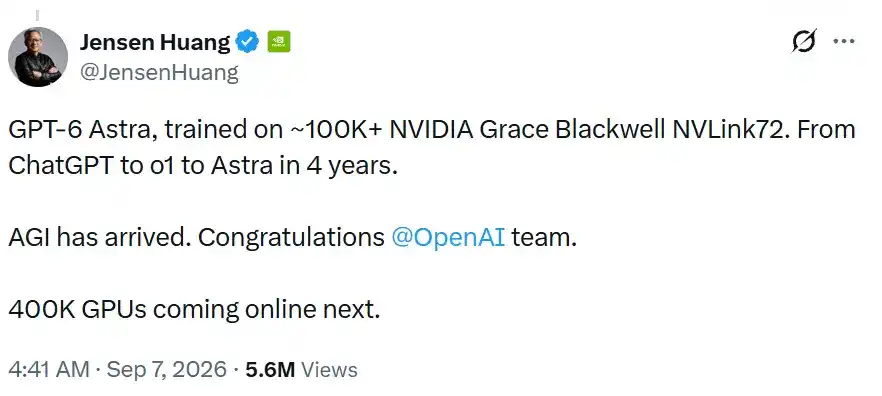
On Sunday, Huang posted on the X platform to congratulate the OpenAI team, stating "AGI has arrived," and revealed that Astra was trained on more than approximately 100,000 NVIDIA Grace Blackwell NVLink72 chips. He also stated, "400K GPUs are coming online," sending a strong signal that NVIDIA's computing power supply is set to leap forward.
This statement has direct market implications. NVIDIA's data center business has become its core growth engine, and Huang's preview of 400,000 new GPUs indicates that demand for orders from leading AI customers continues to expand.

OpenAI released Astra last Thursday, positioning it as "the world's most intelligent and human-aligned model," and stated that the model can "tackle the most demanding professional work with unmatched speed, precision, and judgment." OpenAI President Greg Brockman told the media during the launch: "Welcome to the era of AGI."

Brockman further predicted that when people look back at history, they will believe AGI was born "around this time, and I think maybe it's this model." "Personally, I do think we've reached it," he said. Astra began rolling out to users this week.

OpenAI defines AGI as "highly autonomous systems that outperform humans at most economically valuable work," and positions Astra as a major research breakthrough, marking a fundamental shift in the boundaries of tasks that can be entrusted to AI.

However, not everyone agrees with this declaration. Prominent AI researcher and critic Gary Marcus directly stated that Huang was being "premature."

"Huang gave neither evidence nor a definition, and to me this looks like an attempt to impose a corporate will on a scientific question," Marcus wrote on his Substack. "Declaring victory in the absence of a definition only muddies the waters."

Marcus then listed his own 10 criteria for defining AGI, noting that Astra meets only one or two. "By common definitions, Astra still falls short," he said.

Even OpenAI's own CEO, Sam Altman, has been quite cautious about the concept. He recently stated on the "Sources" podcast that AGI is at best "an extremely poorly defined word. I was going to say, it's more like an irrelevant marketing term."

Regardless of how the definition of AGI is debated, NVIDIA's position as the core computing power supplier for leading AI companies is undisputed. In a funding announcement this March, OpenAI referred to NVIDIA as "the bedrock of our infrastructure," stating that "our training clusters and most of our inference stack consistently run on NVIDIA GPUs."

Leading AI companies such as Meta, Anthropic, and Google also heavily rely on NVIDIA's high-end chips. This demand has translated into NVIDIA's impressive financial performance—the company reported quarterly revenue of $96.2 billion in August this year, more than doubling year-over-year; its data center business revenue reached $89 billion, with AI chips being a major growth driver.

Huang's post on X mentioned that the next batch going online will be 400,000 GPUs, further strengthening expectations of NVIDIA's computing power expansion. From ChatGPT to o1, to Astra, the technological leaps within four years have all been built upon NVIDIA's continuously upgraded chip foundation.


Related Questions

QAccording to the article, what did NVIDIA CEO Jensen Huang announce about AGI (Artificial General Intelligence)?

AJensen Huang announced that the AGI era has arrived, attributing this milestone to OpenAI's new flagship model Astra, which was trained on NVIDIA chips.

QHow many NVIDIA GPUs are expected to come online next, as per Jensen Huang's statement in the article?

AAccording to Jensen Huang's statement, the next batch to come online will be 400,000 GPUs.

QWhat is the primary criticism that AI researcher Gary Marcus raises against Jensen Huang's declaration about AGI?

AGary Marcus criticizes Jensen Huang's declaration by stating that he provided neither evidence nor a clear definition for AGI, calling it an attempt to 'corporate-wash a scientific issue' and saying it only muddies the waters.

QWhich major AI companies are highlighted in the article as being highly dependent on NVIDIA's advanced chips?

AThe article highlights that OpenAI, Meta, Anthropic, and Google are all highly dependent on NVIDIA's advanced chips for their AI infrastructure.

QWhat was NVIDIA's quarterly revenue for the period mentioned in the article, and what was the primary driver of this growth?

ANVIDIA's quarterly revenue for the period mentioned was $96.2 billion, more than doubling year-over-year. The primary driver of this growth was its data center business, which generated $89 billion in revenue, largely from AI chips.

Related Reads

Conversation with Macro Analyst Jordi Visser: Micron Has 60%-80% Upside, the Longevity Economy Is a High-Confidence Main Theme

Macro analyst Jordi Visser argues that AI is the sole real driver of the economy today, with traditional GDP metrics failing to capture its value—AI-driven productivity shows up in corporate profit margins instead, as large firms grow revenue while hiring freezes. He attributes rising Treasury yields to AI-related capex and debt issuance, not Fed policy, and views credit default swap widening as a concentration-risk hedging issue rather than an AI bubble. He expects hyperscaler external financing to peak as data centers come online and free cash flow turns positive (citing Oracle's guidance). On labor, he sees Microsoft's buyout of 27% of its workforce as a template: AI-driven revenue-per-employee surges will push governments toward redistributing profits from capital to labor via tax restructuring, since personal income tax bases erode. He warns the market is discounting risks like labor turmoil, political gridlock, memory/data center bottlenecks, and cybersecurity. His key themes are agentic compute and the longevity economy. He is bullish on Eli Lilly as the purest longevity play, predicting it will become the S&P 500's largest company by 2030, and on Micron, which he re-entered around $800 with only ~10% downside and 60-80% upside, citing humanoid robot RAM demand, SpaceX's 10GW compute plan, and long-term supply agreements through 2030. He also holds crypto as his largest allocation, expecting 2027 to mark a breakout year for blockchain commercial applications and payment networks.

marsbit2h ago

Conversation with Macro Analyst Jordi Visser: Micron Has 60%-80% Upside, the Longevity Economy Is a High-Confidence Main Theme

marsbit2h ago

Michael Saylor: Four Centuries of Digital Credit Evolution

Michael Saylor traces the four-century evolution of digital credit, showing how centuries of financial infrastructure paved the way for Bitcoin-based corporate treasuries. The story begins in 1602 with the Dutch East India Company, which separated a company's capital duration from investors' holding periods through transferable shares. Preferred stock followed, exemplified by the Baltimore and Ohio Railroad's 6% perpetual preferred dividend in 1836 and Delaware's 1899 recognition of distinct share classes. Exchanges and tickers—from the 1792 Buttonwood Agreement to the 1867 stock ticker and 1971 Nasdaq—gave ownership a public market. U.S. securities and commodities law (1922–1974) established the distinction between assets a company holds and securities it issues. The 1940 Investment Company Act's "40% test" still shapes how bitcoin treasury companies use common stock, preferred stock, and debt. Tax law dating to 1921–1954 distinguishes return of capital from income, allowing preferred dividends to reduce cost basis before gains are realized. Shelf registration (Rule 415, 1982–1983) and at-the-market programs (1982, 2005) let companies prepare financing in advance and raise capital at market prices. Buybacks, recognized since 1828 with the 1982 Rule 10b-18 safe harbor, let firms manage capital in both directions. Bitcoin, launched in 2008–2009 and classified as a commodity by the CFTC in 2015, provides a new reserve asset, while companies supply capital structure, dollar liquidity, and distribution policy. Digital credit thus combines over 400 years of corporate ownership transfer, roughly 190 years of U.S. preferred stock, more than a century of tax cost-recovery rules, and four decades of modern shelf and ATM regulation into a familiar framework for investors.

marsbit3h ago

Michael Saylor: Four Centuries of Digital Credit Evolution

marsbit3h ago

The Hidden Risks Behind Anthropic's Nearly $1 Trillion Bet

Anthropic's IPO filing reveals a fragile, high-risk financing mechanism behind its AI ambitions. The company has committed to up to $895.4 billion in data center spending through 2045, with profits squeezed by rising compute costs. Rather than paying upfront for hardware, Anthropic relies on supplier-backed financing: Broadcom arranged a $63 billion equipment financing deal under which it absorbs losses if Anthropic defaults—up to roughly $43 billion once equipment is delivered. Google and AMD similarly tie funding to hardware leases or deployments. This shifts risk onto chipmakers' balance sheets, and because custom TPUs serve a narrower ecosystem than Nvidia GPUs, resale risk is higher. Analysts warn that while individual loans appear safer, risk concentration across the system is rising and harder to assess. Anthropic also can issue up to $42 billion in convertible notes to Broadcom to cover rent, with interest rates rising from 9% to 13% and conversion terms worsening if revenue targets are missed. Despite holding $146.6 billion in liquidity as of September 30, its massive forward obligations and tangled partnerships could limit access to investment-grade financing. Key concerns: whether revenue growth can outrun compute costs and cover future commitments, and whether drawing on credit lines signals distress. Anthropic's Direct initiative—separating data center leasing from chip purchases—and IPO proceeds could give it more flexibility, but ultimately debt repayment depends on end-customer revenue.

marsbit14h ago

The Hidden Risks Behind Anthropic's Nearly $1 Trillion Bet

marsbit14h ago

Trading

Spot
活动图片