Is the Fastest and Deepest Tech Stock Sell-off in History Nearing Its End?

marsbitPublished on 2026-07-19Last updated on 2026-07-19

Abstract

The article discusses whether the historically rapid and severe sell-off in tech momentum stocks is nearing its end. Citing analysis from Goldman Sachs and Morgan Stanley, it notes that the TMT momentum factor has plunged 40% from its peak in just 17 trading days, marking the fastest and deepest such decline on record. Key experts, including Goldman's Mark Wilson, attribute the crash primarily to extreme crowding, high leverage, and structural factors rather than a fundamental deterioration in the economy or corporate earnings. They point to strong underlying data, such as robust bank lending and raised guidance from companies like TSMC, which contrast sharply with the market's price action. While Wilson suggests the momentum unwinding process is likely "approaching its end," he cautions that immediate catalysts for a sharp reversal are lacking. The report highlights extreme internal market stress, with single-stock volatility far exceeding index volatility, and warns that despite the sell-off, positioning in momentum factors remains elevated. It concludes that the core market矛盾 (contradiction) lies in this disconnect between solid fundamentals and violent price corrections driven by positioning and leverage.

Source: Wall Street Insights

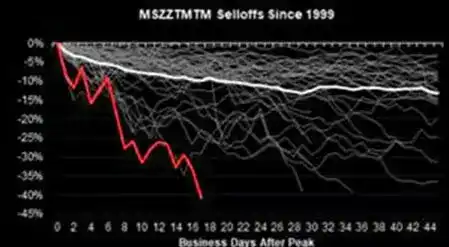
Tech momentum trading is experiencing its most severe unwinding in history. In just 17 trading days, the U.S. stock technology momentum factor (TMT MoMo) has plunged 40% from its peak, setting a record for the fastest and deepest drawdown on record, with contagion spreading comprehensively from semiconductors to hedge funds and credit markets.

Mark Wilson, partner and head of EMEA hedge fund business at Goldman Sachs, provided a systematic review of this "brutal rotation" this week. He noted that this sell-off is historically rare in both speed and depth, but its root cause stems more from non-fundamental factors such as crowded positioning and concentrated leverage, rather than a substantial deterioration in the economy or corporate earnings. He stated that the unwinding process for the momentum factor is "nearing its end," but lacks an immediate catalyst for reversal in the short term.

It is noteworthy that this momentum breakdown occurred against a backdrop of overall robust macro and corporate fundamentals—U.S. banks reported a 17% year-on-year increase in corporate lending, TSMC raised its 2026 revenue growth guidance to over 40%, and inflation data also came in moderately below expectations. This divergence between fundamentals and market price action is the core contradiction in the current market.

Tech Momentum Factor Suffers Historic Sell-off, Drawdown Speed and Depth Exceed Historical Median

According to data from Morgan Stanley's Quantitative and Derivatives Strategy team (MS QDS), this momentum factor drawdown has lasted 17 trading days, with a peak-to-trough decline of 28%. In comparison, the median momentum factor drawdown since 1999 has been 22%, lasting an average of 33 trading days.

This means the current decline has exceeded the historical median in both speed and depth, marking the most severe episode since the 29% drawdown from December 2022 to February 2023.

The situation is even more extreme in the tech sector. The TMT momentum factor (TMT MoMo) has fallen 40% from its peak. According to MS QDS data, this represents the fastest and deepest sell-off ever for the tech momentum factor.

Looking across various subsectors, South Korea's Kospi index is down 27% from its peak, U.S. AI tech beneficiaries are down 25%, global memory chip stocks are down 36%, and European semiconductors are down 23%. Among these, memory chip stocks account for about two-thirds of the overall decline, while the broader AI beneficiaries are down about 24% from their highs.
Low Surface Volatility Masks High Internal Intensity, Market Risk Structure is Unraveling

Price declines are only the surface manifestation of this turmoil; changes in the market's internal risk structure are equally noteworthy.

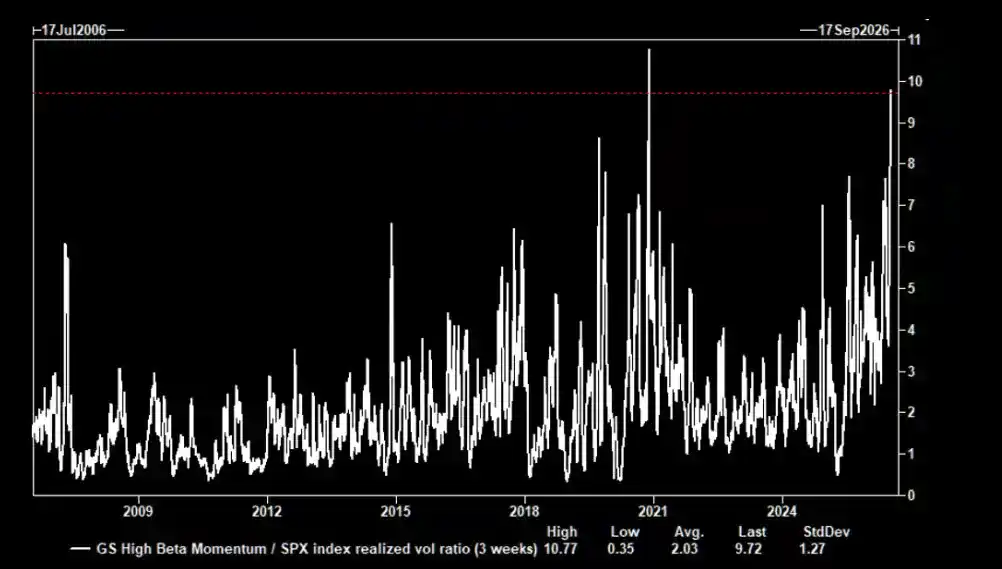
According to Goldman Sachs' volatility trading desk data, the current volatility of Goldman Sachs' High Beta Momentum portfolio (GSPRHIMO) is approximately 10 times that of the S&P 500's volatility. In the historical backtest over the past 20 years, such a stark volatility ratio has only been comparable to the situation during the pandemic shock in November 2020.
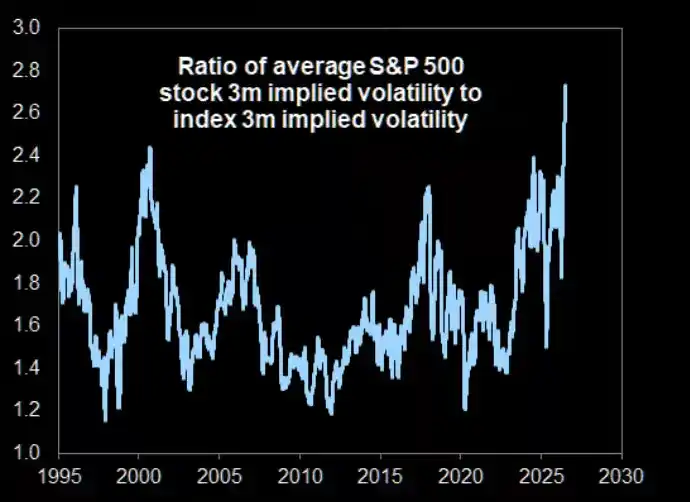
Simultaneously, the gap between single-stock volatility and index volatility has widened to historical extremes. Goldman Sachs data shows that the three-month average implied correlation among S&P 500 constituents fell to a record low of 0.14 this week, causing the S&P 500 index volatility to remain low, while the average implied volatility for single stocks is as high as 40%, 2.8 times that of the index's implied volatility, also setting a historical record.
Positions Remain Crowded, Risks Not Yet Cleared

Despite the recent historic drawdown in the momentum factor, hedge funds' net exposure to it remains high from a long-term perspective. J.P. Morgan data indicates that the combination of current positioning levels and the magnitude of the drawdown continues to make the momentum factor one of the core risks most deserving of caution in the market.

Meanwhile, the Goldman Sachs High Beta Momentum factor has fallen 33% since its June high, with its year-to-date gain plummeting from 60% to just 12%, a development also noted by Mark Wilson.

He cited signs of deleveraging in the Korean market as evidence: reports indicate that approximately one in every 30 South Korean adults had their stock margin accounts forcibly liquidated this week, showing that the deleveraging process has unfolded to a considerable extent.

Fundamentals Remain Sound, Risks Lie in Positioning and Structure

The peculiar aspect of this momentum breakdown is that it occurred against a backdrop of generally positive corporate fundamentals and macroeconomic data.

Mark Wilson pointed out that U.S. bank earnings this week presented an "unmistakably positive reading" of economic conditions: corporate lending grew 17% year-on-year, a record high, covering all economic sectors; U.S. consumer spending tracker growth is in the mid-single digits, with credit card spending up 6%; investment banking-related business lines collectively grew over 40%; large banks' tangible common equity return reached 19%, a post-financial crisis high.

On the tech capital expenditure front, TSMC raised its 2026 revenue growth guidance to over 40% (based on a revenue base exceeding $150 billion), while ASML's earnings report sparked market expectations for a 15% to 30% upward revision in its EPS over the next one to three years.

However, both companies' share prices fell following their earnings announcements, displaying a classic "sell the news" pattern. In contrast, IBM's stock price suffered its largest single-day drop in over 20 years due to large contract delays and underperformance in its consulting business.

Mark Wilson emphasized that this sell-off is "difficult to pinpoint to a clear signal at the fundamental level," reflecting more the influence of structural factors such as positioning, leverage, crowding, and concentration.

Rotation Nearing End, But Reversal Catalyst Still Awaited

Mark Wilson stated that he is inclined to believe the unwinding process for the momentum factor is nearing its end, but he also noted that there is a lack of immediate summer catalysts to drive a market reversal in the short term.

He also suggested that as efficiency and commercial viability improve, new market leadership will gradually emerge, and market breadth will expand accordingly—the Dow Jones Transportation Average breaking to new highs again this week serves as one example.

However, he also warned that the second derivative of earnings growth (i.e., the slowdown in the growth rate) will become increasingly important as the market digests Q2 earnings and enters the summer, while current valuation metrics across the board indicate that tech sector valuations remain elevated.

Furthermore, abnormal breakdowns in correlations are occurring both between traditional asset classes and within them; for example, the three-month correlation between gold and crude oil has fallen to an extreme inverse level in its 35-year history, further increasing the difficulty of risk management and portfolio construction.


Related Questions

QWhat is the historical context of the current tech momentum factor sell-off in terms of speed and depth?

AAccording to the article, the current tech momentum factor (TMT MoMo) sell-off is the fastest and deepest on record, having fallen 40% from its peak in just 17 trading days. Historically, momentum factor drawdowns have a median decline of 22% over an average of 33 trading days.

QAccording to Mark Wilson of Goldman Sachs, what is the primary cause of this momentum factor sell-off?

AMark Wilson of Goldman Sachs attributes the sell-off primarily to structural factors like crowded positioning, concentrated leverage, and high congestion, rather than a deterioration in economic or corporate earnings fundamentals.

QDespite the market sell-off, what positive signals are mentioned regarding the underlying economic and corporate fundamentals?

AThe article highlights robust fundamentals: U.S. bank corporate loan growth at 17%, TSMC raising its 2026 revenue growth guidance to over 40%, and inflation data coming in softer than expected. Bank earnings also showed strong consumer spending and high returns on tangible equity.

QWhat does the data say about the current volatility and risk structure within the market during this event?

AThe volatility of Goldman Sachs's high-beta momentum basket is about 10 times that of the S&P 500, a disparity only seen during the November 2020 pandemic shock. Additionally, the correlation among S&P 500 stocks is at a record low, causing single-stock implied volatility to be 2.8 times higher than index volatility.

QWhat is Mark Wilson's outlook on the momentum factor sell-off and the potential for a market reversal?

AMark Wilson believes the momentum factor unwinding process is 'nearing its end.' However, he notes a lack of immediate catalysts for a sharp reversal in the near term (summer), and warns that valuations remain elevated and that the second derivative of earnings growth (a slowdown in growth acceleration) will become more important.

Related Reads

Strategy stock sheds 5% amid MSCI index removal, Bitcoin sell-off

Strategy (Michael Saylor's Bitcoin treasury company) fell 6.49% on Thursday to close at $114.41, after MSCI confirmed the company's removal from its global equity indexes, compounded by a broader crypto market sell-off. The removal takes effect after the Nov. 30 market close and could trigger selling by index-tracking funds; JPMorgan previously estimated roughly $2.8 billion in potential selling pressure. Ryan Kirkley, CEO of Global Settlement Network, said the decision could distinguish Bitcoin treasury companies from traditional operating businesses and limit indirect crypto exposure for passive investors, noting that index inclusion had given ordinary passive investors leveraged Bitcoin exposure they never chose. He added it raises questions about whether such companies should be classified alongside traditional operating businesses, arguing that buying and holding an asset isn't an operating business but rather a fund that doesn't follow fund rules. In its Aug. 31 response to MSCI's proposed rules, Strategy called the changes a pretext for targeting digital asset treasury companies and downplayed the impact, saying MSCI-linked funds held about 13 million of its shares, just 3.1% of basic shares outstanding. The decline coincided with a broader crypto sell-off, with Bitcoin near $71,340, down 4.3% in 24 hours, and total crypto market capitalization down 3% to about $2.49 trillion.

cointelegraph1h ago

Strategy stock sheds 5% amid MSCI index removal, Bitcoin sell-off

cointelegraph1h ago

US Justice Department, business groups and DeFi firms challenge Illinois crypto tax

The US Department of Justice, business and financial industry groups, and a coalition of DeFi firms have backed a legal challenge to Illinois' 0.2% digital asset tax, arguing it unfairly targets crypto transactions and could impose taxes even without profit. The Justice Department filed a statement of interest, while the US Chamber of Commerce and SIFMA submitted an amicus filing. A coalition including Andreessen Horowitz, Paradigm, Uniswap and Aave Labs also filed a brief. The law, enacted in June, taxes the value of digital assets exchanged, transferred or stored regardless of profit. The Digital Chamber sued Illinois officials in July, followed by a separate challenge from the Blockchain Association and Crypto Council for Innovation in August. Originally set for Jan. 1, 2027, the tax was delayed to July 1, 2027. Illinois projected $60 million in fiscal year 2027 revenue. SIFMA and the Chamber warned the tax would affect banks, broker-dealers, custodians and asset managers nationwide, exposing them to compliance costs and burdening customers—someone who loses money owes the same tax as someone who profits, and moving assets between accounts could trigger tax without a sale or gain. They argued it discriminates against digital assets and may violate federal internet tax protections and constitutional interstate commerce requirements. The DOJ said the tax undermines federal efforts to promote crypto innovation, citing the Strategic Bitcoin Reserve and GENIUS Act. The DeFi coalition warned the rules could impose obligations on software developers and blockchain participants lacking customer information or control over funds.

cointelegraph2h ago

US Justice Department, business groups and DeFi firms challenge Illinois crypto tax

cointelegraph2h ago

DTCC Plans Solana Expansion as Wallet Rules Limit Access

DTCC plans to connect its tokenization service to Solana in the second half of 2027, allowing certain securities held by its DTC subsidiary to be converted into digital tokens on the network. Analysts say the move could attract more traditional financial institutions to Solana, which is known for fast transactions and low fees and had about $4.94 billion in total value locked as of Nov. 12. However, the impact may be limited by US regulatory rules. Alex Lin of Reforge noted that Solana's experience handling memecoin trading served as a public stress test, giving the network credibility to handle retail-scale volume reliably. Still, under a December 2025 SEC no-action letter, DTC participants must register wallets to hold tokenized securities, and tokens can only be transferred between registered wallets. Lin said the near-term impact is overstated because the tokens remain in a walled garden, inaccessible to permissionless retail and DeFi liquidity until regulators allow these assets to function as true onchain collateral. DTCC launched its tokenization service on the Canton Network and its private Besu network on Oct. 28, with 20 DTC participants signed on, though it has not said whether any plan to use Solana. Kha Nguyen of Birdeye said Solana has already seen growing demand for tokenized stocks, with trading volume reaching around $4.9 billion in H1 2026 and over 1 million accounts holding tokenized stocks by late September. However, broader Solana activity has slowed, with transactions down nearly 40%, DEX volume down 34.4%, and fees down 39%, while tokenized RWA value rose almost 7% to $4.76 billion. Nguyen said DTCC's integration would need banks, brokers, and issuers to actively issue, trade, and settle on Solana, with enough liquidity for large trades. He stressed that assets must be active rather than idle—traded around the clock, used as collateral, and earning yield. Lin agreed that long-term impact depends on where assets are used for secondary trading and collateral activity, not where they are issued.

cointelegraph3h ago

DTCC Plans Solana Expansion as Wallet Rules Limit Access

cointelegraph3h ago

Trading

Spot
活动图片