Hunter Biden confirms LAPTOP token ‘not a rug pull,’ just trolling Trumps

cointelegraphPublished on 2026-10-08Last updated on 2026-10-08

Abstract

Hunter Biden, son of President Joe Biden, has released data confirming the LAPTOP memecoin, based on his infamous laptop, was not a "rug pull." Blockchain records show the 300 million tokens allocated to founders have remained locked since the coin's September 9 launch. Biden stated the price chart initially mirrored a typical celebrity rug pull, with two hired market makers profiting significantly—one making $686,000 and the other $2.18 million—by withdrawing liquidity seconds after the price peak. A report by consultancy Groom Lake corroborated the rapid withdrawal of selling liquidity. Biden explained his motivation was to troll "max extraction" projects like former President Donald Trump's TRUMP memecoin by being transparent, locking team tokens, and publishing disclosures. He also aimed to support charities. He added the project continued partly to provoke Trump's sons and critics. The LAPTOP token references the laptop that became a contentious issue in the 2020 election. Biden has criticized the Trump family's crypto ventures as corrupt. Amid this, President Trump plans a dinner for top TRUMP tokenholders on November 22. An advocacy group estimates TRUMP investors have lost $3.2 billion since its 2025 launch.

Hunter Biden, son of former US President Joe Biden, released a full accounting of the memecoin he helped launch last month based on the reports of his infamous laptop.

In a series of X posts on Wednesday, Biden provided blockchain data confirming that 300 million tokens in wallets associated with the founders of the $LAPTOP memecoin “haven’t moved since launch.”

Biden added that charts tracking the price of the memecoin “looked like every celebrity rug ever” shortly after launch on Sept. 9, and the ones to benefit most were unnamed market makers — referred to as “two professional trading firms” hired by the project — that pulled their funds seconds after the peak price of about $317.

According to Biden’s posts, one market maker made $686,000 from liquidity positions on decentralized exchanges, while the other “took in about $2.18 million more than it spent“ through trading.

Similar data was published in a “launch report” prepared by Delaware-based intelligence consultancy Groom Lake and posted on the memecoin’s website.

“The money for sellers was pulled right after the peak,” said the report on $LAPTOP. “Eighty-four seconds after the price topped out, Market Maker 1 withdrew its money. The cash available to people trying to sell near the current price dropped from $16,157 to zero.”

Biden added:

“Here’s why I did this. Trump’s coin was max extraction, and I wanted to troll every grift like it. So we were transparent, committed the team to a lock up and published a MiCA disclosure. And I hoped it could help some charities I care about too.”
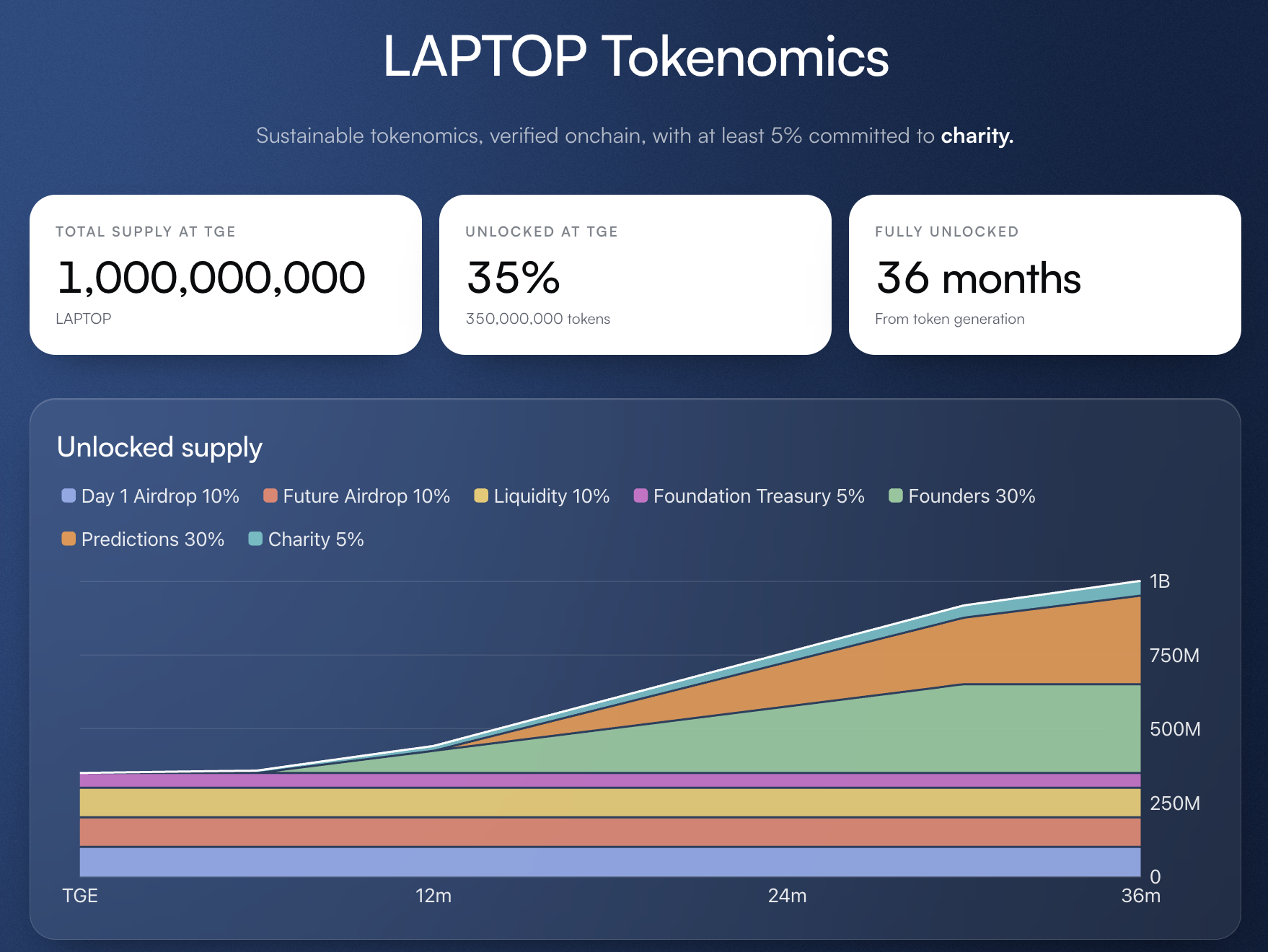
Data on Hunter Biden memecoin. Source: laptoptoken.com

While Biden said he intended to commit 5% of the tokens for charity, he added that he was incentivized to continue the project “just to piss off Don and Eric,” referring to Donald Trump Jr. and Eric Trump, sons of US President Donald Trump, and “every [Key Opinion Leader] who called it a scam because we refused to pay them.”

The basis for the memecoin’s namesake is Biden’s laptop computer, whose existence and contents were subject to intense media scrutiny ahead of the 2020 US Presidential election, in which Trump was running against his father. The laptop continues to be invoked by many right-wing figures and was the subject of two lawsuits filed by Biden over privacy laws.

Related: Hunter Biden’s laptop controversy gets a memecoin afterlife

Biden has been a vocal critic of the Trump family crypto company World Liberty Financial, calling it “corruption at a scale we’ve never seen” in August. The president also faces criticism for launching his memecoin, Official Trump (TRUMP) shortly before taking office in January 2025, which faces its own rug pull and corruption accusations.

According to Biden, the $LAPTOP founder memecoins will remain locked for six months after launch and the team will continue burning unclaimed tokens from airdrops.

President to host another memecoin event amid controversy

Biden’s token, whether launched to hold up a mirror for rug pull projects, a joke, or trolling the Trump family, could shine a spotlight on the president’s crypto ventures as he prepares to speak at another event for his memecoin holders.

Last week, the group behind the $TRUMP memecoin announced that the president will appear at his gold club in Washington, DC alongside three unnamed speakers and the top 185 tokenholders for a Nov. 22 dinner.

The nonprofit consumer advocacy organization Public Citizen estimated that $TRUMP memecoin investors lost $3.2 billion since its 2025 launch.

Magazine: Capital starting to rotate back to crypto from AI: Raoul Pal

Related Questions

QAccording to Hunter Biden, what was the main reason for launching the LAPTOP memecoin?

AHe stated that the main reason was to troll every 'grift' like Trump's coin, which he considered to be 'max extraction.' He also mentioned transparency, committing the team to a token lock-up, publishing a disclosure, and the hope of helping some charities he cares about.

QWhat did the launch report from Groom Lake indicate happened shortly after the $LAPTOP token's peak price?

AThe report indicated that the money for sellers was pulled right after the peak. Eighty-four seconds after the price topped out, a major market maker withdrew its money, causing the cash available for people trying to sell near the current price to drop from $16,157 to zero.

QHow does the article connect the launch of the LAPTOP memecoin to President Trump's crypto activities?

AThe article states that Hunter Biden is a vocal critic of the Trump family's crypto company, World Liberty Financial. It also mentions that President Trump launched his own memecoin, Official Trump (TRUMP), which faces its own rug pull and corruption accusations. Biden's coin is framed partly as a response to or trolling of Trump's crypto ventures.

QWhat upcoming event related to the $TRUMP memecoin is mentioned in the article?

AThe article mentions that the group behind the $TRUMP memecoin announced that President Trump will appear at his gold club in Washington, DC, alongside three unnamed speakers and the top 185 tokenholders for a dinner on November 22.

QWhat did Hunter Biden confirm about the 300 million tokens associated with the $LAPTOP founders' wallets?

AHe provided blockchain data confirming that 300 million tokens in wallets associated with the $LAPTOP founders 'haven’t moved since launch,' which he presented as evidence that the project is not a 'rug pull.'

Related Reads

Crypto Stocks Weekly丨Strategy Adds 1,036 BTC but Holdings Fall Below Cost Basis; Bitmine Holds 4.97% of ETH Supply (November 10)

The article begins by noting that Democrats swept both chambers of Congress, ushering in a divided-government phase, after which markets shifted focus to AI regulation and capex payback cycles, with Anthropic's IPO seen as a bellwether for AI stocks. US equities fell sharply (Nasdaq -5.52% and Philadelphia Semiconductor Index -12.24% on Nov 5) before a Monday rebound driven by falling oil prices and oversold buying—characterized as a repair, not a new high. Macro data showed October nonfarm payrolls +165k and unemployment at 4.1%, keeping 10-year Treasury yields near 4.86% and rate-hike expectations alive. Citi cut US equities and global tech to neutral while upgrading Europe ex-UK, citing unstable AI sentiment; Goldman noted AI stocks are ~40% of the S&P 500 versus ~15% of STOXX 600. Crypto diverged from the equity rebound: US spot Bitcoin ETFs saw $1.282B in weekly net outflows (BlackRock's IBIT -$12.09B... actually $1.209B), Ethereum ETFs -$365M for a sixth straight weekly outflow, with continued outflows on Nov 9. NYSE-affiliated tokenized securities platform chose Avalanche for settlement infrastructure. Corporate treasury updates: Strategy bought 1,036 BTC at ~$79,012 (total 850,364 BTC, average cost ~$75,456, now above spot), funded partly by ATM share sales, with most proceeds used to repurchase STRC preferred shares. Strive added 29 BTC (total 43,153). Listed companies now hold over 6% of Bitcoin's supply (1.2664M BTC across 199 firms). Bitmine added 9,587 ETH, holding 6,070,092 ETH (~4.97% of supply, ~99% of its 5% goal). DeFi Development Corp's SOL rose to 2,609,829. Hyperliquid Strategies raised $911M in Q3, bought ~9.1M HYPE (holdings up to 38.5M, ~16% of circulating supply), and repurchased ~2.7M PURR shares.

marsbit21m ago

Crypto Stocks Weekly丨Strategy Adds 1,036 BTC but Holdings Fall Below Cost Basis; Bitmine Holds 4.97% of ETH Supply (November 10)

marsbit21m ago

When Will the Chip Stock 'Capitulation-Style Selling' End? BofA: Perhaps in Early 2027, Stock Price Pullbacks Typically Lead Fundamental Inflection Points by 6-9 Months

The SOX semiconductor index has fallen 38% (from 14,634 to 9,011) since its June 22, 2026 peak, over 136 days—exceeding the average historical peak-to-trough decline of 32% but less than half the average 253-day duration of past downturns (2011, 2015, 2018, 2022). BofA analyst Vivek Arya expects this "indiscriminate selling," driven by AI capex slowdown fears, to end around early 2027. Historically, SOX declines lead actual semiconductor sales declines by 6–9 months, implying real EPS cuts may emerge from Q1 2027, with capex reductions reflected in H2 2027—though stocks may already price in much of the bad news. SOX currently trades at 13.7x forward P/E versus 17.7x for the S&P 500 (a 22% discount, down from a 15% premium at the AI peak), leaving roughly 12% downside to the historical trough valuation of ~12x. US cloud capex runs at ~$300B/quarter (~$1.2T annualized) versus $1.555T consensus for 2027—about 23% below expectations if spending holds steady, equating to ~30 GW of compute deployment versus BofA's 40+ GW base case. A 20% capex cut would pressure AI semiconductor revenue by 20%+ and EPS by 35–40%. BofA outlines three scenarios: base case ( ~10% downside, bottoming Q1 2027, favor segment leaders), bear case (pressure into mid-2027, favor EDA, high-FCF analog, low-AI-exposure names), and bull case (favor memory, optics, quantum, CPUs). Potential stabilizers include policy clarity in Q1 2027, buybacks (Lam $25B, Nvidia, Micron starting Dec 9), and slower capex extending the upcycle.

marsbit40m ago

When Will the Chip Stock 'Capitulation-Style Selling' End? BofA: Perhaps in Early 2027, Stock Price Pullbacks Typically Lead Fundamental Inflection Points by 6-9 Months

marsbit40m ago

TSMC: October Revenue Up 60%, with Month-over-Month Growth Still Accelerating

TSMC reported October consolidated revenue of NT$586.89 billion, up 59.7% year-over-year and 14.7% month-over-month, signaling accelerating momentum. Converted to RMB, that is about RMB 119.4 billion, with cumulative revenue for the first ten months reaching NT$4.49 trillion, up 43.3% year-over-year. The near-60% growth came on top of an already high base, while the sequential acceleration confirms strengthening demand rather than a slowdown. The report arrived at a delicate moment. The Philadelphia Semiconductor Index had plunged 12.25% over two sessions, its worst single-day drop since March 2020, as political changes in the U.S. prompted new governors in Texas and Ohio to pause approvals for new data center projects. Markets pessimistically priced in a halt across the AI data center supply chain. Sentiment rebounded sharply on November 9, with the semiconductor index jumping 6.86%, and Taiwan's weighted index surging 1,960.06 points, its second-largest single-day gain on record, supported by government stabilization funds and short-selling restrictions. TSMC stands apart from other AI assets. As the only foundry capable of mass-producing 3nm and 2nm chips, it holds about 90% of the global AI chip foundry market, with advanced-node capacity booked through 2028. Its diversified revenue mix—68% high-performance computing, 21% smartphones, 4% automotive and 4% IoT—provides a buffer, allowing it to reallocate capacity to flagship phone chips, automotive computing, and edge AI if data center approvals slow. October's results validate management's guidance of roughly 44% full-year dollar revenue growth and capital spending of US$60-64 billion. Expansion continues, with 2nm ramping and Arizona's second fab moved up to Q3 2027; Goldman Sachs raised its 12-month target price to NT$3,300. Google's expanded eighth-generation TPU lineup adds further demand, with TSMC and other Taiwanese suppliers in the ecosystem. TSMC's ADR trades at about 24x trailing earnings, low relative to its growth. Risks include a prolonged U.S. data center approval freeze and geopolitical or oil-price shocks. In A-shares, domestic substitution names such as SMIC and NAURA remain driven by rising localization rather than Texas approvals.

marsbit41m ago

TSMC: October Revenue Up 60%, with Month-over-Month Growth Still Accelerating

marsbit41m ago

Trading

Spot
活动图片