From 'Interest Rate Trading' to 'Dollar Debasement Trade', the Logic Behind Gold's Rise Has Changed

marsbitPublished on 2026-08-28Last updated on 2026-08-28

Abstract

From "Rate Trade" to "Debasement Trade": The Logic Behind Gold's Rally Has Shifted Gold surged by 17% in August. According to UBS, the key development was a fundamental shift in the driving narrative mid-rally—from the traditional "rate trade" to a "debasement trade" focused on fiscal and dollar concerns. The bank breaks the summer rebound into two acts. The first was a technically-driven bounce from a solid base, supported by light positioning, resilient physical demand (especially from central banks like China's), and softening US economic data. The second act, triggered by the US Treasury's announcement to double long-term bond buybacks, marked a shift in gold's pricing logic. The market began viewing higher long-term yields as a sign of fiscal sustainability risks rather than economic strength, weakening gold's traditional inverse correlation with real rates. Gold's role evolved from an "opportunity cost" asset to a hedge against "fiscal credibility" and currency debasement, further aided by a weakening US dollar. UBS maintains a bullish outlook, noting rising upside risks to its long-term forecasts. While it lowered its 2026 year-end target to $4,675/oz, its 2027+ forecasts are unchanged, with an upside scenario target as high as $6,500/oz. The primary near-term risk is a hawkish Fed pivot, which could trigger a correction. However, UBS views any such dip as a buying opportunity, not a trend reversal, unless AI-driven growth allows for significantly higher rates. The...

Original author: Dong Jing

Original source: Wall Street News

Since the beginning of August, gold has staged a robust rebound of up to 17%. However, UBS believes that more important than the magnitude of the rise is the fundamental shift in the underlying logic driving this gold rally—the market is transitioning from the traditional 'interest rate trade' to the 'dollar debasement trade.'
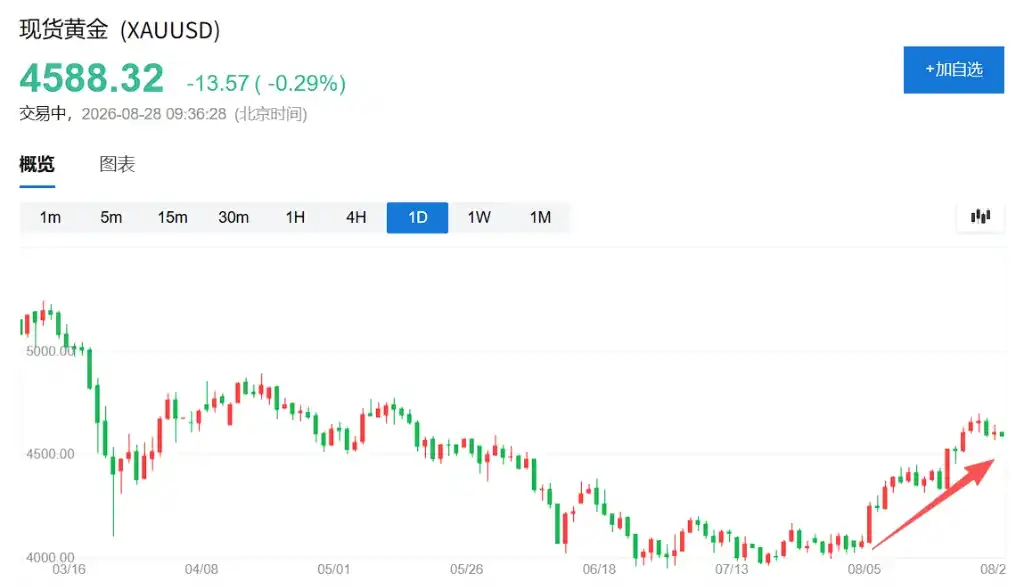
(Spot Gold Daily Chart)

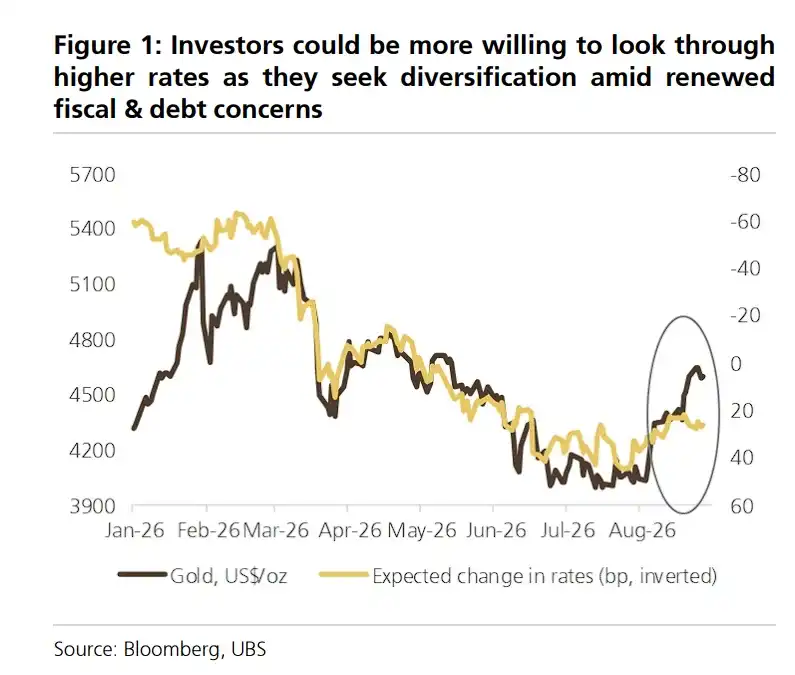
According to information from Wind Trading Desk, UBS's August 27 precious metals research report dissects this late-summer gold rebound into a "two-act play": Act One was a technically-driven rebound fueled by fundamental repair, catalyzed by extremely light positioning, resilient physical demand, central bank gold buying, and softening U.S. economic data. Act Two is a qualitatively different "currency debasement trade"—the U.S. Treasury's announcement to double its long-term bond repurchase program triggered deep-seated market concerns about fiscal sustainability, causing the traditional negative correlation between gold and interest rates to loosen.

The bank argues that gold's pricing logic has shifted from the "opportunity cost framework" (where higher real rates pressure gold) to a "fiscal credibility framework." Even if long-term real interest rates remain high, as long as the market perceives that high rates stem from fiscal risks rather than a strong economy, gold may continue to rise.
UBS maintains its bullish outlook on gold prices and explicitly states that upside risks to medium- to long-term forecasts are rising. UBS lowered its year-end 2026 gold price target from $5,000/oz to $4,675/oz (a 6.5% cut) but kept its 2027 and beyond forecasts unchanged, with an upside scenario target reaching as high as $6,500/oz. Notably, the bank identifies a hawkish Fed stance as the primary near-term downside risk. However, UBS clearly states that any pullback triggered by rising rate hike expectations should be viewed as a buying opportunity, not a trend reversal.

Act One: Fundamental Repair Forms a Bottom—Positioning, Demand, and Central Banks Provide Triple Support

The report states that before the August rally began, net positioning in the gold market was extremely light. Persistent inflation pressures fueled concerns that the Fed might restart rate hikes, leaving investors hesitant to buy aggressively but also lacking conviction to short, resulting in a wait-and-see stance. Despite a roughly 30% pullback from the year's highs, sentiment among medium- to long-term investors remained biased towards bullishness, with many waiting for better entry points.

UBS believes that gold's repeated failed attempts to breach the $4,000/oz level gradually rebuilt market confidence and established a solid bottom. This bottom formation was aided by stronger-than-expected demand resilience:

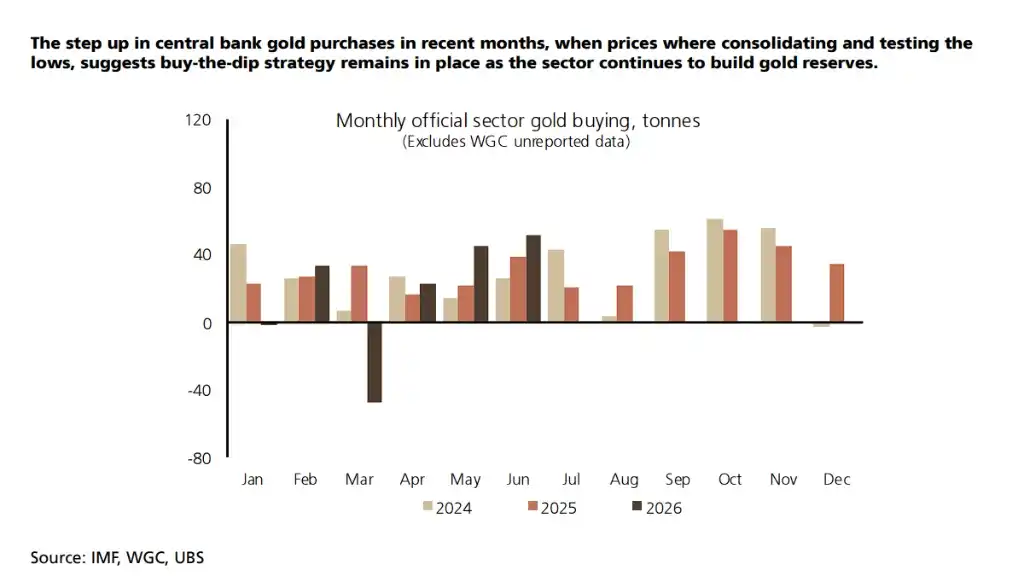
  • Official Sector Buying on Dips: More importantly, the official sector (i.e., central banks) accelerated purchases during price declines, providing substantive support for this bottom—the People's Bank of China's gold purchases increased as prices fell, showing a clear "buy the dip" strategy.
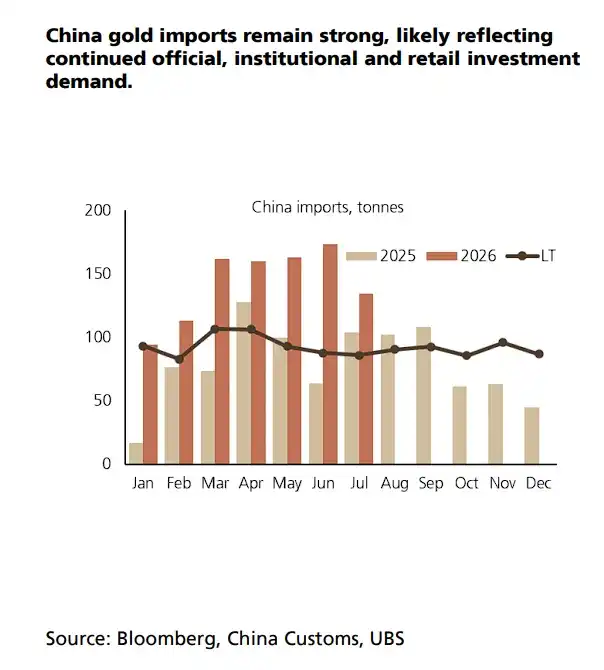
  • Robust Physical Demand: China's gold imports remained consistently above both last year's levels and historical averages, reflecting support from official, institutional, and retail investment demand. In India, imports were suppressed by regulatory hurdles, but seasonal demand patterns are emerging, with stronger fundamental support expected in the second half of the year and during festive seasons.
  • Soft U.S. Economic Data Provides Catalyst: Weak U.S. economic data released in early August prompted markets to scale back Fed rate hike expectations, becoming the direct trigger for gold's breakout. The initial move was driven by short covering, followed by new long entries. However, due to thin summer liquidity, market participants were generally cautious, and profit-taking was relatively swift.

Act Two: Narrative Shift—The "Currency Debasement Trade" Returns to Center Stage

The report points out that as gold prices stabilized and consolidated around $4,400/oz, the catalyst for the second leg higher emerged: the U.S. Treasury's announcement to double its long-term bond repurchase program.

While the scale of this measure itself is not large relative to the entire U.S. Treasury market, and its original purpose was merely liquidity management, the signal it sent far exceeded the operation itself—the market interpreted it as the Treasury's intent to actively intervene when long-end rates are under pressure, bringing discussions of fiscal sustainability and debt credibility back to the forefront.

Under the traditional framework, rising real interest rates mean a higher opportunity cost of holding gold, pressuring prices. But this time was different: the reason for rising rates changed. When the rise in long-end yields reflects fiscal risks and declining confidence in sovereign debt, rather than economic strength, investors become more willing to "look through" this opportunity cost and continue holding gold.

Concurrently, a weakening dollar provided an additional tailwind, further strengthening gold's role as a fiat currency alternative. Whether this logic is termed "de-dollarization," "de-fiatization," or "currency debasement hedging," its portfolio implication is consistent: gold can serve as a diversification tool, hard asset, and source of resilience under a broader range of macro scenarios.

Upside Risks Are Accumulating: What Scenarios Would Make UBS More Bullish?

UBS explicitly states it maintains its basic call for higher gold prices and acknowledges that upside risks to medium- to long-term forecasts have increased.

The clearest upside scenario is: Fiscal and debt issues become embedded in strategic asset allocation decisions, driving broader and more persistent increases in gold holdings, causing the rally to exceed baseline forecasts in both magnitude and duration. The following factors would reinforce this outcome:

  • Evidence of continued central bank gold buying;
  • Sustained resilience in Asian physical demand;
  • Further dollar weakness.

Other bullish scenarios include: persistently soft economic data, a surprisingly dovish pivot by the Fed, or a resurgence of market concerns about Fed independence.

Notably, current monetary and fiscal policy signals are diverging: The Fed remains focused on inflation control, while the Treasury has already acted to ease long-end pressure.

The market will closely parse Fed Chair Kevin Warsh's speech at Jackson Hole and subsequent statements from the Treasury. Due to the lack of forward guidance, every economic data release will have a greater impact on Fed policy expectations and gold price movements.

Biggest Near-Term Risk: A Hawkish Fed, But Pullbacks Are Opportunities

UBS clearly states that gold is not immune to a hawkish Fed. A rate hike this year, or signals from the Fed that significantly raise the probability of hikes, could trigger a sharp decline in gold prices by pushing real rates and the dollar higher. Thin summer liquidity and the rapid August gains could amplify the magnitude of such a correction.

However, UBS's judgment is: Such corrections should be viewed as buying opportunities, not the beginning of a sustained bear market.

A more critical downside risk lies in: If AI investments deliver far stronger-than-expected economic growth, the Fed would have ample room to hike rates significantly to suppress inflation. This scenario would have a more profound and lasting impact on gold.

In summary, the report states that when the market begins to view gold as a hedge against fiscal credibility risk and currency debasement, rather than merely an inflation hedge or interest rate trade, its strategic position in investment portfolios undergoes a qualitative change.

UBS research indicates that overall market allocation to gold remains low, and growth in assets under management creates room for further portfolio diversification. If fiscal and debt sustainability issues become a more enduring driver of strategic allocation, gold's upside potential could far exceed current baseline forecasts.


Related Questions

QAccording to the UBS report mentioned in the article, what are the two distinct phases ('acts') driving gold's strong rally in August?

AThe first phase is a technically-driven rebound based on fundamental repair, catalyzed by extremely light positioning, resilient physical demand, central bank purchases, and softening U.S. economic data. The second phase is a 'Monetary Debasement Trade' driven by market concerns over fiscal sustainability, sparked by the U.S. Treasury's announcement of doubling long-term bond buybacks.

QHow has the primary pricing logic for gold shifted according to UBS's analysis?

AThe primary pricing logic for gold has shifted from an 'opportunity cost framework' (where higher real rates pressure gold) to a 'fiscal credibility framework.' This means gold may continue to rise even if long-term real rates stay high, as long as the market views the high rates as stemming from fiscal risk rather than economic strength.

QWhat recent policy action triggered the market's shift toward a 'Monetary Debasement Trade' narrative for gold?

AThe U.S. Treasury's announcement that it would double the size of its long-term Treasury buyback operations triggered the shift. While operationally small, it signaled active intervention in the long end of the yield curve, leading markets to question fiscal sustainability and debt credibility.

QWhat does UBS identify as the key near-term downside risk for gold, and what is its recommended strategy if this risk materializes?

AA hawkish Federal Reserve stance is identified as the key near-term downside risk. If expectations for rate hikes cause a sharp gold price correction, UBS recommends viewing it as a buying opportunity to increase positions, not as the beginning of a sustained bear market.

QWhat scenario does UBS outline as the clearest 'upside scenario' that could push gold prices significantly above its base forecast?

AThe clearest upside scenario is if fiscal and debt sustainability concerns become embedded in strategic asset allocation decisions, leading to broader and more permanent increases in gold holdings. This would be reinforced by evidence of continued central bank buying, sustained Asian physical demand, and further U.S. dollar weakness.

Related Reads

Coinbase and PNC Bank Launch USDC Collection: Can Stablecoins Become the New Gateway for Enterprise Payments?

Coinbase and PNC Bank have expanded their partnership to launch a USDC collection service for enterprise and institutional clients. Eligible customers can receive USDC via the Ethereum network, which is then converted 1:1 into USD and deposited into their designated PNC bank account. The service uses Coinbase's Payment APIs integrated with PNC's existing treasury management systems, embedding the stablecoin collection process within the traditional banking framework. The collaboration highlights a complementary relationship between stablecoins and banks rather than pure competition. Banks provide client relationships, compliance, and deposit accounts, while blockchain offers round-the-clock value transfer. Coinbase supplies the stablecoin infrastructure and payment APIs, while PNC handles account and traditional financial services. For businesses, the appeal is gaining a new payment channel without overhauling their existing financial systems or managing wallets and private keys themselves. The partnership builds on earlier collaboration announced in July 2025, when the two firms began integrating crypto trading capabilities into PNC's services, followed by Bitcoin spot trading for eligible private banking clients in December. The USDC service extends the focus from wealth management into enterprise payments and treasury management. Coinbase has pursued similar integrations with Citigroup and payment technology firm Moov, signaling a strategic shift from a trading platform toward payment infrastructure. However, questions remain about fees, settlement times, compliance requirements, and actual adoption scale. The service is still in a pilot phase with limited eligibility, and full fee structures and processing times have not been disclosed. The key question is whether enterprises will adopt stablecoin collection in daily operations and whether the funds can be reliably converted, deposited, and used without adding excessive operational cost. The real competitive frontier may be integrating digital dollars into everyday corporate cash flows rather than simply accumulating on-chain assets.

marsbit8m ago

Coinbase and PNC Bank Launch USDC Collection: Can Stablecoins Become the New Gateway for Enterprise Payments?

marsbit8m ago

Crypto Stocks Weekly丨Strategy Adds 1,036 BTC but Holdings Fall Below Cost Basis; Bitmine Holds 4.97% of ETH Supply (November 10)

The article begins by noting that Democrats swept both chambers of Congress, ushering in a divided-government phase, after which markets shifted focus to AI regulation and capex payback cycles, with Anthropic's IPO seen as a bellwether for AI stocks. US equities fell sharply (Nasdaq -5.52% and Philadelphia Semiconductor Index -12.24% on Nov 5) before a Monday rebound driven by falling oil prices and oversold buying—characterized as a repair, not a new high. Macro data showed October nonfarm payrolls +165k and unemployment at 4.1%, keeping 10-year Treasury yields near 4.86% and rate-hike expectations alive. Citi cut US equities and global tech to neutral while upgrading Europe ex-UK, citing unstable AI sentiment; Goldman noted AI stocks are ~40% of the S&P 500 versus ~15% of STOXX 600. Crypto diverged from the equity rebound: US spot Bitcoin ETFs saw $1.282B in weekly net outflows (BlackRock's IBIT -$12.09B... actually $1.209B), Ethereum ETFs -$365M for a sixth straight weekly outflow, with continued outflows on Nov 9. NYSE-affiliated tokenized securities platform chose Avalanche for settlement infrastructure. Corporate treasury updates: Strategy bought 1,036 BTC at ~$79,012 (total 850,364 BTC, average cost ~$75,456, now above spot), funded partly by ATM share sales, with most proceeds used to repurchase STRC preferred shares. Strive added 29 BTC (total 43,153). Listed companies now hold over 6% of Bitcoin's supply (1.2664M BTC across 199 firms). Bitmine added 9,587 ETH, holding 6,070,092 ETH (~4.97% of supply, ~99% of its 5% goal). DeFi Development Corp's SOL rose to 2,609,829. Hyperliquid Strategies raised $911M in Q3, bought ~9.1M HYPE (holdings up to 38.5M, ~16% of circulating supply), and repurchased ~2.7M PURR shares.

marsbit28m ago

Crypto Stocks Weekly丨Strategy Adds 1,036 BTC but Holdings Fall Below Cost Basis; Bitmine Holds 4.97% of ETH Supply (November 10)

marsbit28m ago

When Will the Chip Stock 'Capitulation-Style Selling' End? BofA: Perhaps in Early 2027, Stock Price Pullbacks Typically Lead Fundamental Inflection Points by 6-9 Months

The SOX semiconductor index has fallen 38% (from 14,634 to 9,011) since its June 22, 2026 peak, over 136 days—exceeding the average historical peak-to-trough decline of 32% but less than half the average 253-day duration of past downturns (2011, 2015, 2018, 2022). BofA analyst Vivek Arya expects this "indiscriminate selling," driven by AI capex slowdown fears, to end around early 2027. Historically, SOX declines lead actual semiconductor sales declines by 6–9 months, implying real EPS cuts may emerge from Q1 2027, with capex reductions reflected in H2 2027—though stocks may already price in much of the bad news. SOX currently trades at 13.7x forward P/E versus 17.7x for the S&P 500 (a 22% discount, down from a 15% premium at the AI peak), leaving roughly 12% downside to the historical trough valuation of ~12x. US cloud capex runs at ~$300B/quarter (~$1.2T annualized) versus $1.555T consensus for 2027—about 23% below expectations if spending holds steady, equating to ~30 GW of compute deployment versus BofA's 40+ GW base case. A 20% capex cut would pressure AI semiconductor revenue by 20%+ and EPS by 35–40%. BofA outlines three scenarios: base case ( ~10% downside, bottoming Q1 2027, favor segment leaders), bear case (pressure into mid-2027, favor EDA, high-FCF analog, low-AI-exposure names), and bull case (favor memory, optics, quantum, CPUs). Potential stabilizers include policy clarity in Q1 2027, buybacks (Lam $25B, Nvidia, Micron starting Dec 9), and slower capex extending the upcycle.

marsbit48m ago

When Will the Chip Stock 'Capitulation-Style Selling' End? BofA: Perhaps in Early 2027, Stock Price Pullbacks Typically Lead Fundamental Inflection Points by 6-9 Months

marsbit48m ago

Trading

Spot
活动图片