French Hill highlights CLARITY Act, with 15% probability of passage in 2026

cryptonews.ruPublished on 2026-09-03Last updated on 2026-09-03

Abstract

The CLARITY Act (H.R. 3633), a U.S. bill to establish federal crypto market rules, faces low odds of becoming law in 2026, according to prediction markets. While the House has passed it, the bill's progress in the Senate is uncertain. Prediction markets on Polymarket gave it just a 15% chance of full enactment by year-end, despite public support from lawmakers like Rep. French Hill. A key procedural vote (cloture) is scheduled for September 15th, requiring 60 Senate votes to advance; failure would likely doom its 2026 prospects. Traders see a higher probability (30-50%) of similar legislation passing by 2027 or 2028. The revised bill addresses SEC/CFTC jurisdiction, consumer protection, and oversight of crypto intermediaries.

Washington's efforts to establish national rules for cryptocurrency trading, custody, and market oversight are currently focused on the CLARITY Act. The bill, which passed the House of Representatives, allocates federal authority between the Securities and Exchange Commission (SEC) and the Commodity Futures Trading Commission (CFTC), and establishes requirements for exchanges, brokers, dealers, disclosure, and customer asset protection.

Traders on prediction markets remain skeptical that the Crypto Asset Market Structure Act will complete the legislative process this year. A Polymarket contract on the law taking effect in 2026 showed on September 2 that the probability of the CLARITY Act (H.R. 3633) being passed by both chambers and signed by the president by December 31 is 15%. Trading volume reached approximately $11.62 million.
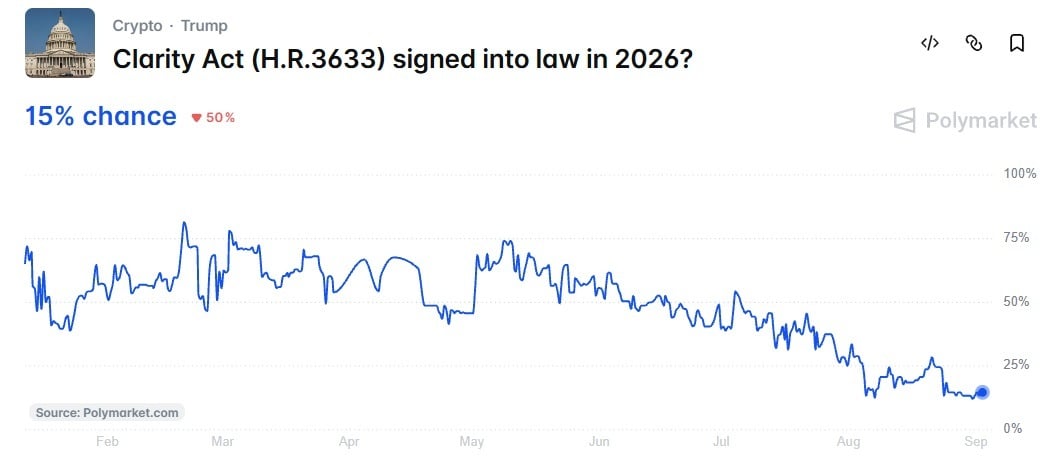
Polymarket traders estimated the probability of the CLARITY Act becoming law by December 31 at 15%. Source: Polymarket, September 2, 2026.

This low probability contrasted with House Financial Services Committee Chairman French Hill's renewed mention of the bill during September 2 hearings on growth, affordability, innovation, and capital access. In his prepared remarks, the Arkansas Republican listed the CLARITY Act's House passage among the committee's accomplishments and called for permanent, predictable financial rules.

Long-term Kalshi contracts showed higher probabilities, although they assess a broader range of possible outcomes and cannot be directly compared to the 2026 Polymarket contract. Kalshi estimated the probability that the CLARITY Act or another relevant crypto market structure bill becomes law by July 1, 2027 at 30%, and by January 1, 2028 at 50%. Trading volume was approximately $6.85 million.
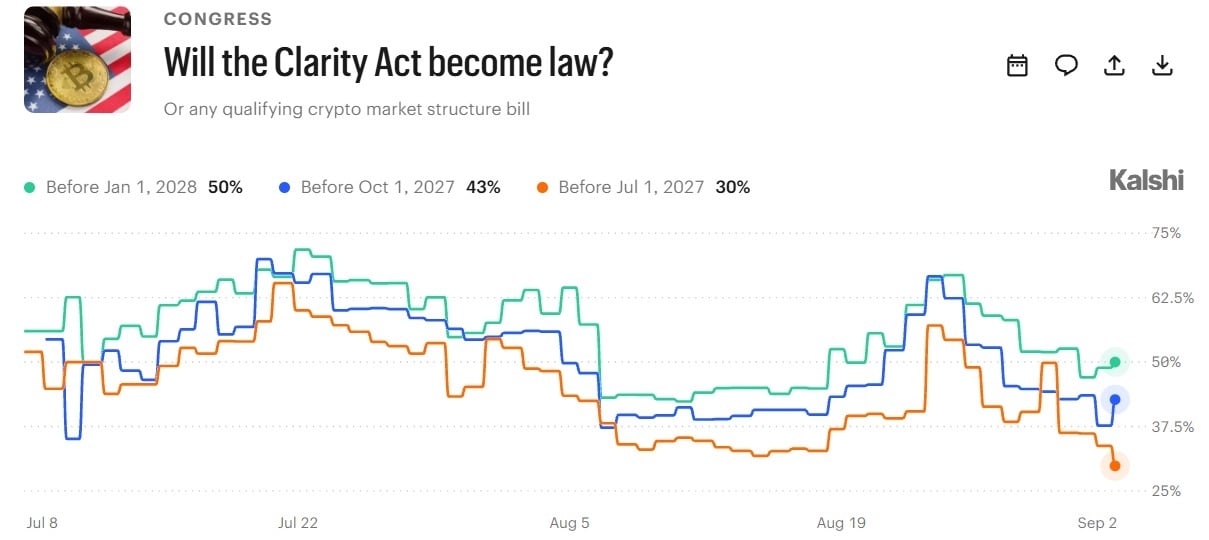
Kalshi traders estimated the probability of a relevant crypto market structure bill passing as 30% by July 1, 2027 and 50% by January 1, 2028. Source: Kalshi, September 2, 2026.

The latest data shows traders are distinguishing between an upcoming Senate vote and final enactment. By August 31, the market had already separated procedural progress from final passage: traders assessed the probability of a Senate vote as high, but the probability of the bill becoming law during 2026 as much lower. The latest Polymarket figure of 15% rose from 13%, but still largely signalled against passage.

September 15 cloture motion will be the next test

The next significant step will be a procedural vote on the bill, which senators could hold as early as September 15. According to the official Senate schedule, a motion to invoke cloture on H.R. 3633 will be voted on at 2:15 PM. Passing a cloture motion typically requires 60 votes, so the bill's future depends on its ability to maintain bipartisan support.

In earlier stages, the bill already received bipartisan support. On May 14, the Senate Banking Committee approved H.R. 3633 by a vote of 15 to 9, sending it to the full floor. Democratic Senators Ruben Gallego and Angela Alsobrooks joined Republicans in supporting the bill's advancement, though the committee's approval did not guarantee sufficient support for cloture or final passage.

Subsequently, Senate negotiators unveiled a revised bill merging the work of the Banking and Agriculture Committees. The updated CLARITY Act framework addresses SEC and CFTC jurisdiction, consumer protection, illicit financing, decentralized finance (DeFi), intermediary oversight, disclosure requirements, and certain network tokens.

The revised language creates another factor affecting the timeline, reflected in the low odds for 2026 passage. Senate approval of provisions differing from the House-passed bill may require additional action before the bill reaches the president's desk. The Polymarket contract will pay out only if H.R. 3633 clears all remaining steps by the end of 2026.

Hill's regulatory initiative faces legislative calendar constraints

Hill included the CLARITY Act within a broader economic agenda covering capital markets, housing, community financial institutions, and regulatory modernization. He stated, "Republicans on the committee are working diligently to codify these reforms into law to make them permanent and predictable." Prediction market probabilities indicate traders view the remaining congressional schedule as a significant obstacle to this goal.

In his September 2 statement, the lawmaker did not provide extensive arguments for digital assets, but had previously explained why he considers CLARITY critical. During July field hearings marking the one-year anniversary of the bill's House passage, Hill compared passing stablecoin legislation without a crypto market framework to an unfinished communication system, with the CLARITY bill remaining stalled in the Senate.

Hill stated:

"We need to get CLARITY done because of one key point I always emphasize: if you have the GENIUS Act and a dollar-backed stablecoin that President Trump signed in July of last year, but you don't have a market structure bill, it's like getting permission to own a cell phone but not having a cellular network."

The bill could impact centralized exchanges, decentralized platforms, brokers, dealers, token issuers, and customers. Centralized and decentralized crypto exchange structures raise different issues related to asset custody, regulatory compliance, and consumer protection, which the proposed framework aims to address.

If senators agree to take up the cloture motion on September 15, the vote will become the next direct test for market skepticism. Overcoming this procedural hurdle could improve forecasts for Senate consideration, while failure would reinforce the current 85% probability assessed for H.R. 3633 not becoming law during 2026.

end-content

Related Questions

QWhat is the CLARITY Act (H.R. 3633) and what are its main provisions according to the article?

AThe CLARITY Act (H.R. 3633) is legislation focused on establishing national rules for cryptocurrency trading, custody, and market oversight in the US. Its main provisions, as passed by the House of Representatives, include allocating federal authority between the Securities and Exchange Commission (SEC) and the Commodity Futures Trading Commission (CFTC), and setting requirements for exchanges, brokers, dealers, disclosure, and client asset protection.

QAccording to the Polymarket prediction contract, what is the perceived probability of the CLARITY Act becoming law by the end of 2026?

AAccording to the Polymarket prediction contract as of September 2, 2026, the perceived probability of the CLARITY Act passing both congressional chambers and being signed by the president before December 31, 2026, is 15%.

QWhat is the significance of the cloture motion scheduled for September 15 for the future of the CLARITY Act?

AThe cloture motion scheduled for a vote on September 15 is a key procedural step for the CLARITY Act. Passing cloture typically requires 60 votes in the Senate. Success would allow the bill to proceed to a final vote, while failure would represent a major setback, confirming market skepticism about its passage in 2026.

QHow do the market prediction probabilities from Kalshi for the CLARITY Act differ from those on Polymarket, and why are they not directly comparable?

AKalshi's long-term contracts show higher probabilities: 30% for a relevant crypto market structure bill (like CLARITY) becoming law by July 1, 2027, and 50% by January 1, 2028. They are not directly comparable to Polymarket's 2026 contract because they assess a broader range of possible outcomes over different, longer timeframes.

QWhat analogy did French Hill use to argue for the necessity of passing the CLARITY Act alongside stablecoin legislation?

AFrench Hill used an analogy comparing stablecoin legislation without a crypto market structure framework to 'having permission to own a mobile phone but not having a cellular network.' He argued that the CLARITY Act is needed to complete the regulatory framework, just as a network is needed for a phone to function.

Related Reads

ENS DAO Proposes Transferring Treasury Management Authority to Foundation Board, Community Retains Ultimate Veto Power

ENS DAO has initiated an on-chain vote on Social Proposal 7.5, which seeks to restructure governance of its core treasury by transferring authority over the Investment Policy Statement (IPS) to the ENS Foundation Board. Under the plan, policy amendment rights currently held by all token holders through on-chain voting would move to the Foundation Board, which would also take over the MetaGov working group's oversight of professional funds and fund managers. The proposal addresses long-standing pain points in decentralized treasury management, including slow token-voting response cycles and the high threshold for financial parameter review. As the protocol delegates management of scaled funds to Karpatkey, requiring full network governance for minor adjustments to asset allocation or risk exposure has caused voter fatigue and risked missing market windows. The shift aims to remove administrative bottlenecks in professional treasury operations. To ensure rigor, the new rules require the Board to solicit community input on the ENS governance forum at least 7 days before proposing amendments. Formal resolutions must receive at least 4 director votes in favor, with conflicted directors recused and remaining eligible directors deciding unanimously. Each amendment must include written rationale and be published within 14 days of passage. ENS DAO has built in checks and balances: the minimum treasury reserve duration and major withdrawals still require full token-holder approval, as does any change to IPS Section 3 governing amendment authority and Board duties. Crucially, ENS DAO retains a permanent override power to overturn any Board amendment via a social proposal, and external fund manager Karpatkey must continue monthly public financial reporting. The proposal reflects mature Web3 infrastructure exploring a balance between modern legal-entity governance and on-chain native democracy, offering a model for compliant, efficient decentralized treasury operations. As of the latest Snapshot data, Proposal 7.5 has 179,900 votes in favor with 100% support and no opposition or abstentions. The vote closes on November 22; if passed, the ENS Foundation will publish IPS v2.1 incorporating the revisions.

marsbit9m ago

ENS DAO Proposes Transferring Treasury Management Authority to Foundation Board, Community Retains Ultimate Veto Power

marsbit9m ago

Ethereum Upgrade Testing Exposes Hidden Risks: Transactions Show Success, but Payments May Fail

Ethereum's proposed Glamsterdam upgrade has exposed compatibility risks in smart contracts during testing on the Sepolia testnet. Simulations of Juicebox payment contracts showed that some transactions confirm successfully at the outer level while internal payments silently fail, causing fund distributions or fee payments to be skipped. The issue stems from changes to the underlying execution gas accounting logic, which affects existing contracts that rely on traditional exception handling. In NFT purchase tests, buyers received NFTs even when the internal payment failed due to gas exhaustion, leaving funds stranded in the payment project. In token distribution tests, cross-project payments were interrupted, so beneficiaries received the project's original tokens instead of the intended cross-project settlement. Cash redemption tests revealed that within a gas range of 679,622 to 817,622, users could redeem funds while the internal 2.5% protocol fee was not charged, effectively waiving the fee. Juicebox developer mejango linked the problem to tiered changes in opcode gas costs and contract error-handling mechanisms, specifically EIP-8037, which sharply raises the gas cost of state creation and new storage writes. Because internal payment subcalls exhaust gas before outer logic, and developers commonly use try/catch structures that isolate errors, the failed payments do not trigger a transaction rollback. On mainnet simulations, the same gas range produced only full transaction failures or complete payments, never silent internal skips. This contrast highlights the impact of gas pricing changes on already-deployed, non-upgradeable contracts, where gas reserves and error catching designed under the old model can turn into fund-leakage risks. The Ethereum Foundation has added the Juicebox report and PoC materials to its agenda and scheduled a special meeting on November 19 to discuss the scope of impact and possible responses. No final decision on adjusting proposal parameters has been made yet.

marsbit9m ago

Ethereum Upgrade Testing Exposes Hidden Risks: Transactions Show Success, but Payments May Fail

marsbit9m ago

Trading

Spot
活动图片