Former Anthropic Researcher Warns: Superintelligence Could Lead to Humanity's Demise

cryptonews.ruPublished on 2026-10-06Last updated on 2026-10-06

Abstract

Former Anthropic and OpenAI researcher Jacob Coxon issued a stark warning at a special New York City Council hearing on AI risks on October 5, 2026. He stated that if the current development trajectory continues, humanity will likely lose control over advanced AI systems, potentially leading to human extinction. Coxon criticized leading AI labs for behaving recklessly, applying a "move fast and break things" startup mentality to what he called the most powerful technology in history. While the goal of creating superintelligence—a system surpassing humans in any task—holds immense potential benefits for the economy, science, and medicine, Coxon emphasized that no one currently knows how to control such systems or understands their internal decision-making processes.

Former Anthropic researcher, who also previously worked at OpenAI, Jacob Coxon spoke on October 5, 2026, at a special New York City Council hearing on AI risks. According to his assessment, if the current course is maintained, humanity is more likely to lose control over such systems, and the outcome could result in the demise of humanity.

Companies Are Acting Recklessly

Coxon stated bluntly that, based on his experience, developers are behaving extremely recklessly given the scale of the stakes. In companies, he said, the startup approach of "move fast, break things, fix later" prevails. For an app where people share photos, such logic is suitable. For the most powerful technology in history—it is not.

All leading labs are striving to create superintelligence—a system that surpasses humans in any task. With proper development, such technology is capable of transforming the economy, advancing science and medicine, and improving people's lives. But so far, Coxon emphasized, no one knows how to control such systems and no one understands what guides them or why they do what they do.

Related Questions

QWhat major risk did Jacob Coxon warn about regarding the development of superintelligence?

AHe warned that with the current course of development, humanity is likely to lose control over superintelligent AI systems, which could potentially lead to the extinction of humanity.

QAccording to Coxon, what is the prevailing mindset or approach in major AI development companies?

AHe stated that companies operate with a reckless 'move fast and break things' startup mentality, which he considers inappropriate for developing the most powerful technology in history.

QWhat potential benefits of superintelligence did Coxon acknowledge?

AHe acknowledged that if developed wisely, superintelligence could transform the economy, advance science and medicine, and improve people's lives.

QWhat key capability does Coxon say is currently lacking for controlling superintelligent AI?

AHe emphasized that no one currently knows how to control such superintelligent systems or understand their reasoning and motivations.

QWhere and when did Jacob Coxon deliver his testimony about AI risks?

AHe delivered his testimony on October 5, 2026, at special hearings held by the New York City Council concerning AI risks.

Related Reads

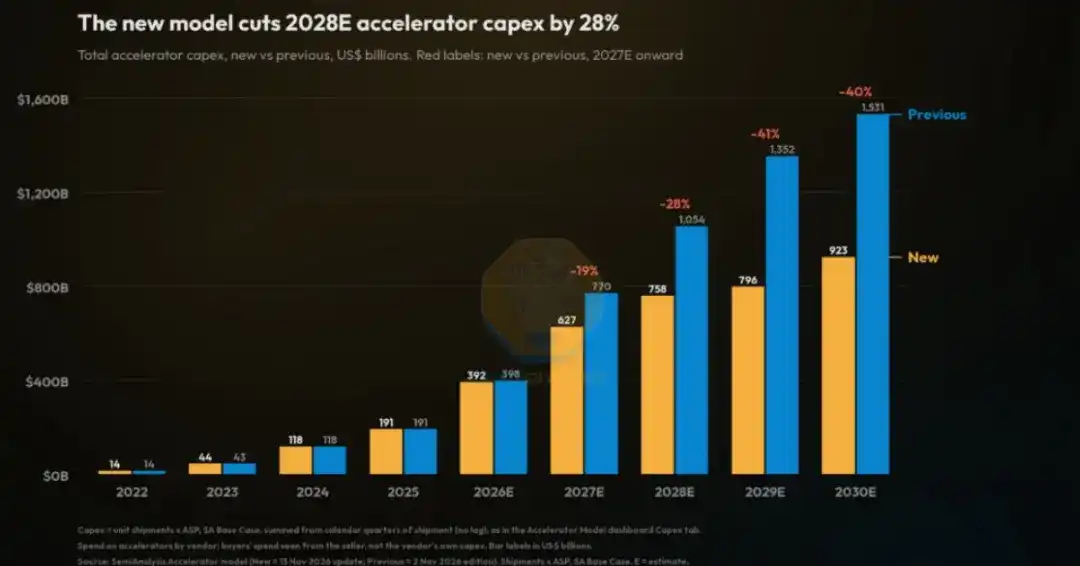
SemiAnalysis Slashes AI Compute Capex Forecast Again: 2029 Cut by 41%, 2030 Down to Only $923 Billion

Semiconductor research firm SemiAnalysis has sharply cut its forecasts for global AI accelerator capital expenditure, shipments, HBM demand, and power demand in its latest model update. The most significant revisions affect 2028–2030: capex forecasts are lowered by 28% for 2028 and by 41% and 40% for 2029 and 2030, respectively. Under the new model, global AI accelerator capex in 2030 falls to $923 billion from the previously projected $1.531 trillion—a reduction of $608 billion. Cumulative accelerator logic silicon wafer shipment area for 2026–2030 is cut by 17%, with Nvidia accounting for 66% of the reduction. The revisions stem from three factors: slowing AI revenue growth, as frontier AI labs saw declining growth in new annual recurring revenue in Q3, prompting reassessment of whether token revenue can cover high computing costs; tighter financing conditions, with debt and equity investors more cautious about projects lacking long-term procurement commitments from cloud providers; and intensifying U.S. regulatory and grid-connection constraints, with 5.8 GW of data centers expected to come online between H2 2027 and H1 2028 facing delays. The impact is uneven across the supply chain. Nvidia is hit hardest, with shipment forecasts cut substantially and average selling price assumptions for its next-generation Feynman series significantly lowered—Feynman from about $110,000 to $78,000, and Feynman Ultra from about $175,000 to $98,000—indicating competition is shifting from capacity to cost-effectiveness, with TPU, Trainium, and AMD GPUs eroding Nvidia's pricing power. Global HBM shipments for 2028 are cut 30%, and AI accelerator power demand for 2030 is cut 34%. This does not mean storage and power lose value; rather, the chain is shifting from grabbing capacity and power to allocating capacity based on returns. For the market, this correction looks like an early de-bubbling calibration. Previously, AI capex was seen as a one-way upward curve, but it is actually shaped by revenue validation, financing constraints, grid connections, chip efficiency, and competition. Key indicators to watch include cloud capex guidance, accelerator order visibility, HBM contract prices, data center grid-connection queues, and the share of inference workloads in total compute. If inference demand keeps growing, unit compute costs fall, and utilization improves, the chain will still find structural support; if long-term project returns prove hard to validate, further downward revisions remain possible. The global AI compute sector is undergoing a painful valuation correction. It is still unclear whether this phase is over—valuations may not look cheap if forecast parameters in valuation models have not been revised down in tandem. The best approach is to wait patiently for the market to clear itself. Market inertia often overshoots: if valuations are pushed to extreme lows and leveraged funds and sellers are cleared out while short positions sit at historic highs, a sharp rebound could follow. When that opportunity arrives is up to the market.

marsbit3m ago

SemiAnalysis Slashes AI Compute Capex Forecast Again: 2029 Cut by 41%, 2030 Down to Only $923 Billion

marsbit3m ago

Democrats Win Both Chambers, Trump's Business Alliance Begins to Crack

After Democrats won both chambers of Congress in the November 2026 midterms, the first shift was not in legislation but in how markets view business-government ties. Before the new Congress takes office on January 3, 2027, Democrats can prepare investigations and demand document preservation, though subpoena power comes later. Current pressure includes congressional oversight, board probes and civil suits—not criminal convictions. Trump retains veto power, and Democrats lack a two-thirds majority, so investigation becomes the key tool. Musk was asked by two Democratic senators to preserve Starlink and Starshield records, including communications with the White House and Pentagon; House Democrats also plan to examine DOGE cuts, SpaceX contracts and conflicts of interest. Nvidia announced on November 12, 2026 that Jensen Huang resigned as CEO and director, with CFO Colette Kress interim CEO and Harvey Jones as first board chair; reports of a possible return remain unconfirmed. Nvidia shares fell about 20% from October 30 to November 13. Democrats also plan to investigate the Trump family's crypto business, World Liberty Financial and related deals, while the CLARITY Act stalled in the Senate. Markets are starting to price the value of political protection that may not survive election cycles, with capital shifting toward AMD, Broadcom, custom chips and compliant financial institutions.

marsbit4m ago

Democrats Win Both Chambers, Trump's Business Alliance Begins to Crack

marsbit4m ago

Former Uniswap Engineering Director at the Helm, Metric Monthly Trading Volume Exceeds $8 Billion

Metric, a DEX led by former Uniswap Labs Engineering Director Christos Gkolias as CTO, surpassed $8 billion in trading volume in its first month, with over $600 million in daily volume, despite having only about $25 million in TVL. Metric focuses on tokenized stocks, major crypto assets, and stablecoins. Unlike traditional AMMs that derive prices from pool ratios, Metric separates pricing from liquidity provision, allowing pools to update quotes based on external references such as Chainlink and Pyth oracles or custom strategies, keeping liquidity near market prices. LP funds are placed in price ranges called Bins that automatically shift with the reference price, so capital stays active without manual redeployment, enabling small TVL to support large cumulative volume. Large trades still incur price impact as liquidity is consumed across bins. Metric also introduced Markout APR to compare execution prices against later reference prices, reminding LPs that more volume does not guarantee more profit. A points campaign launched October 15 distributes 1 million points weekly for trading, providing liquidity, managing pools, and referrals, with early users earning retroactive rewards. Users can earn points through spot trading via Metric's flagged routes or by providing liquidity in pools, though high APR must be weighed against trading losses and price changes. Referrals offer up to 10% point bonuses once bound.

marsbit6m ago

Former Uniswap Engineering Director at the Helm, Metric Monthly Trading Volume Exceeds $8 Billion

marsbit6m ago

Bridgewater's $23 Billion Portfolio Shake-Up: Embracing AI Hardware and Energy, Cutting Google and Amazon

Bridgewater Associates significantly reshaped its portfolio in the third quarter, concentrating on AI chip hardware and energy while cutting exposure to tech giants and traditional industrial stocks. According to Bloomberg's analysis of Bridgewater's 13F filing, the fund disclosed 974 positions worth $230 billion as of September 30. The firm substantially increased holdings in Qualcomm, AppLovin, and memory chip stocks Micron and SanDisk, while reducing stakes in Alphabet and Amazon and exiting industrial names such as Union Pacific. Healthcare saw the largest sector weight increase, while industrials saw the biggest decline. Among top holdings, State Street SPDR S&P 500 ETF Trust remained the largest at $2.595 billion (11% of the portfolio), followed by iShares Core S&P 500 ETF at $1.155 billion (about 5%). Nvidia ranked third at $614 million (about 2.7%), despite a reduction of about 1.178 million shares, remaining the most important single semiconductor holding. Broadcom followed at $462 million (about 2%), nearly unchanged, and Lam Research ranked fifth at $348 million (1.5%). On the buying side, Qualcomm saw the largest increase, up 716,000 shares to 878,000 shares, adding about $132 million in value. AppLovin Class A rose 536,000 shares to 683,000 shares, adding about $123 million. Micron gained 120,000 shares to 237,000 shares (about $118 million), and SanDisk added 66,000 shares to 66,800 shares (about $115 million). Qorvo was increased by over 1.037 million shares to 1.068 million shares, adding about $119 million. On the selling side, State Street SPDR S&P 500 ETF was cut by nearly 1.917 million shares (about $1.378 billion), and iShares Core S&P 500 ETF by 1.494 million shares (about $1.093 billion). Vanguard S&P 500 ETF fell 382,000 shares (about $261 million). Alphabet Class A was reduced by 862,000 shares to 460,000 shares (about $314 million), and Amazon by 1.055 million shares to 971,000 shares (about $241 million). Industrials saw the largest weight decline. Bridgewater fully exited Union Pacific, cutting 514,000 shares (about $140 million), the quarter's largest liquidation. Truck maker Paccar was also cleared, down 946,000 shares (about $114 million) amid an 8.6% price drop. Nutanix and S&P Global were fully exited as well. Healthcare received the biggest weight boost, with new positions in Medtronic and Jazz Pharmaceuticals (amounts not separately disclosed). In energy, Bridgewater opened a new 1.55 million-share position in Occidental Petroleum worth about $85.77 million and bought about 1.516 million shares of Dominion Energy worth about $91.76 million. New tech positions included Synaptics, Fortinet, and Cisco, valued at about $78.35 million, $75.41 million, and $71.2 million respectively.

marsbit7m ago

Bridgewater's $23 Billion Portfolio Shake-Up: Embracing AI Hardware and Energy, Cutting Google and Amazon

marsbit7m ago

Trading

Spot
活动图片