Capital starting to rotate back to crypto from AI: Raoul Pal

cointelegraphPublished on 2026-10-07Last updated on 2026-10-07

Abstract

Capital may be rotating from AI back into crypto as a weakening US dollar could provide a "green light" for the industry's rally, says Real Vision founder Raoul Pal. He notes that high bond yields and a strong dollar have constrained liquidity, but a weaker dollar could improve conditions. Pal observes that recent pauses in the AI trade, evidenced by Nvidia's stock decline during Bitcoin's August surge, allowed capital to flow into crypto. However, a full AI crash would be detrimental, signaling a liquidity drain. For crypto's continued rise, Pal prefers a scenario of a weaker dollar, steeper yield curve, and expanded money supply. Alternatively, sideways-trading AI stocks could also enable capital rotation into crypto. Regarding AI's impact, Pal suggests AI agents could increase economic activity on smart contract platforms like Ethereum and Solana by using them for transactions and potentially raising funds via token issuance. While enthusiastic about both networks, Pal is cautious about Solana overtaking Ethereum in market cap, citing Ethereum's greater "economic density"—more capital per user—as Solana's activity currently involves smaller, more speculative amounts. He refrains from specific price targets but suggests Bitcoin reaching $1 million by 2032 reflects broader adoption trends.

A weakening US dollar could give crypto the “green light” and help extend the industry’s rally, says Real Vision founder Raoul Pal.

He tells Cointelegraph on the latest episode of Trade Secrets that higher bond yields and the strong dollar are keeping liquidity from flowing freely.

“If they can engineer the dollar lower, then we get a green light for further movement in crypto,” he says. “I don’t want to get overly excited, so I haven’t got a full green light on everything.”
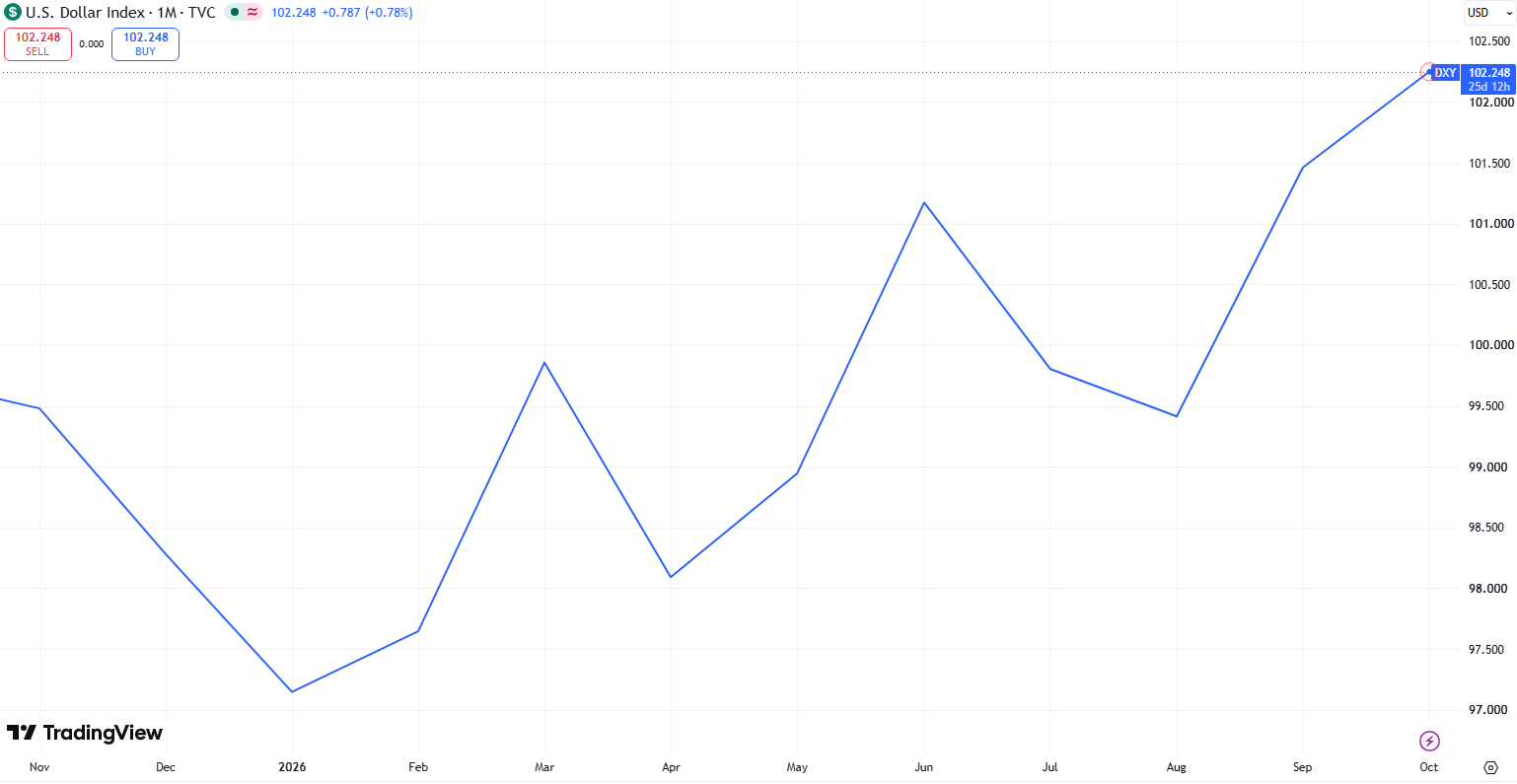
The US Dollar Index has been trading at the year’s highest levels. Source: TradingView


However he believes Bitcoin will miss out of much of the crypto economic activity generated by AI agents, which is likely to flow to smart contract platforms like Ethereum and Solana.

Related: El Salvador receives $138 million from IMF after Bitcoin waivers granted

Pal is among the most experienced high profile crypto analysts, having worked in hedge fund sales at Goldman Sachs in Europe and co-managed a global macro fund at GLG Partners. He launched the research platform Global Macro Investor in 2005 and co-founded financial media Real Vision in 2014.

Pal says he first bought Bitcoin in 2013, after applying a gold-based valuation framework to the cryptocurrency.

An AI pause could help crypto catch up

Bitcoin’s cycle recovery arguably came between Aug. 19 and Aug. 25 when BTC rose about 25% to $80,000. Interestingly, over that period, AI bellwether stock Nvidia notched up seven consecutive losing sessions.

Pal says pauses in the AI trade have allowed capital to rotate into crypto.

“You can tell there’s this sort of rotation for liquidity that’s around right now, which means it’s not abundant yet,” he says.
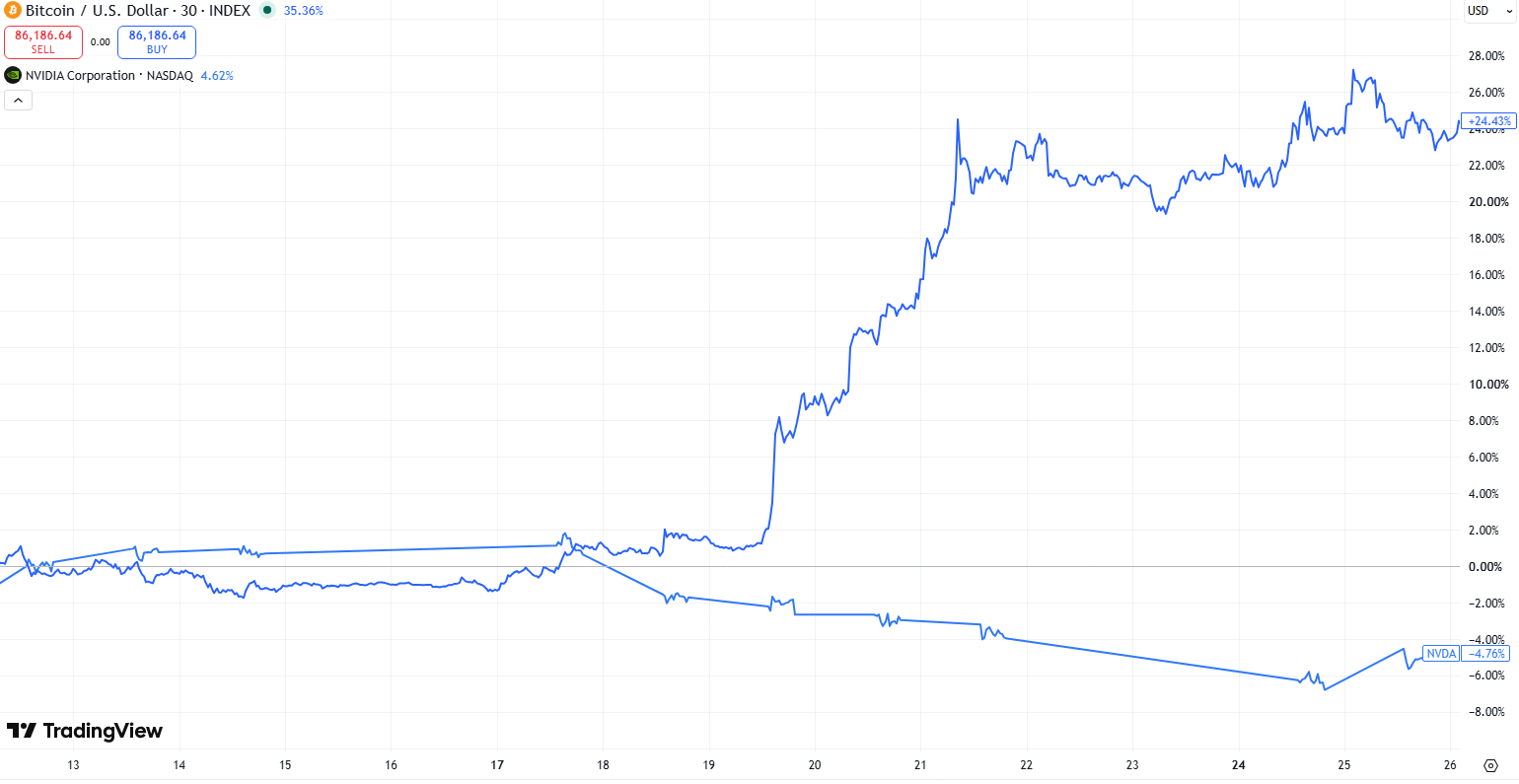
Bitcoin rallied while Nvidia shares fell in August. Source: TradingView

While AI has been competing with crypto for funds, an AI crash would be an unwelcome prospect, as a bursting bubble would indicate that liquidity is being “sucked out of the system,” while threatening the conditions crypto needs to rise.

“Things don’t go bust if liquidity is plentiful,” Pal says.

His preferred outcome would be a weaker dollar, a steeper yield curve and banks expanding the money supply through increased lending.

However, borrowing costs have been moving higher. The US 10-year Treasury yield climbed to 5.29% in September, while the Fed raised its benchmark rate by a quarter-point.

If those conditions don’t materialize, Pal’s “second best scenario” is for AI stocks to trade sideways, which would allow capital to rotate into crypto.

AI agents could bring more business to Ethereum and Solana

AI agents can now pay to access web content using stablecoins through a feature that Amazon Web Services introduced in June. Coinbase handles payment verification and settlement through its x402 protocol, with USDC on Base among the supported payment options.

Pal says agents could eventually raise the money they need to operate, by issuing tokens to fund projects that could last “a week, a month, a year,” then carrying out the work and generating returns.

He says Ethereum and Solana could attract more activity as software uses their smart contracts to transact.

“My guess is they’ll get more adoption over time as AI uses them,” he says.

Related: Coinbase’s AI payments protocol x402 launches app store for AI agents

Solana needs more than activity to overtake Ethereum

Ethereum’s greater concentration of capital makes Pal cautious about claims Solana will overtake it in market value, despite his enthusiasm for both networks.

Multicoin Capital co-founder Kyle Samani predicted on Trade Secrets last month that SOL would surpass Ether’s market capitalization “this market cycle.”

Samani “needs to hold his horses a little bit,” Pal says, even though he acknowledged that it is possible.

The networks are ahead of each other on different metrics. Solana recorded around 3.2 million active addresses over the preceding 24 hours on Monday, compared with Ethereum’s 387,000, according to DefiLlama. But Ethereum has about $54.4 billion in decentralized finance protocols, which is far ahead of Solana’s $6.7 billion.

Pal compares the networks using what he calls “economic density,” dividing total value locked by active users. He says Ethereum attracts more capital relative to its user count, and Solana’s activity involves smaller amounts.

“Solana’s core activity is speculation,” he says. “It’s just smaller clip sizes.”

Pal says he has stopped giving public price targets because his forecasts get clipped and recirculated online. He describes million-dollar Bitcoin by 2030 as a “meme” reflecting growing adoption, ETF interest and Bitcoin’s use as collateral.

“Does it make a million bucks? I don’t know, but certainly by 2032, yeah, I don’t have an issue with that.”

Magazine: Former SEC boss made AI Czar, Bitcoin may hit $600K this cycle: Hodler’s Digest

Related Questions

QAccording to Raoul Pal, what condition could give crypto the 'green light' for further movement?

AA weakening US dollar could give crypto the 'green light' for further movement, as higher bond yields and a strong dollar have been keeping liquidity from flowing freely.

QWhat recent market event does Pal suggest allowed capital to rotate from AI into crypto?

AA pause in the AI trade, specifically when Nvidia stock had seven consecutive losing sessions between August 19 and 25 while Bitcoin rallied about 25%, allowed capital to rotate into crypto.

QWhy does Pal believe Bitcoin will miss out on much of the crypto economic activity generated by AI agents?

APal believes the economic activity generated by AI agents is likely to flow to smart contract platforms like Ethereum and Solana, implying Bitcoin's functionality is less suited for this specific type of activity.

QWhat is Raoul Pal's 'second best scenario' for crypto if his preferred conditions of a weaker dollar and steeper yield curve don't materialize?

AHis 'second best scenario' is for AI stocks to trade sideways, which would allow capital to rotate into the crypto sector.

QWhat metric does Pal use to compare Ethereum and Solana, and what does it reveal about their differences?

APal uses 'economic density,' dividing total value locked by active users. He says this shows Ethereum attracts more capital relative to its user count, while Solana's activity involves smaller amounts and is more focused on speculation.

Related Reads

Nobel Laureate Hassabis Delivers Another Masterpiece: AlphaGenome 2 Deciphers 98% of Human DNA 'Dark Matter'

DeepMind has unveiled AlphaGenome 2, a next-generation DNA foundation model led by Nobel laureate Demis Hassabis. While AlphaFold decoded only the 2% of the human genome that encodes proteins, AlphaGenome 2 targets the remaining 98% of non-coding "dark matter," which harbors gene-regulatory switches and over 90% of disease-causing mutations. Released alongside a 78-page technical report, the model delivers four major breakthroughs. First, it achieves single-cell resolution, trained on over 107 million single cells across 68 human tissues, doubling the rate at which it identifies pathogenic mutations—raising detection from 16% to 30% and directional accuracy from 23% to 43% on the TenK10K immune-cell benchmark. Second, it reproduces years of Nature-published research purely through computation: with zero wet-lab experiments, it correctly identified a distant regulatory mutation that over-activates ETS2 across 290,000 bases to cause inflammatory bowel disease, and precisely located the regulatory site and GATAA core sequence targeted by approved sickle-cell CRISPR therapy. Third, a new cell encoder lets the model interpret previously unseen diseases from just dozens of patient cells without retraining—identifying 41% of pathogenic mutations in unseen Parkinson's brain samples versus 17% for a specialized model, and uncovering a hidden severe-COVID mutation active only in immune-activated T cells. Finally, DeepMind released free databases covering 640 real human cell types and impact scores for nearly 7 million genetic variants across 510 cell states, with APIs and Colab tutorials open for non-commercial research. The model will soon be packaged as Skills and integrated into Google Antigravity for direct use by Gemini 4, promising to dramatically shorten the cycle of disease investigation and drug discovery.

marsbit51m ago

Nobel Laureate Hassabis Delivers Another Masterpiece: AlphaGenome 2 Deciphers 98% of Human DNA 'Dark Matter'

marsbit51m ago

Midterm Elections Settled, What Lies Ahead for the CLARITY Act?

The CLARITY Act (Digital Asset Market Clarity Act), which had already struggled before the election, now faces dim prospects after Democrats swept both chambers in the midterms. On September 15, a Senate cloture motion on the House-passed bill failed 49-50, eleven votes short of the 60-vote threshold. All 49 yes votes came from Republicans; the opposition included all Democrats present, two independents, and four Republicans (Collins, Hawley, Moran, Tillis). Even if absentee Democrat Coons had voted yes and the four Republicans had flipped, the tally would have reached only 54—still short. The bill's core compromise would make the CFTC the primary regulator for digital commodities and trading platforms while preserving clear SEC authority; jurisdictional division and added ethics provisions are the main disputes. Democrats will control both chambers when the new Congress opens January 3, 2027, leaving little incentive to cooperate during the lame-duck session. Only two theoretical paths remain before the 119th Congress ends: renegotiate the text and hold another cloture vote via Tillis's reconsideration motion, or attach crypto market structure provisions to must-pass December legislation such as government funding (expiring December 11) or the NDAA. Both are unlikely, given the tight legislative calendar and Democratic leverage. Stablecoin oversight continues separately under the GENIUS Act and OCC rulemaking. If the bill dies, it must be reintroduced in the 120th Congress, where Democrats—likely led by Elizabeth Warren and Maxine Waters—are expected to draft a very different framework expanding SEC authority and narrowing the CFTC's role. Key things to watch before January 3: any new cloture vote or revised text, any attempt to attach provisions to funding or defense bills, outstanding vote counts in Alaska, Mississippi, and House districts, and the incoming committee chair selections. Absent such developments, the CLARITY Act is effectively finished as a 2026 legislative project.

marsbit52m ago

Midterm Elections Settled, What Lies Ahead for the CLARITY Act?

marsbit52m ago

4.8 Billion Dollars: Tether's Hand Has Reached Into 13 U.S. Public Companies

Tether, the world's largest stablecoin issuer, holds roughly $4.8 billion in public-market exposure across 13 U.S.-listed companies, according to a Protos review of regulatory filings. Its holdings span a controversial video platform, gold royalty companies, a satellite firm, bitcoin miners, and a bitcoin treasury project. Key positions include a 50.3% stake (including warrants) in Rumble (RUM), though voting power is capped below 9.9%; Rumble has also acquired Tether's Northern Data and counts Tether as its most important advertising client, committed to $50 million annually for two years. Tether and Bitfinex are controlling shareholders of Twenty One Capital (XXI), with rights to nominate four of seven directors, including Tether CEO Paolo Ardoino; the company trades at about 60% of its bitcoin value. In gold, Tether holds about 27% of Elemental Royalty (ELE), 12.6% of Gold.com (GOLD), 12.6% of Versamet Royalties (VMET), 14.6% of Metalla (MTA), 14.4% of Gold Royalty (GROY), 12% of Aurelion (AURE), and about 8% of Antalpha (ANTA). It also holds 19.7% of Bitdeer (BTDR) and a stake in Adecoagro (AGRO), plus shares in Satellogic (SATL), 9.9% of SDEV (down about 99%), and a stake in VCI Global (VCIG) via Oobit. Powerlaw Corp (PWRL) claims roughly $20 million in Tether equity. The exposure is concentrated in a few large holdings—Twenty One, Rumble, and Adecoagro—showing Tether's growing role as a multi-sector financial institution that also places executives in key positions.

marsbit1h ago

4.8 Billion Dollars: Tether's Hand Has Reached Into 13 U.S. Public Companies

marsbit1h ago

Trading

Spot
活动图片