Reactive Indicator: Kaufman's Adaptive Moving Average in Cryptotrading

cryptonews.ruPublished on 2026-10-12Last updated on 2026-10-12

Abstract

The Kaufman Adaptive Moving Average (KAMA) is a technical analysis indicator designed to respond better to market volatility. It adjusts its sensitivity based on price noise. During low-volatility periods with minimal market noise, KAMA closely tracks the asset's price. Conversely, during high-volatility periods with sharp price fluctuations, it follows the trend from a greater distance, reducing its sensitivity to random noise. Primarily, KAMA is used to identify market trends, potential reversal points, and to filter out insignificant price movements. The indicator was developed by financial mathematician, trader, and aerospace engineer Perry Kaufman, who first introduced it in his 1995 book "Smarter Trading: Improving Performance in Changing Markets."

Kaufman's Adaptive Moving Average (KAMA) is a technical analysis indicator created to better respond to the price volatility of an asset. When the noise—chaotic, unanalyzable fluctuations on the chart—is low, the tool closely follows the price of the crypto asset. If price swings become sharper, KAMA follows the cryptocurrency price at a greater distance. Primarily, the indicator is used to determine the trend, reversal points, and as a filter for price movements.

Who came up with the idea for KAMA and how is this indicator calculated?

Creator of KAMA

The developer of KAMA was financial mathematician, trader, and aerospace engineer Perry Kaufman. He first presented his indicator to the public in his 1995 book "Smarter Trading: Improving Performance in Changing Markets."

Related Questions

QWhat is the main purpose of the Kaufman's Adaptive Moving Average (KAMA) indicator according to the article?

AThe main purpose of the Kaufman's Adaptive Moving Average (KAMA) indicator, as described in the article, is to better respond to price volatility. It clearly follows the price of a crypto-asset when market noise is low, and follows from a greater distance when price fluctuations become sharper. It is primarily used to identify trends, reversal points, and to filter price movements.

QWho created the Kaufman's Adaptive Moving Average (KAMA) indicator?

AThe Kaufman's Adaptive Moving Average (KAMA) indicator was created by Perry Kaufman, a specialist in financial mathematics, trader, and aerospace engineer.

QHow does the KAMA indicator behave differently in low-noise versus high-volatility market conditions?

AIn low-noise market conditions, the KAMA indicator closely follows the price of the crypto-asset. When price fluctuations become more volatile and sharper, the KAMA indicator follows the price from a greater distance.

QIn what publication did Perry Kaufman first introduce the KAMA indicator to the public?

APerry Kaufman first introduced the KAMA indicator to the public in his 1995 book titled 'Smarter Trading: Improving Performance in Changing Markets'.

QWhat are the primary applications of the KAMA indicator mentioned in the text?

AThe primary applications of the KAMA indicator mentioned in the text are: identifying the trend, identifying reversal points, and acting as a filter for price movements.

Related Reads

From Harshly Criticizing Stablecoins to Building an L1: Airwallex's Jack Zhang Isn't "Converting" — the Battle for the Settlement Layer Has Begun

In June 2025, Airwallex CEO Jack Zhang publicly questioned stablecoins, arguing that fiat conversion costs outweighed their cross-border payment benefits and that crypto had failed to solve real-world problems for 15 years. Yet just 17 months later, in November 2026, Zhang emerged as co-founder of Alta, a blockchain project that raised $80 million (a $47.5 million Series A led by Index Ventures plus a $32.5 million seed round). Rather than a change of heart, the move reflects commercial necessity: a battle over the stablecoin settlement layer is underway, and payment giants that stay out risk becoming mere interfaces atop someone else's chain. Alta is not a general-purpose public chain but a compliant Layer 1 built for banks and licensed payment institutions. Co-founder Loong Wang, previously of Ren Protocol, says existing chains like Ethereum and Solana cannot simultaneously meet institutional demands for privacy, compliance, integration with local financial systems, and liquidity. Alta uses recursive zero-knowledge proofs to enable on-chain compliance checks without exposing identities or transaction amounts, and builds in programmable compliance modules, native identity authorization, and anti-airdrop protections. Co-founder Catherine Porter previously led Meta's Libra (Diem) partnerships. Airwallex itself is Alta's key advantage: with $287 billion in annualized volume, $1.3 billion in revenue, 200 countries, and 90 currencies, it will channel enterprise clients onto the new chain. Zhang's apparent reversal is consistent: he criticized stablecoins as cheap remittance tools, but now bets on tokenized fiat settlement infrastructure. Competitive pressure comes from Stripe, which acquired Bridge for $1.1 billion, bought Privy, and incubated the Tempo chain (raising $500 million at a $50 billion valuation, with OpenAI, Shopify, Deutsche Bank, and Visa as partners). Circle's Arc, Fireblocks, and Canton Network are also competing. With stablecoin market cap exceeding $320 billion and 2025 on-chain volume surpassing $33 trillion, the real contest is over who controls minting, clearing, and fiat redemption. Success will depend less on technology than on three factors: genuine adoption by traditional financial institutions, compliance adaptation across jurisdictions, and efficient on- and off-ramps to real banking systems. The paradigm has shifted: instead of disrupting banks, fintech giants now aim to build infrastructure that lets traditional finance voluntarily move on-chain. Pragmatism, not ideology, now dominates the race.

marsbit1h ago

From Harshly Criticizing Stablecoins to Building an L1: Airwallex's Jack Zhang Isn't "Converting" — the Battle for the Settlement Layer Has Begun

marsbit1h ago

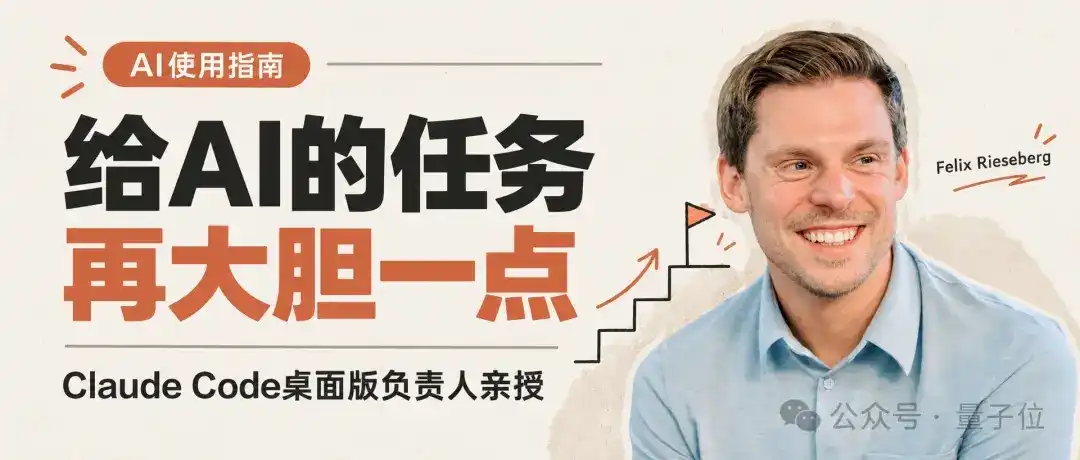
"Everyone is too conservative with AI!" Head of Claude Code: My approach is more ambitious

Felix Rieseberg, who leads Claude Code's desktop app, argues that most people use AI too conservatively and should set more ambitious goals. His central trick: set unreasonably aggressive targets and insist they're achievable—for example, instead of cutting website load time from 10 seconds to 5, aim for 0.2 seconds, and when the model protests, keep telling it the problem is solvable and to try again. He organizes ambition into four categories: speed (doing the same work faster), height (raising the abstraction level to focus on desired outcomes rather than individual tasks), depth (working like top experts, using their real tools, data, and methods), and breadth (drawing on ideas from other fields). For height, he suggests asking what you ultimately want to happen and what the goal behind the goal is—e.g., instead of fixing single crashes, require the app to never crash. For a quarterly business review, move from filling in a template to understanding what changed and why, identifying the most urgent decisions, and redesigning the review process itself. For depth, he advises insisting on the tools top professionals actually use (databases and statistical models rather than Markdown tables), setting "unreasonable" targets, challenging your own assumptions against raw data, hunting for new knowledge, and using external validation rather than letting the model grade itself. A useful prompt asks the model what top experts would do that you haven't requested, what raw materials and tools they'd use, and what besides the model and you could prove the result correct. For breadth, he recommends replacing nouns with verbs (not "make a PPT" but "in 30 minutes, convince busy people of an explanation and drive a decision under uncertainty"), assembling cross-disciplinary teams, and using multi-agent setups—while avoiding mere role-play in favor of adopting other fields' actual methods. He closes with self-efficacy research: people given clear, challenging goals outperform those told to do their best, and believing difficult things are possible—as with the four-minute mile—unlocks achievement. In an era of rapid capability gains, updating our beliefs about what's possible matters more than ever.

marsbit1h ago

"Everyone is too conservative with AI!" Head of Claude Code: My approach is more ambitious

marsbit1h ago

The Traditional Santa Rally: Will It Happen in US Stocks This Year?

US stocks have suffered a sharp selloff, but technical and positioning conditions are repairing, with Goldman Sachs, Morgan Stanley and JPMorgan all signaling a potential year-end rally. Goldman strategist Cosimo Codacci-Pisanelli argues that aggressive deleveraging (the most intense in a decade), valuation multiples back near 35-year averages (MSCI world forward P/E at 15.6x), upward EPS revisions, and seasonal factors create conditions for a year-end short squeeze. Morgan Stanley data shows hedge funds are now underweight AI for the first time since 2023, with the longest deleveraging streak in over 15 years; JPMorgan calls poor sentiment a bullish signal. However, the report flags a paradox: when all three banks call the same trade, the contrarian "year-end squeeze" becomes a crowded consensus trade. Worse, inflation pressure is building faster than during the pandemic: global manufacturing import price inflation is running at about 24% annualized, and the share of import categories with annualized gains above 5% has jumped to 25-40% across major economies. Firms are absorbing costs via margin compression, but upstream pressures typically pass through to consumers in 6-12 months, meaning the bill arrives in Q1. January is historically the month with the most price resets, and Goldman has added a third Fed hike to its forecast. A reflexive loop means a rally that loosens financial conditions removes the rationale for central bank caution, effectively borrowing from future returns. Goldman recommends long front-end inflation as a portfolio hedge, and notes the best rule for 2026 is to short every consensus trade.

marsbit1h ago

The Traditional Santa Rally: Will It Happen in US Stocks This Year?

marsbit1h ago

Claude Deciphers Gödel's Cryptic Manuscripts: 80-Year-Old Notes Shake the Mathematics World

In 1978, logician Kurt Gödel left behind thousands of pages of unpublished notes written in Gabelsberger shorthand, a nearly extinct German stenography system understood by only a handful of people. In 2017, Finnish logician Jan von Plato, upon reaching mandatory retirement age, set out to decode 16 workbooks comprising 1,009 pages that Gödel wrote after settling in Princeton in 1940. After years of manually transcribing the shorthand into modern English, his team could barely digest one page per week—until computer scientists suggested using Claude. Fed the transcripts, von Plato's own books, and modern literature, Claude produced a 650-page interpretation within days, later expanding to 1,084 pages. The AI identified 663 theorem-like results, around 440 of which were confirmed as new theorems through formal verification—suggesting Gödel proved nearly one theorem every two days in the early 1940s. Claude also revealed that Gödel came within a hair of proving the independence of the Axiom of Choice two decades before Paul Cohen's 1963 forcing method earned him a Fields Medal; Gödel had constructed an equivalent framework but made an error in a key definition of "finite support," a result later verified in Coq and praised by Gödel expert Akihiro Kanamori. The notes also contain results rediscovered only in the 1970s–80s, 14 unexplored research topics, and physics work including early use of the Lüders rule (proposed in 1951) and serious study of time-travel via his rotating "Gödel universe." Gödel died in 1978 of starvation caused by paranoia.

marsbit1h ago

Claude Deciphers Gödel's Cryptic Manuscripts: 80-Year-Old Notes Shake the Mathematics World

marsbit1h ago

Trading

Spot
活动图片