Anatomy of the Helium Short Squeeze: A 5.7x Surge in Two Weeks While Revenue Plummets 82%, Who's Swimming Naked?

marsbitPublished on 2026-09-04Last updated on 2026-09-04

Abstract

"Helium HNT Surge Analysis: A 570% Pump Amidst 82% Revenue Drop" The Helium (HNT) token experienced a dramatic 570% price surge from its August low, driven by a combination of catalysts and a major short squeeze. Key triggers included the passing of governance proposal HIP-150—aimed at redirecting subDAO emissions to network operators—and a partnership with the city of Celina, Texas, for public WiFi coverage. However, on-chain data reveals a stark contradiction: while data usage on the Mobile network grew 2.4x year-over-year, actual protocol revenue from paid data credits plummeted 82% from its March peak. This revenue crash is attributed to the removal of subsidies from Nova Labs, providing a clearer picture of organic operator demand. The recent governance changes are designed to restore operator incentives after subsidy cuts. Yet, valuation metrics remain challenging. Annualized revenue stands around $3.1 million against a $95 million market cap, and operator-driven token burns are currently a fraction of new monthly emissions created by growth subsidies. The explosive price move was significantly amplified by market positioning. Deeply negative funding rates and over $1.6 million in short liquidations over a weekend indicate the rally was fueled by a short squeeze finding a narrative catalyst. The surge has repriced HNT as a growth bet, where future value depends entirely on operator data burn accelerating fast enough to outpace new token issuance.

Author:0xResearch

Compiled by: Deep Tide TechFlow

Deep Tide Introduction: The Helium token surged 5.7x from its bottom in two weeks. The apparent catalysts were city partnerships and governance proposal approvals, but on-chain data shows revenue actually plummeted by 82%. This article dissects the real causes of the short squeeze, helping investors distinguish between genuine demand and position squeezes to avoid buying at an emotional peak.

Good morning and happy Thursday!

Strong ETF inflows from institutions, coupled with on-chain breakthroughs by players on the Robinhood Chain, continue to paint a constructive picture for on-chain fundamentals, capital flows, and price action.

Below, we break down HNT's 5.7x rally, separating the true fundamental catalysts from the positioning dynamics that turned it into a short squeeze. The key question now is whether the burn from operator data offload can accelerate enough to outpace issuance and validate this valuation reset.

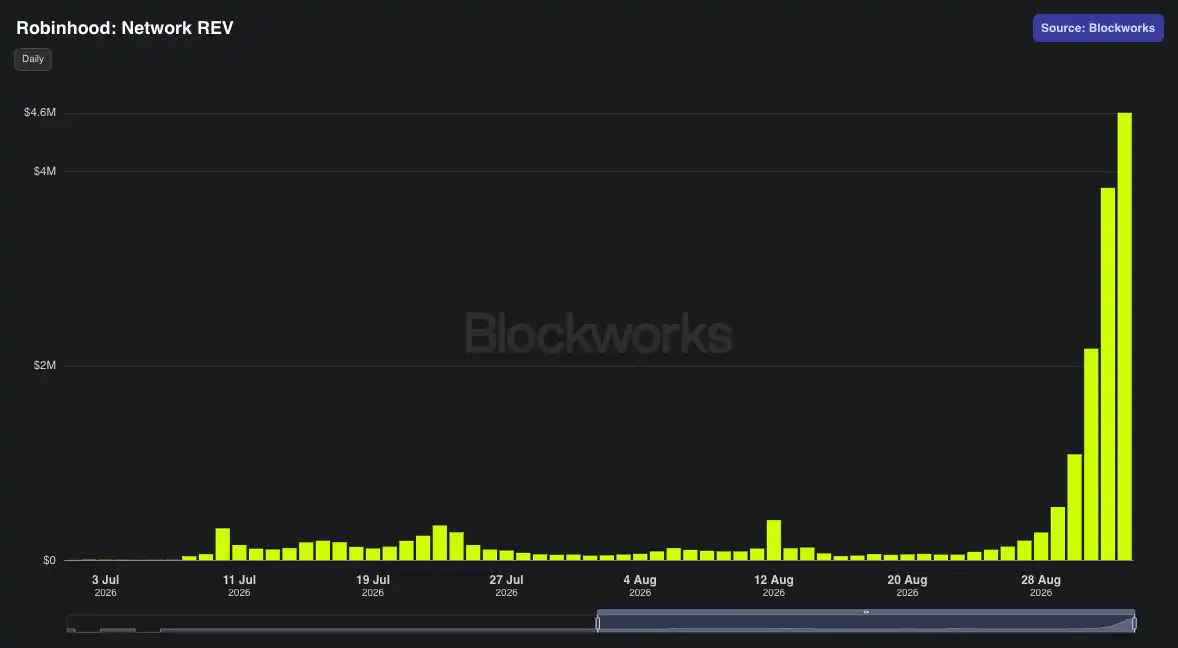
Block space demand on the Robinhood Chain is recovering, with REV breaking $4.6 million yesterday. This marks 11 consecutive days of rising demand on this young L2, bringing it to 97% of total L2 profits and 42% of all on-chain network revenue. One can't help but annualize that number and imagine even greater implications for HOOD stock and the network's applications.
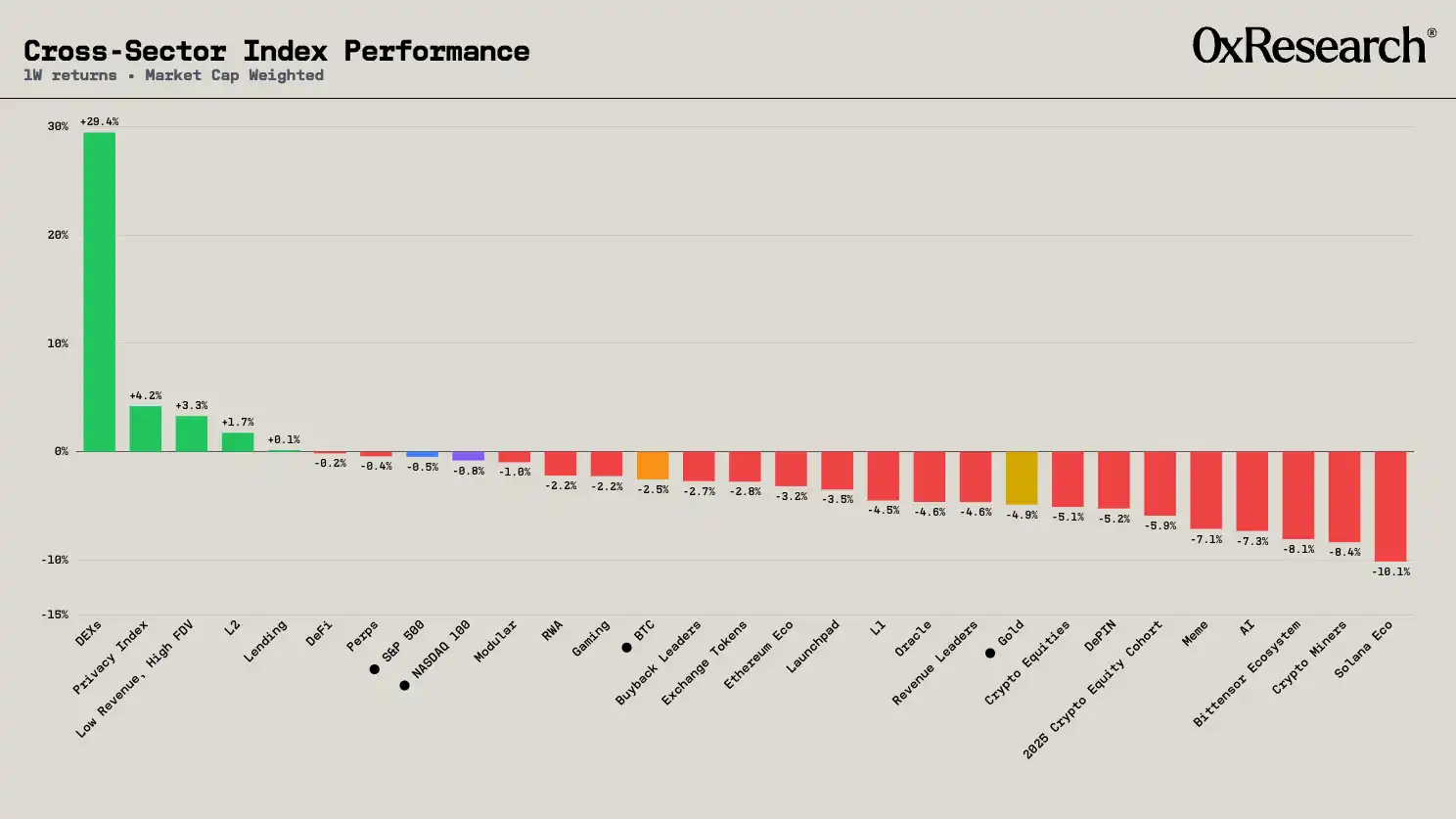
Uniswap is one such winner, being the largest DEX on the Robinhood Chain. Recent token incentive adjustments and a breakthrough deployment on Robinhood drove the token up 33% this week, leading index gains during a week of sideways movement for major coins and a stock market dip. Index data confirms this, with the DEX sector up 29% this week, a clear divergence from overall price action. UNI drove that outperformance.
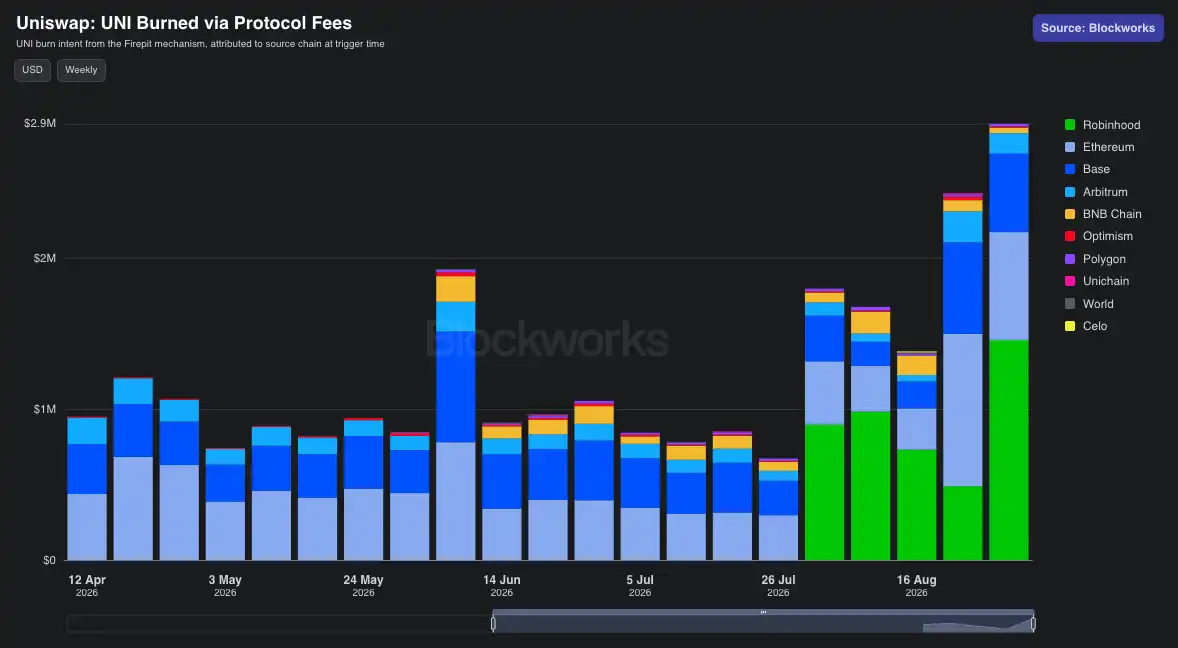
The launch of Robinhood Chain represents a "growing the pie" scenario. It's not taking volume from existing platforms but bringing incremental demand to the entire on-chain economy. For Uniswap, this is evident in the UNI burned via protocol fees, which are at weekly highs, with over 50% of the burn originating from Robinhood Chain. Similarly, over the past 30 days, Robinhood Chain accounted for more than 50% of all on-chain Uniswap total volume. Looking at recent activity, deployment volume on Robinhood exceeded the combined activity of all other chain deployments, including the ETH mainnet.
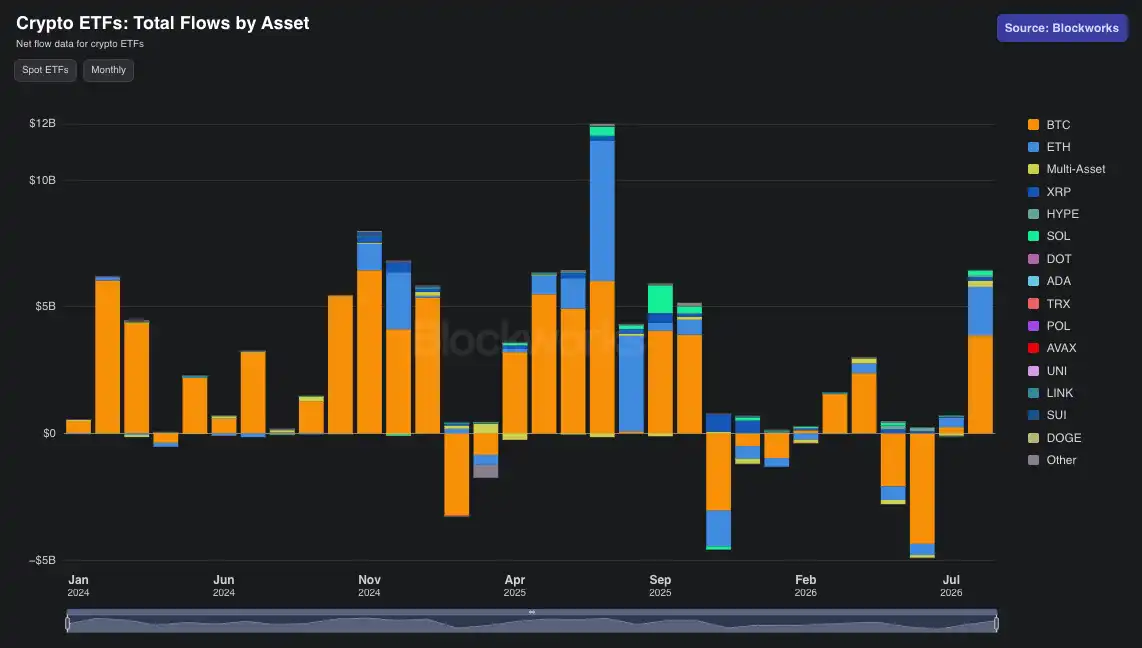
Beyond the on-chain battlefield, ETFs appear to be bottoming in AUM, suggesting major tokens might be forming a higher time frame low. In August, BTC ETFs added $3.871 billion, and ETH ETFs added $1.911 billion. SOL and HYPE products also saw demand, albeit far less than their predecessors.
Taken together, flows, fundamentals, and price action all support an optimistic outlook for year-end and beyond.

Anatomy of the Helium Short Squeeze

HNT hit a multi-year low of $0.167 on August 15, with a market cap nearing $31 million. Two weeks later, the token touched $0.96 intraday, a 5.7x rally from trough to peak. As of this morning, it trades around $0.50, still up over 125% this week with a market cap of about $95 million. This rally warrants dissection because the catalysts were real, positioning amplified them, and the on-chain record is more interesting than either narrative.

The news unfolded in four steps. Helium published HIP-150 on August 21, proposing to redirect Mobile subDAO issuance to deployers carrying paid data traffic. On August 28, Helium announced Celina, Texas had switched its public Wi-Fi to operator coverage on the network. Shorts got crushed over that weekend, the community passed HIP-150 on August 31 with 96.2% voting power in favor, and Helium followed on Tuesday with the launch of HeliumOS, a B2B platform giving operators and MVNOs tools to lease coverage rather than build it themselves.

The US Census Bureau listed Celina as the fastest-growing US city among those with over 20,000 residents. The city layered Helium's operator offload onto its existing Wi-Fi in public libraries, senior centers, and downtown stores, with phones connecting via Passpoint credentials on their SIM cards. Helium's oracle showed the entire Mobile network transmitted 78,000 GB on the day of the announcement, with Celina accounting for roughly 0.1%.
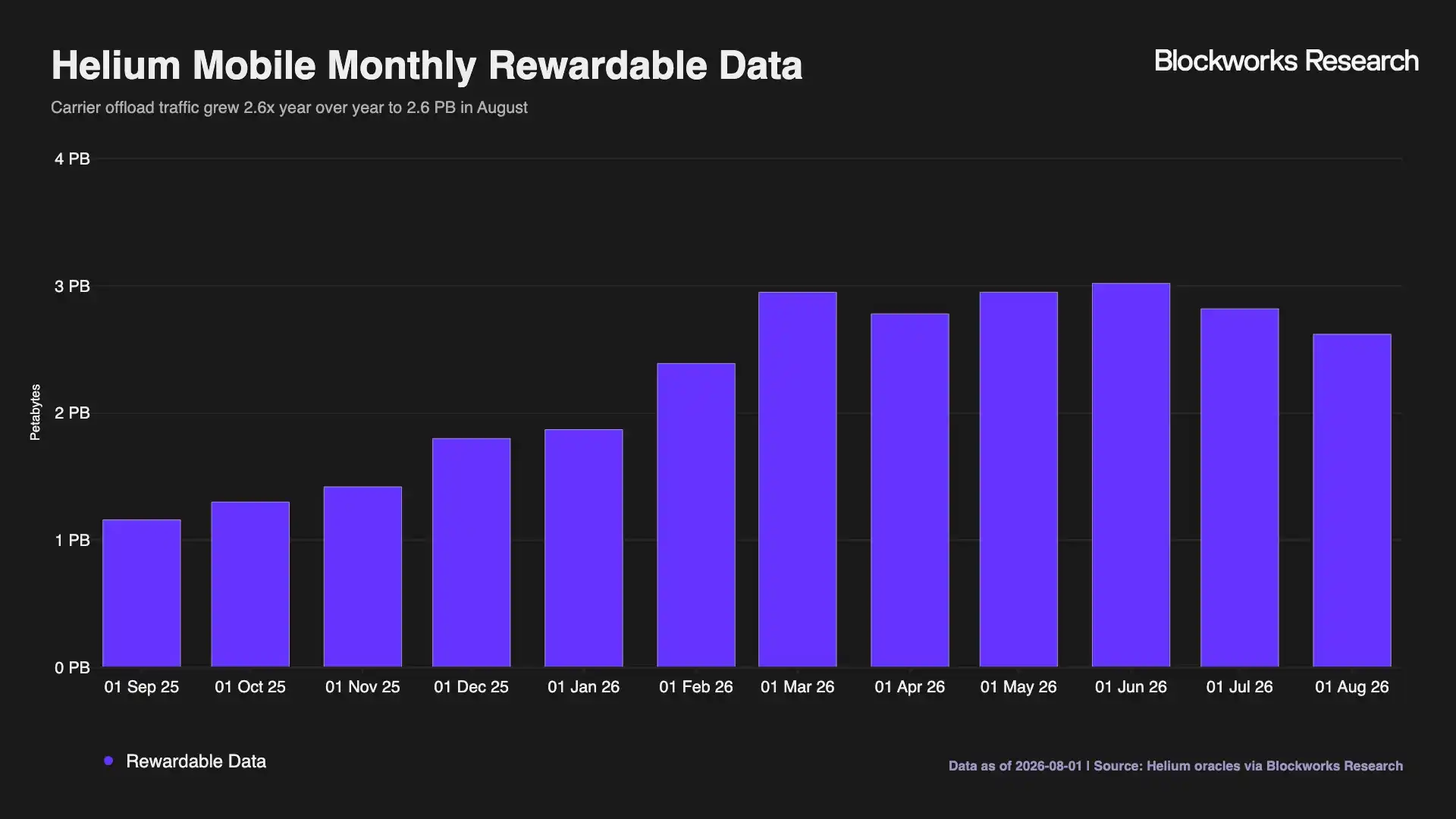
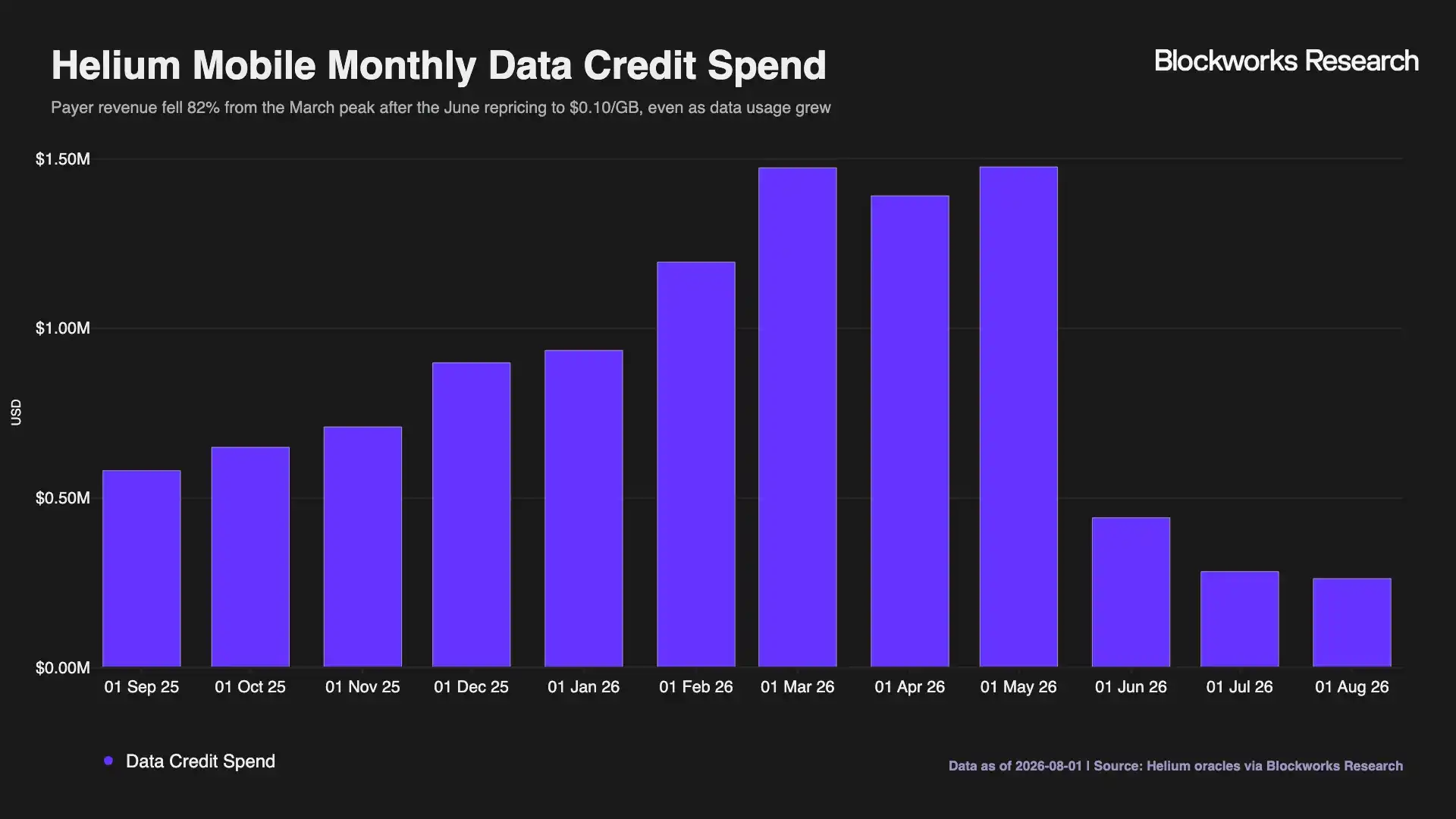
Zooming out, fundamentals diverge in two directions. Usage looks strong, with rewardable operator offload data up 2.4x year-over-year from 1.26 PB in August 2025 to 3.06 PB last month, and daily traffic holding the trend through the rally without an inflection. Revenue goes the other way. Payors spent $263,000 in Data Credits on mobile traffic in August, down 82% from a $1.47 million peak in March.

As we reported in June, the $0.50/GB rate behind that peak was subsidized by Nova Labs, burning its own HNT as a stopgap while operators negotiated location-based pricing ranging from zero in low-value sites to over $0.50 in airports. HIP-143 brought the nominal rate to about $0.10/GB, a level operators could accept at scale, and oracle data shows the subsidy tapered off in June. The March peak measured Nova's balance sheet as much as operator demand. August's DC burn is the first clean read of operators' organic spend.
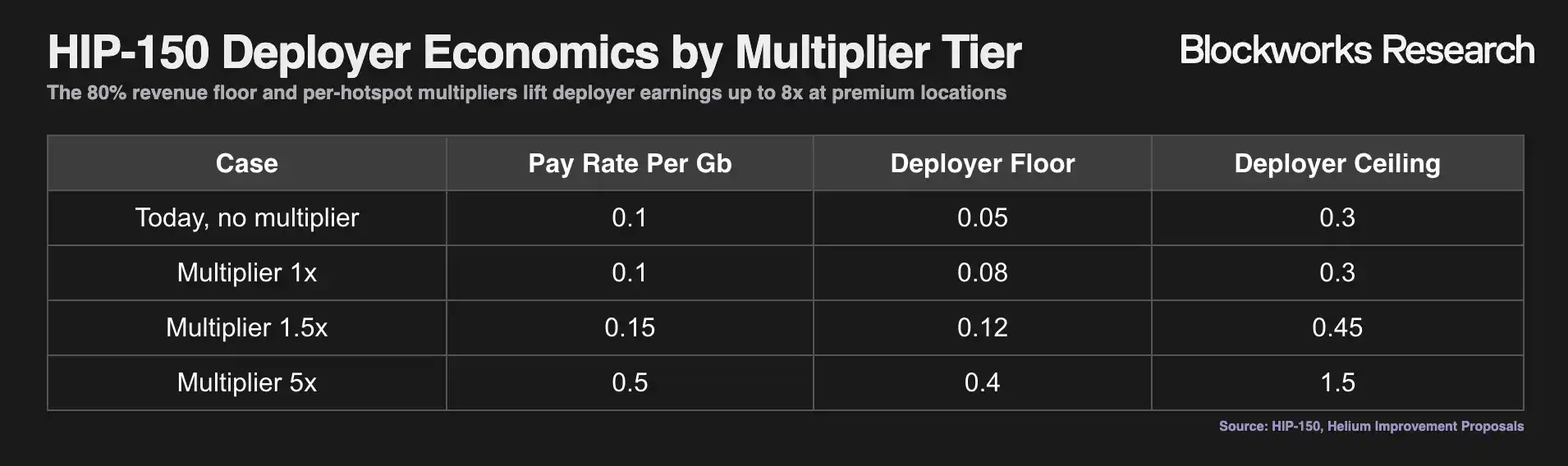
The subsidy's removal explains the urgency of HIP-150. HIP-149, passed in July, set deployer floor prices at 50% of the new operator rate, or $0.05/GB. August's proposal restored their economic incentive, raising floors to 80% ($0.08/GB) with multipliers up to 5x per hotspot, formalizing location-based pricing that operators had already negotiated off-chain, while redirecting Backstop mints directly to the deployer data rewards pool, plugging a leak where the DAO minted $1.60 worth of HNT for every $1.00 that reached deployers. Nova Labs will provide its service provider rewards through July 2027, raising the Mobile data bucket's share of the subDAO from 70% to 94%.
The valuation math remains harsh. August's Data Credit spend annualizes to ~$3.1 million against a $95 million market cap, or about 30x payor revenue, and the supply side works against holders.

HIP-149's growth subsidy mints ~5.96 million HNT per month for the first year into a Nova-managed treasury. That lifts the effective max supply from 206 million to 347 million tokens. So at current rates, operator burn runs at less than a tenth of monthly issuance.

Positioning filled the gap. HNT perpetual funding rates dropped below -1.2%, with $1.6 million in short liquidations over the weekend against less than $200,000 for longs. Volume hit $248 million on August 30, exceeding the entire market cap.

The tape describes a short squeeze that found a good story.

This squeeze has repriced HNT to a level where growth bets must pay off.

Nova sold the consumer business, ended the subsidy, and now funds operator expansion via the HIP-149 treasury. So value accrual can only come from operator offload burn growth, at a pace that exceeds new issuance.

Management set its own target in June: an inflection point at 7 to 10x current traffic. That's when Helium's roaming share from partner operators reaches double digits and pricing leverage flips.

HIP-150 keeps deployers solvent on the way there. HeliumOS is the platform layer promised in Di Dio's roadmap, though its launch customer Affinity Ventures owns Noble Mobile and recently acquired Helium Mobile.


Related Questions

QWhat is the main contradiction identified in Helium's (HNT) recent price surge?

AThe main contradiction is that while the HNT token price surged 5.7 times in two weeks, driven by news catalysts and a short squeeze, the network's actual revenue from data credits plummeted by 82% during the same period.

QWhat were the four key news events that drove the recent price action for HNT?

AThe four key events were: 1) The proposal of HIP-150 to redirect Mobile subDAO emissions to deployers carrying paid data traffic (August 21). 2) The announcement that Celina, Texas switched its public Wi-Fi to Helium network coverage (August 28). 3) The community passage of HIP-150 with 96.2% voting approval (August 31). 4) The launch of HeliumOS, a B2B platform for operators and MVNOs (September 3).

QHow did the change in Data Credit (DC) pricing and subsidies contribute to the drop in revenue?

AThe peak revenue in March was artificially high due to subsidies from Nova Labs, which burned its own HNT to set a rate of ~$0.50/GB. HIP-143 later adjusted the nominal rate to ~$0.10/GB, a level sustainable for operators. The subsidies were phased out by June. The August DC burn of $263k represents the first clean reading of organic operator spending, explaining the 82% drop from the subsidized peak.

QWhat role did market positioning and derivatives play in the HNT price surge?

AMarket positioning, particularly a high level of short interest, amplified the price surge into a short squeeze. HNT perpetual funding rates fell below -1.2%, and over a weekend, short liquidations reached $1.6 million compared to less than $200k for longs. Trading volume on August 30th exceeded the entire market cap, indicating intense speculative activity.

QAccording to the article, what must happen for Helium's current valuation to be justified?

AFor the current valuation to be justified, the growth from operator data offload burn must accelerate significantly to outpace the new token emissions. Management's target is for a tipping point at 7 to 10 times the current traffic, where Helium achieves a double-digit share of roaming partners' traffic and gains pricing leverage. The recent proposals aim to keep deployers solvent until that scale is reached.

Related Reads

Tech Veteran: Anthropic IPO Will Be the Peak of the US AI Rally, Will "Go Big on China AI" If Conditions Allow

Veteran tech investor Jack Selby, head of Copper Sky and managing partner of Peter Thiel's family office, warns that Anthropic's planned IPO—aiming to raise up to $100 billion—could mark the peak of the AI market rally. He cautions that if the highly anticipated IPO prices well below expectations, the expiry of lock-up periods could trigger significant selling pressure and a large-scale AI market correction. Selby names SoftBank and Oracle as "canaries in the coal mine," flagging Oracle's higher debt ratio as a bigger risk, and suggests investors needing AI exposure consider Google instead. Selby also questions Anthropic's fundamentals: over 80% of its revenue is non-recurring and vulnerable to competitors closing the technology gap within six to nine months. He notes the business is extremely capital-intensive—requiring costly data, energy, data centers, and chips—and that with interest rates no longer near zero, calling it a trillion-dollar company seems far-fetched. He further highlights Chinese competition, saying DeepSeek and other Chinese AI models trail Anthropic by only about six months, posing a direct threat. Selby says he would "aggressively go long on Chinese AI" if conditions allow, arguing that Anthropic cannot claim all its business must rely on U.S. models, since most AI use cases resemble basic tool applications, leaving room for Chinese alternatives.

marsbit2h ago

Tech Veteran: Anthropic IPO Will Be the Peak of the US AI Rally, Will "Go Big on China AI" If Conditions Allow

marsbit2h ago

Grayscale's $1 Million Sponsorship Can't Save It: Why ZEC, Once Hyped as the Belle of the Ball, Crashed Again?

Grayscale announced a $1 million ecosystem sponsorship for Zcash on November 10, pledging to return all first-year management fees from its Zcash ETF (ZCSH) to network development and marketing, with the first $100,000 distributed to four nonprofit organizations. Yet the same day, ZEC plunged 11.3% to around $1,043, extending its 30-day decline to nearly 20%. After two months of hype from overseas KOLs and institutions touting ZEC as a "second spring for old coins," the token quickly turned into a slow bleed under the weight of $2.3 billion in open interest. The article argues that Wall Street's narrative halo and Grayscale's PR subsidy have been exhausted, and ZEC—lacking fundamental support—has once again become an ATM for highly leveraged speculators to cash out on good news. Grayscale's pledge, while seemingly generous, is voluntary and can be modified or terminated at any time; only $400,000 of the $1 million has actually been paid, making it more brand marketing for its own ETF than genuine ecosystem donation. The sum is negligible relative to Zcash's market cap, and the Zcash ETF has not attracted sustained institutional capital the way Bitcoin or Ethereum ETFs did. Without new external liquidity, the inflated narrative cannot hold. The core problem is market structure: ZEC perpetual futures open interest stands at roughly $2.3 billion, dominated by high-volatility leveraged gamblers. The article contends that the earlier social media hype was a precise harvest of derivatives liquidity—promoters used the "first privacy ETF" theme to lure retail into leveraged longs, then exited as open interest peaked and the sponsorship news landed. Compounding this, Zcash's privacy pool suffered a critical vulnerability about three months before the ETF listing, halving the price and shattering conservative investors' confidence despite a July fix. The piece concludes that "old coin re-hype" follows a familiar script: find a traditional-finance-approved angle, package a grand revaluation narrative, use KOLs to drive retail buying, then distribute chips at peak liquidity. Those who hyped ZEC have largely cashed out, leaving behind a broken price and $2.3 billion in unsettled leverage. Grayscale's advertising cannot save Zcash; a real revival requires far more than Wall Street's charity.

marsbit3h ago

Grayscale's $1 Million Sponsorship Can't Save It: Why ZEC, Once Hyped as the Belle of the Ball, Crashed Again?

marsbit3h ago

Trading

Spot
活动图片