The Market Size of Risk-Weighted Assets (RWA) Exceeds 38 Billion Dollars, but the Next Challenge Will Be Liquidity

cryptonews.ruPublished on 2026-09-15Last updated on 2026-09-15

Abstract

The market for tokenized real-world assets (RWA) has surpassed $38 billion, but the next major challenge is liquidity. While U.S. Treasury bonds form the largest portion of this market, the ability for these assets to move freely between exchanges, serve as loan collateral, and trade with high liquidity is more critical for the sector's future than simply listing more assets. The market is fragmented across blockchains like Ethereum, BNB Chain, and Solana, contributing to liquidity issues. Reports from Castle Labs and others argue that while asset tokenization has expanded access, its true utility depends on composability and seamless movement within the financial ecosystem. Major institutions are increasingly involved, and regulatory frameworks for stablecoins are advancing globally. However, analysis from Pantera Capital and the OECD indicates that liquidity infrastructure is lagging. Many tokenized assets still behave like their traditional counterparts, with market makers, robust pricing mechanisms, and interoperability between systems remaining key hurdles. The future of the sector hinges not on the total value tokenized, but on whether that value can flow and be utilized effectively across the financial landscape.

The volume of tokenized real-world assets (RWA) on the blockchain has exceeded 38 billion dollars, yet this figure is less significant than what awaits us in the future. In a report published on Monday, September 14, 2026, Castle Labs argued that the industry's future depends not on the number of listings, but on whether tokenized assets can move between exchanges, serve as loan collateral, and be traded with high liquidity.

This distinction is of paramount importance for institutions exploring tokenization, as well as DeFi protocols seeking profitable collateral. It will determine whether tokenized assets can bring meaningful benefit or remain merely digital shells within traditional financial systems.

Treasury Bonds Form the Foundation of the 38 Billion Dollar Base

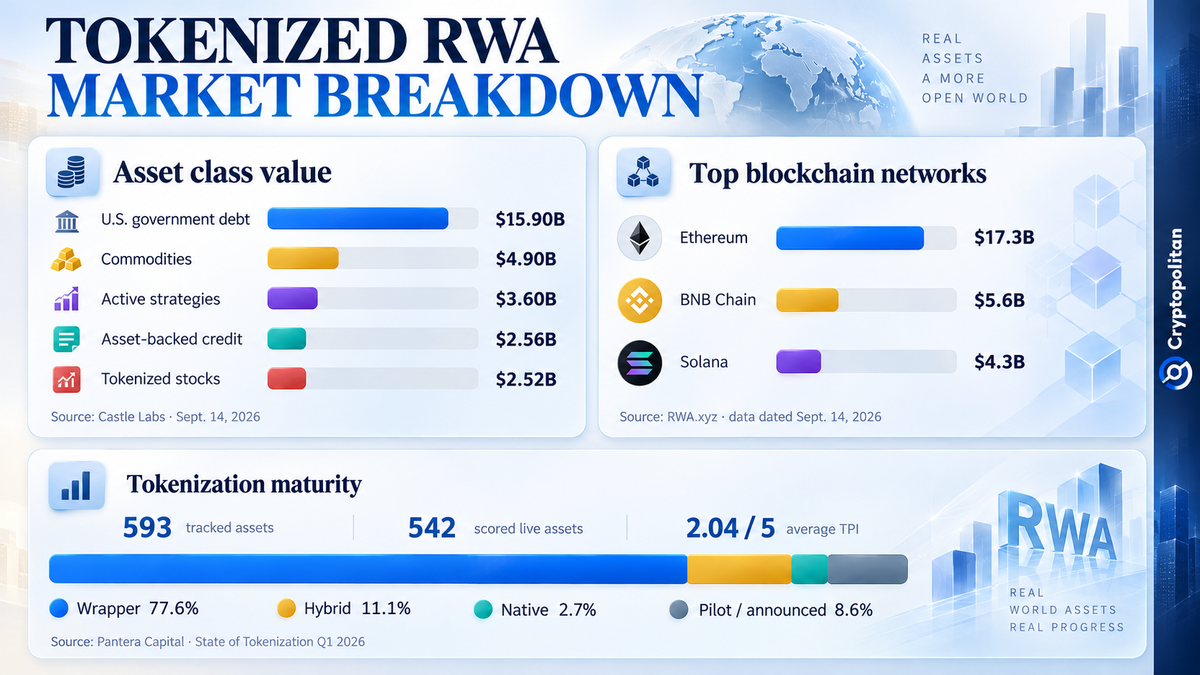
As of September 15, 2026, RWA.xyz reported a distributed asset value of $38.86 billion, up 1.00% over 30 days, and approximately 4.24 million holders. According to Castle Labs, U.S. government debt accounts for over $15.9 billion. Other asset types include: commodities worth $4.9 billion, active strategies worth $3.6 billion, asset-backed loans worth $2.56 billion, and tokenized equities worth $2.52 billion.

The market is also segmented by the blockchains where transactions occur. According to RWA.xyz's ranking as of September 14, the top three networks are Ethereum with $17.3 billion, BNB Chain with $5.6 billion, and Solana with $4.3 billion. The provided information indicates a persistent issue of tokenized assets being distributed across various blockchains, leading to liquidity problems.
Analysis of the Risk-Weighted Asset (RWA) Tokenized Market: Asset Classes, Blockchains, and Maturities in 2026

According to a 2026 CoinGecko report, the volume of risk-weighted tokenized assets (RWA) exceeded $19.3 billion by the end of the first quarter, more than tripling since January 2025.

Listing Assets Has Now Become a Simple Task

Castle Labs claims the supply-side problem is no longer relevant. Companies such as Kraken, Robinhood, Ondo, Securitize, Franklin Templeton, and BlackRock can already provide tokenized access in one way or another.

A more important question is what asset holders can actually do with their assets. Castle Labs divides utility into two categories: accessibility and composability. Tokenization has expanded access to trading venues, but assets become useful only when they can move between different venues, be traded with high liquidity, be used as collateral, and efficiently interact with blockchain transactions.

This has become especially relevant with the extension of trading venue operating hours, which, fortunately, deprives traditional markets of the 24/7 access advantage they have held for the past few years.

Regulation and Institutions Take Action

The sector has found favorable state policies that support its long-term growth. According to TRM Labs, stablecoin regulation had advanced in over 70% of 30 jurisdictions by 2025, and approximately 80% of financial institutions made statements about their digital asset initiatives.

The implications for the banking sector are manifesting at a structural level. In a note published by the IMF in April 2026, economist Tobias Adrian noted that tokenization could enable atomic settlement, continuous liquidity management, and the implementation of regulatory requirements. However, without a proper legal framework and secure settlement assets, tokenization could increase instability by accelerating banking runs and increasing concentration and fragmentation.

A May report from BCG stated that today, risk-weighted digital assets (RWA) are small in scale; however, in the coming decade, digital RWAs are likely to have the greatest structural significance in the banking sector.

Why Does Liquidity Still Lag Behind?

In its Q1 report, Pantera Capital recorded a total of 593 assets, of which 542 were active. The average tokenization progress index for the quarter was only 2.04 out of 5. According to Pantera, of the tracked assets, 77.6% were classified as 'Wrapper', 11.1% as Hybrid, and only 2.7% as Native.

Pantera compared the RWA market to the early phase of the internet when "newspapers were placed on websites": meaning known products moved to another technological platform, though most have yet to fully leverage their potential. In practice, many tokenized assets still behave much like their traditional counterparts, which partly explains why liquidity and market infrastructure are struggling to keep pace with developments.

The Organisation for Economic Co-operation and Development (OECD) reached the same conclusion, identifying insufficient liquidity, a lack of payment networks, gaps in securities custody, legal uncertainty, and lack of interoperability as factors hindering wider adoption.

Cryptopolitan also noted that tokenization alone is insufficient to ensure liquidity, and that market makers, two-way order flow, and a reliable price discovery process will still be necessary.

The future of tokenization will no longer be solely about how much value is tokenized, but whether that value can truly move and be utilized within the financial context.

Related Questions

QAccording to the article, what has surpassed $38 billion, and what is presented as the next major challenge for this sector?

AThe market for tokenized real-world assets (RWA) has surpassed $38 billion. The next major challenge identified is liquidity, specifically whether these assets can move across exchanges, serve as loan collateral, and trade with high liquidity.

QWhat are the top three blockchain networks by value of tokenized assets mentioned in the report from September 14, 2026?

AThe top three blockchain networks by value of tokenized assets are Ethereum with $17.3 billion, BNB Chain with $5.6 billion, and Solana with $4.3 billion.

QHow does Castle Labs differentiate the current focus in tokenization from the more important future challenge?

ACastle Labs states that the initial problem of supply (listing assets) is now largely solved. The more important future challenge is utility, specifically the composability and accessibility of assets—moving them across platforms, trading them with high liquidity, and using them as collateral.

QWhat did Pantera Capital's Q1 report compare the current RWA market phase to, and what does this imply about the technology's use?

APantera Capital compared the RWA market to the early 'newspapers on websites' phase of the internet. This implies that while assets are being ported to a new technological platform (blockchain), most have not yet fully leveraged its potential and still behave similarly to their traditional counterparts.

QWhat regulatory progress and institutional engagement regarding digital assets are highlighted in the article?

AThe article notes that by 2025, stablecoin regulation had advanced in over 70% of 30 jurisdictions surveyed by TRM Labs. Furthermore, around 80% of financial institutions had made statements about their digital asset initiatives.

Related Reads

Materials Science Agent MatOS Officially Open-Sourced, Significantly Improving the Success Rate of Materials R&D Tasks

MatOS is an open-source agent operating system for materials research developed by the Beijing Zhongguancun Academy and Zhongguancun Institute of AI. It addresses key challenges in autonomous materials research: integrating new databases and software without rebuilding pipelines, maintaining state over multi-day tasks, and reusing accumulated experience across studies. MatOS organizes data, knowledge, tools, skills, roles, and workflows into six types of scientific assets connected through typed relationships, allowing both researchers and the system itself to build new capabilities on existing assets. Its stateful adaptive workflows use execution graphs with explicit steps and check conditions to keep long tasks on target, support mid-task adjustments after structural, policy, and compilation checks, and preserve snapshots independent of model sessions. An evidence-driven evolution mechanism converts user corrections, tool failures, and workflow results into candidate asset revisions, which are adopted only after structural and semantic review. The asset library currently includes 3,135 datasets, 386 skills, 104 workflows, 51 expert roles, and 48 materials computation tools. On the ResearchClawBench benchmark, MatOS scored 33.6% higher than Codex CLI on average and 80.8% higher on materials tasks; on MatTools it achieved 97.96% full-problem success. Case studies include screening 97 solid-state electrolyte candidates from over 30 million structures, alloy design with melting scores improved from 0.534 to 0.927, and developing DuoCompNet with a mean absolute error of 3.18°C. Next steps include integrating instruments and experimental workflows.

marsbit22m ago

Materials Science Agent MatOS Officially Open-Sourced, Significantly Improving the Success Rate of Materials R&D Tasks

marsbit22m ago

Gemini's New Model is Ready to Launch, Netizens: Going Through the Periodic Table of Elements?

Google's Gemini 4 series has adopted an element-themed naming scheme, and developers have now spotted a new model identifier, gemini-4-neon, in the Gemini web app code, alongside a matching subscription tier labeled TIER_NEON (displayed as "Gemini Ultra" but treated separately internally). Neon is element No. 10, which has amused and confused users, since Hydrogen (No. 1) was followed by Argon (18) and Carbon (6), with no obvious order. The series so far includes Gemini 4 Argon (complex software engineering, deep reasoning, cybersecurity), Gemini 4 Carbon (long-horizon agent tasks, coding, security), and Gemini 4 Hydrogen (speed and efficiency for everyday coding and agent workflows). Rumors of a Krypton model turned out to be a higher-reasoning Gemini 4 Hydrogen. Commenters joke that Google is picking elements at random, that naming is like Starbucks cup sizes, and that at this rate Google will need to discover new elements (with calls for Oganesson, No. 118). Some suggest the names do carry meaning: Argon means "lazy/inactive," fitting stable security work; Carbon is the basis of life and complex structures; Hydrogen is the lightest element, fitting speed; and Neon derives from "neos" (new). Beyond naming, Google's subscription tiers and six Gemini access points are also confusing users, with some Pro subscribers not seeing new models and accounts showing different model access.

marsbit22m ago

Gemini's New Model is Ready to Launch, Netizens: Going Through the Periodic Table of Elements?

marsbit22m ago

Trading

Spot
活动图片