Capital starting to rotate back to crypto from AI: Raoul Pal

cointelegraphPublished on 2026-10-07Last updated on 2026-10-07

Abstract

Capital may be rotating from AI back into crypto as a weakening US dollar could provide a "green light" for the industry's rally, says Real Vision founder Raoul Pal. He notes that high bond yields and a strong dollar have constrained liquidity, but a weaker dollar could improve conditions. Pal observes that recent pauses in the AI trade, evidenced by Nvidia's stock decline during Bitcoin's August surge, allowed capital to flow into crypto. However, a full AI crash would be detrimental, signaling a liquidity drain. For crypto's continued rise, Pal prefers a scenario of a weaker dollar, steeper yield curve, and expanded money supply. Alternatively, sideways-trading AI stocks could also enable capital rotation into crypto. Regarding AI's impact, Pal suggests AI agents could increase economic activity on smart contract platforms like Ethereum and Solana by using them for transactions and potentially raising funds via token issuance. While enthusiastic about both networks, Pal is cautious about Solana overtaking Ethereum in market cap, citing Ethereum's greater "economic density"—more capital per user—as Solana's activity currently involves smaller, more speculative amounts. He refrains from specific price targets but suggests Bitcoin reaching $1 million by 2032 reflects broader adoption trends.

A weakening US dollar could give crypto the “green light” and help extend the industry’s rally, says Real Vision founder Raoul Pal.

He tells Cointelegraph on the latest episode of Trade Secrets that higher bond yields and the strong dollar are keeping liquidity from flowing freely.

“If they can engineer the dollar lower, then we get a green light for further movement in crypto,” he says. “I don’t want to get overly excited, so I haven’t got a full green light on everything.”
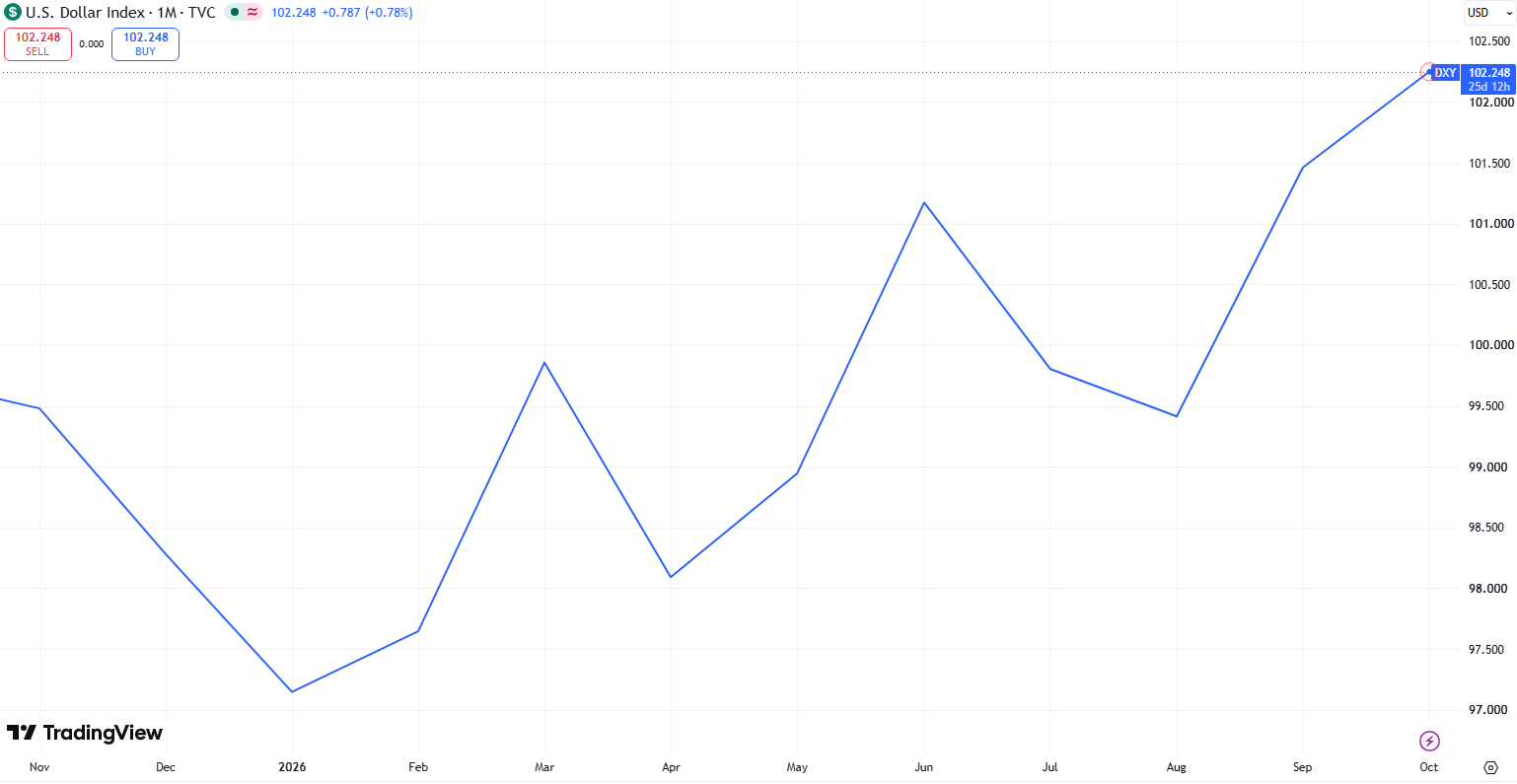
The US Dollar Index has been trading at the year’s highest levels. Source: TradingView


However he believes Bitcoin will miss out of much of the crypto economic activity generated by AI agents, which is likely to flow to smart contract platforms like Ethereum and Solana.

Related: El Salvador receives $138 million from IMF after Bitcoin waivers granted

Pal is among the most experienced high profile crypto analysts, having worked in hedge fund sales at Goldman Sachs in Europe and co-managed a global macro fund at GLG Partners. He launched the research platform Global Macro Investor in 2005 and co-founded financial media Real Vision in 2014.

Pal says he first bought Bitcoin in 2013, after applying a gold-based valuation framework to the cryptocurrency.

An AI pause could help crypto catch up

Bitcoin’s cycle recovery arguably came between Aug. 19 and Aug. 25 when BTC rose about 25% to $80,000. Interestingly, over that period, AI bellwether stock Nvidia notched up seven consecutive losing sessions.

Pal says pauses in the AI trade have allowed capital to rotate into crypto.

“You can tell there’s this sort of rotation for liquidity that’s around right now, which means it’s not abundant yet,” he says.
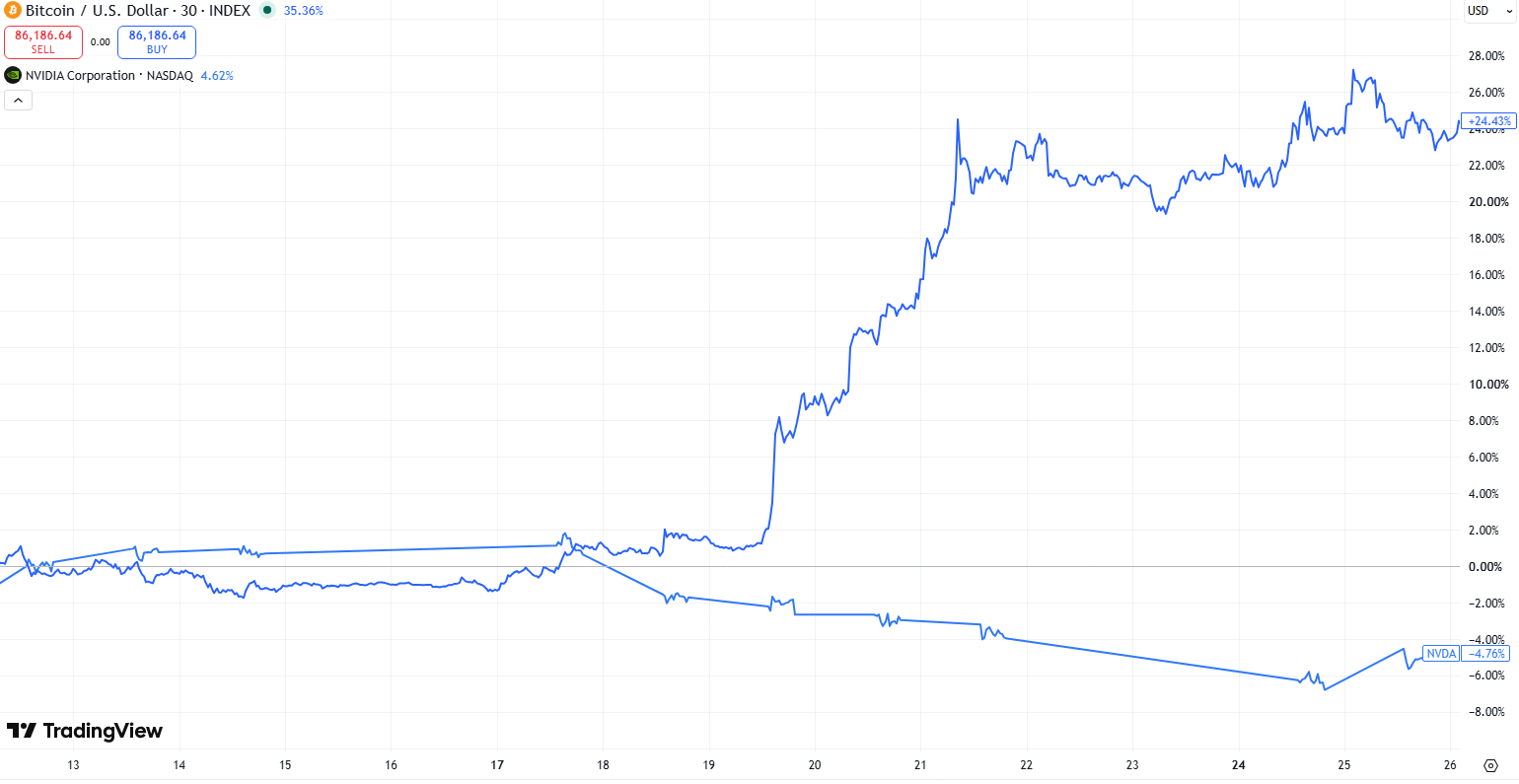
Bitcoin rallied while Nvidia shares fell in August. Source: TradingView

While AI has been competing with crypto for funds, an AI crash would be an unwelcome prospect, as a bursting bubble would indicate that liquidity is being “sucked out of the system,” while threatening the conditions crypto needs to rise.

“Things don’t go bust if liquidity is plentiful,” Pal says.

His preferred outcome would be a weaker dollar, a steeper yield curve and banks expanding the money supply through increased lending.

However, borrowing costs have been moving higher. The US 10-year Treasury yield climbed to 5.29% in September, while the Fed raised its benchmark rate by a quarter-point.

If those conditions don’t materialize, Pal’s “second best scenario” is for AI stocks to trade sideways, which would allow capital to rotate into crypto.

AI agents could bring more business to Ethereum and Solana

AI agents can now pay to access web content using stablecoins through a feature that Amazon Web Services introduced in June. Coinbase handles payment verification and settlement through its x402 protocol, with USDC on Base among the supported payment options.

Pal says agents could eventually raise the money they need to operate, by issuing tokens to fund projects that could last “a week, a month, a year,” then carrying out the work and generating returns.

He says Ethereum and Solana could attract more activity as software uses their smart contracts to transact.

“My guess is they’ll get more adoption over time as AI uses them,” he says.

Related: Coinbase’s AI payments protocol x402 launches app store for AI agents

Solana needs more than activity to overtake Ethereum

Ethereum’s greater concentration of capital makes Pal cautious about claims Solana will overtake it in market value, despite his enthusiasm for both networks.

Multicoin Capital co-founder Kyle Samani predicted on Trade Secrets last month that SOL would surpass Ether’s market capitalization “this market cycle.”

Samani “needs to hold his horses a little bit,” Pal says, even though he acknowledged that it is possible.

The networks are ahead of each other on different metrics. Solana recorded around 3.2 million active addresses over the preceding 24 hours on Monday, compared with Ethereum’s 387,000, according to DefiLlama. But Ethereum has about $54.4 billion in decentralized finance protocols, which is far ahead of Solana’s $6.7 billion.

Pal compares the networks using what he calls “economic density,” dividing total value locked by active users. He says Ethereum attracts more capital relative to its user count, and Solana’s activity involves smaller amounts.

“Solana’s core activity is speculation,” he says. “It’s just smaller clip sizes.”

Pal says he has stopped giving public price targets because his forecasts get clipped and recirculated online. He describes million-dollar Bitcoin by 2030 as a “meme” reflecting growing adoption, ETF interest and Bitcoin’s use as collateral.

“Does it make a million bucks? I don’t know, but certainly by 2032, yeah, I don’t have an issue with that.”

Magazine: Former SEC boss made AI Czar, Bitcoin may hit $600K this cycle: Hodler’s Digest

Related Questions

QAccording to Raoul Pal, what condition could give crypto the 'green light' for further movement?

AA weakening US dollar could give crypto the 'green light' for further movement, as higher bond yields and a strong dollar have been keeping liquidity from flowing freely.

QWhat recent market event does Pal suggest allowed capital to rotate from AI into crypto?

AA pause in the AI trade, specifically when Nvidia stock had seven consecutive losing sessions between August 19 and 25 while Bitcoin rallied about 25%, allowed capital to rotate into crypto.

QWhy does Pal believe Bitcoin will miss out on much of the crypto economic activity generated by AI agents?

APal believes the economic activity generated by AI agents is likely to flow to smart contract platforms like Ethereum and Solana, implying Bitcoin's functionality is less suited for this specific type of activity.

QWhat is Raoul Pal's 'second best scenario' for crypto if his preferred conditions of a weaker dollar and steeper yield curve don't materialize?

AHis 'second best scenario' is for AI stocks to trade sideways, which would allow capital to rotate into the crypto sector.

QWhat metric does Pal use to compare Ethereum and Solana, and what does it reveal about their differences?

APal uses 'economic density,' dividing total value locked by active users. He says this shows Ethereum attracts more capital relative to its user count, while Solana's activity involves smaller amounts and is more focused on speculation.

Related Reads

Just now, Chen Danqi officially announced joining Noeri part-time, a new company betting on AI self-evolution

Princeton computer science associate professor Danqi Chen has revealed she joined AI startup Noeri on a part-time basis two months ago, expressing enthusiasm for its focus on applying AI to scientific discovery so scientists can tackle their hardest research problems. Noeri was co-founded by Stanford computer science professors Yejin Choi and Carlos Guestrin, who serve as co-CEOs. The company focuses on developing AI systems that can continuously learn and self-improve, helping enterprises build customized AI from their own data and business experience. It has raised $110 million led by Menlo Ventures, with participation from Madrona Venture Group, Kindred Ventures, Wing Venture Capital and NEA, plus strategic investors including NVIDIA, Cisco Investments and Snowflake. Choi is a leading researcher in commonsense reasoning, NLP, LLMs and AI alignment, formerly at the University of Washington and Ai2 and a senior research director at NVIDIA. Guestrin is a veteran ML scholar and entrepreneur who co-created XGBoost and co-founded Turi (acquired by Apple in 2016), later serving as Apple's senior director of ML and AI. Chen, an associate professor at Princeton, co-leads its NLP group, serves as deputy director of the Princeton Language and Intelligence initiative, and is a co-author of RoBERTa. Noeri's core idea is "Plural Intelligence" — the belief that future AI should comprise many systems of different scales and specialties, each organization building and continuously improving its own AI, rather than depending on a single corporate superintelligence. Its product acts like a persistent AI engineer: it studies a company's data and workflows and optimizes instructions and skills, tool configuration and orchestration, model selection, and even underlying model parameters. Every change comes with an explanation and requires human review, akin to code review. The system supports both closed and open-weight models and learns from each task's interactions and corrections. Chen said she looks forward to working with Choi, a longtime role model and friend, and is especially excited about plural intelligence in scientific discovery, where specialized AI agents could continuously learn around a specific research question, remember past attempts, and collaborate on hypotheses and validation.

marsbit32m ago

Just now, Chen Danqi officially announced joining Noeri part-time, a new company betting on AI self-evolution

marsbit32m ago

40 Kilometers: Shenzhen Fits an Entire Chip Supply Chain Into a One-Hour Drive

Shenzhen is compressing an entire chip supply chain into a one-hour drive, roughly 40 kilometers. Design firms cluster within 10 km of the Futian APEC venue, while fabs sit 20–40 km away in Pingshan, Pinghu, and Yanluo. The article argues this is not just local ambition but a response to a hard rule: the more mature a process, the easier design and manufacturing can be separated; the more immature, the closer they must be. TSMC's PDK model let California design and Taiwan manufacturing run for 30 years, but only because mature processes could be codified. Shenzhen's outer ring, however, hosts immature work—Huawei's "Tau Law" and stacked "logic folding" chips—where tacit knowledge lives in engineers' heads and demands face-to-face iteration. With回路B (design-process feedback) and回路C (fab-equipment feedback) cut by export controls after 2020, both loops had to return home. Shenzhen lacks an integrated giant like Samsung or Intel, so it uses city governance: a state platform invests across fabs and equipment makers, plus tape-out subsidies up to 10 million yuan. The geography forms a slope—Nanshan offices, Bantian R&D, Guanlan/Pinghu pilot lines, Pingshan fabs—connected by Metro Line 14 (40 minutes Futian to Pingshan). The lesson for planners: zone land by process maturity, not by industry category, and keep the most immature, iteration-hungry steps within an hour's drive rather than chasing a full chain.

marsbit32m ago

40 Kilometers: Shenzhen Fits an Entire Chip Supply Chain Into a One-Hour Drive

marsbit32m ago

German lawmakers back crypto freezes outside criminal cases

Germany’s Bundestag passed a customs reform bill allowing authorities to temporarily freeze cryptocurrency and other high-value assets suspected of unlawful origins without first opening a criminal investigation. The measure targets assets worth over 100,000 euros and explicitly names cryptocurrencies. Authorities could hold assets for up to 30 days given factual indications of unlawful origin, with confiscation applications suspending deadlines pending court decisions; in contested cases courts must be satisfied assets are illicit, effectively placing the burden of proof on the holder. SPD lawmaker Ingo Vogel said the powers let authorities pursue suspicious assets absent grounds for a criminal case. The bill needs Bundesrat consent and is intended to take effect Jan. 1, 2027. The Federal Bar Association (BRAK) opposed the draft, warning “unlawful origin” is too vague and risks treating missing records as evidence of illicit wealth, citing inherited assets as an example, and questioned what the administrative process adds to existing criminal confiscation rules. Bundesblock warned blockchain analysis should not automatically be treated as proof of ownership or control, and incorrect wallet attribution could infringe fundamental rights. Germany has already made large seizures: Saxony sold 49,858 BTC linked to the Movie2k piracy probe in 2024 for about 2.6 billion euros. A Leipzig judge recently proposed ending proceedings against the main defendant for 40,000 BTC and 38 million euros for potential victims; the proposal remains under consideration.

cointelegraph2h ago

German lawmakers back crypto freezes outside criminal cases

cointelegraph2h ago

Trading

Spot
活动图片