If you chat with someone long enough, can a large language model become their 'digital twin'?
From virtual users and synthetic respondents to personalized AI Agents, an increasingly popular technical approach is: first learn about a real person through interviews, questionnaires, and personal data, then have a large language model play that person, predicting how they would answer questions they haven't seen before.
But there's a harder question here: Even if the AI has learned how you think now, can it continue to answer like you in a completely new, previously unasked situation?
To test this, researchers from MIT and other institutions proposed HugAgent, having large language models predict participants' responses to new scenarios—like universal healthcare, public surveillance, and housing densification—based on interviews with real participants. The study covered 54 participants, 1,742 evaluation items, and tested models including GPT, Claude, Gemini, DeepSeek , Llama, and Qwen. The related paper was accepted as an EMNLP 2026 Main Oral presentation.
Paper link: https://arxiv.org/abs/2510.15144
Code link: https://github.com/jajamoa/HugAgent
Project homepage: https://jajamoa.github.io/HugAgent/
The study found that personal interviews do help models simulate a specific individual more accurately. But a more noteworthy phenomenon is: Chatting longer with a person makes the AI clearer about how they think *now*, but doesn't necessarily make it better at knowing how they would answer if conditions change.
This raises a more fundamental question for 'digital twins': Is the AI building a model *of* you, or is it just building an increasingly detailed profile *about* you?

From 'like an average person' to 'like *this* specific person'. HugAgent further asks: When conditions change, can the AI still represent this person?
Why HugAgent is Needed
From 'Like a Human' to 'Like This Human'
Over the past few years, using LLMs to simulate humans has gradually become a genuine research path. Researchers have had LLMs play consumers, voters, and experimental participants. Going further, they've also begun attempting to simulate a real, specific individual: building a 'digital twin' through prolonged interviews, questionnaires, and personal data, then having the AI represent the person in subsequent new questions.
This path sounds natural. The more information a person gives the AI, the more the AI understands them, and thus it *should* be better at predicting their responses.
But there's a crucial leap here:
Describing a person and predicting a person are not the same thing.
Suppose someone states in an interview that they support universal healthcare, but also expresses concerns about cost, efficiency, and personal choice. The model might already accurately judge their current stance.
But what if the conditions change?
If a new plan could save their family $3,000 annually, or if private insurance could still be retained, would they make the same choice?
At this point, the model's task is no longer just remembering 'they support universal healthcare'. It must infer from past expressions what they truly value and how they would re-evaluate their stance when different conditions change.
This is precisely the problem HugAgent aims to examine:
If we build a sufficiently rich persona through interviewing, can it predict how this person would answer *outside* of the interview?
This is an unavoidable question after moving from 'like a human' to 'like *this* human'.
HugAgent Doesn't Just Record Answers
It Also Asks 'Why'
To test whether an AI can simulate '*a* specific person', we first need to know what that person themselves actually thinks.
Therefore, HugAgent did not start from public figure profiles or online text, but instead recruited real participants. The team selected three topics with significant disagreement in the US, involving real trade-offs: universal healthcare, public surveillance, and housing densification (i.e., relaxing zoning restrictions to allow taller, denser housing). After quality screening from over 120 recruits, 54 participants were retained.
Step One: Questionnaire, recording 'you now'.
Participants first provided demographic information, then gave a support score from 1 to 10 for different issues. Simultaneously, they rated how much a series of reasons influenced their stance.
For example, two people might both oppose housing densification, but one might be most concerned about neighborhood character and property values, while the other might care mainly about traffic, rent, or housing supply. The final 'support or oppose' is just an answer; what truly differentiates people are the reasons *behind* the answer and how important each reason is.
This information together forms a person's current *belief state*—what stance they hold now and the reasons supporting it.
Step Two: Change a condition, record 'what if...'.
Next, the questionnaire changed one of the conditions.
What if, after densification, local rents dropped 10-15%? What if universal healthcare saved a family $3,000 per year? What if public surveillance footage was only stored for 48 hours?
Participants needed to restate their stance in each new hypothetical scenario and re-evaluate the importance of relevant reasons.
Thus, the research team not only knew how a person 'thinks now', but also recorded how they themselves would re-answer when a certain condition changed. The change between the two states constituted the *belief update* that HugAgent wanted to predict.
More importantly, these answers came from the participants themselves. When the model later took the test, it would not directly see the correct answer for the target scenario.
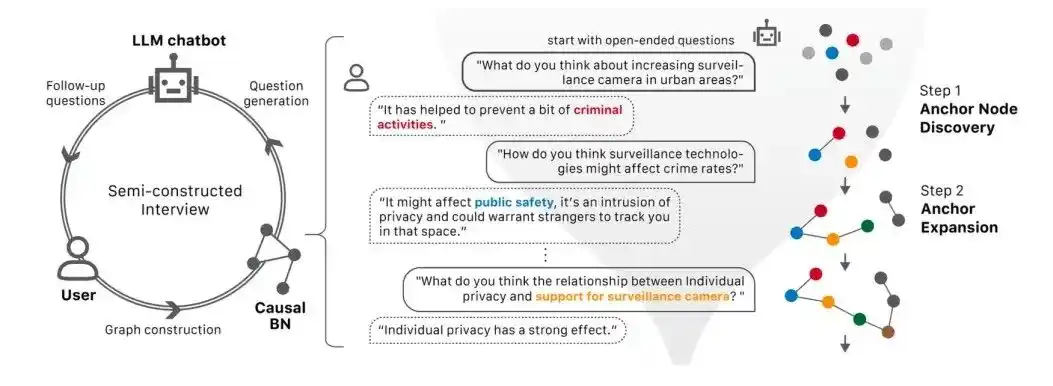
Caption: The TraceYourThinking interview process. The system starts with open-ended questions, dynamically constructs a causal belief graph based on the participant's responses, automatically generates the next round of follow-up questions, and gradually understands a person's views, reasons, and the relationships between different factors.
Step Three: Think-aloud interview, slowly drawing out the 'why'.
Just recording questionnaire answers wasn't enough.
Participants then underwent a semi-structured think-aloud interview via the team's open-source chatbot, TraceYourThinking. They could type or use voice, thinking out loud while explaining their reasoning.
This wasn't a fixed list of questions from start to finish.
The bot would dynamically organize the person's 'causal belief graph' based on what they said earlier: which factors they mentioned, how these factors would shift their stance, and how strong the influence was. Based on this information, the system then automatically generated the next round of follow-up questions, probing areas that were unclear, contradictory, or worth further exploration.
For example, if someone said they were worried about the cost of a policy, the bot could ask: If the cost decreased, to what extent would that change your attitude? If they said 'I'm not really sure about this', the system would probe that uncertainty further.
'I'm not sure' is itself information.
It might mean the person's stance isn't firm, or it might mean two values are pulling in opposite directions. Compared to a simple 1-10 score, the think-aloud interview leaves richer clues: what the person cares about, why they care, which judgments are certain, and where they are hesitant.
Ultimately, the model receives this person's background info and this interview transcript, not their actual answer in the target scenario.
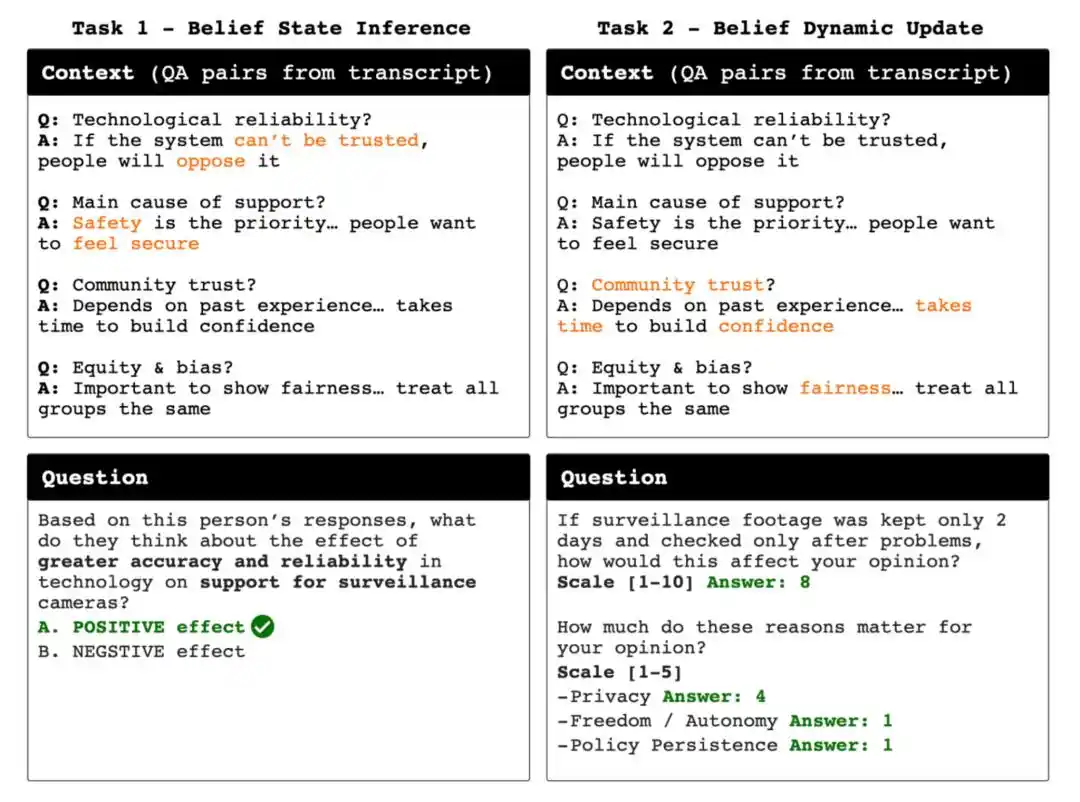
Caption: The two types of evaluation tasks in HugAgent. Belief State Inference infers a person's current beliefs from the interview; Belief Dynamics Update adds a new hypothetical scenario to predict how the same person's stance and reason weights would change.
HugAgent then turned these materials into two types of tests.
The first was Belief State Inference, 356 questions, testing whether the model could infer beliefs this person currently holds but didn't directly state.
The second was Belief Dynamics Update, 1386 questions, testing whether, given a new hypothetical scenario, the model could predict the person's new stance and reason weights.
The entire benchmark contained 1742 evaluation items.
To set an empirical upper bound for the task, the team invited some participants to re-answer the same questions 14 days later. The consistency between participants' answers and their own from two weeks prior was 84.84% and 85.66% for the two task types, respectively, used as the *ceiling* (empirical upper bound) for subsequent model comparison.
Here, an originally abstract question finally became directly measurable:
If you chat more and more with a person, will their 'digital twin' also get better at predicting them?
Core Result: Easy to Understand 'You Now', Harder When Conditions Change
The most intuitive result from HugAgent is the clear performance gap models show between the two task types.
In Belief State Inference, the best method achieved an accuracy of 77.56%, GPT-4o achieved 74.66%. Participants' self-consistency when re-answering the same questions after 14 days was 84.84%, used as the empirical ceiling for this task.
In Belief Dynamics Update, the best, Claude Sonnet 4.5, reached 68.61%, LLaMA 3.3 70B reached 67.57%, and GPT-4o reached 63.11%; the corresponding empirical ceiling was 85.66%.
In other words, within their respective evaluation setups, large models are already quite good at recovering 'how someone thinks now' from an interview. But when facing a new scenario they haven't answered before, there's a more noticeable gap from the participant's own answer.
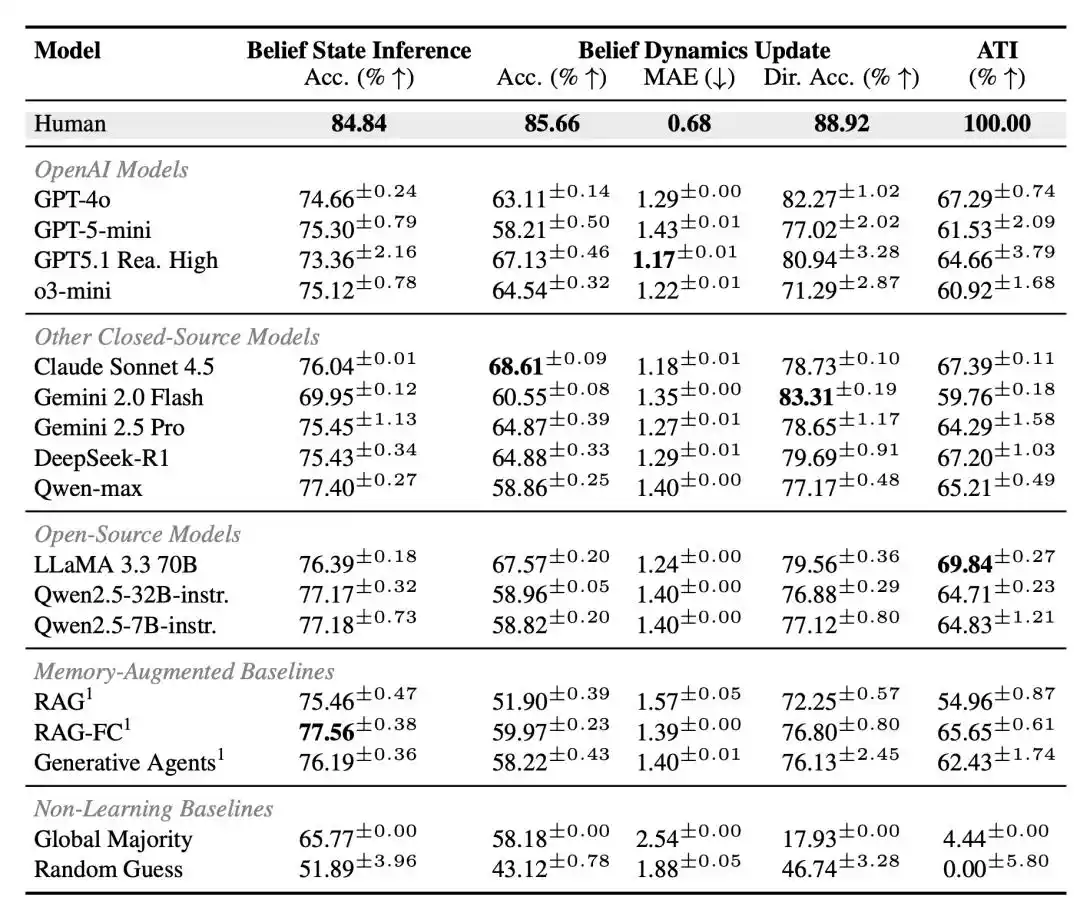
Caption: Overall performance of different models on the two HugAgent tasks. Compared to inferring a person's current beliefs, models show a more significant gap from the self-consistency ceiling when predicting responses in new scenarios.
However, this doesn't mean responses in new scenarios are entirely unpredictable from interviews.
Taking GPT-4o as an example, if no personal interview is provided, relying only on demographic info, Belief Dynamics Update accuracy is only 39.83%; adding the person's full interview raises it to 63.11%.
A similar change occurred with Qwen2.5-32B, from 32.12% to 58.96%.
That is, the interview isn't just giving the model a longer context. The words the person themselves said indeed contain individual-specific information for predicting their later answers.
Further cross-person experiments yielded similar results: If the personal interview is replaced with another person's, GPT-4o's accuracy on the update task drops to 39.30%, almost back to the level without the personal interview.
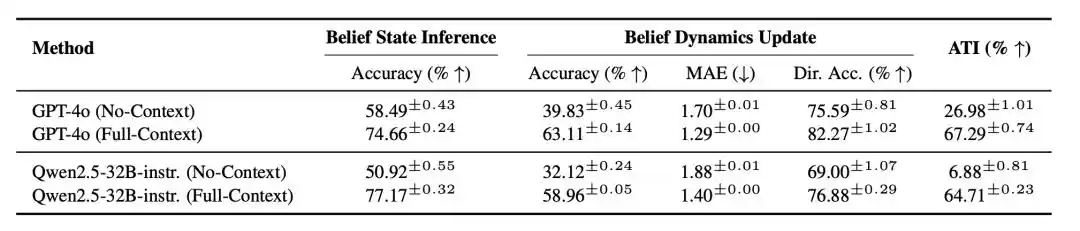
Caption: Performance comparison without personal interview vs. with full personal interview. The personal interview significantly improves the model's predictive ability for specific participants.
Since interviews are useful, a natural thought is: Just chat more.
If a digital twin is mainly a matter of information volume, then 5 interview rounds should be worse than 10, and 10 should be worse than the full interview.
But HugAgent didn't observe such a stable relationship.
Taking Qwen2.5-32B as an example, as interview content increased, Belief State Inference accuracy rose from 68.84% to 73.02%, finally reaching 77.17%.
But Belief Dynamics Update didn't improve accordingly; instead, it went from 61.79% to 60.73%, with the full interview at 58.96%.
This isn't to say interviewing is useless. The previous experiment already showed the significant difference from 'not knowing the person' to having their interview.
What's truly noteworthy is:
Going from no personal information to having personal information is important. But continuing to pile on more and more material about a person doesn't automatically translate to more accurate predictions for new scenarios.
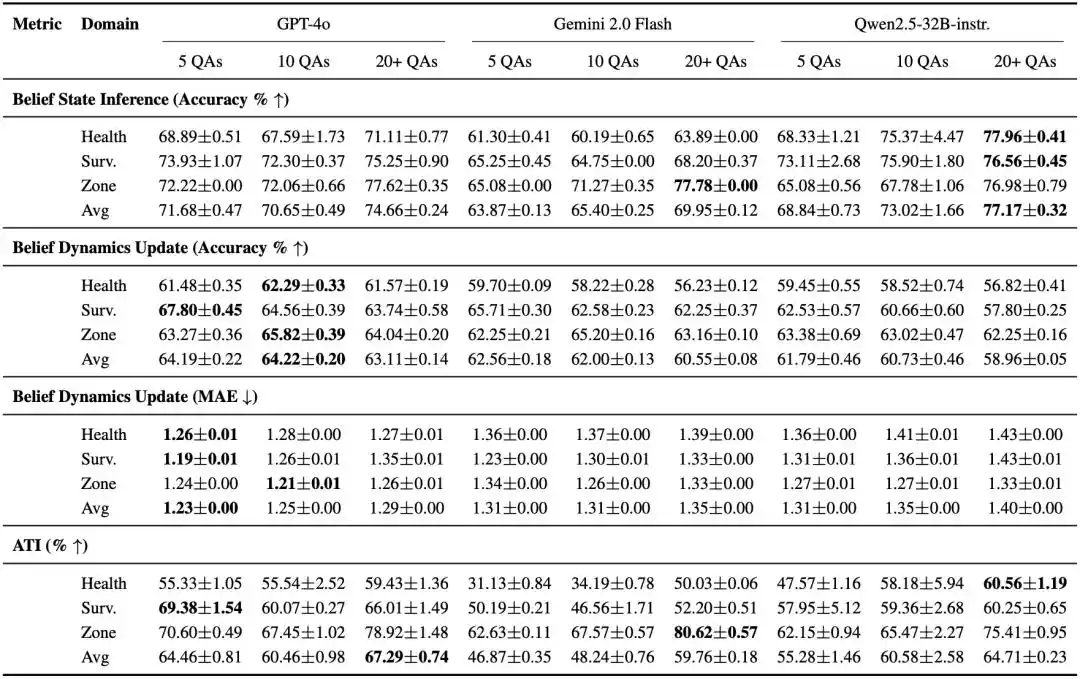
Model performance at different interview lengths. More context provides more clues about current beliefs, but prediction of responses to new scenarios doesn't show the same steady improvement.
Breaking it down further, we can see some clues about where models struggle.
Predicting a person's change can be roughly split into two questions: Will they change, and if so, in which direction?
At least in the healthcare domain, once GPT-4o judged that a person's attitude would change, its accuracy in judging the direction of change was 88.89%; but its accuracy in judging *whether* the person would change at all was only 49.36%.
This suggests models often know which direction new information would push an attitude. The harder problem might be the other one:
What kind of change is truly enough to make this person change their mind?
A possible reason is that interviews easily reveal which factors a person cares about and roughly which direction those factors push their stance; but how much 'change threshold' a person has at a given position is harder to judge from existing expressions.
The Real Test for Digital Twins
Looking at these results, what HugAgent leaves behind isn't just a leaderboard ranking GPT, Claude, Gemini. More importantly, it brings to the forefront a question easily skipped over in 'digital twin' research:
A model replicating your past very well does not automatically prove it can represent your future answers.
This distinction is especially important for human simulation.
If AI is only used to summarize a person's existing views, then a sufficiently detailed persona might already be quite useful. But more and more applications aim to do far more. Researchers hope to use synthetic participants to test unreleased policies, use AI consumers to judge reactions to new products, and have personalized agents handle new choices the user has never encountered before.
These uses share a common premise:
The model must be able to extrapolate from observed personal information to situations not directly asked about.
It's precisely here that the real test for digital twins begins.
Reiterating known views is just the starting point. The real value of a digital twin is representing this person even after the questions and conditions change.
If a model can only increasingly resemble the reproduction of views already present in the interview, then it's closer to a very detailed personal file. What's truly difficult is: When conditions change and a novel choice appears for the first time, can it continue forward along the lines of this person's reasoning and trade-offs?
HugAgent's results show this step cannot be taken for granted.
Personal interviews indeed provide valuable individual information, but more interviews don't stably translate into more accurate predictions for unseen scenarios. When building digital twins in the future, the question might not just be 'how much more data to collect', but also:
What exactly do we need to know about a person to predict how they would judge a question they've never answered before?
Of course, what HugAgent currently measures is still self-reported answers in hypothetical scenarios, not long-term behavior and opinion changes in the real world. It answers: Based on a person's interview and existing answers, can we predict how they would answer when facing a previously unseen hypothetical scenario? And the gap between the model and 100% cannot all be explained as insufficient model capability. Human answers themselves have variability, and some hypothetical questions might not have a single deducible answer from existing information.
So, the final question left might be more fundamental than a specific benchmark score:
What evidence should we use to believe an AI is truly sufficient to 'represent' a specific person?
Is it that it can reiterate the person's views?
Is it that it can answer a few unseen questionnaires?
Or is it only when the environment and conditions change, and it can still make trade-offs similar to the person's, that we should start calling it a reliable digital twin?
Large models are getting better and better at preserving our preferences, language, and experiences.
But from a detailed 'file about me' to a model that can truly represent 'me' in unfamiliar situations, there might still be quite a distance in between.
Interviewing a person might already be enough to make the AI more and more like them.
But 'being like them' and 'being able to represent them' are still two different things.
References:
https://arxiv.org/abs/2510.15144
This article is from the WeChat public account "新智元" (ID: AI_era), author: 新智元