Project Study: DRV Has Been Rising Steadily Since Citrini Mentioned It. Is the On-Chain Options Leader Expensive Now?

marsbitPublished on 2026-10-11Last updated on 2026-10-11

Abstract

Derive's token $DRV has surged approximately 260% in a month following Citrini Research highlighting it as a top crypto allocation. Analysis reveals its current valuation is high relative to protocol revenues, trading at nearly 80x the annualized protocol income based on September data. The core investment thesis is now forward-looking, betting on significant future growth in transaction fees, similar to Hyperliquid's past trajectory. As the dominant on-chain options protocol with over 90% market share, Derive is poised to capture market share from a $40B centralized options market. With no immediate competition in vanilla options from major players like Hyperliquid, Derive enjoys a strategic window. Its upcoming V3 upgrade aims to solidify its position as a foundational settlement layer. However, a critical near-term test arrives on October 14th, when the protocol's token buyback rate increases to 50% of fees. This will test price sustainability against profit-taking and token unlocks. In summary, the initial valuation re-rating driven by institutional recognition is likely complete. A prudent approach is to establish a small position and monitor two key catalysts: Q4 protocol fee growth post-V3 and the development progress of potential competitors like Lighter. The narrative remains driven by future revenue expansion rather than current fundamentals.

Author: Claude, Shenchao TechFlow

Shenchao Intro: Citrini's crypto portfolio allocated 10% to DRV, bringing this crypto options project into the spotlight for more people. However, DRV has risen about 260% in a month, and its buyback ratio is set to increase on October 14th. With business fundamentals, buying pressure, and institutional attention all in place, is it still worth buying now? Let's examine the project's current trading fees alongside its market cap to assess real revenue, buybacks, and value for money.

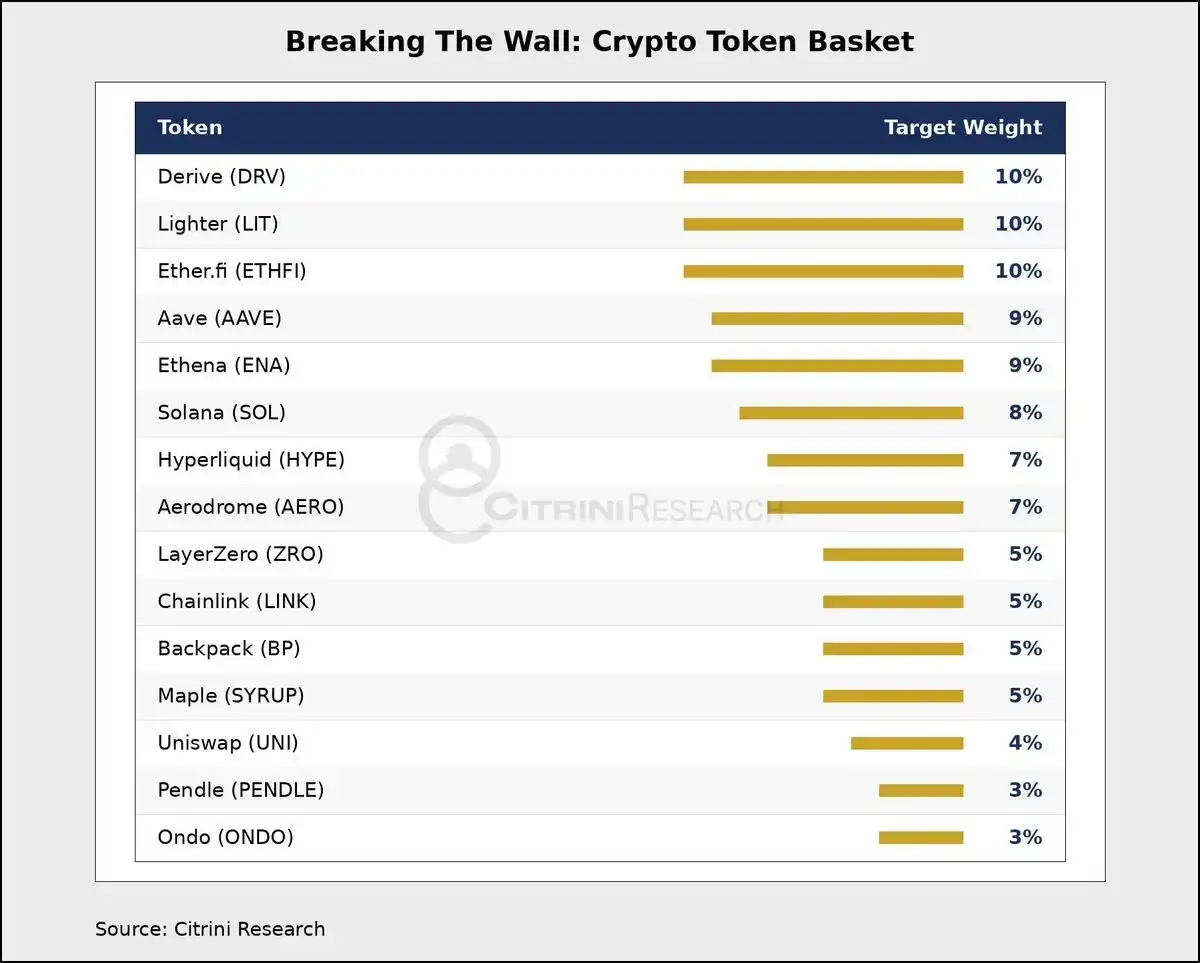
On October 8th, the well-known macro research firm Citrini Research, previously not bullish on crypto assets, released a report titled "Breaking The Wall." After experiencing and researching various current crypto products, they listed their own crypto holdings.

In their publicly disclosed crypto asset portfolio, Derive's token $DRV, along with Lighter and Ether.fi, received the highest allocation weight of 10% each.
Influenced by the institution's transparent position-building, as of October 10th, $DRV stabilized around $0.55, with a 44% gain over the past 7 days and a cumulative increase of approximately 260% over the past month, just a step away from its all-time high of $0.5693.

The institution's call indeed brought attention to a previously niche crypto options business, but is it still timely for everyone to get on board now?

Current $DRV is Expensive, Bulls are Shilling Future Expectations

Combined with real on-chain cash flow data, DRV's current static valuation is not cheap.

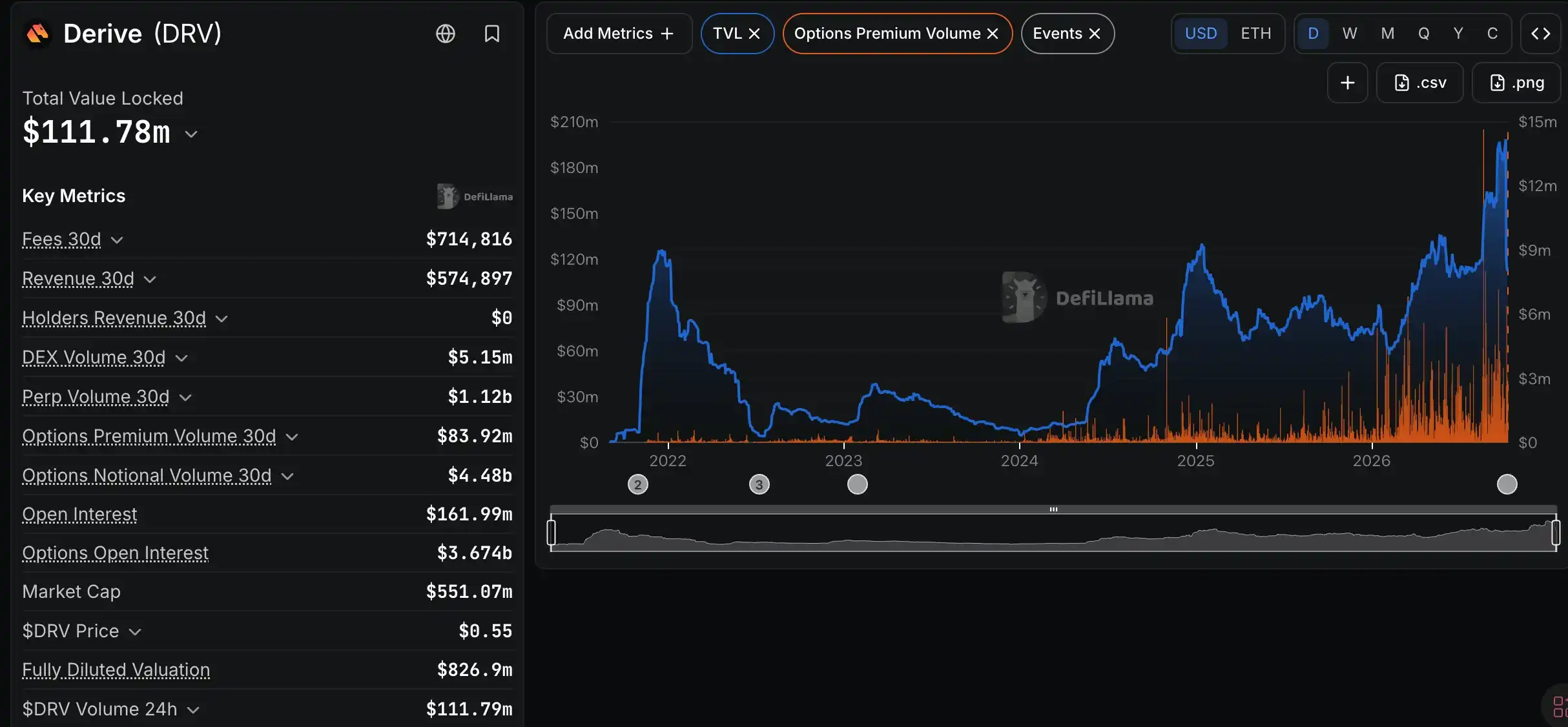
According to the latest 30-day data recorded by DeFiLlama, Derive users paid approximately $714,800 in trading fees; after deducting market maker rebates, the protocol's net revenue was about $574,900.

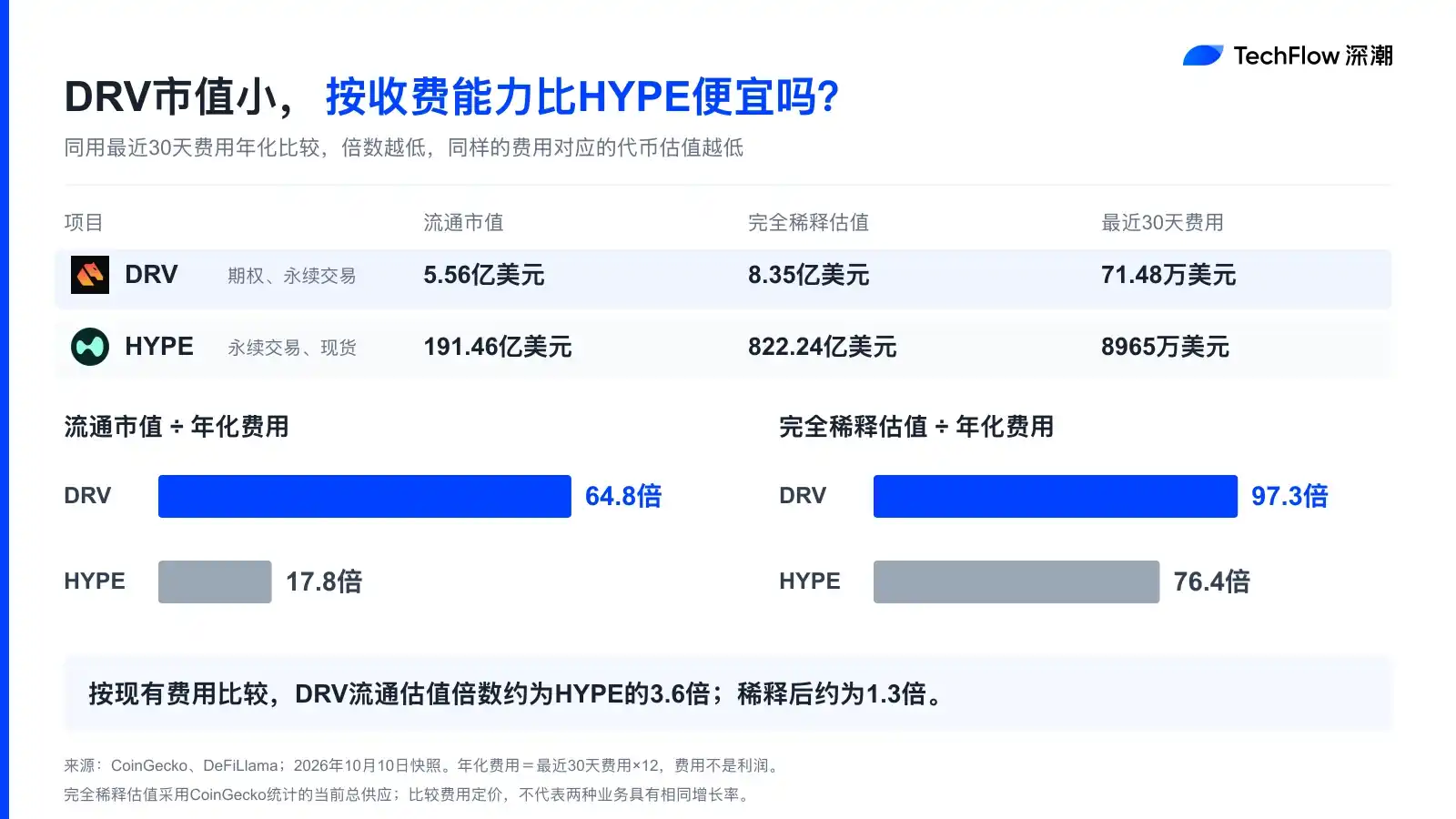
Its current circulating market cap is approximately $551 million, with an FDV (Fully Diluted Valuation) of about $827 million. If this single-month data is simply annualized:

  • Token Circulating Market Cap / Annualized Fees = 64x
  • Token Circulating Market Cap / Annualized Protocol Revenue = 79.5x
  • FDV / Annualized Fees = 96x

Frankly, it's already not cheap. This means that if you buy DRV now, from a revenue perspective, you're essentially paying nearly $80 for $1 of its annual profit.
This also explains why many English-speaking analysts discussing DRV recently have been focusing on hyping and shilling its future growth.

Because it's already not cheap; you must believe that future revenue and usage will explode further.

Taking Hyperliquid's growth experience as a reference, after completing initial trading volume accumulation, Hyperliquid experienced a non-linear explosion in fee revenue. After trading volume increased 10x, fee revenue surged 88x.

Currently, Derive has just completed the first step of "trading volume explosion," with its annual nominal trading volume rising from $660 million to $5 billion over the past year.

Therefore, the capital entering now is not buying its current static annual revenue of a few million dollars, but betting it can complete the leap to "explosive fee growth."

In the bulls' calculations, they are gambling that Derive can amplify its profits by another 5x.

If fees truly increase 5x, it means that at the current market cap, your cost drops from "paying $80 for $1 profit" directly to "paying $16 for $1 profit"; this would be considered relatively cheap among crypto projects with revenue.

How Big is the Pie in the On-Chain Options Track?

Many friends who trade perpetuals might ask: Decentralized Perpetual Contracts (Perp DEXs) are already mature, with simple interfaces and good liquidity. Why bother with on-chain options like DRV?

The author believes these two tools address completely different sets of needs, each with its own market.

In perpetual contracts, encountering a wick or extreme market conditions can lead to instant liquidation and total loss. However, for option buyers, no matter how violent the market fluctuations, the maximum loss is locked in at the moment of placing the order, because your cost is only the initial premium paid.

Professional traders rarely take naked positions; they often hold spot or perpetuals in one hand and buy options for hedging with the other. Derive's success isn't primarily due to a fancy interface, but because it allows bundling options and hedging positions together for margin calculation, eliminating the need for duplicate capital allocation and greatly reducing capital costs for large funds.

Furthermore, large clients can submit a complete set of complex hedging strategies, directly receiving packaged quotes from market makers on-chain.

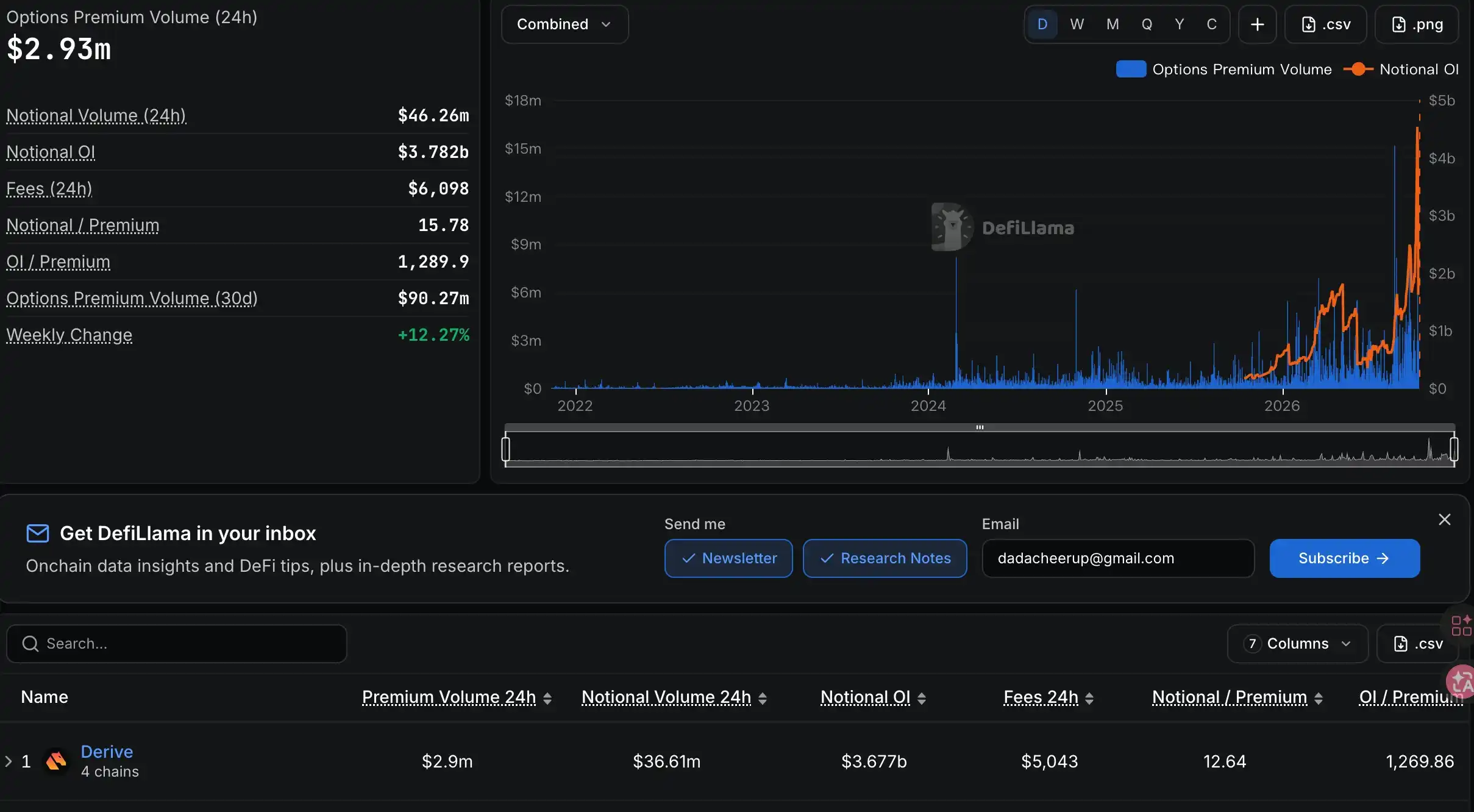
According to public data from DeFiLlama, the on-chain options premium volume in September this year was approximately $77.67 million, with Derive accounting for about 91.7% alone.
Looking beyond the chain, according to data disclosed by Derive in its V3 proposal:

Taking early September this year as an example, Derive's own options Open Interest (OI) was approximately $2 billion, while the global crypto options market OI, primarily on centralized giant exchanges like Deribit, was around $40 billion.

This illustrates two things:

First, in terms of existing volume, Derive has saturated the current on-chain options pool.

Second, the real logic behind the bulls' high valuation is betting that even 10%~20% of that $40 billion centralized volume will migrate on-chain in the future.

So, from an expectation perspective, a very large pie can indeed be painted; just as when CEXs were dominant, no one believed Hyperliquid could carve out a slice with its Perp DEX on-chain.
But many worry that since the current Perp DEX leader is Hyperliquid, if it pivots to options, would Derive be instantly crushed?

The current answer is quite the opposite.

In its publicly available HIP-4 specification, Hyperliquid primarily promotes Binary Options (outcome prediction contracts with capped payoffs). Its founder Jeff has also basically confirmed they won't build standard vanilla options in the short term, which is DRV's main business.

Binary options lean more towards event prediction and根本无法满足专业机构做复杂的波动率交易和 Delta 对冲. (cannot satisfy professional institutions' needs for complex volatility trading and Delta hedging). This means the fiercest predator on-chain is voluntarily avoiding the most orthodox options cake.

As for Lighter, another potential competitor claiming to launch vanilla options by year-end, the earliest delivery and launch won't be until late Q4 or later.

This leaves Derive with a perfect "monopoly vacuum period": giants aren't coming to compete, and competitors haven't built their guns yet.

Derive is leveraging this window by launching its V3 version, migrating fund custody and settlement back to the Ethereum mainnet, while opening cross-asset margin and underlying vault access, attempting to turn its underlying settlement layer into a protocol.

The benefit of this move is that even if other teams build lighter, better front-end interfaces in the future, the underlying layer would still need to run transactions and share fees through Derive.

Buyback Increase on October 14th, But Not Entirely Bullish for Price

Having understood the valuation and moat, let's return to the secondary market practicalities everyone cares about.

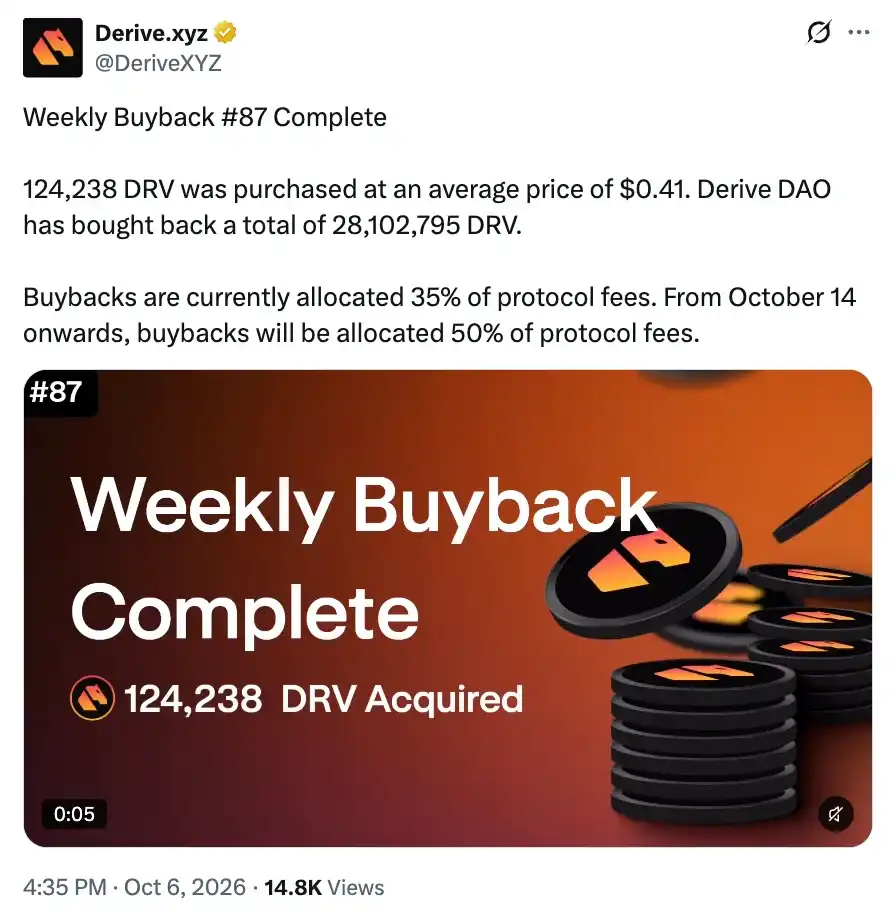
The confidence many bulls hold onto comes from Derive's core token utility mechanism: the protocol previously used 35% of its fees to directly buy $DRV on the secondary market (over 28 million tokens cumulatively repurchased so far). With the V3 launch, the community has passed a resolution to hard-increase this buyback ratio to 50% starting October 14th.

Sounds like an absolute buying pressure catalyst, right? But mature traders must calculate the other side of the equation: the fees traders paid have already become actual buy pressure for DRV.

DRV's price has already surged nearly 260% in the past month.

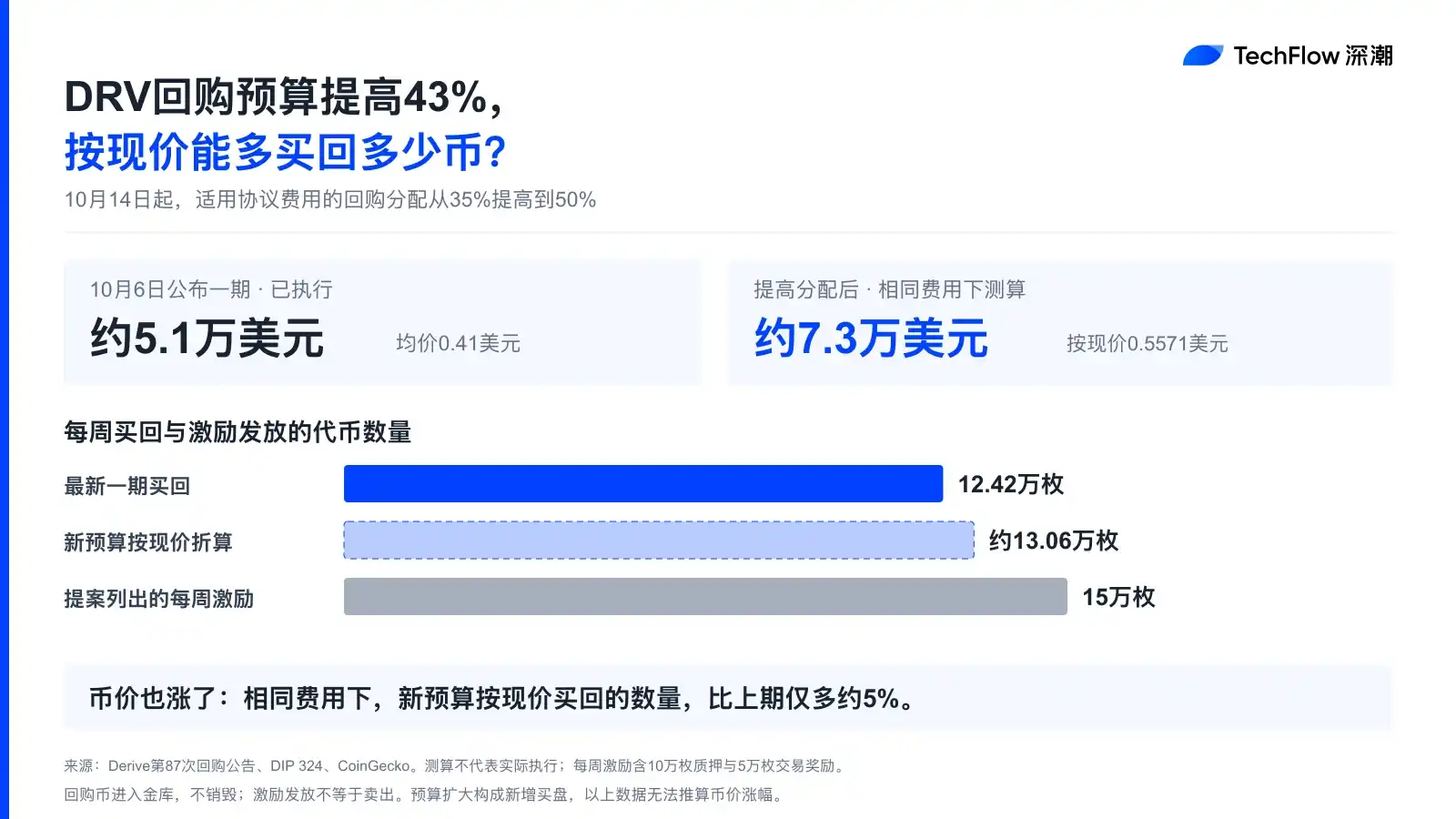
What does this mean? Assuming the protocol allocates $350,000 for buybacks monthly, when the price was $0.15, that money could absorb over 2.3 million tokens of selling pressure. But now with the price at $0.55, the same $350,000 can only buy around 636,000 tokens.
Therefore, after the new rules take effect on October 14th, the real battle begins:

Can this real 50% buy pressure still withstand selling pressure from profit-taking at highs and regular token unlock sell pressure? This will be the first test of DRV's price resilience.
Conclusion

Under the "call" effect from Citrini, DRV has completed its first wave of sentiment-driven valuation re-rating. As calculated earlier, the current price has already partially priced in future expectations, leaving no "blind bargain" safety margin.

Facing such a high-valuation, high-expectation asset, the author believes the most rational strategy is definitely not to heavily chase highs now. A better strategy is to establish a small initial position first and then observe several indicators.

First, real Q4 revenue.

After V3 launches, directly monitor its monthly fees on DeFiLlama. September's $700k is the baseline. If November and December data consistently breaks above $1 million, it indicates the "fee explosion flywheel" the bulls are betting on has truly started; adding positions then is still timely.

But if the data turns downward, it means the options business hasn't captured the call's momentum, and the current 80x valuation is pure bubble, with price driven purely by FOMO and shilling post-institution recommendation.

Second, closely monitor competitor Lighter's developments.

As mentioned earlier, Derive is currently enjoying a "vacuum period"红利. It's crucial to observe whether Lighter, the vanilla options competitor previously said to launch in late Q4, can deliver on time. The options market pie is only so big, and Lighter is also a strong competitor; don't forget that in Citrini's call, both DRV and LIT were allocated 10%, tied for their highest weighting.

Thus, a safer approach might be to place bets on both tokens.

Finally, a reminder: crypto tokens are largely narrative-driven. While the "real revenue" narrative is closer to traditional metrics like P/E ratios or financial indicators for evaluating projects, it still remains significantly influenced by sentiment and the overall crypto market.

DYOR.

Related Questions

QWhat is the current valuation of $DRV based on its revenue, and is it considered expensive?

ABased on the article, $DRV's current valuation is considered expensive. Its circulating market cap is approximately $551 million, with a trailing 30-day net protocol revenue of $574,900. This leads to a price-to-earnings (P/E) ratio of about 79.5x for its circulating market cap relative to annualized revenue. The fully diluted valuation (FDV) to annualized fees ratio is even higher at 96x. The article states this means paying nearly 80 units of currency for 1 unit of annual profit, indicating a high valuation that already prices in future growth expectations.

QWhat is the primary argument of $DRV's bullish investors for its high valuation?

ABullish investors are not buying $DRV for its current static revenue but are betting on its future growth potential. Their primary argument is that Derive, the protocol behind $DRV, is positioned to capture a significant share of the crypto options market migrating from centralized exchanges (CEX) like Deribit to decentralized platforms. They draw parallels to Hyperliquid's growth, anticipating a non-linear explosion in fee revenue as transaction volume increases further. They are speculating that Derive's protocol revenue could potentially increase fivefold, which would make the current valuation more reasonable.

QHow does Derive dominate the current on-chain options market, and what is its main competitive advantage?

AAccording to DeFiLlama data cited in the article, Derive dominated approximately 91.7% of the on-chain options premium volume in September. Its main competitive advantages include: 1) Allowing for portfolio margin calculation, enabling users to bundle options and hedge positions together without over-collateralizing, which significantly reduces capital costs for large funds. 2) Catering to sophisticated professional traders and institutions by enabling complex hedging strategies and direct market maker quoting on-chain. 3) Currently facing a 'monopoly vacuum' as major potential competitors like Hyperliquid are focused on binary options, and others like Lighter have not yet launched their standard vanilla options products.

QWhat change is happening to the $DRV token buyback mechanism on October 14th, and what is its potential impact?

AStarting October 14th, the protocol's fee allocation for $DRV token buybacks will be hard-coded to increase from 35% to 50%. While this represents a significant increase in buy-side pressure, the article cautions that its impact on the token price is not straightforward. Since the token price has already risen by approximately 260% in a month, the same dollar amount allocated for buybacks now purchases far fewer tokens than it did at lower prices. The key test will be whether this increased 50% buyback can effectively absorb selling pressure from profit-taking and regular token unlocks at the current elevated price levels.

QWhat strategy does the article suggest for investors considering $DRV, and what key metrics should they monitor?

AThe article suggests a cautious strategy rather than heavy buying at current high valuations. It recommends initially establishing a small position (a 'base position') and then monitoring key metrics: 1) **Q4 Real Revenue:** Closely watch the monthly fee data on DeFiLlama after the V3 launch. If fees consistently break above the $1 million mark in November and December, it could signal the anticipated revenue growth, justifying further investment. A decline would indicate the valuation is likely a bubble. 2) **Competitor Lighter's Progress:** Monitor the development and potential launch timeline of Lighter, a key competitor planning to launch vanilla options. A successful launch could challenge Derive's market position. The article also suggests a potential hedged strategy of taking positions in both $DRV and Lighter's token ($LIT).

Related Reads

Conversation with Macro Analyst Jordi Visser: Micron Has 60%-80% Upside, the Longevity Economy Is a High-Confidence Main Theme

Macro analyst Jordi Visser argues that AI is the sole real driver of the economy today, with traditional GDP metrics failing to capture its value—AI-driven productivity shows up in corporate profit margins instead, as large firms grow revenue while hiring freezes. He attributes rising Treasury yields to AI-related capex and debt issuance, not Fed policy, and views credit default swap widening as a concentration-risk hedging issue rather than an AI bubble. He expects hyperscaler external financing to peak as data centers come online and free cash flow turns positive (citing Oracle's guidance). On labor, he sees Microsoft's buyout of 27% of its workforce as a template: AI-driven revenue-per-employee surges will push governments toward redistributing profits from capital to labor via tax restructuring, since personal income tax bases erode. He warns the market is discounting risks like labor turmoil, political gridlock, memory/data center bottlenecks, and cybersecurity. His key themes are agentic compute and the longevity economy. He is bullish on Eli Lilly as the purest longevity play, predicting it will become the S&P 500's largest company by 2030, and on Micron, which he re-entered around $800 with only ~10% downside and 60-80% upside, citing humanoid robot RAM demand, SpaceX's 10GW compute plan, and long-term supply agreements through 2030. He also holds crypto as his largest allocation, expecting 2027 to mark a breakout year for blockchain commercial applications and payment networks.

marsbit1h ago

Conversation with Macro Analyst Jordi Visser: Micron Has 60%-80% Upside, the Longevity Economy Is a High-Confidence Main Theme

marsbit1h ago

Michael Saylor: Four Centuries of Digital Credit Evolution

Michael Saylor traces the four-century evolution of digital credit, showing how centuries of financial infrastructure paved the way for Bitcoin-based corporate treasuries. The story begins in 1602 with the Dutch East India Company, which separated a company's capital duration from investors' holding periods through transferable shares. Preferred stock followed, exemplified by the Baltimore and Ohio Railroad's 6% perpetual preferred dividend in 1836 and Delaware's 1899 recognition of distinct share classes. Exchanges and tickers—from the 1792 Buttonwood Agreement to the 1867 stock ticker and 1971 Nasdaq—gave ownership a public market. U.S. securities and commodities law (1922–1974) established the distinction between assets a company holds and securities it issues. The 1940 Investment Company Act's "40% test" still shapes how bitcoin treasury companies use common stock, preferred stock, and debt. Tax law dating to 1921–1954 distinguishes return of capital from income, allowing preferred dividends to reduce cost basis before gains are realized. Shelf registration (Rule 415, 1982–1983) and at-the-market programs (1982, 2005) let companies prepare financing in advance and raise capital at market prices. Buybacks, recognized since 1828 with the 1982 Rule 10b-18 safe harbor, let firms manage capital in both directions. Bitcoin, launched in 2008–2009 and classified as a commodity by the CFTC in 2015, provides a new reserve asset, while companies supply capital structure, dollar liquidity, and distribution policy. Digital credit thus combines over 400 years of corporate ownership transfer, roughly 190 years of U.S. preferred stock, more than a century of tax cost-recovery rules, and four decades of modern shelf and ATM regulation into a familiar framework for investors.

marsbit2h ago

Michael Saylor: Four Centuries of Digital Credit Evolution

marsbit2h ago

The Hidden Risks Behind Anthropic's Nearly $1 Trillion Bet

Anthropic's IPO filing reveals a fragile, high-risk financing mechanism behind its AI ambitions. The company has committed to up to $895.4 billion in data center spending through 2045, with profits squeezed by rising compute costs. Rather than paying upfront for hardware, Anthropic relies on supplier-backed financing: Broadcom arranged a $63 billion equipment financing deal under which it absorbs losses if Anthropic defaults—up to roughly $43 billion once equipment is delivered. Google and AMD similarly tie funding to hardware leases or deployments. This shifts risk onto chipmakers' balance sheets, and because custom TPUs serve a narrower ecosystem than Nvidia GPUs, resale risk is higher. Analysts warn that while individual loans appear safer, risk concentration across the system is rising and harder to assess. Anthropic also can issue up to $42 billion in convertible notes to Broadcom to cover rent, with interest rates rising from 9% to 13% and conversion terms worsening if revenue targets are missed. Despite holding $146.6 billion in liquidity as of September 30, its massive forward obligations and tangled partnerships could limit access to investment-grade financing. Key concerns: whether revenue growth can outrun compute costs and cover future commitments, and whether drawing on credit lines signals distress. Anthropic's Direct initiative—separating data center leasing from chip purchases—and IPO proceeds could give it more flexibility, but ultimately debt repayment depends on end-customer revenue.

marsbit13h ago

The Hidden Risks Behind Anthropic's Nearly $1 Trillion Bet

marsbit13h ago

Trading

Spot
活动图片