孙宇晨表示波场(Tron)的后量子加密技术已在测试网上线

cointelegraphPublished on 2026-10-10Last updated on 2026-10-10

Abstract

Tron创始人孙宇晨表示,该网络的抗量子密码学已在测试网上线。他在社交媒体上称,团队正密切关注量子计算与人工智能进展,随时准备将量子抗性部署至主网,致力于保障用户资产安全,并计划使Tron成为在"Q日"(量子计算能破解当前安全标准之时)到来前少数具备量子抗性的主要区块链之一。 7月28日有报道称,区块链安全公司AmericanFortress公布了一项密码学方案,旨在保护加密钱包免受未来量子攻击,且用户无需转移资金、更换密钥或改变钱包地址。该公司表示,与多数现有方案不同,此方法可在保持原有钱包地址不变的前提下增加抗量子保护。该方案已发布在密码学预印本档案馆,尚未经过同行评审。 随着量子计算机未来可能破解比特币、以太坊等区块链依赖的椭圆曲线密码,开发者日益重视后量子密码学。今年早些时候,多个组织已展开相关布局:一个由Strategy领衔的联盟承诺投入1500万美元支持比特币量子安全研究,以太坊基金会发布了向抗量子密码迁移账户的提案,Algorand则计划在2027年前推出抗量子账户。

波场网络创始人孙宇晨表示,该公司的后量子加密技术现已在测试网上线。
孙宇晨在周六于X平台上发帖称:“我们正在紧密追踪量子计算和人工智能的进展,并已准备好随时将抗量子特性引入主网。”

他补充道:“我们致力于保护用户资产安全,波场有望在‘Q日’(即量子计算能够突破当前安全标准之日)之前,成为少数具备抗量子能力的主要区块链之一。”

据Coindesk于7月28日报道,区块链安全公司AmericanFortress公布了一项加密方案,旨在保护加密货币钱包免受未来量子攻击,且无需用户转移资金、轮换密钥或更改钱包地址。

与大多数已提出的后量子方案不同,AmericanFortress表示,其方案允许现有的钱包地址保持不变,同时增加后量子保护。

提案已发表于技术论文

该公司已将提案以技术论文形式发表于Cryptography ePrint Archive,但该论文尚未经过同行评审。

开发者们日益关注后量子密码学,因为足够强大的量子计算机最终可能会破解用于保护比特币、以太坊及许多其他区块链网络的椭圆曲线密码学。

今年早些时候,一个由Strategy-led领导的联盟承诺投入1500万美元资助比特币量子安全研究,以太坊基金会发布了将账户迁移至抗量子密码学的提案,而Algorand则概述了到2027年引入抗量子账户的计划。

杂志文章:《SHRINCS BIP发布:量子安全的比特币也有代价》

Trending Cryptos

Related Questions

QTron网络的后量子加密技术目前处于哪个测试阶段?

ATron网络的后量子加密技术已经上线测试网(testnet)。

Q根据Justin Sun的说法,Tron网络计划在何时将抗量子攻击能力部署到主网?

A根据Justin Sun的说法,Tron网络已准备好随时将抗量子攻击能力部署到主网。

Q文章中提到的“Q-Day”是指什么?

A文章中提到的“Q-Day”是指量子计算机变得能够破解当前安全标准的那一天。

Q与大多数提出的后量子方法不同,AmericanFortress方案的一个主要特点是什么?

A与大多数提出的后量子方法不同,AmericanFortress方案允许现有的钱包地址保持不变,同时增加后量子保护。

Q除了Tron,文章中还提到了哪些区块链项目或组织正在为量子安全做准备?

A文章中还提到,一个由Strattic领导的联盟承诺资助1500万美元用于比特币量子安全研究,以太坊基金会发布了一份将账户迁移至抗量子密码学的提案,以及Algorand概述了在2027年之前引入抗量子账户的计划。

Related Reads

"Strictest Ever" Wet-Lab Prediction Benchmark Released: Maxed-Out Reasoning and 5x Compute Still Won't Cut It

UniPat AI has launched Science Prediction Universe (SPU), a new benchmark that evaluates whether AI models can predict the outcomes of real wet-lab experiments before they are conducted. The benchmark covers 116 tasks and 4,207 wet-lab experiments across chemistry, materials science, biology, and medicine, drawing on recent papers and unpublished collaborations with institutions such as Stanford, Cornell, and Harvard. Models are given eight hours, an H20 GPU, internet access, and scientific software, and must submit a ranked prediction of experimental results, which is then scored against hidden ground-truth data using the Spearman correlation coefficient. To prevent memorization, evaluation runs in isolated, offline containers and screens outputs for paper identifiers. Results show that even leading models like Opus 5.5 and GPT-6 Astra remain far from reliable prediction: the best average score was 0.486, and only about half of tasks exceeded the random baseline. The study also found that increasing reasoning effort fivefold barely improved accuracy, since models often settled on an answer early and spent the rest of the time on minor adjustments. Likewise, more tool use and GPU calls did not reliably help. Performance varied sharply by measurement target, and API costs ranged 300-fold across configurations. SPU aims to give researchers and model developers a unified way to measure and improve AI's scientific judgment before investing in costly experiments.

marsbit1h ago

"Strictest Ever" Wet-Lab Prediction Benchmark Released: Maxed-Out Reasoning and 5x Compute Still Won't Cut It

marsbit1h ago

From Harshly Criticizing Stablecoins to Building an L1: Airwallex's Jack Zhang Isn't "Converting" — the Battle for the Settlement Layer Has Begun

In June 2025, Airwallex CEO Jack Zhang publicly questioned stablecoins, arguing that fiat conversion costs outweighed their cross-border payment benefits and that crypto had failed to solve real-world problems for 15 years. Yet just 17 months later, in November 2026, Zhang emerged as co-founder of Alta, a blockchain project that raised $80 million (a $47.5 million Series A led by Index Ventures plus a $32.5 million seed round). Rather than a change of heart, the move reflects commercial necessity: a battle over the stablecoin settlement layer is underway, and payment giants that stay out risk becoming mere interfaces atop someone else's chain. Alta is not a general-purpose public chain but a compliant Layer 1 built for banks and licensed payment institutions. Co-founder Loong Wang, previously of Ren Protocol, says existing chains like Ethereum and Solana cannot simultaneously meet institutional demands for privacy, compliance, integration with local financial systems, and liquidity. Alta uses recursive zero-knowledge proofs to enable on-chain compliance checks without exposing identities or transaction amounts, and builds in programmable compliance modules, native identity authorization, and anti-airdrop protections. Co-founder Catherine Porter previously led Meta's Libra (Diem) partnerships. Airwallex itself is Alta's key advantage: with $287 billion in annualized volume, $1.3 billion in revenue, 200 countries, and 90 currencies, it will channel enterprise clients onto the new chain. Zhang's apparent reversal is consistent: he criticized stablecoins as cheap remittance tools, but now bets on tokenized fiat settlement infrastructure. Competitive pressure comes from Stripe, which acquired Bridge for $1.1 billion, bought Privy, and incubated the Tempo chain (raising $500 million at a $50 billion valuation, with OpenAI, Shopify, Deutsche Bank, and Visa as partners). Circle's Arc, Fireblocks, and Canton Network are also competing. With stablecoin market cap exceeding $320 billion and 2025 on-chain volume surpassing $33 trillion, the real contest is over who controls minting, clearing, and fiat redemption. Success will depend less on technology than on three factors: genuine adoption by traditional financial institutions, compliance adaptation across jurisdictions, and efficient on- and off-ramps to real banking systems. The paradigm has shifted: instead of disrupting banks, fintech giants now aim to build infrastructure that lets traditional finance voluntarily move on-chain. Pragmatism, not ideology, now dominates the race.

marsbit3h ago

From Harshly Criticizing Stablecoins to Building an L1: Airwallex's Jack Zhang Isn't "Converting" — the Battle for the Settlement Layer Has Begun

marsbit3h ago

"Everyone is too conservative with AI!" Head of Claude Code: My approach is more ambitious

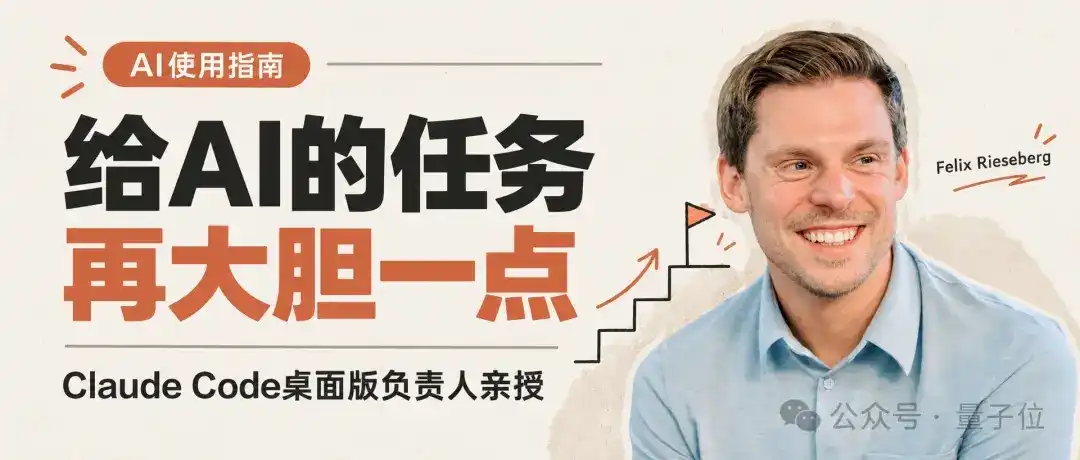
Felix Rieseberg, who leads Claude Code's desktop app, argues that most people use AI too conservatively and should set more ambitious goals. His central trick: set unreasonably aggressive targets and insist they're achievable—for example, instead of cutting website load time from 10 seconds to 5, aim for 0.2 seconds, and when the model protests, keep telling it the problem is solvable and to try again. He organizes ambition into four categories: speed (doing the same work faster), height (raising the abstraction level to focus on desired outcomes rather than individual tasks), depth (working like top experts, using their real tools, data, and methods), and breadth (drawing on ideas from other fields). For height, he suggests asking what you ultimately want to happen and what the goal behind the goal is—e.g., instead of fixing single crashes, require the app to never crash. For a quarterly business review, move from filling in a template to understanding what changed and why, identifying the most urgent decisions, and redesigning the review process itself. For depth, he advises insisting on the tools top professionals actually use (databases and statistical models rather than Markdown tables), setting "unreasonable" targets, challenging your own assumptions against raw data, hunting for new knowledge, and using external validation rather than letting the model grade itself. A useful prompt asks the model what top experts would do that you haven't requested, what raw materials and tools they'd use, and what besides the model and you could prove the result correct. For breadth, he recommends replacing nouns with verbs (not "make a PPT" but "in 30 minutes, convince busy people of an explanation and drive a decision under uncertainty"), assembling cross-disciplinary teams, and using multi-agent setups—while avoiding mere role-play in favor of adopting other fields' actual methods. He closes with self-efficacy research: people given clear, challenging goals outperform those told to do their best, and believing difficult things are possible—as with the four-minute mile—unlocks achievement. In an era of rapid capability gains, updating our beliefs about what's possible matters more than ever.

marsbit4h ago

"Everyone is too conservative with AI!" Head of Claude Code: My approach is more ambitious

marsbit4h ago

Trading

Spot

Hot Articles

How to Buy SUN

Welcome to HTX.com! We've made purchasing SUN (SUN) simple and convenient. Follow our step-by-step guide to embark on your crypto journey.Step 1: Create Your HTX AccountUse your email or phone number to sign up for a free account on HTX. Experience a hassle-free registration journey and unlock all features.Get My AccountStep 2: Go to Buy Crypto and Choose Your Payment MethodCredit/Debit Card: Use your Visa or Mastercard to buy SUN (SUN) instantly.Balance: Use funds from your HTX account balance to trade seamlessly.Third Parties: We've added popular payment methods such as Google Pay and Apple Pay to enhance convenience.P2P: Trade directly with other users on HTX.Over-the-Counter (OTC): We offer tailor-made services and competitive exchange rates for traders.Step 3: Store Your SUN (SUN)After purchasing your SUN (SUN), store it in your HTX account. Alternatively, you can send it elsewhere via blockchain transfer or use it to trade other cryptocurrencies.Step 4: Trade SUN (SUN)Easily trade SUN (SUN) on HTX's spot market. Simply access your account, select your trading pair, execute your trades, and monitor in real-time. We offer a user-friendly experience for both beginners and seasoned traders.

11.0k Total ViewsPublished 2024.03.29Updated 2026.06.02

How to Buy SUN

Discussions

Welcome to the HTX Community. Here, you can stay informed about the latest platform developments and gain access to professional market insights. Users' opinions on the price of SUN (SUN) are presented below.

活动图片