Morpho在以太坊领先,Solana主导DeFi TVL,市场向五大领先托管商集中

cryptonews.ruPublished on 2026-08-26Last updated on 2026-08-26

Abstract

根据vaults.fyi于8月24日发布的报告,当前DeFi托管市场中,约112.9亿美元的资金由五大托管机构控制,占比高达69.3%,市场集中度显著。Morpho作为市场领导者,在基于以太坊和Solana的区块链中,占据了托管总资本的46.2%。 报告指出,托管市场过去一年增长迅速,其份额占DeFi总锁仓价值的比例已从5.24%上升至12.51%。Morpho的领先地位得益于其Morpho Blue和MetaMorpho系统,该系统将核心借贷功能与风险管理分离,允许第三方管理者创建独立借贷市场并聚合资金。 市场格局在过去一年发生变动,Concrete和Sentora等新晋机构进入前五,而Usual等机构的排名则大幅下滑。另一份由DefiLlama在7月发布的数据同样证实了高度集中的趋势,前三大管理者控制着其统计范围内约75.9%的TVL。 尽管DeFi领域安全事件频发(2026年上半年记录207起,远超2025年同期的83起),传统金融机构仍在加速入场。例如Bitwise资产管理公司与Morpho合作推出非托管金库,摩根大通也开始推出代币化货币市场基金金库,显示出机构对链上托管产品的浓厚兴趣。

Vaults.fyi在8月24日发布的报告中指出,在DeFi托管金库中管理的资金达112.9亿美元,其中超过三分之二由五家托管公司控制。

尽管Vaults.fyi和DeFiLlama发布的两份报告因统计金库和协议的方式不同,在总资金量数据上存在分歧,但双方都同意市场高度集中的观点。
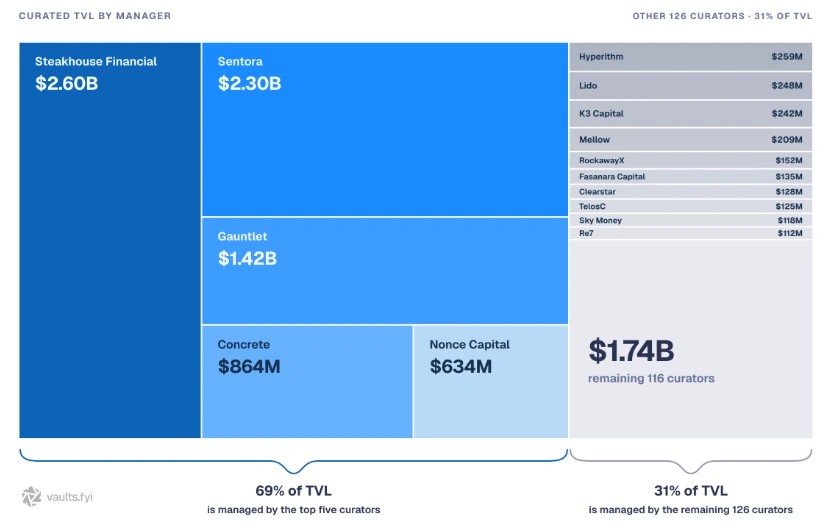
五大领先托管商管理着69%的DeFi托管总锁定价值。来源:vaults.fyi

谁被确定为vaults.fyi报告中的主要托管商?

Vaults.fyi的这份报告被认为是迄今为止对区块链托管市场最全面的研究,其统计的托管市场总价值为112.9亿美元,分布在856个金库、131个托管商和18个协议中。数据截至8月20日。

调查结果显示,被测量的市场中,高达69.3%的份额仅由五个托管商服务。

将存款分散到多个金库并不能分散风险,如果所有这些金库都由同一个团队管理的话。托管商负责选择市场、抵押品、额度和风险限制。然而,当五家公司控制着三分之二的资本时,这几个人的选择就决定了数千名存款人所承担的风险。

在过去一年中,由托管商管理的市场份额已增长至DeFi总供应量的12.51%,而此前为5.24%。研究发现,托管市场规模增长了39%,而整个DeFi供应市场则增长trac了41.8%。

报告称,近一半的托管资本,约46.2%,流经基于以太坊和Solana区块链的Morpho。其余53.8%分布在另外17个协议中。

Morpho的领先地位归功于其与Morpho Blue和MetaMorpho合作创建的系统。该系统将核心借贷功能与风险管理分离开来,允许第三方管理者创建独立的借贷市场,并将其汇集到统一的金库中。

这一发展现在正在吸引来自大型传统金融公司的trac,例如Bitwise资产管理公司,该公司已与Morpho合作推出非托管式金库。第一个产品的目标是实现6%的年化收益率。Bitwise还预测,到2026年,该公司称为“ETF 2.0”的链上金库资产管理规模将翻一番。

报告还指出,在Morpho最大的25个稳定币金库中,存有371亿美元,其中比特币提供了54.1%的贷款抵押。认为自己持有USDC的存款人,实际上可能是在提供以比特币为抵押品的贷款,从而面临因其流动性、预言机可用性以及在市场崩溃时清算抵押品的能力所带来的风险。

Morpho是否一直处于领先地位?

Concrete和Sentora这两家公司在十二个月前还不在排名之列,如今已跻身前五:Concrete排名第四,Sentora排名第二。
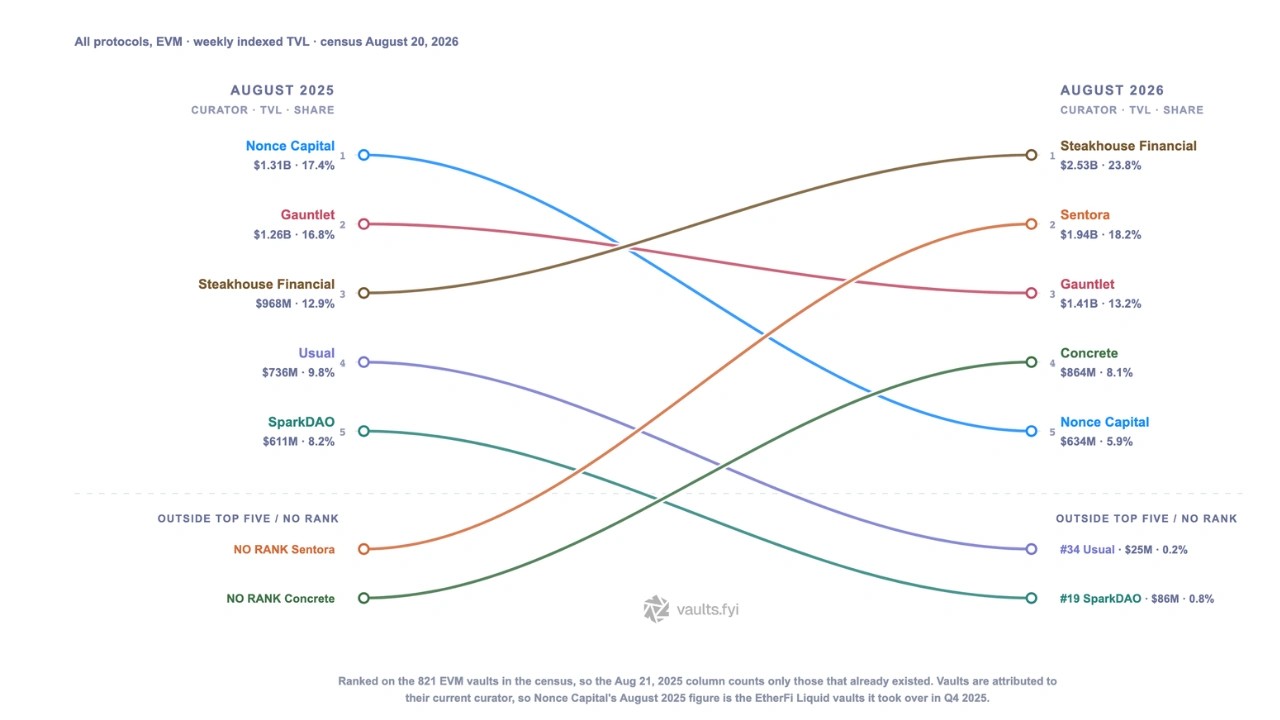
过去一年的DeFi金库排名变化:vaults.fyi

Usual的排名从第四位下滑至第三十四位。报告称,部分排名变动是由市场压力引起的,并指出在Stream和Resolv相关的问题之后,实力较弱的托管商被淘汰,资金流向了留存下来的团队。

使用7月份收集的Sentora数据的独立DefiLlama报告确认了同样的资产集中趋势。该报告基于55家trac托管公司和总计71.8亿美元的数据,列出了前三名:Steakhouse Financial(20.3亿美元)、Sentora(19.7亿美元)和Gauntlet(14.6亿美元)。三者合计控制了75.9%的TVL,而前五大公司则控制了80.9%。
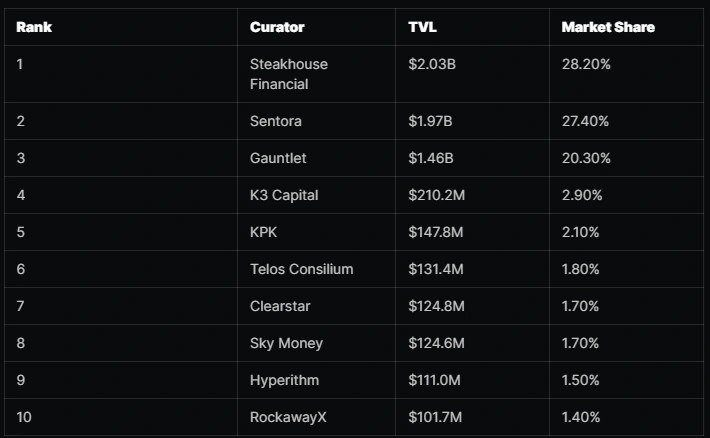
一年前的DeFi金库排名。来源:Defillama

Vaults.fyi的报告提到,加密世界之外的大型参与者现在也开始建立自己的代币化资产金库。例如,Apollo最近开始与Securitize合作,Midas与Fasanara联手,而摩根大通正在推出代币化货币市场基金金库。

5月,交易公司Wintermute也推出了名为Armitage的自有资产托管平台。Wintermute表示,它可以接受其他托管商无法接受的抵押品类型,因为它自行处理清算。

尽管TRM Labs记录到,2026年上半年发生了207起dentDeFi利用事件,是2025年同期83起dent的两倍多,所有这些资金仍在涌入。

end-content
Trending Cryptos

Related Questions

Q根据文章,目前DeFi托管市场中,有多少资金由前五大托管方控制?

A根据vaults.fyi的报告,目前在托管DeFi资金库中锁定的总价值(TVL)为112.9亿美元,其中超过三分之二(69.3%)的资金由前五大托管方控制。

Q在众多托管协议中,哪个协议目前在托管市场占据主导地位,其主要的创新机制是什么?

AMorpho协议目前在托管市场占据主导地位,控制了约46.2%的托管资金。其主要的创新机制是通过Morpho Blue和MetaMorpho系统,将核心借贷功能与风险管理分离,允许第三方管理者创建独立的借贷市场,并将这些市场汇聚到统一的资金库中。

Q文章提到了传统金融机构正在进入这个市场,请列举一个具体的例子。

A一个具体的例子是传统资产管理公司Bitwise Asset Management。该公司已与Morpho合作推出非托管资金库,其首款产品目标是实现6%的年化收益率,并且Bitwise预测其所谓的“ETF 2.0”(链上资金库)的管理资产规模将在2026年翻倍。

Q根据DefiLlama的数据,当前托管TVL前三名的公司是哪几家?

A根据DefiLlama的单独报告,当前托管TVL前三名的公司及其管理资产规模分别是:Steakhouse Financial(20.3亿美元)、Sentora(19.7亿美元)和Gauntlet(14.6亿美元)。这三家公司合计控制了75.9%的TVL。

Q文章指出DeFi领域的安全事件有何趋势?

A文章指出,DeFi领域的安全事件数量正在急剧增加。根据TRM Labs的数据,仅2026年上半年就发生了207起DeFi安全事件,这一数字是2025年同期(83起)的两倍多。

Related Reads

SEC Greenlights On-Chain US Stocks: Five-Year Regulatory Exemption, Uniswap v4 Targets $79 Trillion Market

The SEC's innovation exemption, effective September 17, 2026, creates a new category called Tokenized Securities Venues (TSVs), granting qualifying venues a five-year exemption from registration as exchanges or ATSs, provided they trade tokenized NMS stocks through permissioned liquidity pools on public blockchains. Liquidity providers meeting the order's conditions would also avoid dealer registration. Over $20 billion in tokenized stocks has already traded on Uniswap, and the US equity market represents $79 trillion. AMMs automate much of the work of professional market makers, letting anyone supply liquidity via smart contracts, broadening participation and competition. Pools run 24/7, support trading pairs beyond USD (e.g., NVIDIA paired with tokenized S&P 500 funds), and reach global distribution through thousands of frontends. On TSVs, trading and settlement occur atomically on-chain without a central counterparty, and listed companies must receive 30-day notice with an opportunity to object. To meet compliance requirements such as fee disclosure, access controls, listing and volume limits, and trading halts, Uniswap v4 hooks—especially Permissioned Pools—provide the infrastructure. Uniswap has processed over $4.5 trillion across 30+ chains without core contract exploits. Uniswap Labs invites TSV operators, asset issuers, and LPs to collaborate, while noting it does not operate any TSV and that the exemption is temporary and conditional.

marsbit8m ago

SEC Greenlights On-Chain US Stocks: Five-Year Regulatory Exemption, Uniswap v4 Targets $79 Trillion Market

marsbit8m ago

Polkadot’s first batch of parachain champions can’t hold on either: Acala and Karura plan to halt their chains in February next year

Acala, the flagship DeFi parachain on Polkadot, has submitted governance referendum Acala #195 proposing to shut down the network, with sister chain Karura launching Karura #137 in parallel. If passed, both chains will stop producing blocks on February 10, 2027. In a letter to the community, the team said Polkadot's multi-parachain architecture has deeply fragmented ecosystem funds, leaving DeFi liquidity severely insufficient, with node and network maintenance costs persistently exceeding actual revenue. The exit of a flagship network after seven years of building and operation raises direct questions about application sustainability under the multi-chain vision. The shutdown plan sets clear cross-chain withdrawal deadlines. Holders must move DOT, KSM, and bridged assets such as USDT and USDC to other networks before February 10, 2027. Native assets ACA and KAR cannot be exported cross-chain and will remain permanently in their respective ledgers after the shutdown. Liquid staking products have staggered unbonding deadlines: Polkadot's standard unbonding takes 28 days, and LDOT bound to specific validators requires an additional 28 days, so applications must be filed by December 16, 2026; the unbonding deadlines for regular LDOT and LKSM are January 12 and February 2, 2027, respectively. The early clearing window is driven by technical security concerns: after the shutdown, network code and historical state ledgers will be public, and any third party could recompile and restart the chain. With AI-assisted code audit tools becoming widespread, legacy systems lacking ongoing maintenance are prone to exposing governance vulnerabilities, so clearing retained assets early can block potential theft of stranded funds. Looking back at Polkadot's first parachain auction in November 2021, Acala won the network's first slot, attracting over 81,000 on-chain addresses to participate in the crowdloan and locking more than 32.5 million DOT. The 96-week lease term secured shared security from the relay chain but also caused massive funds to sit idle for long periods, constraining capital turnover efficiency. Five years later, most of the first batch of winning projects have exited or stalled. Moonbeam stopped producing blocks around July 31, 2026 and migrated GLMR to Base; Parallel Finance closed its products after a security incident; Clover also left its original parachain identity, leaving only Astar still actively maintained and upgraded. The multi-chain structure and separate cross-chain wallet interactions worsen the fragmented experience, and scarce on-chain liquidity is continually diluted. Although Polkadot has now shifted to the elastic coretime model described in its Agile Coretime documentation and is advancing the parallel computing upgrade outlined in the JAM protocol gray paper, early ecosystem funds that flowed out are unlikely to return in the short term. The shutdown plan is currently at the signaling vote stage. Subsquare on-chain data shows Acala Referendum #195 has about 23.1 million ACA in favor and Karura Referendum #137 about 1.28 million KAR in favor, with zero opposing votes so far. After the signaling vote passes, the team will initiate an on-chain execution proposal to implement the shutdown. The team pledges to maintain node operation and coretime availability before the shutdown; external assets not withdrawn by the deadline will be returned to the corresponding Asset Hub addresses on a best-effort basis without a full guarantee, while treasury external assets are planned to be donated to the corresponding relay chain treasury.

marsbit23m ago

Polkadot’s first batch of parachain champions can’t hold on either: Acala and Karura plan to halt their chains in February next year

marsbit23m ago

Airwallex Founder "Slaps His Own Face": From Ranting Against Stablecoins to Building His Own Chain

Jack Zhang, co-founder and CEO of Airwallex, publicly dismissed stablecoins in June 2025, saying they could not lower costs and that crypto had solved no real-world problems in 15 years. Just 17 months later, he co-founded Alta, a blockchain company that raised $80 million to build an L1 designed specifically for licensed financial institutions. The turnaround reflects a broader industry shift: Stripe acquired Bridge for $1.1 billion and incubated Tempo, Circle launched Arc, and stablecoin market cap doubled past $300 billion as U.S. and Hong Kong regulation brought institutional certainty. Alta, co-founded with Loong Wang and Catherine Porter, uses recursive zero-knowledge cryptography to combine compliance with privacy, embedding programmable compliance and identity directly into the protocol—features general-purpose chains cannot offer banks. Airwallex serves as Alta's distribution channel, connecting the chain to its network across 200 countries and 90 currencies. Zhang's stated logic is consistent: he never endorsed crypto broadly, but now sees stablecoins as the on-chain form of fiat currency and a new settlement layer. The real battle is over who controls stablecoin settlement infrastructure, with Stripe, Circle, Fireblocks, and Canton Network all racing to build chain-level rails. Zhang's shift is less a conversion than a commercial necessity: as stablecoin settlement becomes standard for enterprise payments, payment companies that do not own the settlement layer risk becoming application-layer interfaces running on someone else's chain.

marsbit2h ago

Airwallex Founder "Slaps His Own Face": From Ranting Against Stablecoins to Building His Own Chain

marsbit2h ago

Trading

Spot

Hot Articles

Discussions

Welcome to the HTX Community. Here, you can stay informed about the latest platform developments and gain access to professional market insights. Users' opinions on the price of ETH (ETH) are presented below.

活动图片